
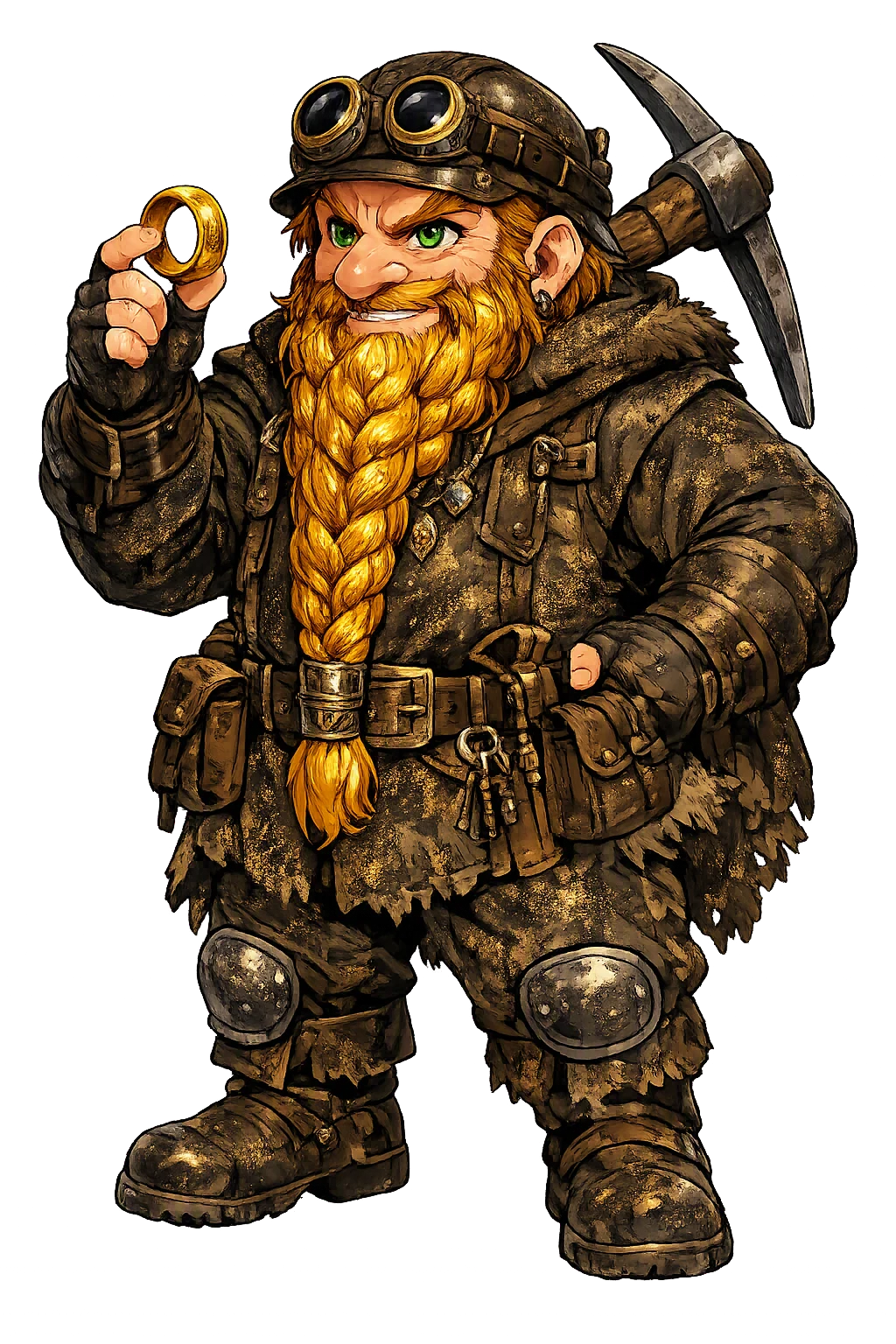
How Andvari was rebuilt, mark by mark
From the restoration bench — the working notes on Andvari, kept because the process is the proof.
What We Found
The attestation runs through the tradition's own sources: ᛅᚾᛏᚠᛅᚱᛁ. Meaning: "Careful one".
The figure behind the name: Andvari's dossier is a single episode and its long echo: one afternoon's extortion at a waterfall, and a curse that runs through the rest of the Völsung cycle like poison through water.
What the Name Carried In
The Otter's Ransom. Óðinn, Loki, and Hœnir were traveling when they came to a waterfall, and there they saw an otter eating a salmon on the bank, its eyes shut. Loki killed it with a stone and boasted of a double catch — otter and fish at one cast.
The Net of Rán. Völsunga saga gives the fullest account of the catching. Loki went to Rán, the sea-queen who drowns sailors, and borrowed her net, then came to the waterfall called Andvarafors.
A spelling that has to carry stories like these is not a label. It is equipment.
Where It Stood Before Us
Andvari himself is a purely literary figure: no runestone, votive deposit, or named image records him. But the cycle his gold sets in motion is the best-attested narrative in Viking-Age art. The Ramsund carving in Södermanland (Sö 101, c. 1030) cuts the whole Fáfnir episode into a rock face — Sigurðr thrusting up through the serpent's body, the slain Reginn with his smith's tools, Grani loaded with the treasure, and the birds whose speech the dragon-heart taught — and the Gök stone (Sö 327) weaves the same scenes through a runic inscription. The Drävle runestone (U 1163) shows Sigurðr stabbing the serpent, and related scenes appear on the Isle of Man and in English stone sculpture as far west as the Halton cross in Lancashire, tracking the cycle along the Norse sea-roads. The manuscript witnesses are thin in the usual way: Reginsmál and its narrative prose stand in the Codex Regius of the Poetic Edda, Snorri's account in the codices of the Prose Edda, and Völsunga saga in the paper manuscript NKS 1824 b 4to (c. 1400), the saga's only complete medieval copy. The bench inherits all of it — the web temple is the newest site, not the first.
What We Rejected
andvari as the primary form. It survives as the convenience it is; it does not get to lead. The hierarchy is full restoration first, and this name can afford to stand at the top of it.
What We Set Down
Andvari — Tier-2 here means one preserved truth — not less important, just singular. The temple shows it and names it.
For the voice: 'AHND-vah-ri' — three even syllables, stress on the first, the v soft as in 'very', the r trilled, the ending a short 'ih' as in 'bit'.
The temple stands at /sites/andvari/ — the notes above are public in its Scholarly Edition, sources and all.
At a Glance
- Restored name: Andvari
- ASCII form: andvari
- Meaning: "Careful one"
- Domain of influence: Dwarf, Guardian of Gold
- Pantheon: Norse
- Classification: Tier 2
- Original script: ᛅᚾᛏᚠᛅᚱᛁ
- Series: The Restoration Files, No. 22 of 397
The File Continues
The temple's founding dispatch tells the name's story; its Resonance File reads the myths into the industries; the blog index holds the whole archive.
Continue the series — previous file: Andromedē (read it here) · next file: Angrboða (read it here).
The Restoration Files are written from the same canonical record as the temples themselves: the lexicon, the lore catalog, the pattern atlas, and the cited scholarly sources. If a file ever disagrees with its temple, the temple is right — tell us, and the file will be corrected.