
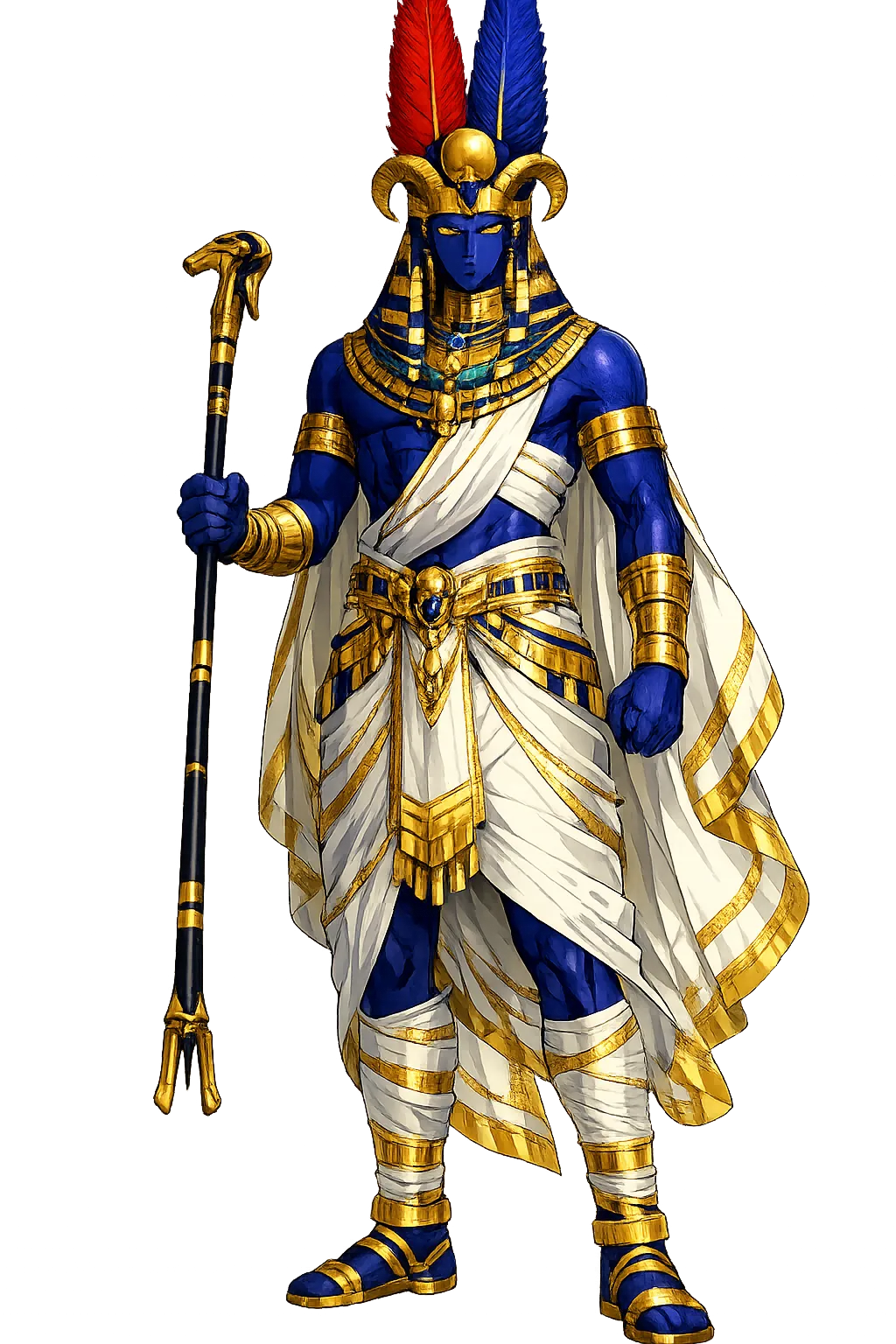
Ꜣmun, spelled the way the sources wrote it
There is a version of this name the early internet had to settle for: amun. This is the file on how Ꜣmun replaced it.
Amun's rise from provincial wind god to universal king is one of the great success stories of Egyptian religion. By the Middle Kingdom he is national; by the New Kingdom he is Amun-Ra, hidden lord of the cosmos; by the Late Period his oracles and priesthoods rival pharaonic power. His myths revolve around concealment, revelation, and the transmission of authority. Amun began as one of several gods of the Hermopolitan Ogdoad, associated with the invisible air. When Thebes rose to political prominence in the Middle Kingdom, Amun rose with it.
That is the figure this file is about — and the temple now standing at its restored name.
At a Glance
- Restored name: Ꜣmun
- ASCII form: amun
- Meaning: "Hidden One (Egyptian jmn; vocalized Ꜣmun)"
- Domain of influence: Wind, Kingship, Thebes
- Pantheon: Egyptian
- Classification: Tier 1
- Original script: 𓇋𓏠𓈖
- Series: The Restoration Files, No. 17 of 271
The Name Before the Marks
Ꜣmun preserves its form without added diacritics: the restoration here is the exactness of the spelling itself, the form the tradition's own sources record. amun and Ꜣmun may look interchangeable to a search box; they are not interchangeable to a philologist.
The Temple That Stands Now
The restored name is not a plaque; it is an address. The temple of Ꜣmun lives at /sites/amun/, with its mythology in the lore halls, its peer-reviewed record in the Scholarly Edition, and its place in the pattern atlas on the patterns floor.
The restoration preserves more than the ASCII form can say — stress, length, or a letter the Latin keyboard lost — which places it in Tier-1: mechanically verifiable, information-rich.
Every flagship temple is hand-built to the same standard: the original script displayed with its provenance, the pronunciation reconstructed phoneme by phoneme, the sources named — because a restoration you cannot audit is just a spelling with confidence.
The Archetype at Work
A temple is also a reading of what this figure means — and meanings have addresses in the modern world. The pattern atlas maps Ꜣmun to the industries its archetype genuinely resonates with, each match argued, weighted, and open to challenge:
- Leadership, Governance & Public Administration — King of gods in Thebes; the hidden hand of empire.
- AI, Data & Predictive Intelligence — His oracle at Siwa answered Alexander the Great; hidden knowledge delivered as a prediction service.
- Astrology, Tarot & Esoteric Services — The Hidden One; modern esotericism's patron of unseen forces and concealed power.
The mapping is conservative on purpose: only resonances that can be argued aloud. The rest of the atlas follows the same rule, industry by industry.
In the Sacred Texts
The Egyptian tradition is not a vibe; it is a library. The Sacred Texts collection holds The Book of the Dead — the primary sources the temple's scholarship is built on, free to read, cross-linked back to the names they mention. The temple is the argument; the texts are the evidence.
The File Continues
This is one of 271 Restoration Files — a second dispatch from every flagship temple in the fleet. The temple's first dispatch tells the founding story of the name; the blog index holds the whole archive.
Continue the series — previous file: Aṃśa (read it here) · next file: Anánkē (read it here).
The Restoration Files are written from the same canonical record as the temples themselves: the lexicon, the lore catalog, the pattern atlas, and the cited scholarly sources. If a file ever disagrees with its temple, the temple is right — tell us, and the file will be corrected.