
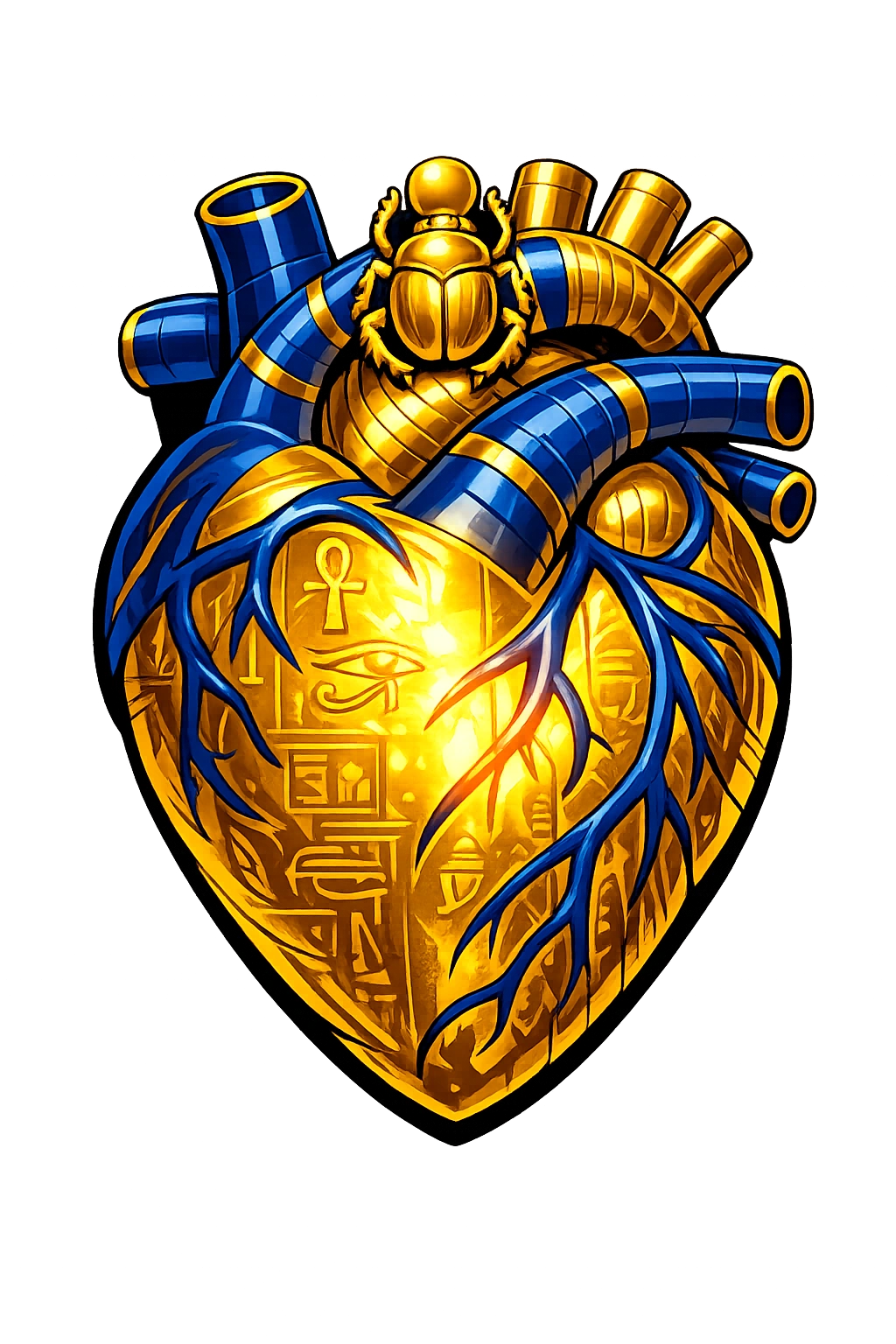
From Hieroglyphs to Unicode: the journey of Ꜣb
Long before it was a domain, this name traveled through scripts. Ꜣb begins in Hieroglyphs, passes through scholarly transliteration, and ends — for now — inside the punycode machinery of the global DNS. Each stage of that journey preserves some information and loses some, and the craft of restoration is knowing exactly which marks matter. This post follows the name stage by stage: the original script, the reconstructed pronunciation, the mythological record, the material evidence, and finally the Unicode form that carries all of it into the address bar. Think of it as a biography of a name, told through its spelling.
At a Glance
- Restored name: Ꜣb
- ASCII form: ab
- Meaning: "Heart. Central to the weighing of the heart ritual. Represents conscience, emotion, moral worth"
- Domain of influence: Heart, Conscience, Emotion
- Pantheon: Egyptian
- Classification: Tier 2
- Original script: 𓍋𓃀𓂻 (Hieroglyphs)
- Live domain: ꜣb.com
Overview
Ꜣb (ab) — Heart. Central to the weighing of the heart ritual. Represents conscience, emotion, moral worth — belongs to the Egyptian tradition, where it is catalogued under the domain "Heart, Conscience, Emotion". The name means "Heart. Central to the weighing of the heart ritual. Represents conscience, emotion, moral worth".
The Egyptian Ꜣb is far more than a physical organ. It is the seat of intelligence, memory, emotion, and moral character — the only organ left inside the mummy at embalming, because it must speak for the deceased in the Hall of the Two Truths.
PuniCodex restores the name as Ꜣb and serves its temple at ꜣb.com. The original preserves one prosodic feature — stress or vowel length — rather than both, which places the name in Tier 2. The plain ASCII form ab survives as a modern convenience imposed by the early domain-name system; the restoration, not the fallback, is the form the project defends as philologically complete.
The Name
The name is attested in Hieroglyphs as 𓍋𓃀𓂻. The word is conventionally transliterated jb (also ib; this edition restores Ꜣb) and means 'heart' — the seat of thought, memory, emotion, and moral character. The hieroglyphic spelling records consonants only.
Egyptian jb has a secure cognate across the Afroasiatic family: Semitic libb- 'heart' (Hebrew לֵב lēḇ, Arabic لُبّ lubb), a correspondence recognised in the standard etymological literature. Arabic قلب qalb 'heart', though semantically identical, belongs to a different Semitic root.
The ASCII form ab survives only because the early domain-name system could not carry diacritics; it is a technological compromise, not an ancient spelling. The Unicode restoration Ꜣb recovers the Egyptological alef of the scholarly transliteration directly in the address bar. The name preserves a single class of diacritic detail — its marked consonant — rather than both stress and vowel length, which places it in Tier 2.
The letter-by-letter transformation runs:
- a → Ꜣ — Egyptological alef: glottal stop (the sign transliterated j in older systems)
- b → b — Same
The project holds the domain ꜣb.com (xn--b-xw3e.com) as the canonical home of this name.
Etymology & Roots
The recorded derivation reads: From Egyptian and Semitic ʾb "father, ancestor". The heart of the deceased.
The reconstructed proto-form is *ʾb (proto-afro-asiatic), glossed as "father, ancestor".
The reconstruction is classed as attested.
The Original Script
The name is preserved in Hieroglyphs as 𓍋𓃀𓂻 — Egyptian hieroglyphic, attested from the Old Kingdom to Late Antiquity (c. 2600 BCE – 400 CE) in Egypt. The script is written right-to-left or top-to-bottom.
The scholarly transliteration is Ꜣb (Egyptological convention; the word is also written jb or ib). The original vocalisation is unknown; the conventional reading is /ʔaːb/.
The rendering proceeds step by step:
- The Egyptian name is written 𓍋𓃀𓂻 in hieroglyphs, with the heart sign (Gardiner F34) as its ideographic core.
- Hieroglyphs combine logograms, phonograms, and determinatives; the exact function of each sign depends on context.
- Egyptian writing does not record vowels; the vocalised form is a modern convention reconstructed from Coptic and comparative evidence.
- The Unicode restoration Ꜣb uses the Egyptological alef and other registrable characters; the hieroglyphic form is not registrable in .com.
Pronunciation
The reconstructed pronunciation of the name is /ʔaːb/ — Egyptological Reconstruction.
Phoneme by phoneme:
- Ꜣ- — Egyptological alef [ʔ], a glottal catch opening the word (the sign's older phonetic value is debated); the long open [aː] is supplied by convention.
- -b — Voiced bilabial stop [b], closing the word like a heartbeat.
For the modern speaker, the closest approximation is: 'AHB' — begin with a catch deep in the throat, then close firmly on b.
Kindred and historical forms of the name:
- Egyptian — jb / Ꜣb, 'heart, mind, will' — the seat of intelligence and moral character
- Egyptian — ḥꜣty, the anatomical, beating heart, lexically distinct from jb
- Semitic — Hebrew לֵב (lēḇ) and Arabic لُبّ (lubb), 'heart, understanding', true cognates of Egyptian jb
- Coptic — ϩⲏⲧ (hēt), 'heart', descends from ḥꜣty rather than from jb
The Ꜣb is Tier 2 because the restoration preserves the Egyptological alef (Ꜣ) as a distinctive consonant, without a stress accent in the Greek sense. Egyptian vowels are reconstructed from Coptic and comparative evidence.
Mythology
The Egyptian ab — usually translated as 'heart' — is far more than a physical organ. It is the seat of intelligence, memory, emotion, and moral character. The ab is the only organ left inside the mummy at embalming, because it must speak for the deceased when the soul stands before the divine tribunal.
The Heart in the Chest (Anatomy of the Soul)
For the Egyptians, thought, feeling, and will all occurred in the heart. The ib recorded every deed, word, and intention of a person's life. It was therefore the most truthful witness at judgment. A heart that was heavy with wrongdoing could not deceive the gods, while a heart that was 'true of voice' — maat-kheru — carried its owner into the blessed afterlife.
The Weighing of the Heart (Judgment)
In the Hall of the Two Truths, the heart of the deceased is placed on one pan of the scales and the feather of Maat — truth, justice, cosmic order — on the other. If the heart balances, the soul is declared maat-kheru and passes into the Field of Reeds. If the heart is heavy with sin, it is devoured by Ammit, the 'Devourer of the Dead', and the soul ceases to exist.
The Heart's Defence (Protection)
To prevent the heart from testifying against its owner, spells were inscribed on scarabs or heart amulets placed on the mummy. The most famous is Book of the Dead Spell 30B: 'O my heart... do not stand up against me as a witness, do not oppose me in the tribunal.' The prayer reveals both terror and trust: the heart knows the truth, but the gods may grant mercy to the properly prepared.
The Ib and the Gods (Theology)
The heart is not only a witness but an offering. In temple ritual and in the afterlife, the ib is presented to the gods — above all to Horus, who guards it, and to Thoth, who records the verdict. The heart is sometimes identified with Horus himself, the living king. Thus the ab binds individual morality, royal legitimacy, and cosmic order into a single symbol.
Symbols & Iconography
The iconography associated with Ꜣb concentrates in a small set of recurring attributes, each a compressed statement about the name:
- Heart scarab — Green-stone amulet inscribed with Book of the Dead Spell 30B, placed over the chest of the mummy
- Scales of Maat — The balance in the Hall of the Two Truths on which the heart is weighed
- Ostrich feather — The feather of Maat, the standard of truth against which the heart is measured
- Heart amulet (ib) — Heart-shaped amulets of carnelian, jasper, or red glass, known from the Middle Kingdom onward, protecting the organ the hieroglyph F34 depicts
- Heart hieroglyph (F34) — The ib-sign itself, among the most charged images of the funerary repertoire
Archaeology & Evidence
The heart's material record is exceptionally rich. The green jasper heart scarab of King Sobekemsaf (Seventeenth Dynasty, British Museum) is among the earliest royal examples of the amulet inscribed with Spell 30B, and the heart scarab of Hatnefer, mother of the vizier Senenmut, was found in her Eighteenth Dynasty burial at Thebes (Metropolitan Museum of Art).
The judgement scene itself is preserved on the walls of the tomb of Sennedjem (TT1) at Deir el-Medina and in the papyri of Ani (BM EA 10470) and Hunefer (BM EA 9901), while heart-shaped amulets of carnelian and jasper from Middle Kingdom burials onward show the concept's reach beyond the elite.
Realm & Domain
The Egyptian Ꜣb is far more than a physical organ. It is the seat of intelligence, memory, emotion, and moral character — the only organ left inside the mummy at embalming, because it must speak for the deceased in the Hall of the Two Truths.
Seat of Intelligence
Thought, feeling, and will all arise in the heart; the ib records every deed, word, and intention.
Moral Witness
In judgment the heart is weighed against the feather of Maat; it cannot lie about a life.
Heart Scarab
Spell 30B amulets, often of green stone, prevent the heart from testifying against its owner.
Temple Offering
The heart is presented to Horus and Thoth as the core of the justified self.
Across Cultures
The Egyptian heart was not mapped directly onto Greek psychology, but later traditions found echoes.
The Coptic word for heart, hēt (ϩⲏⲧ), preserves a different Egyptian root (ḥꜣty), yet the concept of the heart as moral witness survived in Christian Egyptian monasticism. Greek and Roman authors, following Aristotle, also located thought and emotion in the heart, a convergence that made Egyptian cardiac theology intelligible to Mediterranean readers. In medieval and Renaissance hermeticism, the 'weighing of the heart' became an image of conscience and final judgment, influencing alchemical and moral symbolism. Modern phrases such as 'heavy heart' and 'light heart' are unwitting heirs to the Egyptian scales.
Within this edition the heart belongs to a family of soul-concepts: Ba (the mobile personality), Ka (the vital force), and Akh (the transfigured spirit), with Maat as the standard against which it is weighed.
Cultural Legacy
The image of the heart on the scales remains one of Egypt's most powerful exports.
From the Book of the Dead papyri of Hunefer and Ani to museum displays worldwide, the weighing of the heart has become the quintessential scene of Egyptian afterlife belief. It appears in popular films, comics, and games as a moral test, and in Neopagan and Kemetic practice as a ritual of self-examination. The heart scarab, once a funerary amulet, is now a widely recognized symbol of protection. The ab reminds the modern world that morality was once understood not as a list of rules but as a physical weight carried in the chest — a truth the body itself could measure.
The Scholarly Record
The account of Ꜣb given in this edition rests on the witnesses and reference works listed below. Lexica and etymological dictionaries secure the form and meaning of the name; the literary and religious texts supply the narrative evidence.
- Book of the Dead (Spell 30B).
- Pyramid Texts.
- Faulkner, The Ancient Egyptian Book of the Dead.
- Wb (Erman & Grapow, Wörterbuch der ägyptischen Sprache).
- Book of the Dead, Spell 27 (preventing the heart from being taken away).
- Book of the Dead, Spell 29B (heart amulet of carnelian).
- Coffin Texts, Spell 30 (heart spell for the justified).
- Instruction of Amenemope (Egyptian wisdom on the heart and Maat).
A Meditation
To contemplate Ꜣb is to sit with the weight of one's own record. Egyptian anthropology made the heart the one organ that must survive death intact, because it alone could testify: every deed, word, and intention was written into it, and no advocate could argue against its evidence. Conscience, in this system, is not a voice but a mass — something that can be placed on a scale and found heavy or light.
The practice the name suggests is the negative confession inverted: not a list of denials but a daily lightening, so that the heart need never be persuaded to stay silent. The restored alef of Ꜣb is the mark of that discipline — a letter that costs attention, like the organ it names.
The Unicode Restoration
Ꜣb is classified as Tier 2: the original preserves at least one philological feature that ASCII cannot encode. The ASCII fallback ab still resolves everywhere, but it is the restored form that carries the name's full information. Across the 2 characters of the name, the restoration adjusts 1: 1 further adjustment (Ꜣ). That is the whole thesis of this temple: the marks are the message.
Character by Character
The journey from ab to Ꜣb, one character at a time:
- a → Ꜣ — Ayin: voiced pharyngeal
- b → b — Same
The Domain Name
The restored name is live as a working domain: ꜣb.com, which the DNS carries in punycode form as xn--b-xw3e.com — an ASCII-compatible encoding that lets a non-ASCII name travel the global network without breaking older infrastructure. The visitor sees Ꜣb; the machines see the encoding. That duality is the engineering compromise on which the entire restoration rests, and it is why a name written the way its own tradition wrote it in Hieroglyphs can now be typed into any browser on earth.
The Egyptian Pantheon
Ꜣb is one of 66 entries the PuniCodex lexicon catalogues under the Egyptian pantheon. The Pantheon page gathers the tradition's major figures in one place, and the Lexicon lets you filter all 895 restorations by tradition, tier, or script — the fastest way to see where this name sits among its kin.
Frequently Asked Questions
What does Ꜣb mean? The traditional gloss is "Heart. Central to the weighing of the heart ritual. Represents conscience, emotion, moral worth."
Which tradition does Ꜣb belong to? Ꜣb is catalogued in the Egyptian pantheon of the PuniCodex lexicon.
Why is Ꜣb classified as Tier 2? Because the original preserves at least one philological feature that ASCII cannot encode — and the marks in the restored spelling preserve exactly that evidence.
Is Ꜣb a working domain? Yes — ꜣb.com resolves today and routes to this temple.
What is the punycode for ꜣb.com? The DNS encoding is xn--b-xw3e.com; browsers perform the translation automatically, so visitors only ever see the restored name.
Typing Ꜣb
You do not need a special keyboard to use this restoration. The PuniCodex Type Tool converts the ASCII form ab into Ꜣb as you type, and the browser extension offers the same conversion inside any text field. Copy the restored form, paste it into the address bar, and the DNS does the rest.
Sister Temples
Other temples in the Egyptian pantheon include Nnw, Rꜥ, and Ssḥt — each with its own restoration story, its own scholarly record, and its own place in the lexicon.
Why This Restoration Matters
Every stage of the journey from Hieroglyphs to Unicode was an act of care: the scribe who first wrote the name, the lexicographer who glossed it, the engineer who taught the DNS to carry it. The PuniCodex restoration is the latest stage, not the last word — the Scholarly Edition is revised as the evidence improves. What does not change is the principle: a name deserves to be written the way its own tradition wrote it. Ꜣb in the address bar is that principle, made routable.
Explore Further
This post is one doorway into the temple. The home page carries the full character breakdown and the ambient canvas; the lore page tells the myths in long form; the Scholarly Edition preserves the sources, pronunciation data, and revision history; and the patron wall supports the restoration directly. For the wider map, browse the Lexicon, explore the Pantheon, or return to the PuniCodex blog.
Related Names
Sources
The full scholarly apparatus — every citation, revision, and review — lives in the Scholarly Edition. Key references for this post:
- James P. Allen, Middle Egyptian: An Introduction to the Language and Culture of Hieroglyphs, Cambridge University Press, 2000.
- Book of the Dead (Spell 30B).
- Pyramid Texts.
- Faulkner, The Ancient Egyptian Book of the Dead.
- Erman, A. & Grapow, H. Wörterbuch der ägyptischen Sprache, vol. I, s.v. jb (pp. 59–60).
- Lexicon authorities for this entry: Faulkner, Wb.