PuniCodex

Extended Lore

Sindri — The Deeper Record

Etymology · Orthography · Cult · Iconography · Reception · Sources

ASCII-equivalent form Sindri
Sindri — Dwarf Smith
01

At a Glance

Sindri — every fact links to its home

PantheonNorse
DomainDwarf Smith
Original Scriptᛋᛁᚾᛏᚱᛁ →
Primary Sources5 cited →
02

Etymology & Word Family

From original script to canonical restoration — the full etymology page →

Original Script ᛋᛁᚾᛏᚱᛁ Sindri — "Sparkling"
Canonical Restoration Sindri Canonical scholarly spelling — ASCII-identical
Modern ASCII sindri Plain-ASCII fallback

The name Sindri reaches the modern world through scholarly transliteration of the norse tradition. Because the conventional spelling uses only Latin letters, its canonical and ASCII forms coincide — the tradition it carries is in the name itself, not in diacritics.

03

Character breakdown

Character-by-character philological analysis

CharacterUnicodeNameBlockPhonetic Role
SU+0053Latin Capital Letter SBasic LatinSame, capitalized
iU+0069Latin Small Letter IBasic LatinSame
nU+006ELatin Small Letter NBasic LatinSame
dU+0064Latin Small Letter DBasic LatinSame
rU+0072Latin Small Letter RBasic LatinSame
iU+0069Latin Small Letter IBasic LatinSame

This restoration reflects fidelity to the attested tradition, not recovered diacritics: every character of Sindri already survives in ASCII. What the restoration preserves is the canonical spelling itself — the form scholarship standardised.

04

Cult & Worship

How the sacred was kept — rites, sanctuaries, remains

The Cult

No cult of Sindri is attested, and none should be expected: he is a dwarf of story, not a god of shrine or harvest, and the Norse dwarfs as a class left no trace of organized worship — no runestone invokes one, no votive deposit honours one, and the skaldic tradition treats them as figures of the mountain, useful in verse. What was genuinely venerated was his work. The hammer Mjǫllnir, his third casting, survives by the hundred as miniature pendants from tenth-century graves, hoards and settlement sites across Scandinavia and the diaspora — the commonest amulet of the late Viking Age, worn by the converted and the unconverted alike — and gold arm-rings of Draupnir's type fill the same hoards. But these are devotion to the product, not the producer; no source links the pendants to a cult of the smith who forged their archetype. Modern Heathen memory of Sindri, where it exists, is a literary honouring of the master-craftsman — a revival sentiment, honestly labelled, with no ancient rite behind it.

In the Earth

Sindri is a wholly textual dwarf: no runestone invokes him, no votive deposit names him, and no image can be securely identified with him. His attestation hangs on the manuscript witnesses — the Codex Regius and related codices of Snorri's Edda for Skáldskaparmál 35 (with the Codex Upsaliensis tradition reading the brother's name as Eitri), and the Codex Regius of the Poetic Edda for Völuspá's golden hall at Niðavellir. The material context is nonetheless richer for him than for most dwarfs, because his products are findable. Thor's-hammer pendants — Mjǫllnir in miniature — are the commonest amulets of the late Viking Age, known by the hundred from tenth-century graves, hoards, and settlement sites across Scandinavia and the diaspora: the forge's most famous casting, worn at the neck of the converted and unconverted alike. Gold arm-rings of Draupnir's type fill the hoards. And the corpus's visual language of the smithy survives on the Gotland picture stones — Ardre VIII shows a smithy scene with tools and a headless body, usually read as Vǫlundr — proof that the smith at his forge was a carved subject in the Viking-Age north, though no carving names Sindri himself.

05

Iconography

How Sindri was imaged across the ages

The Image

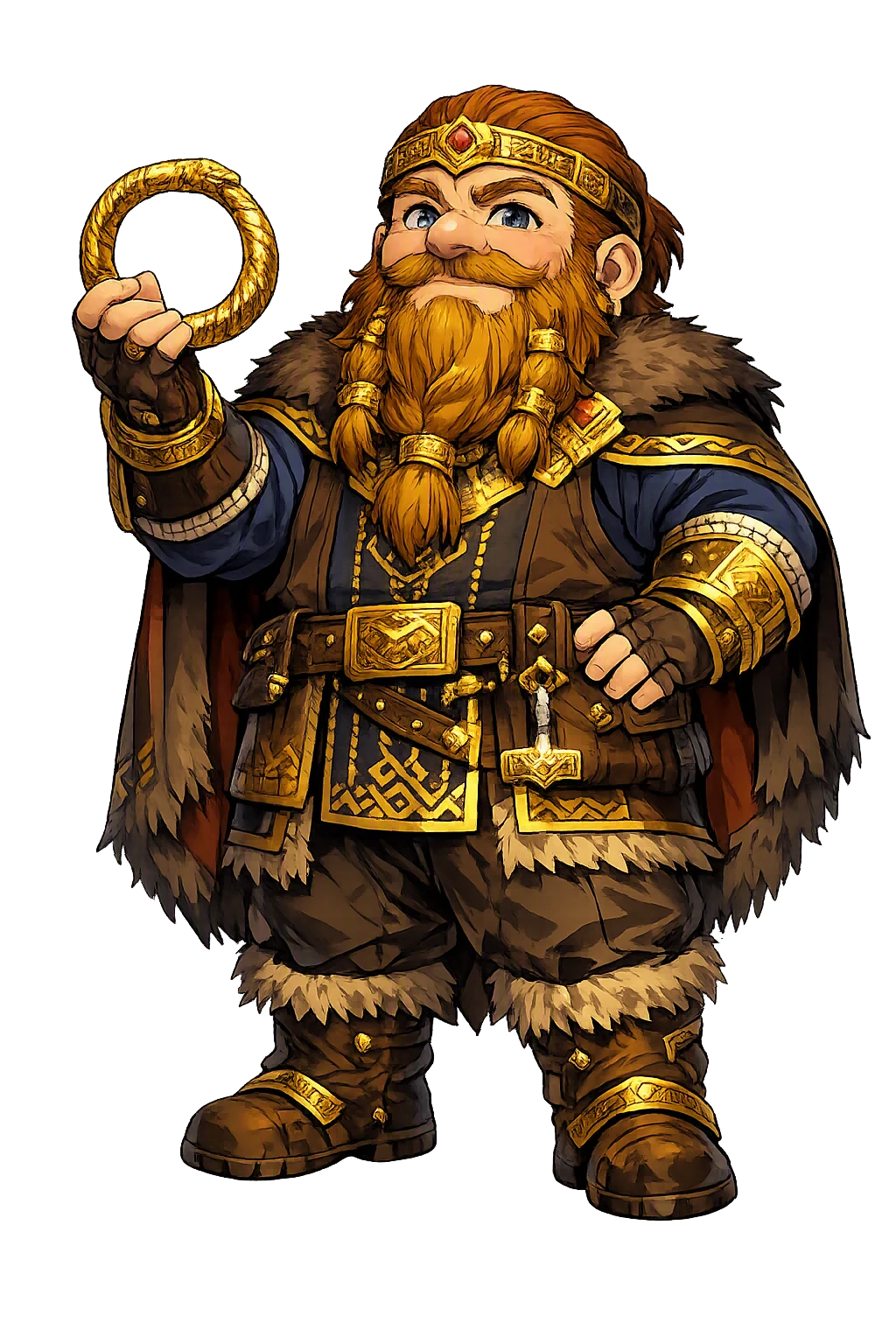
No image of Sindri himself survives — no runestone, picture stone, or manuscript shows the smith at his forge — but the iconography of his products is the richest of any dwarf's. Thor's-hammer pendants, Mjǫllnir in miniature, are the commonest metal amulets of the late Viking Age, known by the hundred from tenth- and eleventh-century contexts from Iceland to Russia, and gold arm-rings of Draupnir's dripping type fill the same hoards; the smith is invisible, yet his three castings defined a visual culture. The Gotland picture stones do preserve the smithy as a carved subject — Ardre VIII shows the forge with its tools — but the scene is read as Vǫlundr's, not Sindri's, and no carving ties the brothers' wager to stone. What the texts fix as his attribute-set is exact and was never expanded in art: the anvil on which the metal is laid, the bellows that must not stop, and the one flaw — the hammer's short handle, a finger's breadth of sabotage that every retelling keeps as the smith's signature. Modern illustration, from the Victorian handbooks on, has supplied the dwarf himself: squat at the anvil, a fly at the bellows-boy's eyes.

06

Reception & Transformation

The name after its own age — transmission, translation, survival

Afterlives

Sindri's transmission is a tale of codex traditions and a living word. The forge-scene survives in the manuscripts of Snorri's Edda — the Codex Regius and Codex Wormianus calling the smith Sindri, the Uppsala codex reading Eitri, an equation the editors have printed since the nineteenth century set the manuscripts side by side — while his grander identity, the dwarf-chieftain of the golden hall, descends through Völuspá's verse in the Codex Regius of the Poetic Edda and the dwarf-name lists of the þulur. The medieval Church never troubled itself over a dwarf, so the story's preservation is Iceland's own doing, crowned by Árni Magnússon's eighteenth-century collecting of the vellum codices after the Copenhagen fire of 1728 destroyed so much else. Philology then gave the name a second life in dictionaries: Cleasby–Vigfusson printed sindr, 'forge-slag', and sindra, 'to sparkle', beside the name, and de Vries set the cognates in a row — Old English sinder, modern English cinder, the cooled spark of the smith's fire. That everyday English word is the sturdiest survival any Edda-smith owns: the forge's waste product, still carrying the dwarf.

Identifications Across Traditions

Sindri's closest kin are inside the corpus itself. His brother Brokkr is the other half of one workshop — the two are never separated in the sources, bellows and anvil, and Snorri names the forge by the pair. Andvari is the corpus's other great dwarf of the gold, but inverted: Andvari's hoard is won by robbery and carries a curse, Sindri's gold is made in three heats and carries only a wager. Vǫlundr of Vǫlundarkviða, 'prince of elves', is the verse tradition's other smith narrative — the smith wronged who takes revenge, where Sindri is the smith wagered against who wins. Cross-culturally the comparisons are structural, not borrowed: Hephaistos, the Greek smith who forges the gods' masterworks and is himself marred; Ilmarinen of the Kalevala, who forges the Sampo under a bargain's pressure; Goibniu of the Irish Tuatha Dé Danann, whose smith-work arms the gods for their last battle. The pattern is old — the divine weapon must come from an other-than-divine hand — but Sindri's version is the only one where the masterpiece's flaw is timed to a single held breath of the bellows.

Modern Legacy

Sindri's afterlife is the afterlife of his three treasures: every retelling of Norse myth that reaches the forging of Mjǫllnir keeps his one afternoon and its three stings, from the Victorian handbooks onward — the short handle is the detail no adapter has ever dared to cut, because it is the story. The smith himself has had a quieter reception than his work, and much of it flows under his manuscript double: the variant name Eitri carries the same dwarf-smith into a robust modern afterlife in games and film, where the forge that made the hammer is restaged for new audiences — the inventions are modern, but the forge, the brother, and the interrupted casting are Skáldskaparmál's own. The sturdiest legacy is the name: Sindri never died out in Iceland and remains a living male given name, borne today by men who inherit the forge's spark in its plainest form.

07

The Original Script Note

What the written record preserves — and what it does not

Original Script

The normalized Old Norse form is Sindri — already plain ASCII, with no diacritic or distinctive letter for the restoration to recover; in the Younger Futhark the name would have been carved ᛋᛁᚾᛏᚱᛁ (s-i-n-t-r-i), a normalized phonetic reconstruction in which the short-twig row writes the n-d-r cluster with its undifferentiated stop rune. Because the name is pure ASCII, its domain was registered decades ago in the ordinary way: sindri.com is held by a third party outside the PuniCodex collection and is watched for release — no form of the name is currently owned, and this temple claims none.

08

The Meditation

What Sindri means — beyond the dictionary

Sindri is the Edda's shortest sermon on how perfection fails. The gods' three greatest treasures are made in one afternoon by a smith whose name is a forge-word for sparks, and two of them are flawless. The third — the best, the one the Æsir will trust in the last battle — is marred by a single instant: a fly, an eyelid, a held breath of the bellows, and the handle is short forever. The tradition does not call the hammer ruined; it calls it the finest thing ever forged, short handle and all. That is the forge's verdict and the story's mercy: the masterpiece is not the work that never faltered but the work that survived its interruption. Loki wins the sting and loses the wager. Sindri wins everything except the head he was promised — and takes the trickster's voice instead, one stitch at a time, with an awl. In a mythology that ends in fire, the smith who arms the gods gets the corpus's most practical blessing: his work holds, and no one remembers the fly who won.

09

Frequently Asked Questions

Deep-dives into the cult, attestation, reception, and sources of Sindri

01How do we know how Sindri was worshipped?

Sindri is a wholly textual dwarf: no runestone invokes him, no votive deposit names him, and no image can be securely identified with him. The full cult record →

02Where do the earliest attestations of Sindri come from?

The record rests on Snorri Sturluson, Prose Edda: Skáldskaparmál 35 (the cutting of Sif's hair; the sons of Ívaldi's three treasures; the wager of Loki's head; Sindri at the forge and Brokkr at the bellows; Gullinbursti, Draupnir, and the short-handled Mjǫllnir; the judgment of the Æsir; the sewing of Loki's lips with Vartari); Skáldskaparmál þulur (dwarf heiti), Poetic Edda: Völuspá 37 (the hall of gold of Sindri's kindred, standing north on Niðavellir); Grímnismál 43 (Ívaldi's sons and the making of Skíðblaðnir), Snorri Sturluson, Prose Edda: Gylfaginning (the svartálfar and their world; Draupnir laid on Baldr's pyre and sent back from Hel by Hermóðr's errand), among 6 cited works. The full source apparatus →

03How did later traditions reinterpret Sindri?

Sindri's transmission is a tale of codex traditions and a living word. Reception & transformation →

04What do the surviving images of Sindri actually show?

No image of Sindri himself survives — no runestone, picture stone, or manuscript shows the smith at his forge — but the iconography of his products is the richest of any dwarf's. The iconography →

05What does the written record of Sindri actually preserve?

The normalized Old Norse form is Sindri — already plain ASCII, with no diacritic or distinctive letter for the restoration to recover; in the Younger Futhark the name would have been carved ᛋᛁᚾᛏᚱᛁ (s-i-n-t-r-i), a normalized phonetic reconstruction in which the short-twig row writes the n-d-r cluster with its undifferentiated stop rune. The Original Script note →

10

Scholarly Sources

The philological foundations of the record

Every claim on this page is grounded in established scholarship. The orthographic restorations follow disciplinary convention. The etymological chain follows the best available reference works. This is not invention — it is resurrection through scholarship.

◈

Lexicography & Philology

  • Cleasby-Vigfusson
◎

Primary Texts

  • Prose Edda
  • Snorri Sturluson, Prose Edda: Skáldskaparmál 35 (the cutting of Sif's hair; the sons of Ívaldi's three treasures; the wager of Loki's head; Sindri at the forge and Brokkr at the bellows; Gullinbursti, Draupnir, and the short-handled Mjǫllnir; the judgment of the Æsir; the sewing of Loki's lips with Vartari); Skáldskaparmál þulur (dwarf heiti)
  • Poetic Edda: Völuspá 37 (the hall of gold of Sindri's kindred, standing north on Niðavellir); Grímnismál 43 (Ívaldi's sons and the making of Skíðblaðnir)
  • Snorri Sturluson, Prose Edda: Gylfaginning (the svartálfar and their world; Draupnir laid on Baldr's pyre and sent back from Hel by Hermóðr's errand)
  • de Vries, Altnordisches etymologisches Wörterbuch, s.v. sindra, Sindri (the forge-word and its cognates: Old English sinder, modern English cinder)
◉

Archaeology & Art History

  • Foote, P., & Wilson, D. M. The Viking Achievement; Graham-Campbell, J. Viking Art.
✦

Religious Studies

  • Cleasby–Vigfusson, An Icelandic-English Dictionary, s.v. sindr ('forge-slag, sparks'), sindra ('to sparkle'), Sindri, Eitri, Brokkr, Draupnir, Mjǫllnir, Gullinbursti; Zoëga, A Concise Dictionary of Old Icelandic, s.v. Sindri, draupnir, mjǫllnir
  • Simek, Dictionary of Northern Mythology; Orchard, Dictionary of Norse Myth and Legend; Lindow, Norse Mythology: A Guide — s.v. Sindri, Eitri, Brokkr, Mjǫllnir (attestation; the Sindri/Eitri manuscript equation; dwarf-lore and the smith motif)
Return

The Surface Awaits

You have traced the name from its earliest attestation to its canonical restoration. Now return to the myth. The story is where the name lives.

Back to Lore
Sindri mascot