PuniCodex

Extended Lore

𒀭𒌓 Šamaš

Etymology · Orthography · Cult · Iconography · Reception · Sources

Tier 1 Šamaš.com
Šamaš — Sun, Justice, Law
01

Quick Facts

Essential information about Šamaš, Sun, Justice, Law

Original Script𒀭𒌓
Unicode RestorationŠamaš
Reconstructed Pronunciation/ˈʃa.maʃ/
PantheonMesopotamian
DomainSun, Justice, Law
MeaningSun (Akkadian Šamaš)
ClassificationTier 1
Primary DomainŠamaš.com
Sacred SymbolsSolar disc with serrated rays, Winged sun disc, Scales, Saw or serrated knife, Stairway or mountain
02

Etymology & Word Family

From original script to Unicode restoration

Original Script 𒀭𒌓 Šamaš — "Sun (Akkadian Šamaš)"
Unicode Restoration Šamaš Restored stress, length, and script
Modern ASCII shamash Plain-ASCII fallback

The name Šamaš carries the orthographic signature of the mesopotamian tradition: 𒀭𒌓. Unicode restoration recovers what ASCII flattens.

03

Unicode Character Breakdown

Character-by-character philological analysis

CharacterUnicodeNameBlockPhonetic Role
ŠU+0160Latin Capital Letter S with CaronLatin Extended-AS-caron: voiceless postalveolar /ʃ/
—N/ADropped characterMesopotamian orthographyDropped: digraph simplified
aU+0061Latin Small Letter ABasic LatinSame
mU+006DLatin Small Letter MBasic LatinSame
aU+0061Latin Small Letter ABasic LatinSame
šU+0161Latin Small Letter S with CaronLatin Extended-AS-caron: voiceless postalveolar /ʃ/
—N/ADropped characterMesopotamian orthographyDropped: not represented

The Tier 1 classification reflects how much of the original phonology this restoration preserves — stress and vowel length for Greek names, distinctive letters and diacritics for every other tradition.

04

Cult & Worship

How the sacred was kept — rites, sanctuaries, remains

The Cult

Šamaš's temple was a courtroom with a sunrise. The E-babbar — the 'White House' — at Sippar kept his daily cult, with hymns recited as the god climbed the eastern mountains, for his presence was measured in daylight. His true congregation was everyone who needed a witness: contracts, verdicts, and treaties across two millennia swear by him, from Old Babylonian debt notes to the vassal oaths of Esarhaddon's succession treaties, in which he stands among the powers who watch the signature and punish the perjurer.

The diviners made him their patron of record. Every extispicy query — the liver-reading questions put to the gods by Assyrian kings — opens by invoking Šamaš and Adad, lords of judgement, to write the answer in the omen. A ninth-century cult copy from Sippar, the so-called Sun Tablet of Nabu-apla-iddina found by Rassam in 1881 and now in the British Museum, even pictures the god enthroned in his shrine: the nearest thing Mesopotamia left us to a photograph of a service.

In the Earth

Šamaš's principal cult center was the E-babbar ('White House') at Sippar, excavated by Iraqi and British teams; temple archives yielded hundreds of administrative and hymnic tablets. A second major temple stood at Larsa, where rulers such as Rim-Sîn and Hammurabi sponsored renovations. The famous stele of Hammurabi, now in the Louvre, depicts the Babylonian king receiving authority from Šamaš. Sun-discs, door-sockets, and royal inscriptions naming Šamaš have been recovered from Ur, Babylon, Nineveh, and Assur, testifying to a cult that spanned the whole Mesopotamian floodplain.

05

Iconography

How Šamaš was imaged across the ages

The Image

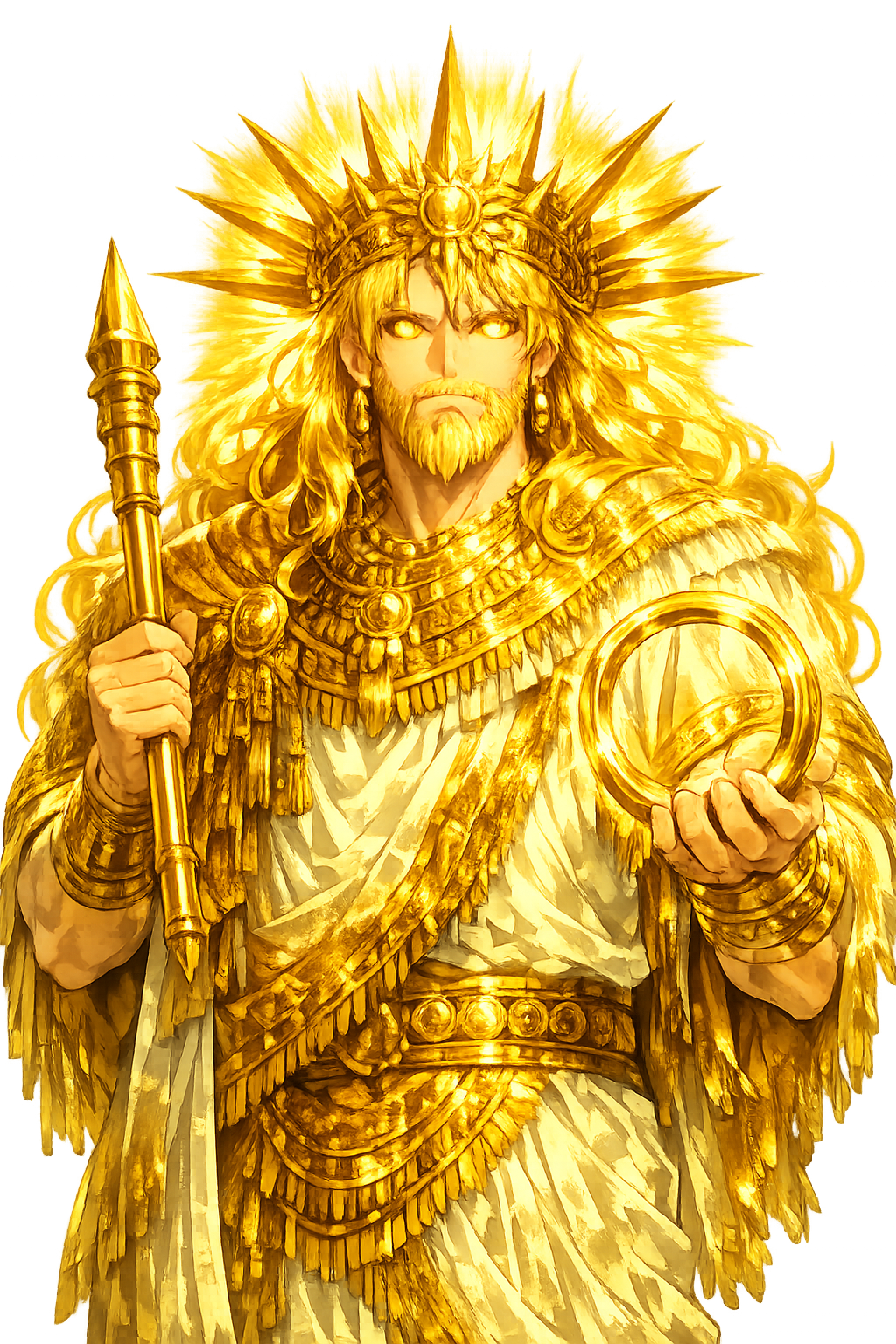
Recognition is easy: the long beard and horned crown of Mesopotamian divinity, flames of dawn rising from his shoulders, and in his hands the rod and ring — the measuring tools of the surveyor-judge, emblem of a verdict that fits the world exactly. On some cylinder seals he carries the saw, the clean cut of judgement.

His earliest images are Akkadian, and the type barely changed: the god who rises between the mountain doors of the east, night-demons scuttling before him. When Kassite sculptors carved the boundary stones (kudurrus), his rayed solar disk joined the canon of divine symbols beside Sîn's crescent and Ištar's star, and Neo-Assyrian glyptic shows kings in prayer before it. The culminating image is juridical: on Hammurabi's stele the god, seated with rod and ring, hands the law to the king — sun-disk, sceptre, and verdict compressed into one quiet gesture.

06

Reception & Transformation

The name after its own age — transmission, translation, survival

Afterlives

Šamaš's name never left the languages: Hebrew šemeš and Arabic šams keep the sun-word with his signature long after his cult thinned, and biblical solar theology — the 'sun of righteousness' of Malachi — carried the judge-of-light idea into scripture.

The god himself was recovered by the great decipherments: the Behistun trilingual and the nineteenth-century reading of Akkadian gave the West back Šamaš's hymns, and in 1901 the French expedition at Susa hauled Hammurabi's stele from the earth — suddenly the sun-god sat enthroned at the head of the world's oldest law code, and legal historians made him the very image of law's heavenly origin. The type proved immortal: rayed solar crowns on baroque allegory, the eye on the banknote, the scales of justice, and Adolph Weinman's frieze of lawgivers in the United States Supreme Court, where Hammurabi keeps his place among the great. Lambert's 1960 edition of the Great Hymn restored the theology in full: the one witness no bribe can reach.

Identifications Across Traditions

Šamaš is the Akkadian continuation of the Sumerian sun-god Utu, whose name is written with the same cuneiform sun-sign (𒌓). In Amorite and West Semitic contexts the related root appears as Samsu, and Hebrew šemeš ('sun') preserves the same etymology, though not usually as a deity in the biblical corpus. Greeks and Romans identified him with Helios and Sol; in later iconography the winged sun-disc influenced Mithraic and Iranian solar imagery. In some theological texts Šamaš is paired with his father Sîn (the moon) as complementary witnesses of night and day.

Modern Legacy

Šamaš's most durable legacy is the image of justice as sunlight. The scales, the all-seeing eye, and the king receiving law from heaven all descend partly from him. The biblical prophetic phrase 'sun of righteousness' (Malachi 4:2) and later Christian iconography of Christ as Sol Iustitiae owe something to this Mesopotamian pedigree. In modern legal and political symbolism — the blindfolded statue, the rayed eye on currency, the Enlightenment equation of light with reason — Šamaš keeps shining, even when his name is forgotten.

07

The Meditation

What Šamaš means — beyond the dictionary

Šamaš asks a question that every civilization must answer: what gives a law authority? Not force alone, since force is partial; not tradition alone, since tradition can be corrupt. The Mesopotamian answer is the sun itself — the one witness no bribe can reach, the one light that falls equally on palace and hovel. To invoke Šamaš is to appeal from human partiality to cosmic impartiality.

There is something almost modern in this theology. The idea that justice should be transparent, visible, and available to the weak is not a recent invention; it was already old when Hammurabi had it carved in stone. Šamaš is the god who sees the orphan, the widow, and the traveler — the people most likely to fall through the cracks of human institutions. His rays are not merely warm; they are evidentiary. They make the hidden visible and then ask the community to act on what has been seen.

To name him Šamaš is to remember that the sun is not neutral. It is a moral force, a daily summons to honesty. Every sunrise is a verdict waiting to be delivered on yesterday's secrets.

08

Frequently Asked Questions

Common questions about Šamaš, Sun, Justice, Law, and Unicode restoration

01How do you pronounce Šamaš?

In reconstructed pronunciation, Šamaš is /ˈʃa.maʃ/ — approximately 'SHAH-mahsh' — both sh sounds are like English 'ship'; stress the first syllable.

02What does Šamaš mean?

Šamaš means Sun (Akkadian Šamaš) in the mesopotamian tradition.

03What are the symbols of Šamaš?

Šamaš is associated with Solar disc with serrated rays (The saw-toothed sun that cuts through darkness, lies, and night itself), Winged sun disc (The sun's journey across the sky and its protective power over king and temple), Scales (The balance of justice; honest merchants weighed goods before Šamaš), Saw or serrated knife (The weapon that severs falsehood from truth, darkness from light), Stairway or mountain (The eastern mountains from which Šamaš ascends each morning).

04Why restore Šamaš in Unicode?

Plain ASCII shamash strips the stress, length, and script that make the name specific. Unicode restoration returns the name to its original written dignity.

05What is the most important myth about Šamaš?

“The Great Hymn to Šamaš” — the Hymn story that anchors the mythology of Šamaš, told in full on the lore page.

09

Scholarly Sources

The philological foundations of this restoration

Every claim on this page is grounded in established scholarship. The orthographic restorations follow disciplinary convention. The etymological chain follows the best available reference works. This is not invention — it is resurrection through scholarship.

◈

Lexicography & Philology

  • CAD
  • AHw
◎

Primary Texts

  • Code of Hammurabi, stele prologue and epilogue
  • Epic of Gilgamesh, Tablets I, VII, XI
  • Hebrew Bible, Genesis 1:14–19; Malachi 4:2 (solar imagery)
◉

Archaeology & Art History

  • George, House Most High: The Temples of Ancient Mesopotamia
✦

Religious Studies

  • Chicago Assyrian Dictionary (CAD), šamšu
  • Electronic Text Corpus of Sumerian Literature (ETCSL)
  • Black & Green, Gods, Demons and Symbols of Ancient Mesopotamia
  • Jacobsen, The Treasures of Darkness
  • Great Hymn to Šamaš, ed. Lambert, Babylonian Wisdom Literature (1960), pp. 121–138
  • Epic of Etana (Old Babylonian and Standard Babylonian recensions)
Return

The Surface Awaits

You have traced the name from its earliest attestation to its Unicode restoration. Now return to the myth. The story is where the name lives.

Back to Lore
Šamaš mascot