PuniCodex

Extended Lore

शाक्यमुनि Śākyamuni

Etymology · Orthography · Cult · Iconography · Reception · Sources

Tier 1 Śākyamuni.com
Śākyamuni — Enlightenment, Teaching, Historical Buddha
01

Quick Facts

Essential information about Śākyamuni, Enlightenment, Teaching, Historical Buddha

Original Scriptशाक्यमुनि
Unicode RestorationŚākyamuni
Reconstructed Pronunciation/ˈɕaː.kjɐ.mu.ni/
PantheonBuddhist
DomainEnlightenment, Teaching, Historical Buddha
Meaning‘sage of the Śākya clan’, epithet of the historical Buddha Siddhārtha Gautama, MW.
ClassificationTier 1
Primary DomainŚākyamuni.com
Sacred SymbolsThe Bodhi tree, The earth-touching hand, The begging bowl, The wheel (dharmacakra), The twin sāla trees
02

Etymology & Word Family

From original script to Unicode restoration

Original Script शाक्यमुनि Śākyamuni — "‘sage of the Śākya clan’, epithet of the historical Buddha Siddhārtha Gautama, MW."
Unicode Restoration Śākyamuni Restored stress, length, and script
Modern ASCII shakyamuni Plain-ASCII fallback

The name Śākyamuni carries the orthographic signature of the buddhist tradition: शाक्यमुनि. Unicode restoration recovers what ASCII flattens.

03

Unicode Character Breakdown

Character-by-character philological analysis

CharacterUnicodeNameBlockPhonetic Role
ŚU+015ALatin Capital Letter S with AcuteLatin Extended-AŚ: voiceless palatal sibilant /ɕ/
—N/ADropped characterBuddhist orthographyPart of ś digraph
āU+0101Latin Small Letter A with MacronLatin Extended-AMacron: long /aː/
kU+006BLatin Small Letter KBasic LatinSame
yU+0079Latin Small Letter YBasic LatinSame
aU+0061Latin Small Letter ABasic LatinSame
mU+006DLatin Small Letter MBasic LatinSame
uU+0075Latin Small Letter UBasic LatinSame
nU+006ELatin Small Letter NBasic LatinSame
iU+0069Latin Small Letter IBasic LatinSame

The Tier 1 classification reflects how much of the original phonology this restoration preserves — stress and vowel length for Greek names, distinctive letters and diacritics for every other tradition.

04

Cult & Worship

How the sacred was kept — rites, sanctuaries, remains

The Cult

The historical Buddha's cult is defined by pilgrimage to the eight great sites (aṣṭamahāprasthāna): Lumbinī, Bodh Gayā, Sarnath, and Kuśinagara chief among them. Aśoka's Rummindei pillar already marks Lumbinī as sacred by c. 249 BCE, while the Mahābodhi temple at Bodh Gayā preserves the seat of enlightenment through successive rebuildings. Monastic veneration centers on the three refuges, the fortnightly uposatha recitation, and the annual Vesākha festival marking birth, awakening, and parinirvāṇa. Relic veneration, from the Piprahwa vase to the bodily enshrinements of Sri Lanka and Southeast Asia, has shaped Buddhist kingship for two millennia.

In the Earth

No sacred biography of antiquity is better grounded. Lumbinī's Rummindei pillar (Aśoka's twentieth year, c. 249 BCE) names the birthplace in words; Kapilavastu's candidate sites (Piprahwa, with its inscribed relic vase of 1898, debated but famous) anchor the clan; Bodh Gayā preserves the seat itself, marked by Aśoka's shrine and the Mahābodhi temple of later centuries; Sarnath holds the Dhāmekh stupa and the lion capital that India took as its national emblem; Kusinārā (Kushinagar) keeps the parinirvāṇa temple and the cremation stupa. The eight original relic stupas of DN 16 began the tradition that Aśoka multiplied, by the later legend, to eighty-four thousand.

05

Iconography

How Śākyamuni was imaged across the ages

The Image

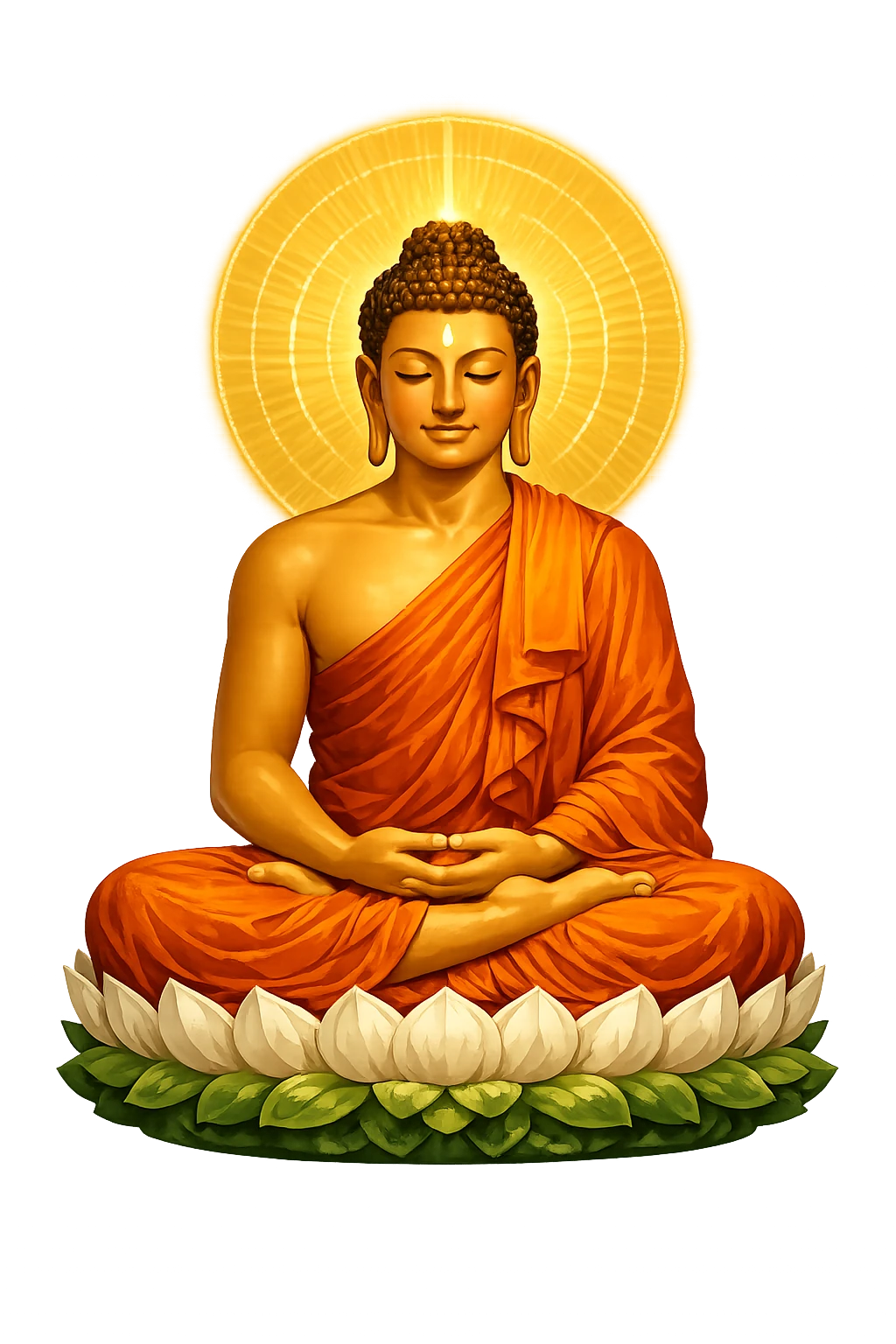
Early aniconic symbols — the empty throne, Bodhi tree, wheel, and footprints — dominated the first three centuries. The first anthropomorphic images appear in Gandhāra and Mathurā during the first centuries CE, blending Hellenistic drapery with Indian spiritual physiognomy: cranial protuberance (uṣṇīṣa), ūrṇā, elongated earlobes, and monastic robe. The bhūmisparśa mudrā of enlightenment and the dharmacakra-pravartana of the first sermon become canonical. Mahāyāna and Vajrayāna traditions multiply forms: thousand-armed, medicine, and cosmic Buddhas, each distinguished by attributes, colors, and consorts.

06

Reception & Transformation

The name after its own age — transmission, translation, survival

Afterlives

The epithet Śākyamuni, 'sage of the Śākya clan,' displaced earlier titles in normative Buddhism and traveled with the textual caravan from northwest India through Central Asia to China, Korea, and Japan. Buddhist Hybrid Sanskrit sūtras, Chinese pilgrims Xuanzang and Faxian, and Tibetan translators rendered his biography into every major Asian literary language. The Pāli chronicles of Sri Lanka preserved a southern version of the life that shaped Theravāda identity. In modernity, colonial archaeology rediscovered Aśoka's pillars and the sites of the sacred biography, while the Buddha image entered Western museums, Theosophy, and popular spirituality, often stripped of monastic context. Contemporary scholarship continues to disentangle the historical teacher from the accrued layers of hagiography.

Identifications Across Traditions

Every Buddhism is his daughter: the Theravāda of the Pāli canon, the Mahāyāna that set him among countless Buddhas yet kept his biography as the pattern of all awakening, the Vajrayāna that read his life as an already-enlightened being's demonstration. East Asia naturalized the name itself — Chinese Shìjiāmóuní, Japanese Shakamuni, Korean Seokgamoni — and Southeast Asia made his earth-touching gesture the single most common Buddha image on earth. Modern scholarship from Rhys Davids onward has treated him as history's first fully-documented founder: a reformer of the Gangetic plain whose dates, places, and words can be argued from evidence, not legend alone.

Modern Legacy

A third of Asia orders its calendar by him: Vesak keeps his birth, awakening, and death in one full-moon festival; the Buddhist Era counts from his parinibbāna; India's national emblem is the lion capital of the pillar Aśoka raised at his first sermon. The English word "Buddha" is his epithet — "the Awakened" — and Śākyamuni remains the name that ties the cosmic teacher back to a clan, a grove, and a date: the sage of the Śākyas, a man of one valley whose refusal to accept decay as final became a world religion.

07

The Meditation

What Śākyamuni means — beyond the dictionary

Śākyamuni's whole authority rests on a refusal: he would not call the palace enough, and he would not call the ashes enough either. The middle way is not a compromise but a discovery — that comfort and punishment are the same evasion — and it is walked, not believed. He left no creed to sign, only a path to test and a closing sentence: everything conditioned decays; be diligent.

08

Frequently Asked Questions

Common questions about Śākyamuni, Enlightenment, Teaching, Historical Buddha, and Unicode restoration

01How do you pronounce Śākyamuni?

In reconstructed pronunciation, Śākyamuni is /ˈɕaː.kjɐ.mu.ni/ — approximately SHAH-kyuh-moo-nih — ś is the soft palatal 'sh'; the ā of Śākya is long.

02What does Śākyamuni mean?

Śākyamuni means ‘sage of the Śākya clan’, epithet of the historical Buddha Siddhārtha Gautama, MW. in the buddhist tradition.

03What are the symbols of Śākyamuni?

Śākyamuni is associated with The Bodhi tree (The axis of the awakening: the tree a whole religion still calls by one name), The earth-touching hand (Bhūmisparśa: the gesture that called the earth to witness against Māra), The begging bowl (The middle way in an object: neither the palace's gold nor the ash of the fire-ascetics), The wheel (dharmacakra) (The teaching itself in motion: the rim, hub, and spokes of suffering, origin, cessation, and path), The twin sāla trees (The pair that flowered out of season at Kusinārā — the world's grief made visible in blossom).

04Why restore Śākyamuni in Unicode?

Plain ASCII shakyamuni strips the stress, length, and script that make the name specific. Unicode restoration returns the name to its original written dignity.

05What is the most important myth about Śākyamuni?

“The Birth at Lumbinī” — the Nidānakathā / Lalitavistara story that anchors the mythology of Śākyamuni, told in full on the lore page.

09

Scholarly Sources

The philological foundations of this restoration

Every claim on this page is grounded in established scholarship. The orthographic restorations follow disciplinary convention. The etymological chain follows the best available reference works. This is not invention — it is resurrection through scholarship.

◈

Lexicography & Philology

  • MW
  • Buddhist texts
◎

Primary Texts

  • The Larger Sukhāvatī-vyūha Sūtra; the Smaller Sukhāvatī-vyūha Sūtra; the Amitāyurdhyāna Sūtra; the Lotus Sūtra.
◉

Archaeology & Art History

  • Material evidence — iconography, inscriptions, and temple archaeology — for Śākyamuni and related cults.
✦

Religious Studies

  • Ariyapariyesanā Sutta (MN 26)
  • Dhammacakkappavattana Sutta (SN 56.11)
  • Mahāparinibbāna Sutta (DN 16)
  • Aśvaghoṣa, Buddhacarita
  • Lalitavistara
  • Monier-Williams, A Sanskrit-English Dictionary, s.v. śākya, muni
Return

The Surface Awaits

You have traced the name from its earliest attestation to its Unicode restoration. Now return to the myth. The story is where the name lives.

Back to Lore
Śākyamuni mascot