PuniCodex

Extended Lore

𓋴𓏏𓐍 Stḫ

Etymology · Orthography · Cult · Iconography · Reception · Sources

Tier 1 Stḫ.com
Stḫ — Desert, Storm, Strength
01

Quick Facts

Essential information about Stḫ, Desert, Storm, Strength

Original Script𓋴𓏏𓐍
Unicode RestorationStḫ
Reconstructed Pronunciation/ˈsɛː.tɛx/
PantheonEgyptian
DomainDesert, Storm, Strength
MeaningThe god Seth/Setekh; etymology disputed, possibly "the one who separates"
ClassificationTier 1
Primary DomainStḫ.com
Sacred SymbolsThe Set animal, The red crown's opposite, The iron, The storm cloud, The foreign lands
02

Etymology & Word Family

From original script to Unicode restoration

Original Script 𓋴𓏏𓐍 Stḫ — "The god Seth/Setekh; etymology disputed, possibly "the one who separates""
Unicode Restoration Stḫ Restored stress, length, and script
Modern ASCII seth Plain-ASCII fallback

The name Stḫ carries the orthographic signature of the egyptian tradition: 𓋴𓏏𓐍. Unicode restoration recovers what ASCII flattens.

03

Unicode Character Breakdown

Character-by-character philological analysis

CharacterUnicodeNameBlockPhonetic Role
SU+0053Latin Capital Letter SBasic LatinSame letter
tU+0074Latin Small Letter TBasic LatinTau of stḫ
ḫU+1E2BLatin Small Letter H with Breve BelowUnknownChet ḫ (velar fricative)
—N/ADropped characterEgyptian orthographyDropped in the Unicode form

The Tier 1 classification reflects how much of the original phonology this restoration preserves — stress and vowel length for Greek names, distinctive letters and diacritics for every other tradition.

04

Cult & Worship

How the sacred was kept — rites, sanctuaries, remains

The Cult

Seth's primary cult center was Nubt (Greek Ombos), the 'gold town' near modern Naqada in Upper Egypt, where temple remains and votive material stretch back to the predynastic period. In the New Kingdom he became a royal patron: Seti I and Ramesses II took his name, and the dynasty celebrated him as the god who violently defends the solar barque against the chaos-serpent Apophis each night. New Year rites and foundation ceremonies invoked his strength. After the Late Period, however, Seth was increasingly demonized; his images were defaced, his temples fell into disuse, and the animal that represented him was deliberately erased from reliefs, an archaeological trace of theological politics.

In the Earth

His cult centre was Nubt (Ombos, near modern Naqada), the 'gold town,' where temple remains and the predynastic votives tie him to Egypt's earliest strata; Set-animal standards appear on the Scorpion macehead and the Narmer palette's war context. The sha-beast's erasure is itself archaeological: reliefs at Karnak and elsewhere show the animal chiseled out in the Late Period and restored by modern epigraphy. The Edfu temple texts preserve the fullest dramatic liturgy of the Horus-Set conflict, performed as temple drama.

05

Iconography

How Stḫ was imaged across the ages

The Image

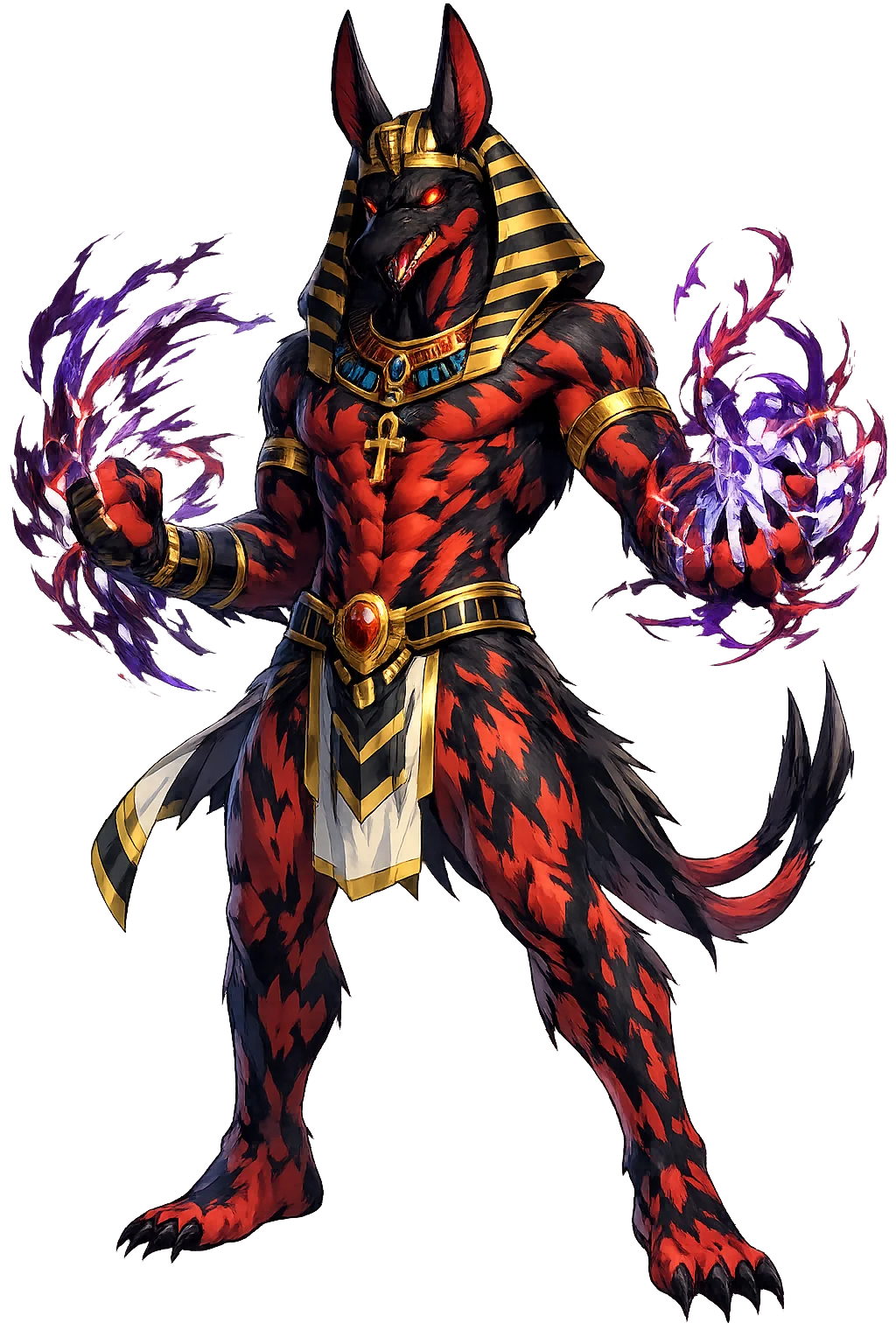
Seth is embodied by the mysterious Set-animal or sha — a long-snouted, square-eared, fork-tailed creature that has never been securely matched to any living species and may be a composite. In fully anthropomorphic form he appears as a man with the animal's head, carrying the was-scepter and wearing a tripartite wig. His skin is conventionally red, the color of the desert and of disorder. The Contendings of Horus and Seth shows him alternately violent and comic, while temple reliefs cast him as the boatman who spears Apophis. The erasure or replacement of his animal in later periods is itself part of his iconographic history.

06

Reception & Transformation

The name after its own age — transmission, translation, survival

Afterlives

Plutarch's On Isis and Osiris transmitted the demonized Seth to the Greco-Roman world as Typhon, a chaotic adversary who influenced later Gnostic and magical demonologies. Coptic and Byzantine Egypt remembered him chiefly as a figure of evil, and medieval bestiaries inherited the strange animal through classical compendia. Modern Egyptology began to rehabilitate him in the nineteenth century, recognizing that New Kingdom kings had honored him as a necessary force rather than a mere villain. Today Seth occupies a contested place in scholarship and in popular reception — sometimes a god of strength and margins, sometimes the archetype of disorder — reflecting the long arc of his transformation from royal protector to cosmic enemy and back again.

Identifications Across Traditions

The New Kingdom identified him with Baal, the Syrian storm god — an equation made by warriors, for warriors. The Greeks, reading the Osiris cycle, identified him with Typhōn, the hundred-headed enemy of Zeús, and as Egypt's religion closed, the identification became damnation: Set-Typhon absorbed all evil, his animal was hacked from the reliefs, his name excised. Te Velde's classic study calls the process 'the demonization of a god' — the first documented case of a deity becoming a devil.

Modern Legacy

He is the ancestor of every 'god of the enemy' in Western imagination — the Typhonian tradition runs from Plutarch through modern occultism. Egyptology's rehabilitation of him (as the necessary opposite, strength without which order is defenceless) is one of the field's signature achievements. The Set animal remains the standard icon of ambiguity itself, and 'Sethian' survives as a scholarly label for Gnostic sects who saw the world as his kind of storm.

07

The Meditation

What Stḫ means — beyond the dictionary

stḫ is the god of the strength you hope never to need. Egypt's answer to evil was not to banish it but to post it at the prow: the desert's violence pointed outward, against the true nothing. He asks every ordered world the question it least likes: what, in you, is strong enough to fight the serpent — and where will you let it stand?

08

Screen & Culture

Where Stḫ echoes through film, television, and games — and how

09

Frequently Asked Questions

Common questions about Stḫ, Desert, Storm, Strength, and Unicode restoration

01How do you pronounce Stḫ?

In reconstructed pronunciation, Stḫ is /ˈsɛː.tɛx/ — approximately 'SEH-tek' — ending in a dry back-of-the-throat 'kh'; Greeks smoothed it to Σήθ (Seth).

02What does Stḫ mean?

Stḫ means The god Seth/Setekh; etymology disputed, possibly "the one who separates" in the egyptian tradition.

03What are the symbols of Stḫ?

Stḫ is associated with The Set animal (The unidentifiable beast — ambiguity made heraldry), The red crown's opposite (Lord of the red desert, against Horus of the black land), The iron ('The iron of Set' — the Egyptians' name for meteoric metal and hardness), The storm cloud (Thunder and the desert wind; in the New Kingdom he is 'the thunderer in the sky', the weather that arrives uninvited), The foreign lands (The nine bows — every country beyond the frontier — are his flocks, and his protection extends over them).

04Why restore Stḫ in Unicode?

Plain ASCII seth strips the stress, length, and script that make the name specific. Unicode restoration returns the name to its original written dignity.

05What is the most important myth about Stḫ?

“The Drowning at Nedyet” — the The Murder story that anchors the mythology of Stḫ, told in full on the lore page.

10

Scholarly Sources

The philological foundations of this restoration

Every claim on this page is grounded in established scholarship. The orthographic restorations follow disciplinary convention. The etymological chain follows the best available reference works. This is not invention — it is resurrection through scholarship.

◈

Lexicography & Philology

  • Faulkner, R. O. A Concise Dictionary of Middle Egyptian. Oxford: Griffith Institute, 1962.
  • Gardiner
  • Te Velde
◎

Primary Texts

  • Pyramid Texts (Osiris drowned at Nedyet)
  • Papyrus Jumilhac (Ptolemaic anti-Seth theology)
  • Plutarch, On Isis and Osiris 12–20
◉

Archaeology & Art History

  • Material evidence — iconography, inscriptions, and temple archaeology — for Stḫ and related cults.
✦

Religious Studies

  • Te Velde, Seth, God of Confusion (1967)
  • The Contendings of Horus and Set (Papyrus Chester Beatty I)
  • Amduat, Hours 1–12
  • Allen, Middle Egyptian
Return

The Surface Awaits

You have traced the name from its earliest attestation to its Unicode restoration. Now return to the myth. The story is where the name lives.

Back to Lore
Stḫ mascot