PuniCodex

Extended Lore

𓋇𓏏𓁐 Sšꜣt

Etymology · Orthography · Cult · Iconography · Reception · Sources

Tier 1 Sšꜣt.com
Sšꜣt — Writing, Architecture
01

Quick Facts

Essential information about Sšꜣt, Writing, Architecture

Original Script𓋇𓏏𓁐
Unicode RestorationSšꜣt
Reconstructed Pronunciation/ˈsɛː.ʃat/
PantheonEgyptian
DomainWriting, Architecture
MeaningShe who scrivens
ClassificationTier 1
Primary DomainSšꜣt.com
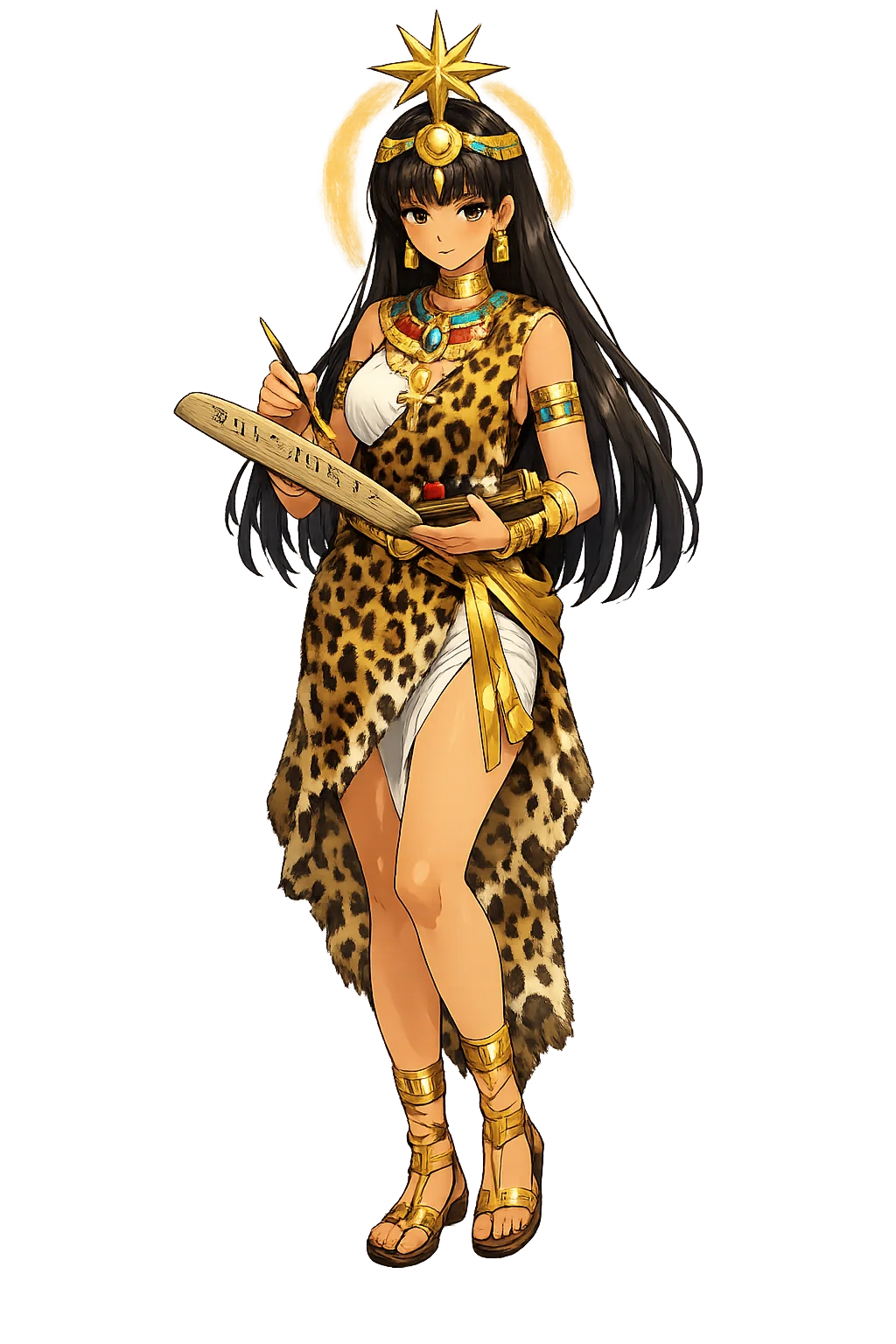
Sacred SymbolsThe seven-pointed star, The palm-rib, The leopard skin, The writing kit
02

Etymology & Word Family

From original script to Unicode restoration

Original Script 𓋇𓏏𓁐 Sšꜣt — "She who scrivens"
Unicode Restoration Sšꜣt Restored stress, length, and script
Modern ASCII seshat Plain-ASCII fallback

The name Sšꜣt carries the orthographic signature of the egyptian tradition: 𓋇𓏏𓁐. Unicode restoration recovers what ASCII flattens.

03

Unicode Character Breakdown

Character-by-character philological analysis

CharacterUnicodeNameBlockPhonetic Role
SU+0053Latin Capital Letter SBasic LatinSame, capitalized
šU+0161Latin Small Letter S with CaronLatin Extended-ASibilant š (palatal s)
ꜣU+A723Latin Small Letter Egyptological AlefLatin Extended-DAlef ꜣ: glottal stop
tU+0074Latin Small Letter TBasic LatinSpecial phonetic character
—N/ADropped characterEgyptian orthographyDropped: vowel not written

The Tier 1 classification reflects how much of the original phonology this restoration preserves — stress and vowel length for Greek names, distinctive letters and diacritics for every other tradition.

04

Cult & Worship

How the sacred was kept — rites, sanctuaries, remains

The Cult

Seshat had no mass popular cult and no great temple of her own; her worship was inseparable from the king's building program. In the stretching-the-cord ritual she stood opposite the pharaoh and helped align temples to the cardinal points by sighting the circumpolar stars. Foundation deposits buried beneath pylons and corners — pots, tablets, model tools — record her presence at the inception of sacred architecture. Her appearances cluster in coronation, jubilee, and temple-foundation scenes from the Old Kingdom through the Ptolemaic period. The consistency of the rite across three millennia suggests a priestly office rather than a devotional following: Seshat was the goddess whom kings needed, not the goddess ordinary Egyptians petitioned.

In the Earth

Her iconography is remarkably consistent across three millennia: leopard-skin robe, seven-pointed emblem on a double horizontal bar, palm-rib in hand. The finest foundation reliefs — Seti I at Abydos, Hatshepsut's foundation deposits, Edfu and Dendera's Ptolemaic versions — show the cord-stretching in identical form, a ritual grammar unchanged from Old Kingdom to Rome. Foundation deposits under real temples (model tools, plaques, the cord's physical traces) confirm the rite was performed, not just pictured.

05

Iconography

How Sšꜣt was imaged across the ages

The Image

Seshat is one of Egypt's most stable iconographic types. She wears a leopard-skin robe, emblem of priestly function, and crowns her head with a tall emblem of seven points rising above a double horizontal bar — interpreted as a stylized flower, a star, or a notched palm rib. In her hand she carries a palm rib notched to record years, the hieroglyph for 'year,' and a writing brush, signifying her role as measurer and recorder. Reliefs at Abydos, Edfu, Dendera, and Deir el-Bahari show her stretching a cord with the king beside her. She is almost always a slender, upright woman, and her seven-pointed emblem is unique: no other deity carries it.

06

Reception & Transformation

The name after its own age — transmission, translation, survival

Afterlives

Seshat virtually disappears from the record after the pharaonic era; unlike Isis or Thoth, she had no Greco-Roman cult and no medieval transmission. She was recovered only with modern Egyptology: Champollion's decipherment of hieroglyphs returned her name and her role in temple foundation ceremonies. Since then she has become an emblem of writing, libraries, and architectural precision, and appears in museum labels and modern Kemetic and esoteric circles as a patroness of scribes and builders. Her reception is therefore less a continuous afterlife than a rediscovery, a goddess who passed from the walls of temples into the footnotes of Egyptology and then into contemporary symbolism for measurement and record-keeping.

Identifications Across Traditions

The Greeks found no clean equivalent — she sits between the Muses, Mnemosyne, and Athena Polias' architectural side — and mostly left her untranslated, a mark of how specifically Egyptian the office was. In Hermetic literature her functions migrate toward Thoth-Hermes Trismegistus: the great scribe absorbs his lady's archive. Modern revivals quietly restored her: she is the unofficial patroness of librarians, archivists, and surveyors who know her seven-pointed star.

Modern Legacy

She embodies an idea the modern world runs on: that power follows from record — the survey, the ledger, the archive. Egyptologists cite her rite in every study of temple alignment (the "stretching of the cord" is the founding document of archaeoastronomy), and her palm-rib is the ancestor of every tally, census, and database. Wherever a foundation stone is laid by measure rather than by guess, her cord is still stretched.

07

The Meditation

What Sšꜣt means — beyond the dictionary

Sšꜣt is the goddess of "write it down." Civilization begins, in her liturgy, not with fire or the wheel but with the cord and the notch: measure the ground, record the year. She asks of every age drowning in information the only question that matters: what, of all this, have you measured truly enough to keep?

08

Frequently Asked Questions

Common questions about Sšꜣt, Writing, Architecture, and Unicode restoration

01How do you pronounce Sšꜣt?

In reconstructed pronunciation, Sšꜣt is /ˈsɛː.ʃat/ — approximately SEH-shaht; the middle consonant is the aleph (ꜣ), not the ayin.

02What does Sšꜣt mean?

Sšꜣt means She who scrivens in the egyptian tradition.

03What are the symbols of Sšꜣt?

Sšꜣt is associated with The seven-pointed star (Her crown-emblem — celestial order marked above the leopard skin), The palm-rib (The tally of years; chronology as sacred craft), The leopard skin (The priestly robe she wears — keeper of the deepest rites), The writing kit (Palette and reed — the tools that make memory permanent).

04Why restore Sšꜣt in Unicode?

Plain ASCII seshat strips the stress, length, and script that make the name specific. Unicode restoration returns the name to its original written dignity.

05What is the most important myth about Sšꜣt?

“Pedj-Shes” — the The Foundation story that anchors the mythology of Sšꜣt, told in full on the lore page.

09

Scholarly Sources

The philological foundations of this restoration

Every claim on this page is grounded in established scholarship. The orthographic restorations follow disciplinary convention. The etymological chain follows the best available reference works. This is not invention — it is resurrection through scholarship.

◈

Lexicography & Philology

  • Faulkner, R. O. A Concise Dictionary of Middle Egyptian. Oxford: Griffith Institute, 1962.
  • Wb
◎

Primary Texts

◉

Archaeology & Art History

  • Temple of Edfu: Ptolemaic foundation texts
✦

Religious Studies

  • Seti I temple, Abydos: foundation reliefs (Dynasty 19)
  • Palermo Stone (royal annals, Dynasty 5)
  • Lexikon der Ägyptologie, s.v. 'Seshat'
  • Wilkinson, The Complete Gods and Goddesses of Ancient Egypt
  • Allen, Middle Egyptian
Return

The Surface Awaits

You have traced the name from its earliest attestation to its Unicode restoration. Now return to the myth. The story is where the name lives.

Back to Lore
Sšꜣt mascot