PuniCodex

Extended Lore

Σελήνη Selēnē

Etymology · Orthography · Cultural Legacy · Reception · Primary Sources

Tier 1 Selēnē.com
Selēnē — Moon, Night Light
01

Quick Facts

Essential information about Selēnē, Moon, Night Light

Original ScriptΣελήνη
Unicode RestorationSelēnē
Reconstructed Pronunciation/se.lɛ́.nɛː/
PantheonGreek
DomainMoon, Night Light
MeaningMoon, light (from σέλας)
ClassificationTier 1
Primary DomainSelēnē.com
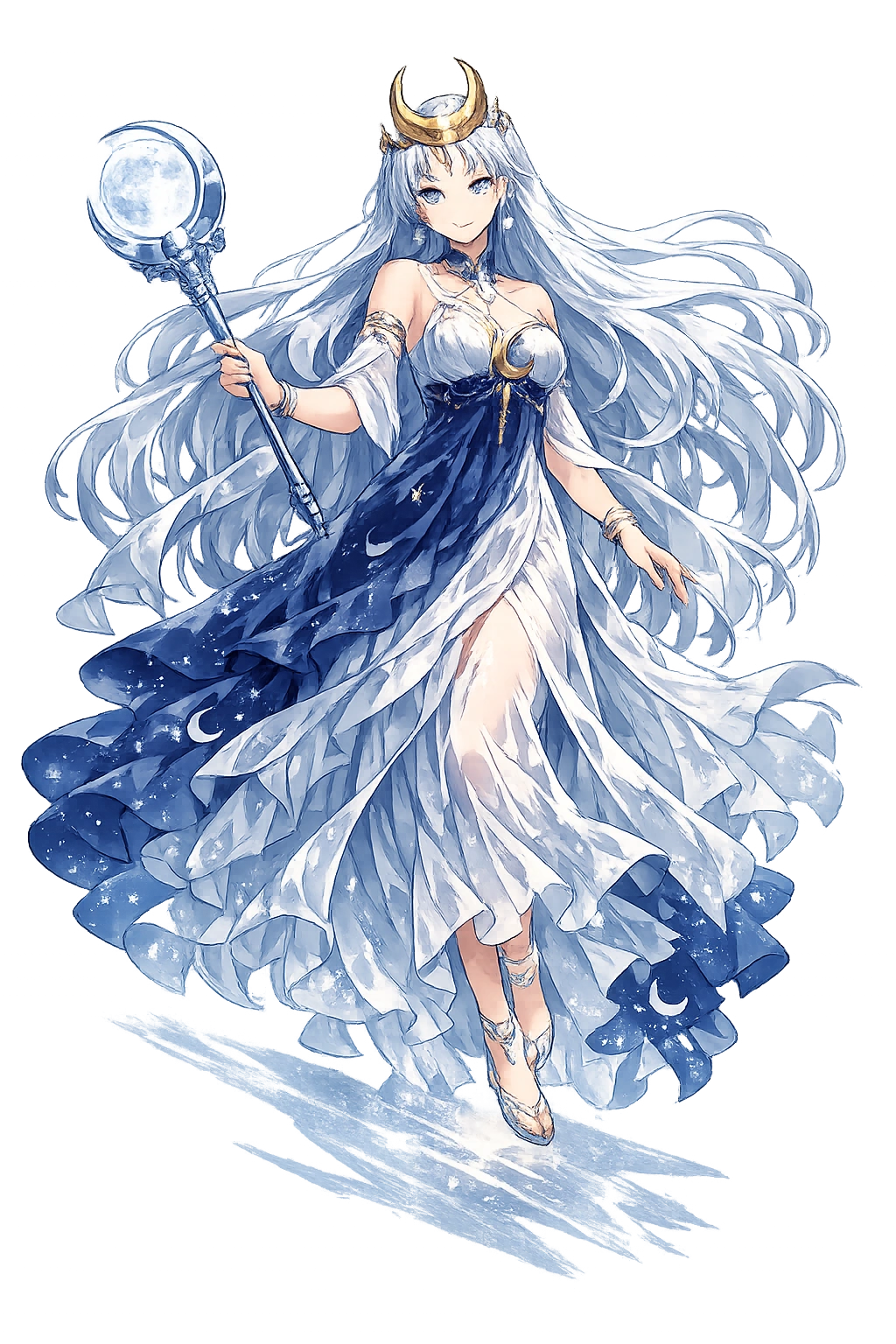
Sacred SymbolsCrescent moon, Silver chariot, Veil, Torch, The sleeping Endymion
02

Etymology & Word Family

From original script to Unicode restoration

Proto-indo-european *sel- light, brightness
Original Script Σελήνη Selēnē — "Moon, light (from σέλας)"
Unicode Restoration Selēnē Restored stress, length, and script
Modern ASCII selene Plain-ASCII fallback

From σελήνη "moon", from σέλας "light, brightness". The moon goddess.

03

Unicode Character Breakdown

Character-by-character philological analysis

CharacterUnicodeNameBlockPhonetic Role
SU+0053Latin Capital Letter SBasic LatinSigma
eU+0065Latin Small Letter EBasic LatinShort epsilon
lU+006CLatin Small Letter LBasic LatinLambda
ēU+0113Latin Small Letter E with MacronLatin Extended-AEta: long epsilon
nU+006ELatin Small Letter NBasic LatinNu
ēU+0113Latin Small Letter E with MacronLatin Extended-AEta: long epsilon

The Tier 1 classification reflects how much of the original phonology this restoration preserves — stress and vowel length for Greek names, distinctive letters and diacritics for every other tradition.

04

Cultural Significance

From ancient cult to modern memory

Selēnē in Later Traditions

The Romans identified Selḗnē with Luna, though as with Hēlios/Sol, the Greek goddess was increasingly absorbed by Artemis-Diana in later periods — the triple lunar goddess of Neoplatonic and magical thought fuses all three. In Hellenistic and Roman Egypt, Selḗnē was syncretized with Isis, who wears the lunar disk between the horns of a cow; the aretalogy of Isis at Maroneia explicitly calls her 'the one who ascends in the gold-wreathed hour'. Neoplatonists made the moon the boundary between the material and immaterial realms, and Selḗnē the mediator between Hēlios and the earth. The scientific afterlife of her name is everywhere: selenography (mapping the moon), selenology, and the element selenium — the Greeks' moon-goddess now names a column of the periodic table.

Modern Legacy

Selḗnē is the archetype of the moon as feminine, cyclical, and magical. She governs not only the night sky but the rhythms of women's bodies, the agricultural calendar, and the vocabulary of madness ('lunacy' remembers her). The crescent moon remains one of humanity's most universal symbols, appearing on flags, coins, and religious iconography across cultures. In modern witchcraft and Neopaganism, the moon goddess — whether called Selene, Diana, or Hecate — is central, and the old magical formula of 'drawing down the moon' lives on in contemporary ritual. Restoring Selḗnē restores the Greek name of the moon as a conscious, luminous presence — not a reflector, but a queen.

In the Earth

Selḗnē's most famous fragment is a horse's head — one of the team from the east pediment of the Parthenon (British Museum), carved at the moment the moon's chariot sinks below the horizon as the sun rises opposite. Vase-paintings show her as a wing-sleeved charioteer with billowing veil, often paired with Hēlios on opposite sides of a scene. In Roman imperial art Luna rides the biga across mosaics and sarcophagi, and she flanks the tauroctony in the cult images of Mithras. No great independent sanctuary was hers; her monumental presence is sculptural, framed at the very edge of the world's most famous temple.

05

The Meditation

What Selēnē means — beyond the dictionary

Selḗnē is the goddess of reflected light — and of everything reflection makes possible. She does not generate radiance; she transforms what Hēlios gives. That is her power and her limitation, and the Greeks knew both: she is the light by which secrets are kept and by which spells are worked, the lamp of thieves and lovers and the dying. The night reveals what the day hides: dreams, transformations, the slow processes of waxing and waning that govern bodies and fields.

Modern life has banished the moon. Electric light has made her irrelevant for practical purposes, and with her disappearance went much of the ancient vocabulary for nocturnal experience. The restoration of her name is a small act of lunar reclamation: the night, too, has its goddess, and the dark was never empty — it was attended.

06

Frequently Asked Questions

Common questions about Selēnē, Moon, Night Light, and Unicode restoration

01How do you pronounce Selēnē?

In reconstructed pronunciation, Selēnē is /se.lɛ́.nɛː/ — approximately 'seh-LAY-nay' — the second syllable carries the pitch, and the final vowel is long and pale.

02What does Selēnē mean?

Selēnē means Moon, light (from σέλας) in the greek tradition.

03What are the symbols of Selēnē?

Selēnē is associated with Crescent moon (The waxing and waning boat of her passage; on gems and coins, the emblem of increase and decrease.), Silver chariot (The two-horse car that crosses the night — the pale gleam of its wheels is the whole of her archaic theology.), Veil (The billowing mantle that streams behind her in art — the clouds that alternately hide and reveal the moon.), Torch (The cool lamp of the night, carried against the dark that her brother's absence leaves behind.), The sleeping Endymion (The beautiful shepherd fixed in everlasting sleep — youth preserved, but at the price of waking.).

04Why are there different spellings of Selēnē?

Each form is a historically attested restoration rather than a mistake: Selḗnē is the ideal form (Stacked macron+acute on the stressed long vowel, matching Greek Σελήνη; philologically ideal but often untypeable on phones.). PUNICODEX registers the full set so the tradition is preserved under every defensible spelling.

05Why restore Selēnē in Unicode?

Plain ASCII selene strips the stress, length, and script that make the name specific. Unicode restoration returns the name to its original written dignity.

06What is the most important myth about Selēnē?

“Endymion on Mount Latmus” — Selḗnē rules the night the way Hēlios rules the day — but where his light reveals, hers conceals, transforms, and bewitches. Her myths are fewer than her brother's because the night was less personified in early Greek poetry; what survives is a handful of late, luminous stories that turned the moon's monthly rhythm into love, sleep, and sorcery. The full telling lives on the lore page.

07

Scholarly Sources

The philological foundations of this restoration

Every claim on this page is grounded in established scholarship. The orthographic restorations follow disciplinary convention. The etymological chain follows the best available reference works. This is not invention — it is resurrection through scholarship.

Lexicography & Philology

  • Liddell, H. G., Scott, R., & Jones, H. S. A Greek-English Lexicon. Oxford: Clarendon Press, 9th ed. 1996.
  • Pape, W., & Benseler, G. E. Wörterbuch der griechischen Eigennamen. Braunschweig: Vieweg, 1884.
  • Beekes, R. S. P. Etymological Dictionary of Greek. Leiden: Brill, 2010.

Primary Texts

  • Hesiod, Theogony 371–374
  • Homeric Hymn to Selene (32)
  • Apollodorus, Bibliotheca 1.7.5
  • Pausanias, Description of Greece
  • Cicero, Tusculan Disputations 1.38

Archaeology & Art History

  • Material evidence — iconography, inscriptions, and temple archaeology — for Selēnē and related cults.

Religious Studies

  • Theocritus, Idylls 2–3
Return

The Surface Awaits

You have traced the name from its earliest attestation to its Unicode restoration. Now return to the myth. The story is where the name lives.

Back to Lore
Selēnē mascot