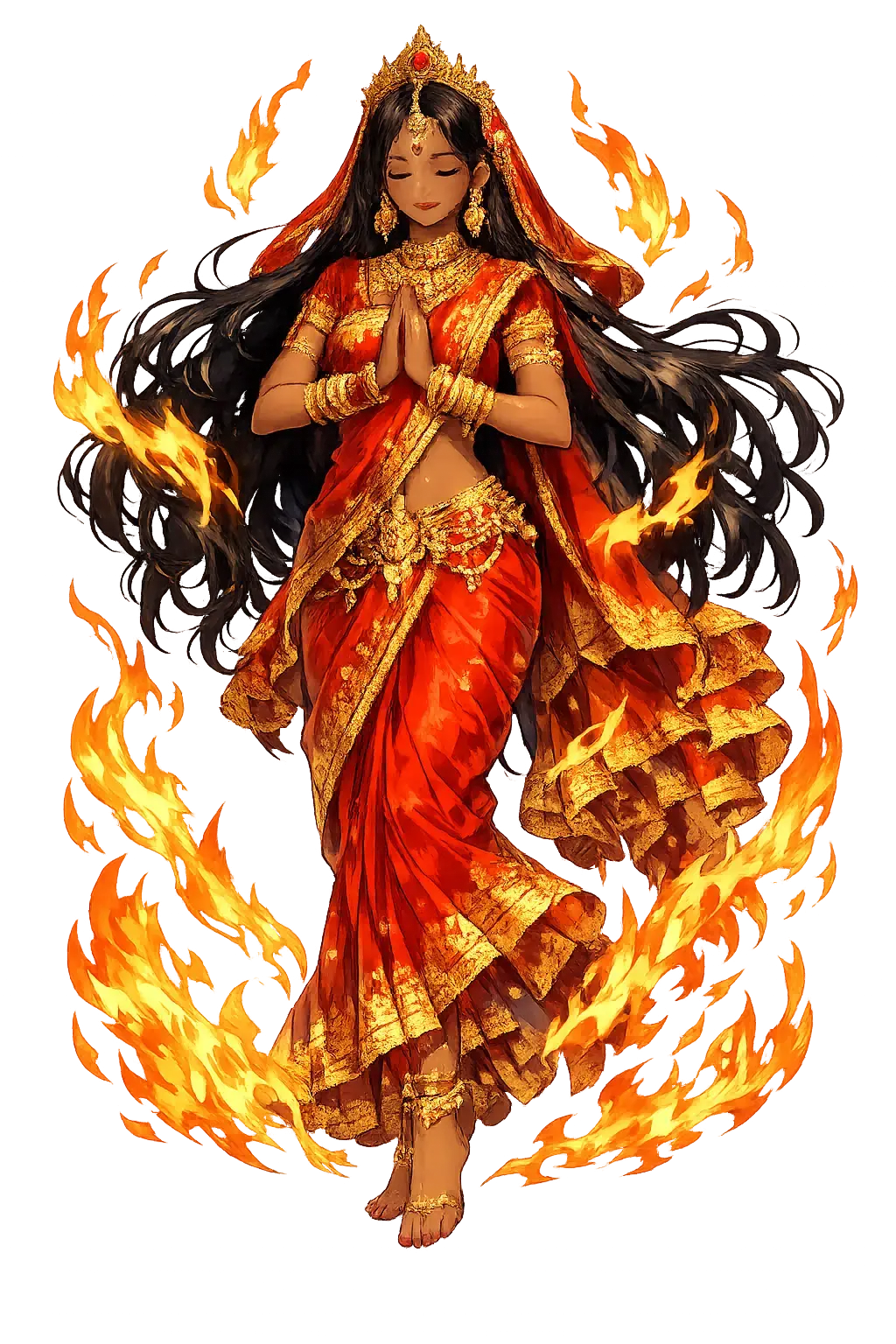
Stories of Satī
Satī's story is told at length in the Śiva Purāṇa and the Skanda Purāṇa, with variant retellings across the Purāṇic corpus and Kālidāsa's account of her rebirth. It is a drama of honor, love, and the catastrophic consequences of refusing a daughter's chosen god — the founding tragedy of the Śaiva cosmos.
Satī was born to Dakṣa and his wife Prasūti as the incarnation of the supreme goddess Śakti, and from childhood she set her heart on Śiva — the ascetic who wore the ashes of cremation grounds, a garland of skulls, and a serpent for a cord, lord of yogins and dweller at the edge of society (Śiva Purāṇa, Rudrasaṃhitā, Satīkhaṇḍa). Dakṣa despised him: what father gives his daughter to a beggar smeared with funeral dust? Satī, rejected and mocked, withdrew to the mountain and performed austerities until Śiva, tested and satisfied, accepted her. Their marriage was celebrated by the gods against the father's silence, and she went to live with her husband on Kailāsa, the mountain that is both throne and hermitage. The union the myth celebrates is also the wound it will open: householder wed to renouncer, daughter to a father who could not forgive her choice. Every later catastrophe of the Śaiva cycle flows from that first exclusion.
Dakṣa arranged a great sacrifice at Kankhal, near the Ganges' descent, and invited every god, sage, and celestial being — omitting Śiva, his own son-in-law, and posting guards against his entry (Śiva Purāṇa 2.2; Skanda Purāṇa, Kāśīkhaṇḍa). Satī begged to attend her father's festival; Śiva warned her that a gift given in contempt is poison, but let her go with his gaṇas. At the rite she was received not with welcome but with a public tirade — Dakṣa reviled Śiva as a corpse-dweller, a skull-bearer, no true god at all. The assembled deities hung their heads; no one defended her. Then the myth takes its terrible turn: Satī does not curse the assembly and does not weep. She invokes her inner fire — the yogāgni of the goddess within — and abandons her body on the spot, before the eyes of the sacrifice she had come to honor. The altar raised to bind the cosmos together becomes the pyre that unmakes a daughter's place in her father's house.
News reached Kailāsa, and the ascetic who had conquered desire by yoga discovered its full violence (Śiva Purāṇa 2.2; Skanda Purāṇa). From a lock of his matted hair he plucked two hairs and dashed them to the ground: from one rose Vīrabhadra, a warrior like a storm-cloud, and from the other Bhadrakālī, dark and laughing. They marched on Kankhal with the gaṇas, broke the sacrifice, scattered the gods, and beheaded Dakṣa — who was later restored, in some tellings with a goat's head, humbled and reconciled. Śiva himself came, took up Satī's body, and wandered the cosmos in the Tāṇḍava, the dance that shakes worlds, until the gods begged Viṣṇu to intervene; his discus cut the corpse apart, and the pieces fell across the subcontinent. The grief of the unmoved god is the myth's center: yoga had not removed love, only taught it where to break.
Where each fragment of Satī's body fell, a Śakti-pīṭha arose — the 'seats of power' that map the goddess across India (Devībhāgavata Purāṇa 7; the lists vary between 51 and 52 sites). Her yoni fell at Kāmākhyā in Assam; her tongue at Jwalamukhi in the Punjab hills; her eyes at Nainital; each pīṭha sanctifying a different member of the dismembered wife. The geography is devotional, not surgical: the myth turns a catastrophe of patriarchal honor into a country-wide network of goddess-shrines, so that from Kashmir to Kanyakumari no pilgrim is far from Satī. The theological move is quietly radical — the father tried to erase the daughter from the sacrifice, and instead the daughter became the ground every sacrifice stands on. Satī worshipped at Kankhal itself is called Dākṣāyaṇī, 'Dakṣa's daughter', the very name the insult had thrown at her now an honorific of the shrine.
The Purāṇas carry the story past death. Satī was reborn to Himavat, the mountain-king, and his queen Menā, and named Pārvatī, 'daughter of the mountain' (Śiva Purāṇa, Umāsaṃhitā; Kālidāsa, Kumārasambhava 5–8). She grew into beauty and resolve, and when her father despaired of finding her a husband she answered that she would have Śiva or no one. Her austerities drew the ascetic's attention; he tested her in disguise — an old Brahmin mocking the god she loved — and her defense of Śiva convinced him. But the wooing nearly failed before it began: the love-god Kāma shot his flower-arrow at the meditating god and was burned to ash for it, until Pārvatī's penance itself won the marriage the gods needed, for only a child of Śiva and Śakti could kill the demon Tāraka. The rebirth is the tradition's answer to the first tragedy: Satī returns not as victim but as sovereign, the Śakti without whom the great god is a corpse.
First Wife of Śiva, Daughter of Dakṣa
Satī is the first consort of Śiva, the daughter of the proud Prajāpati Dakṣa. Her myth is the hinge on which the larger Śaiva narrative turns: an insult to her husband, an unbearable grief, and a self-immolation so total that it forces the god of destruction himself to destroy the sacrifice.
She is Śiva's first wife, drawn to his ascetic power against her father's wishes.
Born to the patriarch Dakṣa, she embodies the conflict between household and hermitage.
She destroys her body by inner fire after Dakṣa insults Śiva.
After death she is reborn as Pārvatī, who finally wins Śiva as her husband again.
From the original script to the living URL
सती
The name in its original Sanskrit form. Satī (सती) is attested in the source tradition — “The True One — daughter of Dakṣa and first wife of Śiva, who immolated herself at her father's sacrifice”. Its macron-length vowels carry the full phonetic and orthographic weight of the source tradition.
sati
Reduced to plain sati, the name loses everything that made it specific: macron-length vowels. What remains is an ASCII string that machines can parse but that no longer speaks with its original voice.
Satī
The Unicode restoration recovers what ASCII flattened. Satī restores macron-length vowels, returning the name to its original written dignity. The domain encodes to Punycode, but the browser displays the truth.
Satī.com → xn--sat-wta.com
The non-ASCII characters in Satī are encoded while the ASCII remains visible. To the DNS, it is Punycode. To humanity, it is Satī.
Owned, ideal, and ASCII forms of Satī
Satī
Restores सती. The live temple domain — satī.com.
sati
Flattens सती. The plain ASCII fallback — what DNS and legacy systems see.
How Satī was spoken
How Satī travels from ancient script to the modern URL
The lore you have read is the living myth. Extended Lore opens the scholarly vault beneath it: the cult and its material remains, a history of the image, the name after antiquity, a meditation on what the name still means, and the full scholarly apparatus — etymology, orthography, sources.
Enter Extended Lore