PuniCodex

Extended Lore

शनि Śani

Etymology · Orthography · Cult · Iconography · Reception · Sources

Tier 1 Śani.com
Śani — Justice, Saturn, Karma
01

Quick Facts

Essential information about Śani, Justice, Saturn, Karma

Original Scriptशनि
Unicode RestorationŚani
Reconstructed Pronunciation/ɕɐ.ni/
PantheonSanskrit
DomainJustice, Saturn, Karma
Meaning"The Slow One" — Saturn as the lord of karma, justice, discipline, and time
ClassificationTier 1
Primary DomainŚani.com
Sacred SymbolsThe crow, The iron, The slow orbit
02

Etymology & Word Family

From original script to Unicode restoration

Original Script शनि Śani — ""The Slow One" — Saturn as the lord of karma, justice, discipline, and time"
Unicode Restoration Śani Restored stress, length, and script
Modern ASCII sani Plain-ASCII fallback

The name Śani carries the orthographic signature of the sanskrit tradition: शनि. Unicode restoration recovers what ASCII flattens.

03

Unicode Character Breakdown

Character-by-character philological analysis

CharacterUnicodeNameBlockPhonetic Role
ŚU+015ALatin Capital Letter S with AcuteLatin Extended-APalatal ś (IAST)
aU+0061Latin Small Letter ABasic LatinSame
nU+006ELatin Small Letter NBasic LatinSame
iU+0069Latin Small Letter IBasic LatinSame

The Tier 1 classification reflects how much of the original phonology this restoration preserves — stress and vowel length for Greek names, distinctive letters and diacritics for every other tradition.

04

Cult & Worship

How the sacred was kept — rites, sanctuaries, remains

The Cult

Śani's cult is above all a Saturday cult. Devotees observe Śanivār fasts, light sesame-oil lamps before his image, and offer black cloth, iron, sesame seeds, and mustard oil to appease the slow planet's karmic gaze. Shani Shingnapur in Maharashtra, with its open-air black boulder and famously doorless houses, is his premier living shrine; the Saturday queue stretches for kilometers. Across South India he is installed in Navagraha temples in fixed planetary order, often as a bronze in the Kumbakonam circuit, while household worship pairs his image with protective mantras against sāḍe-sātī and other Saturn transits.

In the Earth

Shani Shingnapur's open-air black boulder — the village with famously doorless houses, trusting his protection — is his great shrine; the queue on Saturdays runs for kilometers. Navagraha temples across the South (the Kumbakonam circuit) install him among the nine planets in fixed order, and his bronze from the Chola period shows the stiff, dark, crow-mounted figure unchanged.

05

Iconography

How Śani was imaged across the ages

The Image

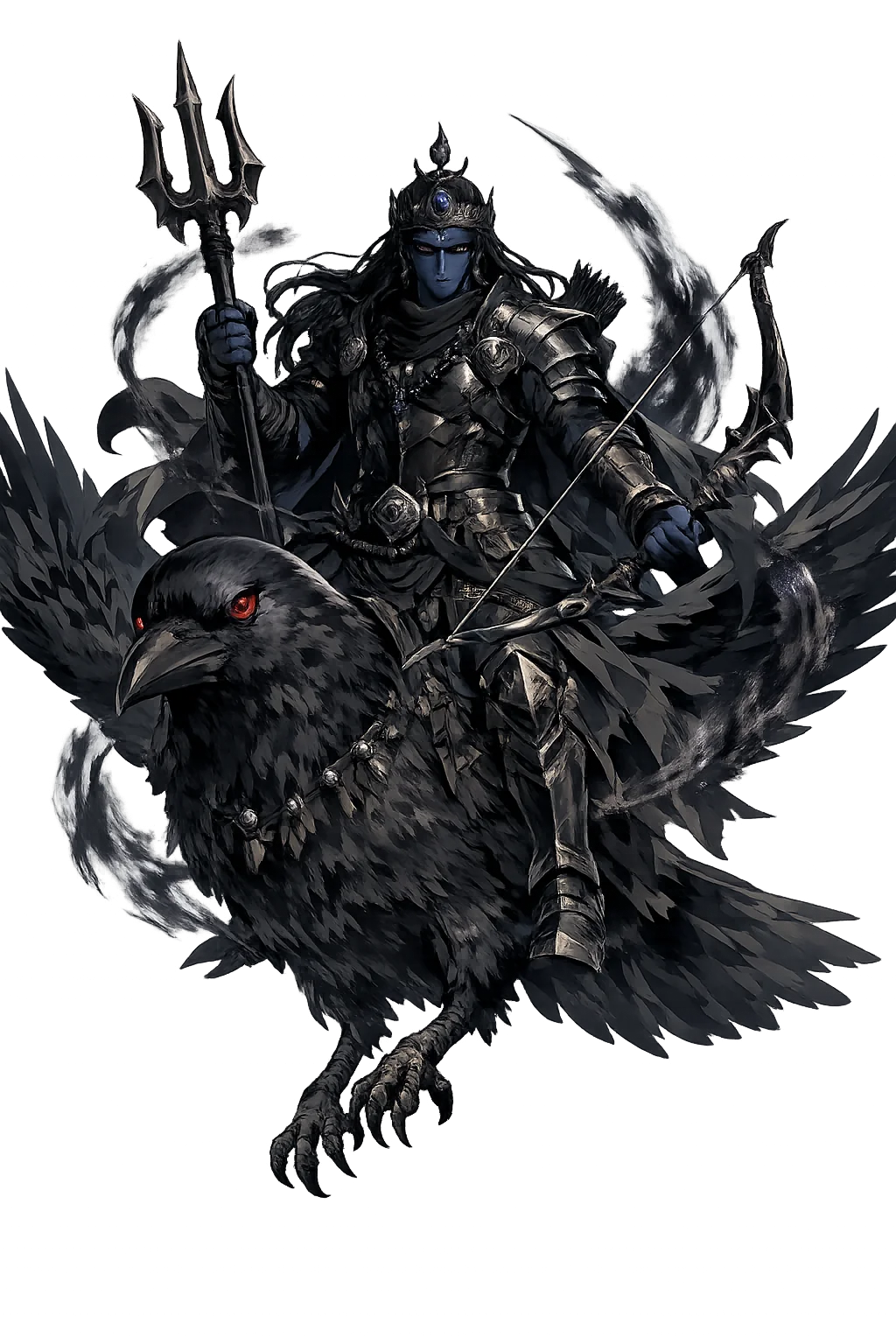
Śani is imaged as dark, stiff, and austere. Chola bronzes show him blue-black or charcoal in color, dressed in rags, mounted on a crow, and carrying a sword, staff, or sceptre. His gaze is sidelong or averted, since direct sight is held to bring misfortune. In Navagraha panels he occupies the planet row, the crow at his feet marking his vahana. Modern calendar art preserves the same formula: a solemn figure moving slowly on his bird, surrounded by the attributes of time and judgment. The color and posture say more than facial detail; Śani's iconography is a visual theology of delay, discipline, and inescapable consequence.

06

Reception & Transformation

The name after its own age — transmission, translation, survival

Afterlives

Śani is the Indian reinterpretation of Saturn, filtered through Hellenistic astral science and the Yavana-jātaka tradition before being fully domesticated in Sanskrit Jyotiṣa. Varāhamihira's sixth-century Bṛhat-saṃhitā gives the classic description of the planet's nature, while the Purāṇic myth of his birth from Chāyā, Sūrya's shadow-wife, supplies a narrative explanation for his darkness and distance. Medieval temple culture placed him in the Navagraha cluster, and colonial scholars puzzled over his mixture of dread and devotion. In modern India he dominates newspaper astrology columns, Saturday taboos, and temple television, his name a byword for the delays and reckonings everyone fears yet everyone must face. Gem therapists prescribe blue sapphire with caution, and Bollywood films regularly invoke him as the planet no ritual can fully placate.

Identifications Across Traditions

Saturn's malefic reputation is Indo-European common ground — the Greek Kronos' devouring shadow and Rome's cold planet carry the same dread — but India alone made the planet a judge to be appeased weekly. His temple at Shingnapur (Maharashtra), where the god is an unwalled black stone under open sky, is the anti-temple: no roof over the planet, as if architecture itself feared to constrain him.

Modern Legacy

"Śani chal raha hai" (Saturn is upon us) is the everyday explanation for every run of bad luck from Mumbai to Trinidad. His Saturday fast, his black-and-blue colors, his iron-and-sesame remedies constitute the largest planetary cult in the world. The fear is genuinely democratic: billionaires and bus-drivers check the same ephemeris, and Shingnapur's donations fund entire towns. Jyotiṣa, India's living astrology, centers on his slow clock.

07

The Meditation

What Śani means — beyond the dictionary

Śani is the god of "later." Every tradition has a debt-collector, but his genius is slowness: the audit arrives when the deeds are half-forgotten, itemized to the day. He asks the only question that matters at midlife: not what did you build, but what did you balance — and are you ready for the season when the slow planet comes to check?

The open shrine at Shingnapur is the whole doctrine in stone: no roof, no walls, a black boulder under the same sky he rules. You do not contain Saturn; you stand under him honestly, doors unlocked, accounts straight. The doorless village trusts the audit. That is the only prayer he reads.

The remedies are worth reading closely: sesame oil, iron, the feeding of crows, the Saturday fast — not magic but discipline, small weekly acts of humility calibrated to his tempo. Śani is appeased by exactly what he represents: patience, repeated, in small measures, for seven and a half years if necessary. The cure and the god are the same medicine.

The astrologers' caution is not terror but timing: Sade Sati ends, as surely as it begins, and the households that keep the small disciplines through it emerge, the tradition says, tempered like iron that stayed in the fire long enough. Śani does not punish; he anneals. The slow planet's real gift is what patience makes of the patient.

The doorless village understood this centuries ago. You do not lock out the auditor; you live so that the audit is boring.

His temple etiquette is the final lesson: oil poured, iron touched, crows fed before breakfast, and then the week begins — small debts paid in advance against the slow account. India has refined the art of living under Saturn into a weekly hygiene, and it works exactly as intended: the audit, when it comes, finds everything already in order.

Slow is not the opposite of just; it is how justice travels when it intends to be exact. The planet keeps his time; the accounts keep theirs.

08

Frequently Asked Questions

Common questions about Śani, Justice, Saturn, Karma, and Unicode restoration

01How do you pronounce Śani?

In reconstructed pronunciation, Śani is /ɕɐ.ni/ — approximately SHUH-nee — soft palatal sh, short and even.

02What does Śani mean?

Śani means "The Slow One" — Saturn as the lord of karma, justice, discipline, and time in the sanskrit tradition.

03What are the symbols of Śani?

Śani is associated with The crow (The dark mount — witness of the unavoidable), The iron (His metal — hard, cold, unglamorous, indispensable), The slow orbit (Twenty-nine-and-a-half years — time as the measure of justice).

04Why restore Śani in Unicode?

Plain ASCII sani strips the stress, length, and script that make the name specific. Unicode restoration returns the name to its original written dignity.

05What is the most important myth about Śani?

“The Shadow of the Sun” — the The Birth story that anchors the mythology of Śani, told in full on the lore page.

09

Scholarly Sources

The philological foundations of this restoration

Every claim on this page is grounded in established scholarship. The orthographic restorations follow disciplinary convention. The etymological chain follows the best available reference works. This is not invention — it is resurrection through scholarship.

◈

Lexicography & Philology

  • Puranas
  • Mahabharata
  • Monier-Williams
  • MW
  • Brāhmaṇas
  • Cambridge
◎

Primary Texts

  • The Ṛgveda; the Śatapatha Brāhmaṇa; the early Upaniṣads; the Śiva Purāṇa and Liṅga Purāṇa.
◉

Archaeology & Art History

  • Pingree, 'The Indian Iconography of the Planets and their Influences' (Journal of the Warburg and Courtauld Institutes, 1963)
✦

Religious Studies

  • Varāhamihira, Bṛhat-saṃhitā (6th c.), the chapters on the planets' natures and effects
  • Brahma Vaivarta Purāṇa (the birth of Śani from Chhāyā, the shadow-wife of Sūrya)
  • Śani Mahātmya — the sthala-purāṇa of Shani Shingnapur (late, but the charter text of his living cult)
  • Monier-Williams, A Sanskrit-English Dictionary, s.v. śani ('the slow one')
  • Mahābhārata — śani among the grahas in epic astrology
Return

The Surface Awaits

You have traced the name from its earliest attestation to its Unicode restoration. Now return to the myth. The story is where the name lives.

Back to Lore
Śani mascot