
The Cult
The Pāṇḍava-brotherhood village cults of the western Himalaya worship the set; astrologers’ lineages invoke him in their initiation verses. His festival is the epic-recitation itself.
Extended Lore
Etymology · Orthography · Cult · Iconography · Reception · Sources
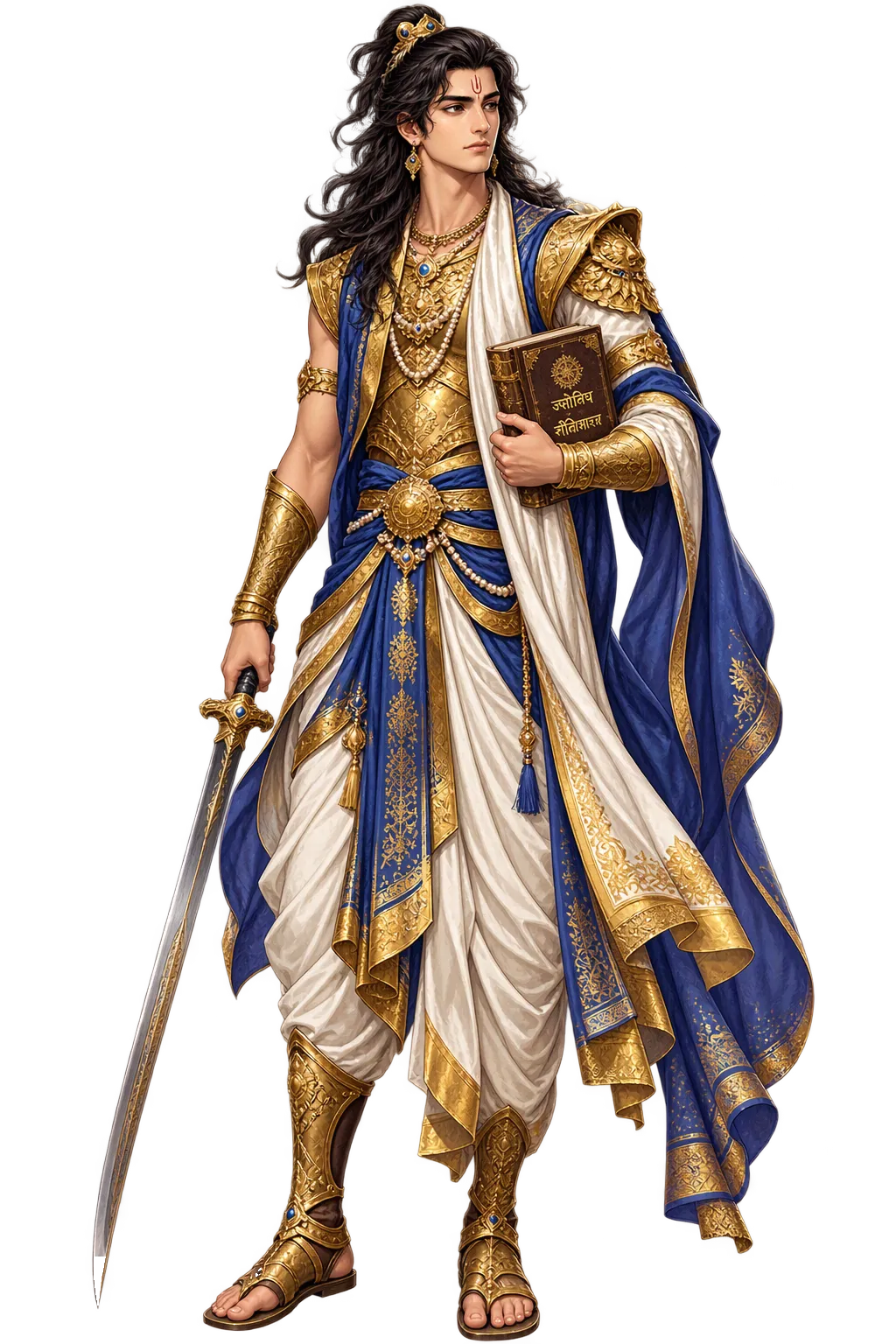
Essential information about Sahadeva, Twin, Son of Madri
From original script to Unicode restoration
The name Sahadeva reaches the modern world through scholarly transliteration of the sanskrit tradition. Because the conventional spelling uses only Latin letters, its Unicode and ASCII forms coincide — the tradition it carries is in the name itself, not in diacritics.
Character-by-character philological analysis
| Character | Unicode | Name | Block | Phonetic Role |
|---|---|---|---|---|
| S | U+0053 | Latin Capital Letter S | Basic Latin | Same, capitalized |
| a | U+0061 | Latin Small Letter A | Basic Latin | Same |
| h | U+0068 | Latin Small Letter H | Basic Latin | Same |
| a | U+0061 | Latin Small Letter A | Basic Latin | Same |
| d | U+0064 | Latin Small Letter D | Basic Latin | Same |
| e | U+0065 | Latin Small Letter E | Basic Latin | Same |
| v | U+0076 | Latin Small Letter V | Basic Latin | Same |
| a | U+0061 | Latin Small Letter A | Basic Latin | Same |
This restoration reflects fidelity to the attested tradition, not recovered diacritics: every character of Sahadeva already survives in ASCII. What the restoration preserves is the canonical spelling itself — the form scholarship standardised.
How the sacred was kept — rites, sanctuaries, remains
The Pāṇḍava-brotherhood village cults of the western Himalaya worship the set; astrologers’ lineages invoke him in their initiation verses. His festival is the epic-recitation itself.
As with Nakula, his monuments are the epic’s performance traditions and the Pāṇḍava-ratha reliefs of the Pallava south. The jyotiṣa-manuscript traditions of medieval India invoke his name as patron of the astronomical arts.
How Sahadeva was imaged across the ages
The twin beside Nakula, differentiated by the astrolabe or the chart in later paintings; his icon is the star-diagram — the heavens reduced to the hand.
The name after its own age — transmission, translation, survival
Literary criticism reads Sahadeva as the Mahābhārata’s Cassandra — the truth-teller structurally fated to be ignored. In the study of expertise and power, his scenes are cited as the epic’s analysis of how organizations fail: the one who calculates best is the one the assembly interrupts.
Sahadeva is the Aśvins’ second son — the epic’s accounting keeps the physician-gods’ line in the heroic blood — and later tradition made him the type of the jyotiṣika, the court astrologer whose charts rule kingdoms. The twins together became the subcontinent’s archetype of matched excellence in different keys: Nakula the body’s arts, Sahadeva the mind’s.
The twins’ names remain a matched set in Indian naming — Sahadeva a standing boy’s name meaning ‘attended by gods’. His unheeded-counsel scene is the epic’s image of every expert ignored by power; and the jyotiṣa tradition claims him as its founding hero, the astronomer inside the world’s longest poem.
What Sahadeva means — beyond the dictionary
Sahadeva: ‘god with god’ — the name is a theology of twins. Restored plainly, it keeps the epic’s quietest lesson: wisdom that cannot persuade is still wisdom, and the stars he read were right whether the court listened or not. Four syllables, infallible and ignored.
Common questions about Sahadeva, Twin, Son of Madri, and Unicode restoration
In reconstructed pronunciation, Sahadeva is /səˈhɑːdɛvə/ — approximately “suh-HAH-deh-vuh”.
Sahadeva means Son of the Aśvins and Mādrī — twin of Nakula, youngest of the Pāṇḍu princes, famed for wisdom in the sanskrit tradition.
Sahadeva is associated with The Astronomer (His knowledge of the stars set the war’s calendar; the epic calls his astrology infallible.), The Sword (His blade-work equalled Nakula’s — the twins were the epic’s matched pair of arms.), The Cattle-Seer (Like his twin he knew herds — but Sahadeva read their breeding and their futures too.), The Unheeded Counsel (He advised the dice-refusal and the war’s conduct — right, and passed over.).
Sahadeva is written entirely in ASCII letters, so its restoration is about canonical fidelity rather than recovered diacritics: the temple fixes the name in its scholarly standard spelling, attested in the source tradition, instead of leaving it to drift.
“The Younger Twin” — the Ādi Parvan story that anchors the mythology of Sahadeva, told in full on the lore page.
The philological foundations of this restoration
Every claim on this page is grounded in established scholarship. The orthographic restorations follow disciplinary convention. The etymological chain follows the best available reference works. This is not invention — it is resurrection through scholarship.
You have traced the name from its earliest attestation to its Unicode restoration. Now return to the myth. The story is where the name lives.
Back to Lore