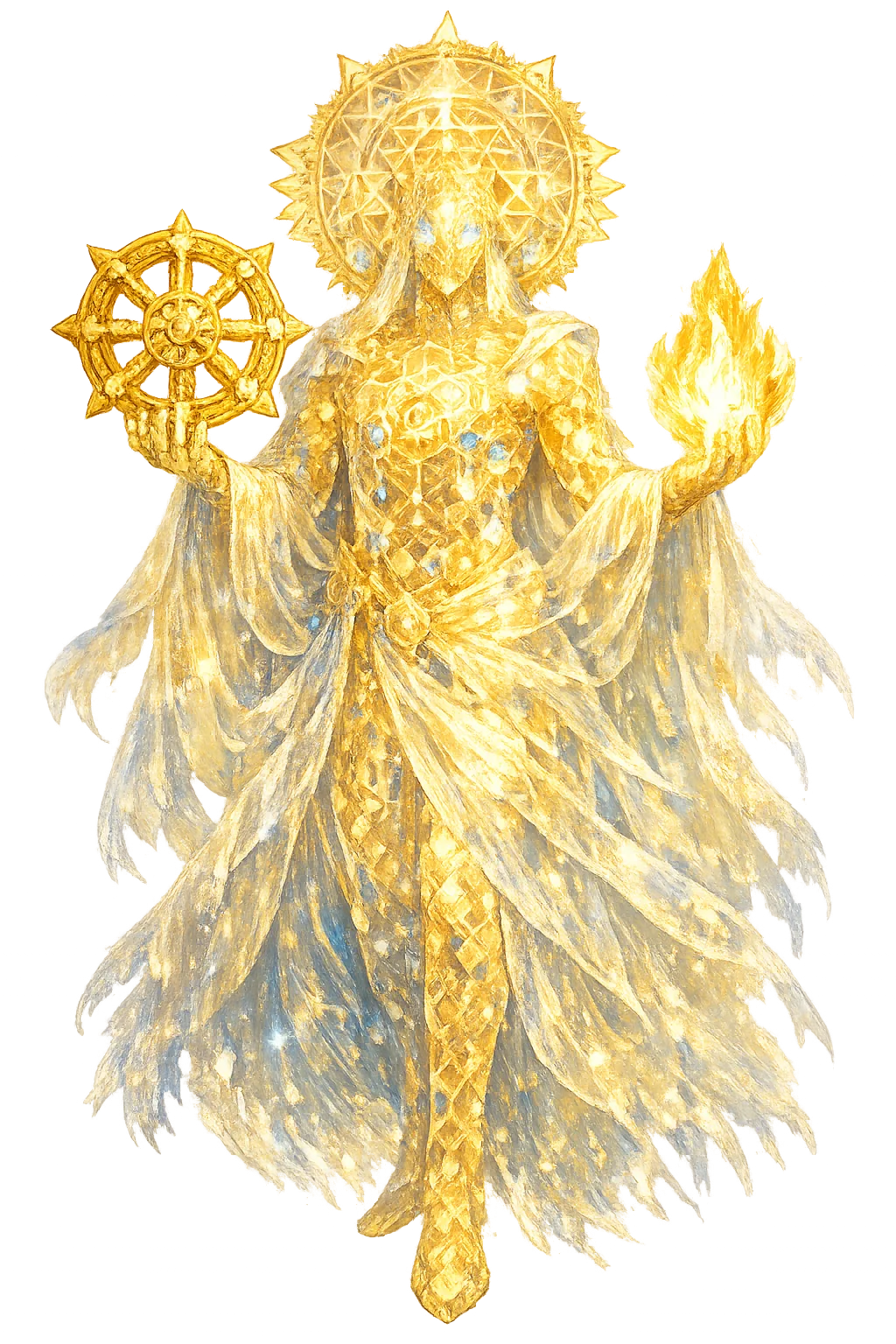
Stories of Ṛta
Ṛta has no personal mythology — no birth, no love affairs, no wars. Its 'stories' are the regular events of the cosmos: dawn after night, rain after drought, the fire rising when the priest kindles it.
In Ṛgvedic hymns, the sun's chariot is said to roll by Ṛta. The seven horses, the wheel, and the path are all fitted together by this principle. If the sun rises each morning, it is not merely because the sun is powerful but because Ṛta compels it. The cosmos is therefore not arbitrary; it is a machine of meaning, maintained by an invisible law.
Ṛta is closely linked to satya, truth. A true statement is one that is ṛta — rightly joined to reality. The poet-seers (ṛṣis) do not invent hymns; they see them, because their words are aligned with the cosmic order. Speech that violates Ṛta is not merely false; it is destructive, loosening the bonds that hold the world together.
Unlike the sovereign gods of Near Eastern mythologies, the Vedic gods are not above cosmic law. Indra, Agni, and Varuṇa act within Ṛta and are praised for upholding it. Varuṇa, lord of the waters and the night sky, is especially its guardian, watching over oaths and punishing those who break them. Ṛta is therefore closer to a natural law than to a divine decree.
Ṛta becomes personal in the figure of Varuṇa, the great Asura who guards it. In Vasiṣṭha hymn (Ṛgveda 7.86), the poet lies bound by the Varuṇa noose and cries out: what Varuṇa has bound, may Varuṇa release... so that we may again behold the sun. The sin is real — some small betrayal, an unkept word — and the binding is real: Ṛta is not an idea but a force with a custodian. Yet the hymn ends in confidence, for the order that binds also restores; the same Varuṇa who fastens the noose unties it when truth is spoken. Moral order in the Ṛgveda is a relationship before it is a law — watched, judged, and forgivable.
Cosmic Order, True Speech, and Right Ritual
Ṛta is the hidden spine of the Vedic universe. It is not a god to be petitioned but the law that makes petition possible — the right fit of stars, seasons, words, and actions. Where later Hinduism speaks of Dharma and Karma, the earliest poets spoke of Ṛta.
The regular rising of sun and stars, the turning of seasons, and the flow of rivers all move by Ṛta.
Speech that is true is speech that fits reality; Ṛta is the standard against which words are measured.
The sacrifice works only when every gesture, mantra, and offering is aligned with Ṛta.
The gods themselves are subject to Ṛta; it is older and higher than any personal will.
From the original script to the living URL
ऋत
The name in its original Sanskrit form. Ṛta (ऋत) is attested in the source tradition — “Cosmic order, truth — the Vedic principle of rightness that governs gods and nature (ṛta)”. Its original diacritics and script distinctions carry the full phonetic and orthographic weight of the source tradition.
rta
Reduced to plain rta, the name loses everything that made it specific: original diacritics and script distinctions. What remains is an ASCII string that machines can parse but that no longer speaks with its original voice.
Ṛta
The Unicode restoration recovers what ASCII flattened. Ṛta restores original diacritics and script distinctions, returning the name to its original written dignity. The domain encodes to Punycode, but the browser displays the truth.
Ṛta.com → xn--ta-ezs.com
The non-ASCII characters in Ṛta are encoded while the ASCII remains visible. To the DNS, it is Punycode. To humanity, it is Ṛta.
Owned, ideal, and ASCII forms of Ṛta
Ṛta
Restores ऋत. The live temple domain — ṛta.com.
rta
Flattens ऋत. The plain ASCII fallback — what DNS and legacy systems see.
How Ṛta was spoken
How Ṛta travels from ancient script to the modern URL
Sanskrit Ṛta; from the root ṛ- “to rise, arrange"; the Vedic principle of cosmic order and truth.
Cosmic Order, Truth, Law
The IAST form Ṛta uses registrable Latin diacritics; the Devanagari form is not supported in .com.
The lore you have read is the living myth. Extended Lore opens the scholarly vault beneath it: the cult and its material remains, a history of the image, the name after antiquity, a meditation on what the name still means, and the full scholarly apparatus — etymology, orthography, sources.
Enter Extended Lore