PuniCodex

Extended Lore

Ranginui

Etymology · Orthography · Cult · Iconography · Reception · Sources

Tier 2 Ranginui
Ranginui — Sky, Fatherhood, Creation
01

Quick Facts

Essential information about Ranginui, Sky, Fatherhood, Creation

Scholarly TransliterationRanginui
Unicode RestorationRanginui
Reconstructed Pronunciation/ˈɾaŋinui/
PantheonPolynesian
DomainSky, Fatherhood, Creation
Meaning'Great heaven' (Māori rangi 'sky, heavens' + nui 'great'), the sky father prised apart from the earth mother Papatūānuku by their children.
ClassificationTier 2
Primary DomainRanginui
Sacred SymbolsRain, Mist, The ridge-pole (tahuhu), The stars
02

Etymology & Word Family

From original script to Unicode restoration

Scholarly Transliteration Ranginui Ranginui — "'Great heaven' (Māori rangi 'sky, heavens' + nui 'great'), the sky father prised apart from the earth mother Papatūānuku by their children."
Unicode Restoration Ranginui Canonical scholarly spelling — ASCII-identical
Modern ASCII ranginui Plain-ASCII fallback

The name Ranginui reaches the modern world through scholarly transliteration of the polynesian tradition. Because the conventional spelling uses only Latin letters, its Unicode and ASCII forms coincide — the tradition it carries is in the name itself, not in diacritics.

03

Unicode Character Breakdown

Character-by-character philological analysis

CharacterUnicodeNameBlockPhonetic Role
RU+0052Latin Capital Letter RBasic LatinSame, capitalized
aU+0061Latin Small Letter ABasic LatinSame
nU+006ELatin Small Letter NBasic LatinSame
gU+0067Latin Small Letter GBasic LatinSame
iU+0069Latin Small Letter IBasic LatinSame
nU+006ELatin Small Letter NBasic LatinSame
uU+0075Latin Small Letter UBasic LatinSame
iU+0069Latin Small Letter IBasic LatinSame

The Tier 2 classification here reflects fidelity to the attested tradition, not recovered diacritics: every character of Ranginui already survives in ASCII. What the restoration preserves is the canonical spelling itself — the form scholarship standardised.

04

Cult & Worship

How the sacred was kept — rites, sanctuaries, remains

The Cult

Ranginui was never worshipped in a temple — Māori religion built almost none. His cult was invocation and architecture: the tohunga chanted karakia addressing Rangi and Papa as the first ancestors at every major rite, from the dedication of a meeting house to the lifting of tapu, and whakapapa recitals — the genealogies that structure Māori identity — run back through named ancestors to end in the primordial pair. His sanctuary is the wharenui itself, whose ridge-pole (tahuhu) is Rangi and whose floor is Papa, the carved ancestors standing between them. Elsdon Best’s records of early twentieth-century Tūhoe practice preserve the prayers; the carved houses preserve the building. There were no festivals tied to him — the calendar belonged to the planting gods — but the open sky received daily address, and the cult continues unbroken on marae today.

In the Earth

Māori tradition built no temples, so Ranginui's archaeology is the archaeology of the meeting house: the great carved wharenui of the nineteenth century are material cosmogonies. Te Hau-ki-Tūranga (carved c. 1842, now at Te Papa Tongarewa) shows the convention fully formed — the tahuhu ridge-pole as the sky father, the earth floor as Papatūānuku, and the carved ancestors standing between them. The textual witnesses are themselves artifacts: Grey recorded the separation cycle from Māori informants in Nga Mahi a nga Tupuna (1854), and White's Ancient History of the Māori (1887–90) preserved variants from the Tainui and Te Arawa traditions. Earlier than both stands the transmission they committed to paper — an unbroken oral and ceremonial custody, measured in centuries, that no excavation is needed to prove.

05

Iconography

How Ranginui was imaged across the ages

The Image

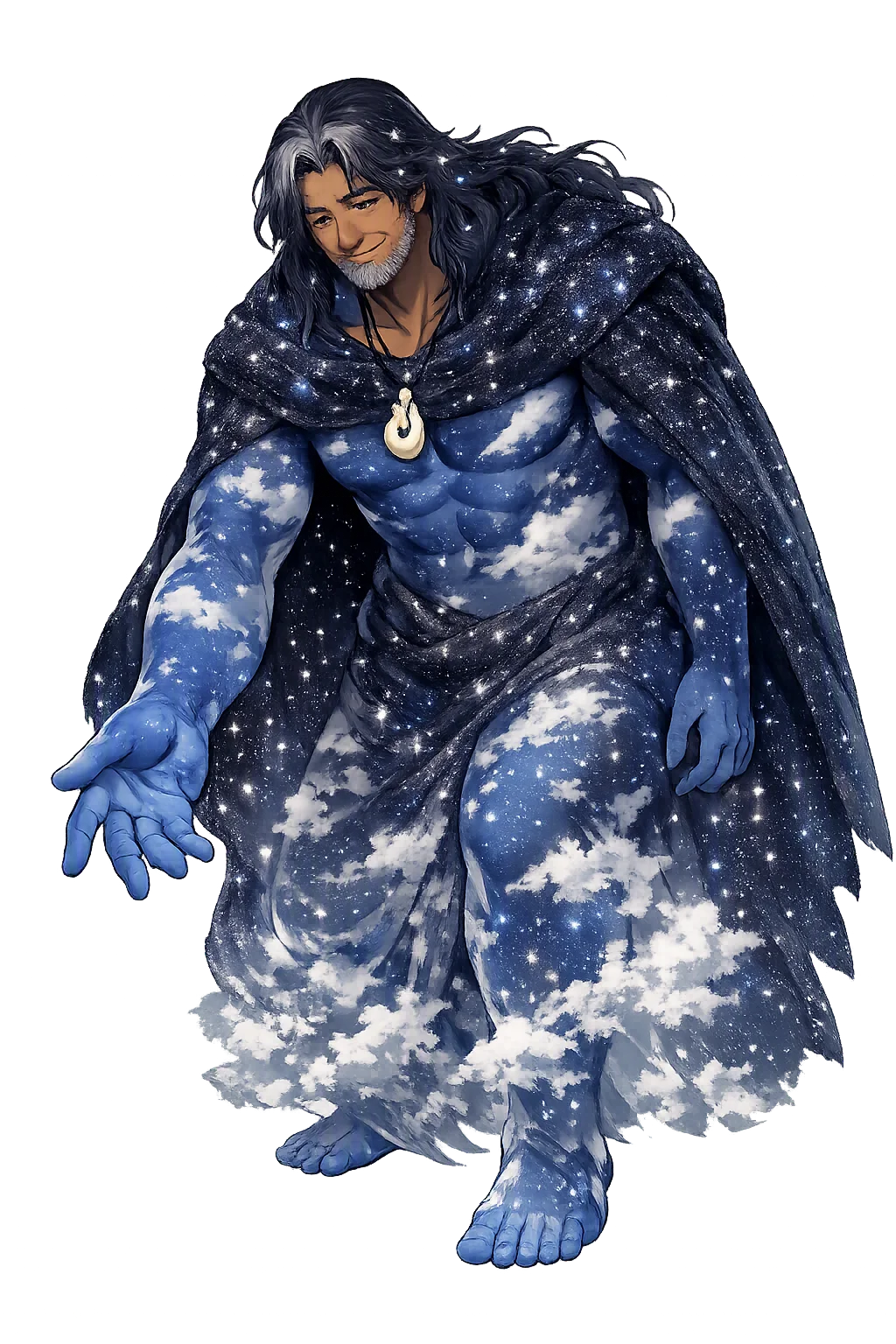
Ranginui is imaged as architecture, not idol. In the great carved meeting houses the whole building becomes his body: the tahuhu ridge-pole is the sky father, the floor is Papatūānuku, and the paired bargeboards — maihi — that sweep toward each other at the gable are traditionally read as the arms of the still-reaching lovers. The convention was fully formed by the mid-nineteenth century; strikingly, Rangi is rarely given a human face, for he is the roof, the vault, the upward surface itself. Māori modernism eventually took him to canvas, where the separated embrace — luminous sky locked against dark earth — became one of the defining images of contemporary Māori painting. The earliest and truest portraits of this god are thus whakairo, carved wood: a meeting house is the only icon the sky father ever needed.

06

Reception & Transformation

The name after its own age — transmission, translation, survival

Afterlives

Ranginui’s journey began with a governor’s pen. Sir George Grey, collecting from Māori informants in the 1840s, printed the separation cycle first in Māori (Nga Mahi a nga Tupuna, 1854) and then in his Polynesian Mythology (1855), which carried Rangi and Papa into world literature; White’s six volumes (1887–90) added the tribal variants, and Williams’s dictionary anchored the language. Victorian scholarship promptly misread the embrace: Tregear’s Aryan Maori (1885) argued the sky father proved Māori kinship with the Aryans — the era’s comparative philology at its most inventive. The twentieth century set the record straight, in print and in Māori: Best’s careful Māori Religion and Mythology (1924) and Orbell’s synthesis (1995) gave the tradition its modern scholarly form. Meanwhile the living transmission never broke — the marae kept the myth in whakataukī and carving while the libraries caught up. A cosmogony held simultaneously in oral custody and in print is rare; Rangi and Papa live in both.

Identifications Across Traditions

Ranginui is the Māori face of the Polynesian sky father, whose other avatars include the Hawaiian Wākea — the sky paired with Papahānaumoku, whose very name repeats the Papa of Māori tradition (Beckwith, Hawaiian Mythology) — and the Tahitian and Rarotongan ra'i and rangi of cognate cosmogonies; the separation of a primordial parental pair recurs across the Pacific. Nineteenth-century European recorders, Grey among them, were quick to hear biblical echoes — a sky father, an earth mother, children thrust out of a dark paradise — and Māori Christianity in turn folded Rangi and Papa into a theology of creation that could be preached from the pulpit. The carved meeting house became the permanent site of the synthesis: its ridge-pole is Rangi, its floor Papa, its ancestors the children between them. Later Māori thought, including the contested twentieth-century traditions gathered around the god Io, debated whether the sky father pointed toward a single supreme being; the scholarly consensus treats the separation myth as the genuine core and the monotheistic framing as accretion (Orbell).

Modern Legacy

The separation of Ranginui and Papatūānuku remains the founding narrative of Māori identity — taught in schools, sung in waiata, and carved into the wharenui of every marae, where the building itself is the myth: ridge-pole as sky, floor as earth, ancestors as the space between. The national museum of New Zealand takes its name, Te Papa Tongarewa, from the earth mother of his embrace. Rangi is a living given name, and the pair have travelled far beyond Aotearoa: the story appears in environmental theology, indigenous-rights discourse, and the global revival of creation narratives as title-deeds of belonging. And the rain-as-tears reading gives Māori weather its poetry and its pedagogy — the landscape is a family, and the family is still speaking.

07

The Meditation

What Ranginui means — beyond the dictionary

Ranginui is the god of necessary grief. The myth refuses the fantasy that love alone could sustain the world: the parents' perfect embrace is a prison for their children, and the world begins only when Tāne's legs force the lovers apart. What the story understands — with a psychological precision rare among cosmogonies — is that separation is not the failure of love but its condition. Rangi and Papa do not stop loving each other: the rain is his tears, the mist her sighs, and the whole weather of the world is their continuing conversation.

To meditate on Ranginui is to meditate on every necessary leaving — the child who must push away the parents in order to stand up, the people who must leave the homeland to become themselves. The children win light and space, but they inherit a wound, and the father's grief falls on them daily as rain. The Māori genius is to make that wound sacred rather than tragic: the tears water the flax, the mist feeds the morning, and the sky, for all its weeping, holds the stars.

08

Frequently Asked Questions

Common questions about Ranginui, Sky, Fatherhood, Creation, and Unicode restoration

01How do you pronounce Ranginui?

In reconstructed pronunciation, Ranginui is /ˈɾaŋinui/ — approximately 'RAH-ngi-NOO-ee' — tap the 'r' as in Spanish 'pero'; 'ng' is the sound in 'singer'; the four light syllables run together.

02What does Ranginui mean?

Ranginui means 'Great heaven' (Māori rangi 'sky, heavens' + nui 'great'), the sky father prised apart from the earth mother Papatūānuku by their children. in the polynesian tradition.

03What are the symbols of Ranginui?

Ranginui is associated with Rain (The tears of Rangi falling on Papatūānuku — the sky father's enduring grief at the separation (Grey, Polynesian Mythology).), Mist (The sighs of Papatūānuku rising to meet him — the parents' continuing dialogue written on the morning air (Orbell, Māori Myth and Legend).), The ridge-pole (tahuhu) (In the wharenui the ridge-beam is Rangi held above the earth floor, Papa: every meeting house re-enacts the separation.), The stars (The children hung in the sky by Tāne to give their father light and to adorn his darkness (White, Ancient History of the Māori).).

04Why restore Ranginui in Unicode?

Ranginui is written entirely in ASCII letters, so its restoration is about canonical fidelity rather than recovered diacritics: the temple fixes the name in its scholarly standard spelling, attested in the source tradition, instead of leaving it to drift.

05What is the most important myth about Ranginui?

“The Embrace of Rangi and Papa” — the The Beginning story that anchors the mythology of Ranginui, told in full on the lore page.

09

Scholarly Sources

The philological foundations of this restoration

Every claim on this page is grounded in established scholarship. The orthographic restorations follow disciplinary convention. The etymological chain follows the best available reference works. This is not invention — it is resurrection through scholarship.

◈

Lexicography & Philology

  • Grey, Polynesian Mythology
  • Tregear
◎

Primary Texts

  • Primary sources in the polynesian tradition for Ranginui.
◉

Archaeology & Art History

  • Material evidence — iconography, inscriptions, and temple archaeology — for Ranginui and related cults.
✦

Religious Studies

  • George Grey, Polynesian Mythology / Nga Mahi a nga Tupuna (1854) — the separation of Rangi and Papa, recorded from Māori oral tradition
  • John White, The Ancient History of the Māori, 6 vols. (1887–90)
  • H. W. Williams, A Dictionary of the Māori Language, s.v. rangi, nui
  • Margaret Orbell, Māori Myth and Legend (1995)
  • Elsdon Best, Māori Religion and Mythology (1924)
  • Martha Beckwith, Hawaiian Mythology (1940) — the Wākea parallel
Return

The Surface Awaits

You have traced the name from its earliest attestation to its Unicode restoration. Now return to the myth. The story is where the name lives.

Back to Lore
Ranginui mascot