PuniCodex

Extended Lore

Pýthōn — The Deeper Record

Etymology · Orthography · Cult · Iconography · Reception · Sources

Preserves stress & vowel length Pýthōn.com
Pýthōn — Serpent, Delphi, Slain by Apollo
01

At a Glance

Pýthōn — every fact links to its home

PantheonGreek
DomainSerpent, Delphi, Slain by Apollo
Original ScriptΠύθων →
Primary Sources5 cited →
02

Etymology & Word Family

From original script to Unicode restoration — the full etymology page →

Original Script Πύθων Pýthōn — "To rot, decay"
Unicode Restoration Pýthōn Restored stress, length, and script
Modern ASCII python Plain-ASCII fallback

The name Pýthōn carries the orthographic signature of the greek tradition: Πύθων. Unicode restoration recovers what ASCII flattens.

03

Unicode Character Breakdown

Character-by-character philological analysis

CharacterUnicodeNameBlockPhonetic Role
PU+0050Latin Capital Letter PBasic LatinSame
ýU+00FDLatin Small Letter Y with AcuteLatin-1 SupplementAcute on upsilon
tU+0074Latin Small Letter TBasic LatinSame
hU+0068Latin Small Letter HBasic LatinSame
ōU+014DLatin Small Letter O with MacronLatin Extended-AMacron: long omega
nU+006ELatin Small Letter NBasic LatinSame

More than one historically valid Unicode spelling of Pýthōn exists — each variant is a real, attested restoration, and the owned forms live as temples.

04

Cult & Worship

How the sacred was kept — rites, sanctuaries, remains

The Cult

Pýthōn had no cult of her own: she is a primordial monster whose death founds Apollo's sanctuary at Delphi. The site itself became the center of her afterlife through the Pythia, the priestess who sat above the chasm and spoke Apollo's oracles, and through the Pythian Games, held every four years in the god's honor. Votive offerings to Apollo at Delphi—tripods, statues, and treasuries—commemorate the victory over the serpent rather than worship her. The name 'Pythian' thus preserves the monster as aetiological memory, not as an object of sacrifice. No altar to Pýthōn is recorded; her religious function was to be defeated.

In the Earth

The site itself is the monument: French excavations at Delphi (from 1892) uncovered the successive temples of Apollo, the great altar, the Castalian spring, and the omphalos, whose carved net-pattern marks the 'navel-stone' the serpent was said to guard. The myth had a long life in art: sixth- and fifth-century Attic vases — lekythoi and drinking cups especially — show the coiled drakaina taking Apollo's arrows beside the tripod, making the slaying one of the most repeated monster scenes of the Archaic repertoire. Every ancient map of Greece silently carried her corpse, for the sanctuary's name, Pythô, preserves the verb for rotting — the dragon written into the geography itself.

05

Iconography

How Pýthōn was imaged across the ages

The Image

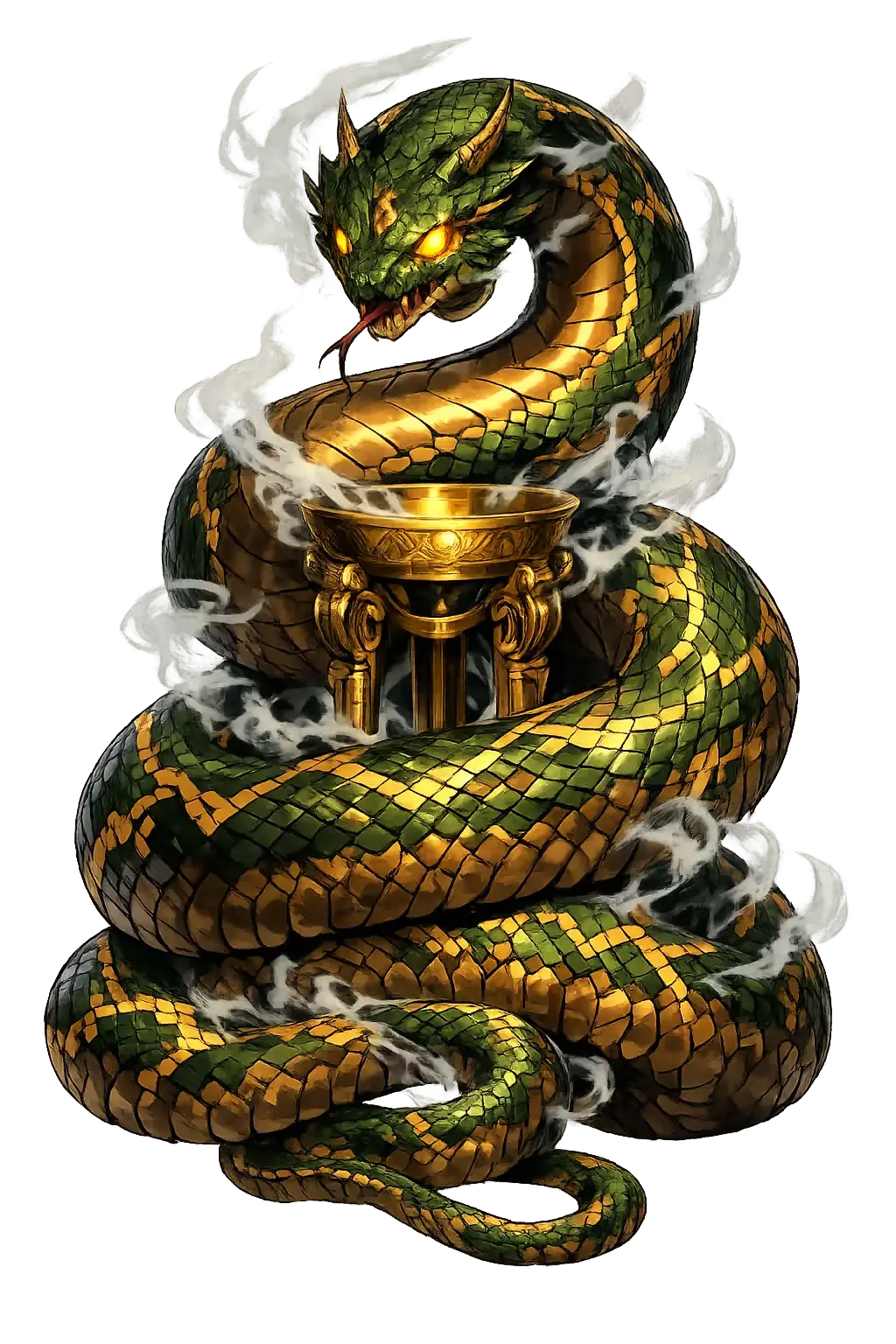
Pýthōn appears in Greek art as a colossal she-serpent or drakaina, coiled around the omphalos at Delphi or rearing before Apollo. Sixth- and fifth-century BCE Attic vases—lekythoi and kylikes—show the moment of her slaughter, her body looping in muscular curves around the sacred stone. Roman sarcophagi and wall paintings repeat the scene as an emblem of Apollo's civilizing victory. Hellenistic and later sculptors occasionally rendered her as a python-size snake entwined with Leto or Artemis. In modern visual culture she survives in programming logos and space-agency mission patches, a curious afterlife for a creature whose ancient image was almost always in defeat.

06

Reception & Transformation

The name after its own age — transmission, translation, survival

Afterlives

The slaying of Pýthōn was never forgotten because Delphi made it foundational: the Pythia, the Pythian Games, and the Homeric Hymn to Apollo kept the serpent at the center of Greek religious identity. Roman poets and encyclopedists transmitted the story into Latin learning; medieval bestiaries and Renaissance mythographers turned the serpent into an image of primal chaos subdued by divine reason. The name passed into English through the programming language Python, whose creators chose it for its association with wisdom and the serpent, not the myth. Modern scholarship debates whether the serpent was originally female, male, or a chthonic deity suppressed by Apollo, while psychoanalytic and ecological readings have reclaimed the monster as a symbol of the repressed earth. Her afterlife is therefore a history of being reinterpreted, never venerated.

Identifications Across Traditions

Pýthōn belongs to the oldest stratum of myth: the dragon of the deep waters slain by the newcomer god, a pattern running from Tiamat through Vṛtra to Leviathan — the chaos-battle the comparatists mapped, here shrunk to a single gorge in Phocis. Her gender was disputed even in antiquity — female (drakaina) in the Homeric Hymn, male in Hyginus and Ovid — and the wavering suits her: earth-mother's child and storm-god's victim, oracle and obstacle, the power that must be defeated before truth can speak. Christian writers, less ambivalent, read her as the devil's kin, and the serpent guarding the shrine became, in their telling, the serpent of Eden in local dress.

Modern Legacy

Pýthōn lives on in the Pythian Games, the Pythia priestess, and the very word 'python' — borrowed first by a British comedy troupe and then by a programming language that took its name from the circus, not the serpent, though its two-snake logo restores the reptile by the back door. More seriously, the myth remains a foundational text for understanding how Apollo's rational prophecy superseded older, chthonic forms of divination: every oracle of Delphi still stands in the shadow of the serpent he killed. The Christian centuries kept her too — the slave-girl of Philippi possessed by a 'spirit of Python' (Acts 16:16) gave the languages of Europe the word pythoness for any woman who tells fortunes.

10

The Original Script Note

What the written record preserves — and what it does not

Original Script

The Greek is Πύθων, connected by the ancients with the verb πύθω ('to rot'), because the serpent's corpse decayed at Delphi. The initial Π is the unaspirated stop [p] — breathings occur only on initial vowels and rho, never on a consonant — while the theta of the second syllable is the aspirated stop [tʰ] that Latin script writes 'th'. The acute on ύ marks the pitch peak, and the final -ων is long. PUNICODEX writes Pýthōn with the acute and the macron on the long vowel, the two features the domain system can carry.

11

The Meditation

What Pýthōn means — beyond the dictionary

Pýthōn is the past that must be killed before the future can speak. She is the old oracle, the earth's own voice, the serpent wisdom that predates Olympus. Apollo does not deny her power; he inherits it. The Pythia sits where the serpent coiled; the tripod replaces the coils.

There is something honest in this myth. New institutions rarely arise from empty ground. They come by confronting, incorporating, and renaming what came before. To remember Pýthōn is to remember that every 'new' revelation has an older voice behind it, and that the name of the defeated often outlasts the name of the victor — the sanctuary is called Pythô after her, and her title became her killer's priestess.

12

Frequently Asked Questions

Deep-dives into the cult, attestation, reception, and sources of Pýthōn

01How do we know how Pýthōn was worshipped?

The site itself is the monument: French excavations at Delphi (from 1892) uncovered the successive temples of Apollo, the great altar, the Castalian spring, and the omphalos, whose carved net-pattern marks the 'navel-stone' the serpent was said to guard. The full cult record →

02Where do the earliest attestations of Pýthōn come from?

The record rests on Homeric Hymn to Apollo, Hesiod, Theogony, Aeschylus, Eumenides 1–8, among 6 cited works. The full source apparatus →

03How did later traditions reinterpret Pýthōn?

The slaying of Pýthōn was never forgotten because Delphi made it foundational: the Pythia, the Pythian Games, and the Homeric Hymn to Apollo kept the serpent at the center of Greek religious identity. Reception & transformation →

04What do the surviving images of Pýthōn actually show?

Pýthōn appears in Greek art as a colossal she-serpent or drakaina, coiled around the omphalos at Delphi or rearing before Apollo. The iconography →

05What does the written record of Pýthōn actually preserve?

The Greek is Πύθων, connected by the ancients with the verb πύθω ('to rot'), because the serpent's corpse decayed at Delphi. The Original Script note →

13

Scholarly Sources

The philological foundations of this restoration

Every claim on this page is grounded in established scholarship. The orthographic restorations follow disciplinary convention. The etymological chain follows the best available reference works. This is not invention — it is resurrection through scholarship.

◈

Lexicography & Philology

  • Liddell, H. G., Scott, R., & Jones, H. S. A Greek-English Lexicon. Oxford: Clarendon Press, 9th ed. 1996.
  • Pape, W., & Benseler, G. E. Wörterbuch der griechischen Eigennamen. Braunschweig: Vieweg, 1884.
  • Beekes, R. S. P. Etymological Dictionary of Greek. Leiden: Brill, 2010.
◎

Primary Texts

  • Homeric Hymn to Apollo
  • Hesiod, Theogony
  • Aeschylus, Eumenides 1–8
  • Ovid, Metamorphoses 1.438–451
  • Plutarch, On the Obsolescence of Oracles
◉

Archaeology & Art History

  • Boardman, J. Greek Sculpture: The Classical Period; Carpenter, T. H. Art and Myth in Ancient Greece.
✦

Religious Studies

  • Hyginus, Fabulae 140
Return

The Surface Awaits

You have traced the name from its earliest attestation to its Unicode restoration. Now return to the myth. The story is where the name lives.

Back to Lore
Pýthōn mascot