PuniCodex

Extended Lore

Perun

Etymology · Orthography · Cult · Iconography · Reception · Sources

Tier 2 Perun
Perun — Thunder, Lightning, Oak
01

Quick Facts

Essential information about Perun, Thunder, Lightning, Oak

Scholarly TransliterationPerun
Unicode RestorationPerun
Reconstructed Pronunciation/perun/
PantheonSlavic
DomainThunder, Lightning, Oak
MeaningThunderer, striker
ClassificationTier 2
Primary DomainPerun
Sacred SymbolsThrowing axe / thunderbolt, Oak and perpetual fire, Thunderstone (gromovik), The sacred hill, Elijah's fiery chariot
02

Etymology & Word Family

From original script to Unicode restoration

Scholarly Transliteration Perun Perun — "Thunderer, striker"
Unicode Restoration Perun Canonical scholarly spelling — ASCII-identical
Modern ASCII perun Plain-ASCII fallback

The name Perun reaches the modern world through scholarly transliteration of the slavic tradition. Because the conventional spelling uses only Latin letters, its Unicode and ASCII forms coincide — the tradition it carries is in the name itself, not in diacritics.

03

Unicode Character Breakdown

Character-by-character philological analysis

CharacterUnicodeNameBlockPhonetic Role
PU+0050Latin Capital Letter PBasic LatinSame
eU+0065Latin Small Letter EBasic LatinSame
rU+0072Latin Small Letter RBasic LatinSame
uU+0075Latin Small Letter UBasic LatinSame
nU+006ELatin Small Letter NBasic LatinSame

The Tier 2 classification here reflects fidelity to the attested tradition, not recovered diacritics: every character of Perun already survives in ASCII. What the restoration preserves is the canonical spelling itself — the form scholarship standardised.

04

Cult & Worship

How the sacred was kept — rites, sanctuaries, remains

The Cult

Perun’s cult is documented chiefly by its enemies. Procopius (Wars 7.14) reports that the Slavs ‘revere one god, the maker of lightning, as sole lord of all.’ The Primary Chronicle’s Kyiv of 978–988 gives the fullest picture: a wooden idol with a silver head and a golden moustache on a hill outside the city, and the people commanded to sacrifice to it — until the idols were beaten with sticks and drowned in the Dnieper at the conversion. The treaty oaths of 944 and 971 show the working cult: envoys swore by Perun and Volos, with a curse of death by their own weapons on perjurers. At Peryn’ near Novgorod, excavation found a tenth–twelfth-century open-air sanctuary with a stone-and-clay ritual platform — no temple building, consistent with the hill-shrine of the texts. Modern Rodnover communities have rebuilt his fires; that is a revival, not a survival.

In the Earth

The clearest material footprint of Perun's cult is Peryn', a rounded hill at the bend of the Volkhov south of Novgorod, excavated by G. Lebedev's team in the 1950s: a circular ritual enclosure with a stone- and clay-lined platform, dated to the tenth–twelfth centuries, on a site whose very name derives from the god. No temple building was found — the open-air precinct fits the chronicle image of a hill shrine — but the enclosure's planned geometry and burnt deposits mark organized, funded cult practice. Across the Slavic world, miniature axe-amulets ('thunder-axes on chains') and axe-mark graffiti are read as Perun's weapon in miniature, though none is inscribed. The Kyiv hill of 988 has never been securely located archaeologically, and the enigmatic four-sided Zbruch idol is more often assigned to Svetovit than to the thunderer. Direct evidence is thin — but Peryn' proves the cult was real.

05

Iconography

How Perun was imaged across the ages

The Image

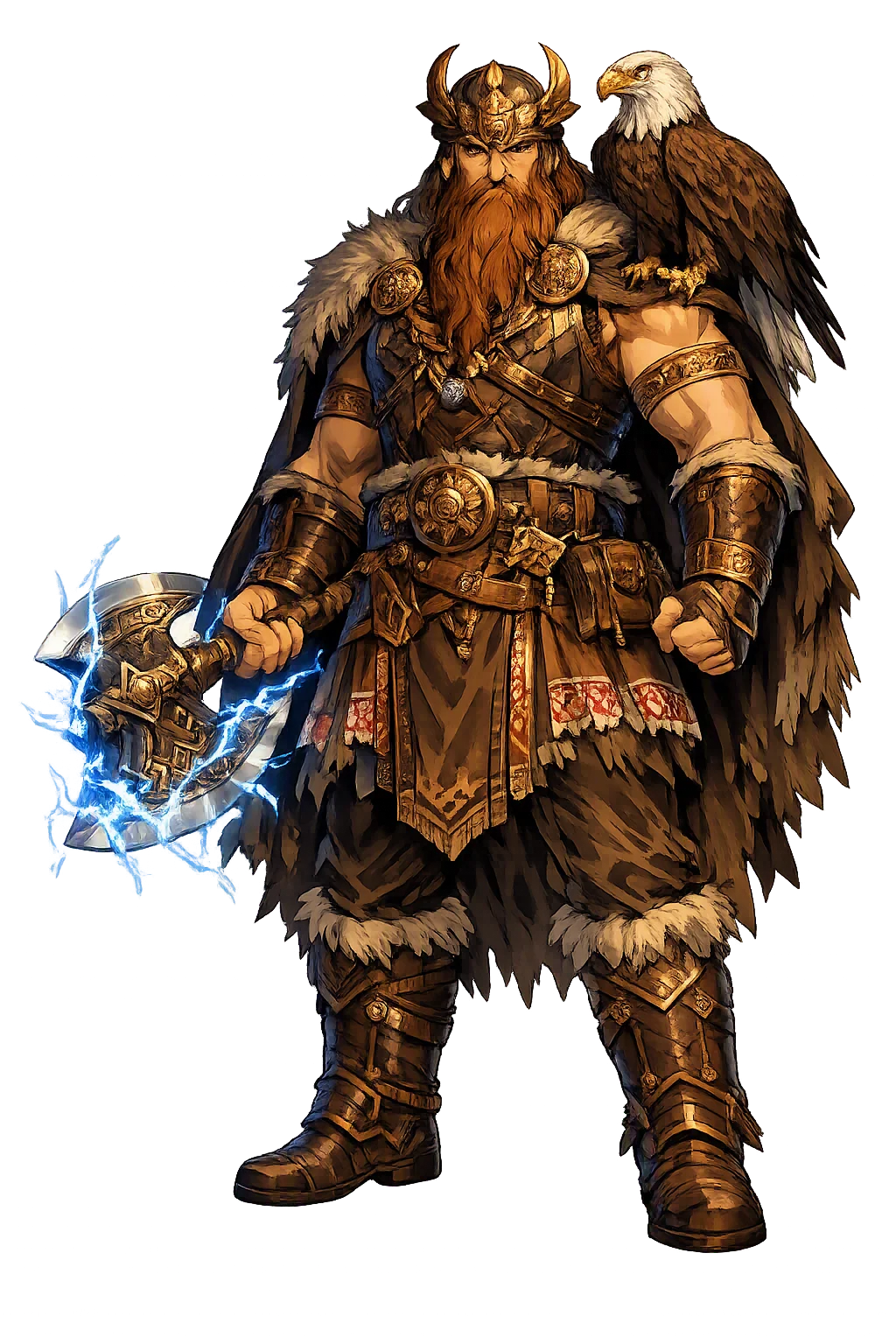
No ancient image of Perun survives, so his iconography must be rebuilt from words and small finds. The Primary Chronicle’s description of the Kyiv idol — a wooden figure with a silver head and a golden moustache — is the only detailed portrait we have, and it was destroyed in 988. The material record is miniature: axe-amulets of bronze and iron, axe graffiti, and fossil belemnites hung from eaves as ‘thunder-stones’ across the Slavic world — the weapon worn small, the way a worshipper carries a god home. The enigmatic four-sided Zbruch idol is more often assigned to Svetovit, and the so-called ‘sign of Perun’ popular in modern Rodnover art is a recent invention. His true ancient portrait is textual: the moustached face in silver and gold, enthroned first among the gods on the Kyiv hill.

06

Reception & Transformation

The name after its own age — transmission, translation, survival

Afterlives

Perun’s transmission is a study in enforced forgetting. The monks who drowned his idol preserved his name better than any priest: the Primary Chronicle’s manuscript tradition — the Laurentian codex of 1377, the Hypatian of c. 1425 — carried the oaths, the drowning, and the 1071 revolt down to modernity, and Procopius had already fixed him for Byzantine readers. Under the new calendar his weather and his day passed to the prophet Elijah, whose July feast still brings the thunder — a transfer the Church itself performed. Modern scholarship rebuilt him: Šafařík’s Slawische Alterthümer (1837) first catalogued the Slavic pantheon philologically, Rybakov’s Ancient Rus’ made him a fixture of Soviet-era historiography, and Ivanov and Toporov (1974) set him beside Indra and Thor in the Indo-European storm-combat — the framework the catalog’s own sources inherit. The twentieth century also forged him: the so-called Book of Veles, once hailed as his lost scripture, is a demonstrable modern fabrication. A god this loved will be counterfeited.

Identifications Across Traditions

Christianization did not erase Perun; it reassigned him. His functions passed chiefly to the prophet Elijah — Il'ya — whose fiery chariot crosses the sky in Russian folklore, whose day kept the thunderer's weather, and whose icons still stand in village fields against storm and fire. Saint George absorbed something of the dragon-slaying warrior. Byzantine-educated writers performed the usual interpretatio, reading Perun as a Slavic Zeus, while comparative scholarship has added Thor and Indra as cousins through the shared inheritance of the storm-combat myth. In the twentieth century Perun returned openly: Slavic Native Faith movements restored his name, his day, and his hilltop fires, and he now stands — as the chronicles always placed him — first among the gods. Of all the drowned pantheon, he alone kept a national audience.

Modern Legacy

Perun never left the languages. The word itself became the poetic Slavic name for thunder — Polish piorun is the everyday word for a thunderbolt, and Russian keeps perun in elevated speech — while Lithuanian Perkūnas keeps the cognate alive next door. Folklore preserved his attributes as 'thunderstones,' fossil belemnites (gromovik) hung in houses against lightning, and the epic hero Il'ya Muromets rides in his shadow with a mace that is really a bolt. In the modern period Perun has become an emblem of Slavic identity: he heads the pantheon of Rodnover and Native Faith communities from Ukraine to Poland, lends his name to military units, rockets, and football terraces, and appears wherever the question is asked what a pre-Christian Slavic civilization would have honored. The Church feared him for a reason: of all the Kyiv gods, his name proved the hardest to drown.

07

The Meditation

What Perun means — beyond the dictionary

Perun is the god of the strike — the moment when the sky asserts itself against the earth and the forest smells of split wood. Everything about him is vertical: the bolt falls, the oak points up, the oath rises to the witness who will enforce it. He is violent, but his violence is legal: he does not rage, he executes. That is why treaties trusted him and why rebels in 1071 invoked him against hoarding governors; he is the enforcer of an order older than any prince. To study Perun is to watch a society argue with its own thunder. The chroniclers beat his idol with sticks and threw it in the river, then preserved his name more carefully than any priest had — in oath-texts, in curses, in the weeping of the baptized. A god whose worshippers cry when he leaves has not been defeated; he has been internalized. Perun endures as the sound above the roof that still makes everyone, believer or not, look up.

08

Frequently Asked Questions

Common questions about Perun, Thunder, Lightning, Oak, and Unicode restoration

01How do you pronounce Perun?

In reconstructed pronunciation, Perun is /perun/ — approximately 'PER-un' with a rolled r; the name is an agent noun meaning 'Striker'.

02What does Perun mean?

Perun means Thunderer, striker in the slavic tradition.

03What are the symbols of Perun?

Perun is associated with Throwing axe / thunderbolt (His striking weapon, worn in miniature on amulets and incised on stones across the Slavic world), Oak and perpetual fire (The lightning-struck tree and the hilltop flame kept burning in his honor at open-air shrines), Thunderstone (gromovik) (Fossil belemnites kept in Slavic households against lightning, understood as his spent arrows), The sacred hill (Kyiv's shrine hill and Novgorod's Peryn' — high ground set apart for his unroofed cult), Elijah's fiery chariot (The Christian successor-image that inherited his storm: wheels of fire crossing the sky).

04Why restore Perun in Unicode?

Perun is written entirely in ASCII letters, so its restoration is about canonical fidelity rather than recovered diacritics: the temple fixes the name in its scholarly standard spelling, attested in the source tradition, instead of leaving it to drift.

05What is the most important myth about Perun?

“The Idols on the Hill” — the Kyiv, 988 story that anchors the mythology of Perun, told in full on the lore page.

09

Scholarly Sources

The philological foundations of this restoration

Every claim on this page is grounded in established scholarship. The orthographic restorations follow disciplinary convention. The etymological chain follows the best available reference works. This is not invention — it is resurrection through scholarship.

◈

Lexicography & Philology

  • Miklosich
◎

Primary Texts

  • The Primary Chronicle (Povest’ vremennykh let); the Hypatian Codex; East Slavic chronicle tradition and South Slavic folk invocations.
◉

Archaeology & Art History

  • Material evidence — iconography, inscriptions, and temple archaeology — for Perun and related cults.
✦

Religious Studies

  • Primary Chronicle / Povest' vremennykh let, s.a. 944, 971, 988, 1071
  • Procopius of Caesarea, Wars 7.14
  • Novgorod First Chronicle (1071 revolt)
  • Ivanov, Vyacheslav, and Vladimir Toporov, 'Le mythe indo-européen du dieu de l'orage poursuivant le serpent' (1974)
  • Ivanits, Linda J., Russian Folk Belief (1989)
  • Rybakov, B. A., Ancient Rus' (1987)
Return

The Surface Awaits

You have traced the name from its earliest attestation to its Unicode restoration. Now return to the myth. The story is where the name lives.

Back to Lore
Perun mascot