PuniCodex

Extended Lore

Perkūnas

Etymology · Orthography · Cult · Iconography · Reception · Sources

Tier 1 Perkūnas.com
Perkūnas — God of Thunder, Lightning and Storms
01

Quick Facts

Essential information about Perkūnas, God of Thunder, Lightning and Storms

Scholarly TransliterationPerkūnas
Unicode RestorationPerkūnas
Reconstructed Pronunciation/pʲɛrˈkuːnɐs/
PantheonBaltic
DomainGod of Thunder, Lightning and Storms
MeaningLithuanian/Baltic thunder deity, cognate with Slavic Perun and Indo-Iranian Parjanya.
ClassificationTier 1
Primary DomainPerkūnas.com
Sacred SymbolsStone axe or hammer, Oak tree, Flaming chariot or cart, Fire and spark
02

Etymology & Word Family

From original script to Unicode restoration

Proto-indo-european *perkʷu- oak, thunder
Scholarly Transliteration Perkūnas Perkūnas — "Lithuanian/Baltic thunder deity, cognate with Slavic Perun and Indo-Iranian Parjanya."
Unicode Restoration Perkūnas Restored stress, length, and script
Modern ASCII perkunas Plain-ASCII fallback

From Proto-Baltic *Perkūnas, from PIE *perkʷu- "oak; thunderer", also reflected in Slavic Perun and Vedic Parjanya.

03

Unicode Character Breakdown

Character-by-character philological analysis

CharacterUnicodeNameBlockPhonetic Role
PU+0050Latin Capital Letter PBasic LatinSame, capitalized
eU+0065Latin Small Letter EBasic LatinSame
rU+0072Latin Small Letter RBasic LatinSame
kU+006BLatin Small Letter KBasic LatinSame
ūU+016BLatin Small Letter U with MacronLatin Extended-AMacron marks long u
nU+006ELatin Small Letter NBasic LatinSame
aU+0061Latin Small Letter ABasic LatinSame
sU+0073Latin Small Letter SBasic LatinSame

The Tier 1 classification reflects how much of the original phonology this restoration preserves — stress and vowel length for Greek names, distinctive letters and diacritics for every other tradition.

04

Cult & Worship

How the sacred was kept — rites, sanctuaries, remains

The Cult

Perkūnas was worshipped in the open, and the ground has kept almost nothing. The chronicler Peter of Dusburg, writing around 1326 during the conquest, describes the Prussians' chief sanctuary at Romove — its perpetual sacred fire guarded day and night and images of the gods, usually taken to include Perkūnas at the head of the pantheon — the fullest account of his cult we possess, and a hostile one. The Lithuanian evidence is wooded rather than written: sacred oaks and groves where offerings were poured, and the lightning-struck stones and trees that farmhouses adopted as his marks. The cult's suppression is documented precisely because it had been real: the organized baptisms of Samogitia around 1413–1414 carried statutes forbidding the old rites under penalty. What survived went underground into folklore — Thursday observances and the dainas collected in the nineteenth century, where Pērkons still rides his storm and counts his oak trees.

In the Earth

Direct evidence for Perkūnas's cult is scarce precisely because the cult was suppressed and practiced in groves, not masonry. What the ground keeps is indirect: Baltic hillfort complexes such as Kernavė in Lithuania — a medieval capital whose five hillforts and unexcavated cult layers long identified with the open-air sanctuary tradition — and, across the region, thousands of Neolithic and Bronze Age stone axes kept in farmhouses as Perkūno kirviai, 'Perkūnas's axes', believed to be the thunderer's own bolts fallen from the sky and prized as lightning-charms. The textual witnesses predate the folklore collections: the sixteenth-century Old Prussian catechisms record the name Percunis on a converted heathen's lips, and Grunau's chronicle describes the idol in its grove. Christian crosses and chapel sites across the Baltic often stand where the lightning-oaks stood — the map of the new religion drawn directly over the old one.

05

Iconography

How Perkūnas was imaged across the ages

The Image

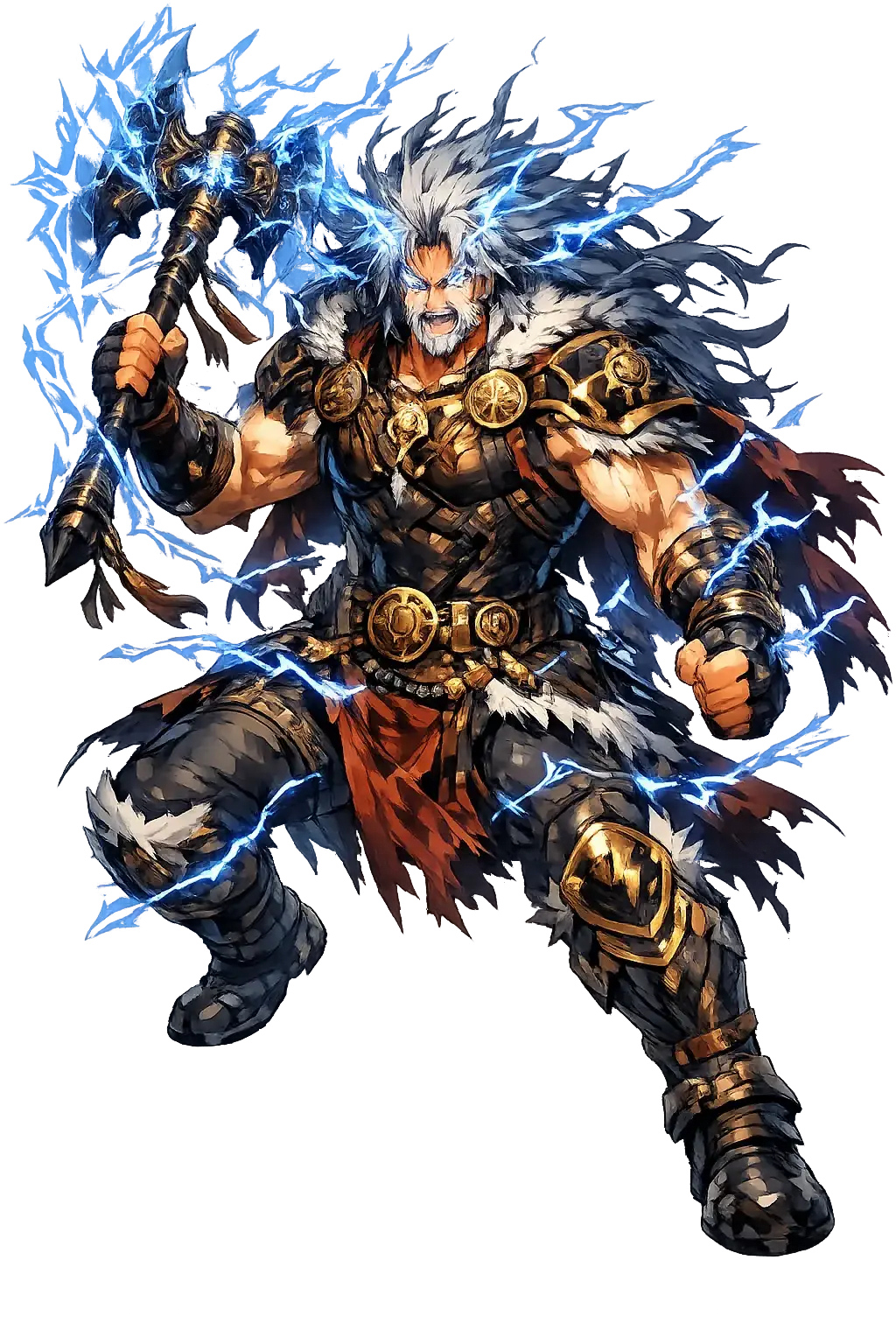
No Baltic image of Perkūnas survives — unsurprisingly, given a cult of oaks and hilltops and a habit of smashing idols wherever baptism went. What antiquity describes are idols seen by enemies: Peter of Dusburg and, a century and a half later, Simon Grunau describe carved images in the Prussian sanctuaries, Grunau's account — late and embroidered — even endowing the gods with multiple faces. These reports are confessional folklore at best. The true vernacular iconography is geological and domestic: the fossil sea-urchins and Neolithic stone axes kept in farmhouse rafters as Perkūno kirviai, Perkūnas's axes, thunder made stone, held in the house as protection and wonder. The dainas supply the attributes the images lack — the copper mallet, the chariot rattling across the sky, and above all the oak he strikes. Recognition, in Baltic practice, was by signature: a tree split and blackened, an axestone on the shelf.

06

Reception & Transformation

The name after its own age — transmission, translation, survival

Afterlives

Perkūnas reaches us on two clocks: chronicle time and folklore time. Chronicle time begins with the Teutonic chroniclers — Peter of Dusburg in 1326, Wigand of Marburg, and the often-fanciful Simon Grunau around 1521 — recording the god as they destroyed him; then the Old Prussian catechisms of 1545–1561, where Percunis survives as a catechism word on the very threshold of extinction. Folklore time runs slower: the nineteenth-century national awakeners built the archive — Simon Daukantas in Lithuanian, and above all Krišjānis Barons, whose 1894 Latvju dainas gathered the songs where Pērkon(s) still rides; Theodor Narbutt's antiquarian history of 1835–1841 dressed the thunder god in Romantic costume. Twentieth-century scholarship made him comparative: Marija Gimbutas placed him in the deep Baltic past, Algirdas Julien Greimas read him structurally as the axis of Lithuanian myth. Philology carried the name farthest — into Finnish, where a Baltic loanword survives as perkele, the old thunder being Christianity reclassified as the Devil. The modern Romuva rites in his honor are a conscious revival, barely a century old — the youngest chapter of a very old cult.

Identifications Across Traditions

Perkūnas is cognate with Slavic Perun and Indo-Iranian Parjanya, all descendants of a Proto-Indo-European thunder deity. Slavic Perun, worshipped at Kiev and other centers, is the closest historical parallel. In Christianized folklore, Perkūnas was partially displaced by Saint Michael, Elijah, or God the Father, but his oak cult, thunder lore, and moral role survived under Christian names. The Old Prussian evidence shows how the church read him: the sixteenth-century catechisms record converts still swearing by Percunis, and Simon Grunau's Preussische Chronik describes his idol in its grove beside the harvest god Potrimpo and the death-god Peckols. Scholars have compared him to Germanic Thor, Greek Zeus, and Vedic Indra, though each culture shaped the thunder god according to its own landscape — and in the Baltic, uniquely, the thunderer stayed a working judge of the peasantry's daily affairs.

Modern Legacy

Perkūnas remains a living symbol of Lithuanian and Latvian national identity. His name appears in place names, folk songs, and contemporary pagan (Romuva) revival rituals. Oak groves are still protected in the Baltic states as natural and cultural heritage, and the thunder god features in metal music, fantasy literature, and neo-pagan art. The Romuva movement — the name itself is the old word for a Baltic sanctuary — has restored public fire-rituals to his groves, and Lithuania's independence movement of the late twentieth century reached readily for his imagery as a badge of pre-Soviet, pre-Christian identity. For linguists, Perkūnas is a key witness to the survival of Indo-European theonyms in a region that preserved archaic traditions longer than most of Europe — a god whose cult the church suppressed for six centuries without ever quite managing to replace him.

07

The Meditation

What Perkūnas means — beyond the dictionary

Perkūnas is the sky's conscience. His thunder is not random noise but a voice that says: there is a limit to what can be hidden. In an age of corporate crime and political lies, his mythology still resonates — the belief that some justice arrives not from human courts but from the sheer force of nature. To remember Perkūnas is to remember that the sky is watching, and that oaths once mattered enough to call down lightning. Yet the folklore is wiser than the moral slogan: it also knows the bolt sometimes hits the innocent cottage, and it answers with stubborn faith rather than doubt. That double vision — justice that must be believed in even when it miscarries — is what makes the Baltic thunderer more than a storm in a costume. He is the oldest European image of a law above the law.

08

Frequently Asked Questions

Common questions about Perkūnas, God of Thunder, Lightning and Storms, and Unicode restoration

01How do you pronounce Perkūnas?

In reconstructed pronunciation, Perkūnas is /pʲɛrˈkuːnɐs/ — approximately pyair-KOO-nuss — roll the 'r,' make the 'oo' long, and give the final syllable a light hiss.

02What does Perkūnas mean?

Perkūnas means Lithuanian/Baltic thunder deity, cognate with Slavic Perun and Indo-Iranian Parjanya. in the baltic tradition.

03What are the symbols of Perkūnas?

Perkūnas is associated with Stone axe or hammer (The thunderbolt weapon that Perkūnas hurls and that Neolithic axes symbolized as fallen from the sky), Oak tree (His sacred tree, struck by lightning and used for offerings), Flaming chariot or cart (His vehicle as he rumbles across the sky in Lithuanian songs), Fire and spark (The sacred fire struck from the sky and preserved in Baltic ritual).

04Why are there different spellings of Perkūnas?

Each form is a historically attested restoration rather than a mistake: perkūnas.com is the owned form (Owned domain form). PUNICODEX registers the full set so the tradition is preserved under every defensible spelling.

05Why restore Perkūnas in Unicode?

Plain ASCII perkunas strips the stress, length, and script that make the name specific. Unicode restoration returns the name to its original written dignity.

06What is the most important myth about Perkūnas?

“Perkūnas and the Oak” — the Baltic Folklore story that anchors the mythology of Perkūnas, told in full on the lore page.

09

Scholarly Sources

The philological foundations of this restoration

Every claim on this page is grounded in established scholarship. The orthographic restorations follow disciplinary convention. The etymological chain follows the best available reference works. This is not invention — it is resurrection through scholarship.

◈

Lexicography & Philology

  • Folklore
  • Ivanov-Toporov
◎

Primary Texts

  • Primary sources in the baltic tradition for Perkūnas.
◉

Archaeology & Art History

  • Material evidence — iconography, inscriptions, and temple archaeology — for Perkūnas and related cults.
✦

Religious Studies

  • Lithuanian folklore collections (Jonas Basanavičius, Lietuvių mitologija)
  • Latvian dainas (Krišjānis Barons, Latvju dainas)
  • Old Prussian Catechisms (Percunis); Simon Grunau, Preussische Chronik
  • Greimas, Of Gods and Men: Studies in Lithuanian Mythology
  • Gimbutas, The Balts
  • Mallory & Adams, The Oxford Introduction to Proto-Indo-European and the Proto-Indo-European World
Return

The Surface Awaits

You have traced the name from its earliest attestation to its Unicode restoration. Now return to the myth. The story is where the name lives.

Back to Lore
Perkūnas mascot