PuniCodex

Extended Lore

Πήγασος Pḗgasos

Etymology · Orthography · Cult · Iconography · Reception · Sources

Tier 1 Pḗgasos.com
Pḗgasos — Flight, Inspiration, Freedom
01

Quick Facts

Essential information about Pḗgasos, Flight, Inspiration, Freedom

Original ScriptΠήγασος
Unicode RestorationPḗgasos
Reconstructed Pronunciation/pɛ̌ː.ɡa.sos/
PantheonGreek
DomainFlight, Inspiration, Freedom
MeaningPossibly from πηγή (spring) or a pre-Greek name
ClassificationTier 1
Primary DomainPḗgasos.com
Sacred SymbolsThe golden bridle, The hoof-print, The constellation
02

Etymology & Word Family

From original script to Unicode restoration

Original Script Πήγασος Pḗgasos — "Possibly from πηγή (spring) or a pre-Greek name"
Unicode Restoration Pḗgasos Restored stress, length, and script
Modern ASCII pegasos Plain-ASCII fallback

The name Pḗgasos carries the orthographic signature of the greek tradition: Πήγασος. Unicode restoration recovers what ASCII flattens.

03

Unicode Character Breakdown

Character-by-character philological analysis

CharacterUnicodeNameBlockPhonetic Role
PU+0050Latin Capital Letter PBasic LatinSame letter
ḗU+1E17Latin Small Letter E with Macron and AcuteUnknownStacked macron + acute on one vowel
gU+0067Latin Small Letter GBasic LatinSame letter
aU+0061Latin Small Letter ABasic LatinSame letter
sU+0073Latin Small Letter SBasic LatinSame letter
oU+006FLatin Small Letter OBasic LatinSame letter
sU+0073Latin Small Letter SBasic LatinSame letter

The Tier 1 classification reflects how much of the original phonology this restoration preserves — stress and vowel length for Greek names, distinctive letters and diacritics for every other tradition.

04

Cult & Worship

How the sacred was kept — rites, sanctuaries, remains

The Cult

No temple of Pḗgasos is known, and no festival or priesthood bears his name — worship of the horse himself was a thin stream. What the record holds is emblem and spring. Corinth, whose silver coinage flew his winged profile for three centuries, treated him as the civic sign rather than a cult god; his watering place Peirene was a sanctuary of its own, the spring-nymph's fountain at the city's heart. On Helikṓn the hoof-struck spring Hippokrenē belonged to the Muses, and it was they, with the nymphs, who received the poet's libation — the horse was simply the hammer. His heaven was administrative: Hesiod already stations him in Zeús' stables, bearer of the thunder. The honest summary: cities stamped him, poets toasted the springs he opened, and the sky employed him — but the altars belonged to others.

In the Earth

Corinthian coinage is the standing archive: silver staters showing Pḗgasos in flight, with the koppa letter of Corinth, survive in thousands from ca. 550–250 BCE. Vase painters loved the birth scene — the foal springing from Medusa's severed neck beside the recoiling Perseus — from early Corinthian and Attic examples onward. Corinth's Peirene fountain-house, repeatedly rebuilt from Archaic to Roman times, is the physical site of the bridle myth.

05

Iconography

How Pḗgasos was imaged across the ages

The Image

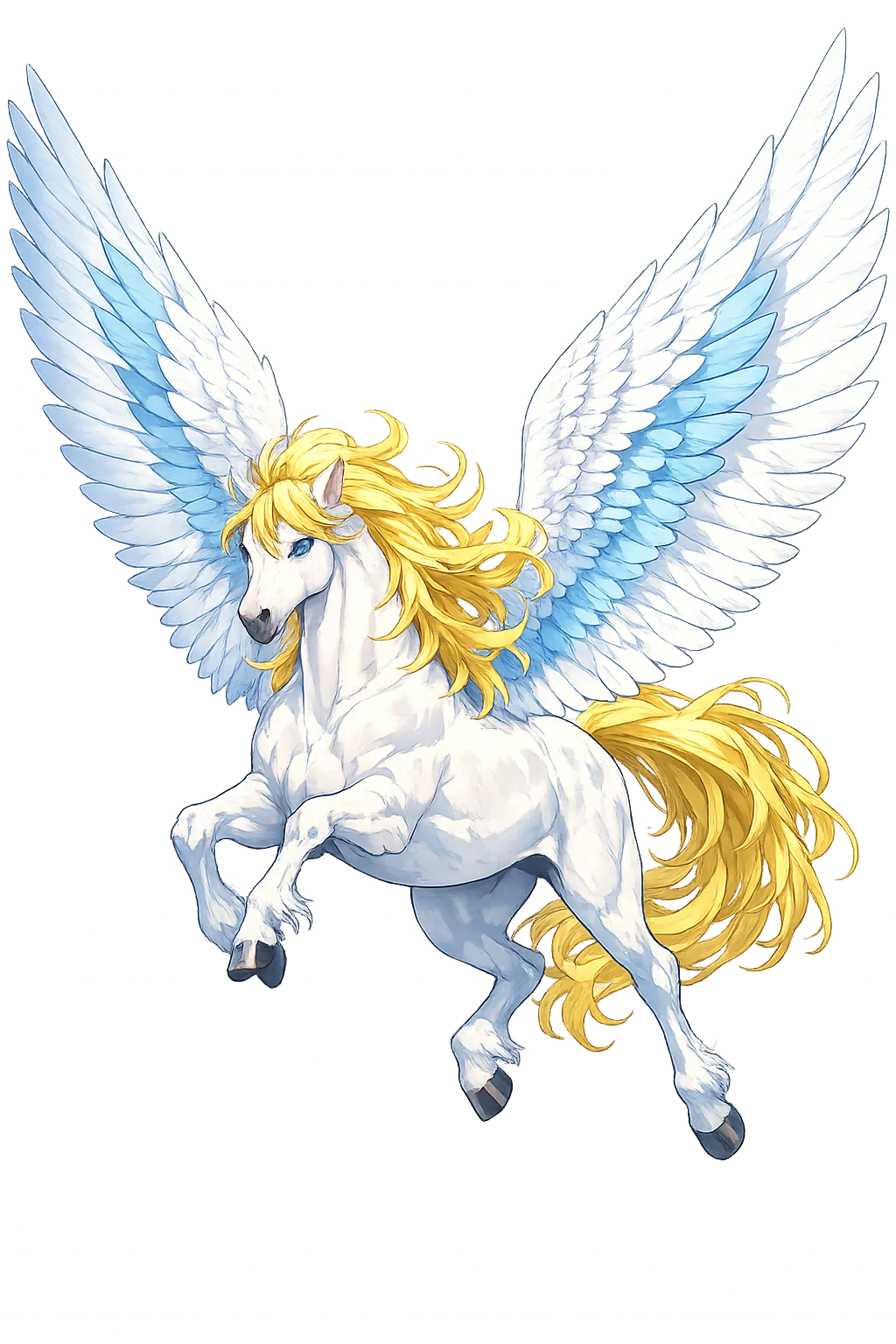
The wings are the whole signature — a horse that should not fly, flying. The type is born in Corinth: by the late seventh century BCE Corinthian potters paint Bellerophōn astride the winged horse, spear levelled at the Chimaira, and the trio becomes one of Archaic art's favorite combat machines. Attic painters take up the birth scene — the foal springing from Médousa's severed neck, wings already spread — from the early fifth century. Then the mint takes over: Corinthian staters from about 550 BCE carry the flying profile with the city's koppa, one of antiquity's most durable logos, struck for three hundred years. Hellenistic gem-cutters miniaturize him into a seal, and Roman mosaics and the constellation fix him overhead. The two stock scenes — the Chimaira fight and the Gorgon birth — never vary, because they never needed to: winged, bridled, airborne, the thunder-horse is legible at a glance.

06

Reception & Transformation

The name after its own age — transmission, translation, survival

Afterlives

Hesiod's six lines gave him immortality; the poets gave him a career. Píndar's thirteenth Olympian made the golden bridle famous, Aratos catalogued his constellation in the Phaenómena, and Hyginus repeated the myth for Roman readers in his De Astronomia. Latin epic folded him into its machinery, and the Middle Ages received him through the mythographers not as a beast of fable but as the Muses' horse. Renaissance poetic theory made his spring the standing emblem of inspiration — to drink at Hippokrenē was the humanist's definition of the poet, and the winged horse pranced through sixteenth-century title pages and academies. The nineteenth century's comparative philologists returned him to the sky: the name's link to Luwian pihassas, the Cilician storm-god, recovered by twentieth-century Anatolian scholarship, explained the thunder-bearer in Zeús' stable — the horse had served a weather-god all along. The etymology is still argued; the constellation keeps the body; and on Helikṓn and at Corinth the springs still carry his name, read by every tourist at the rebuilt fountain of Peirene.

Identifications Across Traditions

His name is the syncretism: Luwian pihassas, a storm-god honoured in Cilicia, meets the Greek horse — which explains why an earth-and-sea creature serves the sky god's bolts. Rome made him a cavalry emblem and a favourite of coinage; Corinth stamped him on her silver for three centuries as the city's own beast, since Bellerophōn's Corinthian Peirene was his watering place.

Modern Legacy

Pḗgasos became the western shorthand for poetic flight — from the Renaissance "hobby-horse of the Muses" to Pope's mock-epic. His silhouette is arguably the most commercially licensed image from Greek myth: the red Pegasus of Mobil Oil flew over filling stations across the planet, and the TriStar Pictures logo opens thousands of films. Astronomy keeps his body nightly; literature keeps his spring.

07

The Meditation

What Pḗgasos means — beyond the dictionary

Pḗgasos proves that origin is not destiny. Born of blood and salt and horror, he ends as pure ascent — the horse of storms who chooses the sky. He is the emblem of every act of imagination that takes off from wreckage: the spring in the stone, the poem in the wound.

And he remains the honest emblem of inspiration because the myth hides none of it: the gift is caught, not earned — a bridle in a dream, a spring in a stone — and it throws the rider who mistakes it for his own wings. Every artist who has flown on something they did not make, and every one who has been dropped for flying too high on it, knows exactly whose back they were on.

08

Frequently Asked Questions

Common questions about Pḗgasos, Flight, Inspiration, Freedom, and Unicode restoration

01How do you pronounce Pḗgasos?

In reconstructed pronunciation, Pḗgasos is /pɛ̌ː.ɡa.sos/ — approximately PAY-ga-sos, with the stacked macron+acute on the first ē.

02What does Pḗgasos mean?

Pḗgasos means Possibly from πηγή (spring) or a pre-Greek name in the greek tradition.

03What are the symbols of Pḗgasos?

Pḗgasos is associated with The golden bridle (Athēnā's gift to Bellerophōn — divine technique mastering divine power), The hoof-print (The spring-maker; inspiration struck from stone), The constellation (His final shape — the great square of Pegasus riding the autumn sky).

04Why are there different spellings of Pḗgasos?

Each form is a historically attested restoration rather than a mistake: Pēgasos is the macron-only form (LSJ convention: length only, no stress mark); Pégasos is the alt form (Latinized form Pegasus; the temple uses the Greek Pḗgasos.). PUNICODEX registers the full set so the tradition is preserved under every defensible spelling.

05Why restore Pḗgasos in Unicode?

Plain ASCII pegasos strips the stress, length, and script that make the name specific. Unicode restoration returns the name to its original written dignity.

06What is the most important myth about Pḗgasos?

“Out of the Gorgon” — the The Birth story that anchors the mythology of Pḗgasos, told in full on the lore page.

09

Scholarly Sources

The philological foundations of this restoration

Every claim on this page is grounded in established scholarship. The orthographic restorations follow disciplinary convention. The etymological chain follows the best available reference works. This is not invention — it is resurrection through scholarship.

◈

Lexicography & Philology

  • Liddell, H. G., Scott, R., & Jones, H. S. A Greek-English Lexicon. Oxford: Clarendon Press, 9th ed. 1996.
◎

Primary Texts

  • Hesiod
  • Pindar
  • Hesiod, Theogony 281–286
  • Homer, Iliad 6.155–202
  • Pindar, Olympian 13.63–92
  • Pausanias 9.31.3 (Hippocrene on Helikon)
  • Apollodorus, Bibliotheca 2.3.2
◉

Archaeology & Art History

  • Material evidence — iconography, inscriptions, and temple archaeology — for Pḗgasos and related cults.
✦

Religious Studies

  • LSJ; Beekes, s.v. Πήγασος
Return

The Surface Awaits

You have traced the name from its earliest attestation to its Unicode restoration. Now return to the myth. The story is where the name lives.

Back to Lore
Pḗgasos mascot