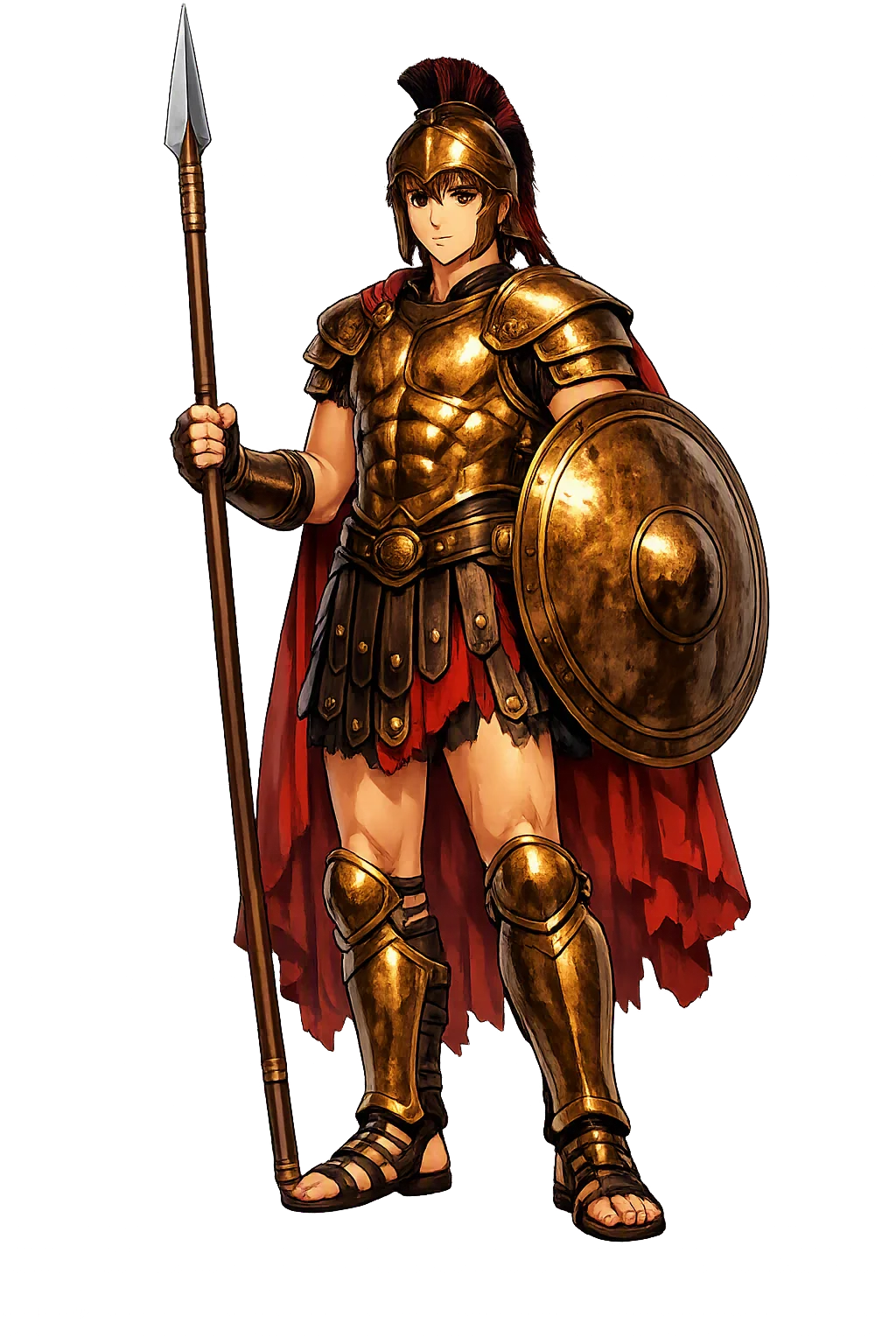
PuniCodex

Extended Lore

Πάτροκλος Pátroklos

Etymology · Orthography · Cult · Iconography · Reception · Sources

Tier 2 Pátroklos
Pátroklos — Warrior, Companion of Achilles
01

Quick Facts

Essential information about Pátroklos, Warrior, Companion of Achilles

Original ScriptΠάτροκλος
Unicode RestorationPátroklos
Reconstructed Pronunciation/patroclus/
PantheonGreek
DomainWarrior, Companion of Achilles
MeaningFather's glory
ClassificationTier 2
Primary DomainPátroklos
Sacred SymbolsThe borrowed armour of Achilles, Xanthos, the prophetic horse, The wine-cup, The golden double urn, The cut lock of hair
02

Etymology & Word Family

From original script to Unicode restoration

Original Script Πάτροκλος Pátroklos — "Father's glory"
Unicode Restoration Pátroklos Restored stress, length, and script
Modern ASCII patroclus Plain-ASCII fallback

The name Pátroklos carries the orthographic signature of the greek tradition: Πάτροκλος. Unicode restoration recovers what ASCII flattens.

03

Unicode Character Breakdown

Character-by-character philological analysis

CharacterUnicodeNameBlockPhonetic Role
PU+0050Latin Capital Letter PBasic LatinSame
áU+00E1Latin Small Letter A with AcuteLatin-1 SupplementSame
tU+0074Latin Small Letter TBasic LatinSame
rU+0072Latin Small Letter RBasic LatinSame
oU+006FLatin Small Letter OBasic LatinSame
kU+006BLatin Small Letter KBasic LatinKappa
lU+006CLatin Small Letter LBasic LatinSame
oU+006FLatin Small Letter OBasic LatinOmicron
sU+0073Latin Small Letter SBasic LatinSame

The Tier 2 classification reflects how much of the original phonology this restoration preserves — stress and vowel length for Greek names, distinctive letters and diacritics for every other tradition.

04

Cult & Worship

How the sacred was kept — rites, sanctuaries, remains

The Cult

Patroklos was never worshipped as a god — he received the Greek rite for the special dead, hero-cult, and its center was his tomb. Homer builds the rite into the poem itself: the funeral games of Iliad 23, with tripods, cauldrons, and horses set as prizes, are liturgy as much as contest, and Pindar’s ninth Olympian — composed for an Opuntian victor — ties the great games of his home city to Achilles’ honors for Patroklos, evidence that the Locrians kept heroic games in his name. Strabo (13.1.28) places his great barrow on the Trojan coast beside Achilles’, the shared mound Greek sailors visited by the Hellespont. What he left behind was not temples or priesthoods but an institution: the funeral games that Greek cities kept celebrating for their own dead, modeled on the one in the Iliad.

In the Earth

Patroklos’s witnesses are text and vase, not temple. Strabo (Geography 13.1.28) records the great barrows of the Troad — Achilles, Patroklos, Antilochos — near Sigeion by the Hellespont, on ground modern survey associates with the Besik Bay anchorage used by the Bronze-Age expedition. In art, the fight over his body was a favourite of early painters: the François Vase (Kleitias, c. 570 BCE, Florence) already arranges the funeral games of Patroklos around the golden jar, and black- and red-figure painters of the sixth and fifth centuries return again to the moment Ajax carries the corpse out of the rain of missiles. The gold-and-urn burial Homer describes matches Late Bronze Age bier-and-ossuary practice from the Mycenaean world — the poem’s material memory outliving any single grave.

05

Iconography

How Pátroklos was imaged across the ages

The Image

Patroklos is one of the oldest identifiable figures in Greek art. The François Vase (Kleitias, c. 570 BCE, Florence) already wraps its body with the funeral games of Patroklos, each contest labeled for the viewer; the fight over his body — warriors lifting the corpse out of the rain of missiles — became one of the most repeated battle scenes of black- and red-figure vase painting. The masterpiece is quieter: on the Sosias cup (c. 500 BCE, Antikensammlung Berlin) Achilles kneels to bandage Patroklos’s wounded arm, the two named by inscription, tender and absorbed. He is usually beardless, standing in Achilles’ shadow, identified by painted names rather than attributes; only the borrowed armor makes him briefly magnificent, and vase painters loved exactly that tragic doubling.

06

Reception & Transformation

The name after its own age — transmission, translation, survival

Afterlives

Patroklos’s afterlife is the afterlife of the text that made him. The Iliad survived antiquity in Byzantine copies — the Venetus A manuscript, with its scholia preserving ancient commentary on his scenes, is the landmark witness — and medieval Greek reading kept him current long before the Latin West recovered Homer. Petrarch owned a Greek Homer he could not read and commissioned one of the first Latin translations; the 1488 Florentine editio princeps then fixed the text for Europe. Renaissance humanists, Plutarch in hand, read Achilles and Patroklos as the supreme type of friendship — Montaigne cites the pair in his essay on friendship — and Roman sarcophagus reliefs of the fight over his body had already given the theme its funerary grammar. Modern philology made him a test case: Wolf’s Prolegomena (1795) split the poem’s authorship, and Parry’s oral-formulaic studies later read his aristeia as formula rather than art. Eustathius of Thessalonica’s twelfth-century commentary, printed at Rome in 1542–50, remains the door through which ancient scholarship on him reaches us.

Identifications Across Traditions

Antiquity argued over what Achilles and Patroklos were to each other. Aeschylus in his lost Myrmidons made the bond explicitly erotic, and Plato’s Phaedrus, in Symposium 179e–180b, held Achilles up as the model of a lover who chose death to avenge his beloved. Aeschines, defending himself in Against Timarchus 142–150, read Homer’s own text as a chaste ideal of heroic friendship and rebuked the erotic reading — the first recorded round of a debate that has never closed. Alexander the Great staged himself in the pair: at Troy he crowned himself from Achilles’ tomb while Hephaestion did homage at Patroklos’, and after Hephaestion’s death he cut his own hair short over Patroklos’ barrow, replaying Achilles’ grief (Plutarch, Alexander 15.8; 72.2). Homer himself never says the word; every later age supplied it for him.

Modern Legacy

Patroklos survives wherever the faithful companion dies to set the hero’s story moving — the template runs from medieval romance to modern fantasy. Shakespeare’s Troilus and Cressida gives him a sardonic afterlife as Achilles’ pampered favourite. Madeline Miller’s The Song of Achilles (2011) retold the bond as a love story for a modern readership, and the 2004 film Troy made his death the emotional centre of its second act. In scholarship he anchors one of the field’s standing debates — Dover’s austere reading of Homer against the later eroticising tradition — and his name lives in the language itself: the compound patrōia, ‘paternal inheritance,’ keeps his etymon, ‘father’s glory,’ in ordinary Greek speech. The mound Strabo saw by the Hellespont (Geography 13.1.28) is long ploughed flat, but the question his story asks — what is a hero worth when the gentle one dies? — is still open.

07

The Meditation

What Pátroklos means — beyond the dictionary

Patroklos is the Iliad’s quiet thesis: that the qualities war cannot use — mercy, service, tears — are the ones that finally move it. Every other hero in the poem fights to be seen; Patroklos fights to spare others, and he is destroyed the moment he consents to be seen, in armour that is not his. Homer’s economy is exact: the man who could not refuse a wounded stranger could not refuse the role of Achilles either.

His death is the only event that changes Achilles, and it does so by subtraction — when Patroklos dies, Achilles loses not a friend but the part of himself that was still answerable to anyone. The poem’s last gesture for him is domestic and permanent: two men’s bones in one jar. Against all the golden armour and the divine horses, Homer sets that urn as the epic’s true treasure — the smallest container of glory in Greek literature, and the fullest.

08

Screen & Culture

Where Pátroklos echoes through film, television, and games — and how

09

Frequently Asked Questions

Common questions about Pátroklos, Warrior, Companion of Achilles, and Unicode restoration

01How do you pronounce Pátroklos?

In reconstructed pronunciation, Pátroklos is /patroclus/ — approximately Say "patroclus" with the stress and length implied by the scholarly restoration "Patroklos".

02What does Pátroklos mean?

Pátroklos means Father's glory in the greek tradition.

03What are the symbols of Pátroklos?

Pátroklos is associated with The borrowed armour of Achilles (The self that is not his own: wearing it, Patroklos wins Achilles’ glory and attracts Achilles’ death.), Xanthos, the prophetic horse (Achilles’ immortal horse that weeps and foretells Patroklos’ fall (Iliad 19.400–424).), The wine-cup (Patroklos pours for Achilles and the embassy (Iliad 9.209–217) — the courteous steward of the hero’s table.), The golden double urn (The vessel in Achilles’ barrow holding two men’s bones — loyalty outlasting both lives.), The cut lock of hair (Achilles’ shorn hair, vowed to the river Spercheios and finally laid on Patroklos’ pyre (Iliad 23.135–153).).

04Why restore Pátroklos in Unicode?

Plain ASCII patroclus strips the stress, length, and script that make the name specific. Unicode restoration returns the name to its original written dignity.

05What is the most important myth about Pátroklos?

“Sent Away from Opus” — the The Exile story that anchors the mythology of Pátroklos, told in full on the lore page.

10

Scholarly Sources

The philological foundations of this restoration

Every claim on this page is grounded in established scholarship. The orthographic restorations follow disciplinary convention. The etymological chain follows the best available reference works. This is not invention — it is resurrection through scholarship.

◈

Lexicography & Philology

  • Liddell, H. G., Scott, R., & Jones, H. S. A Greek-English Lexicon. Oxford: Clarendon Press, 9th ed. 1996.
  • Pape, W., & Benseler, G. E. Wörterbuch der griechischen Eigennamen. Braunschweig: Vieweg, 1884.
  • Beekes, R. S. P. Etymological Dictionary of Greek. Leiden: Brill, 2010.
◎

Primary Texts

  • Homer, Iliad 9, 11, 16–19, 23
  • Homer, Odyssey 24.71–84
  • Aeschylus, Myrmidons (fr. 135–137 Radt)
  • Plato, Symposium 179e–180b
  • Strabo, Geography 13.1.28
◉

Archaeology & Art History

  • Material evidence — iconography, inscriptions, and temple archaeology — for Pátroklos and related cults.
✦

Religious Studies

  • Aeschines, Against Timarchus 142–150
Return

The Surface Awaits

You have traced the name from its earliest attestation to its Unicode restoration. Now return to the myth. The story is where the name lives.

Back to Lore
Pátroklos mascot