The Living Myth
War, Hunting · He Who Brings Back the Distant One · He who brings back the distant one
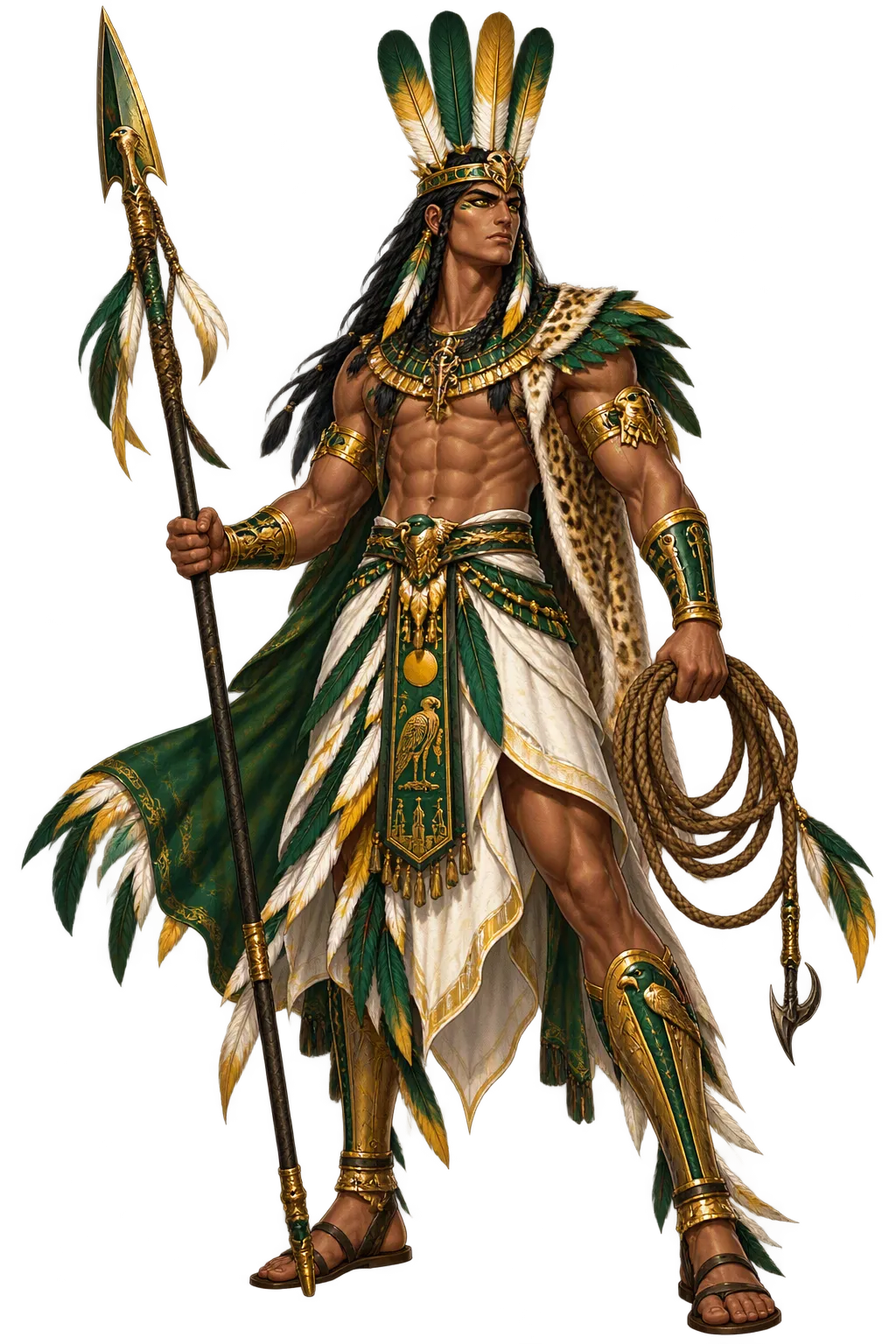
Stories of Onuris
Onuris’ mythology is the romance of retrieval: the Eye of Ra, in her lioness form as Mehyt, raged in the southern hills, and Onuris went up with spear and rope and brought her home. The New Kingdom theologians read the story as the sun’s power recovered from the desert’s edge — and as the model of the husband who fetches back what the household loses.
In the nome of This the story ran: Mehyt, the lioness, fled into the eastern hills; Onuris pursued, threw the rope, and brought her down — and married her. The temple hymns celebrate the return procession: the retrieved goddess re-entering the town at her husband’s side, the desert’s ferocity domesticated into civic power.
Read cosmically, Onuris’ retrieval is Shu’s embassy to the Eye — the same story the Leiden hymns tell of Tefnut’s return. Onuris is Shu’s local, warlike face: the one god whose job description is fetching the godhead’s missing power, whether by flattery or by spear.
This and Abydos were the ground of the first kings; Onuris received the devotion of dynasties that claimed the Thinite soil as their own. His was the war-god of the ancestral nome — the spear at the head of the line that unified the Two Lands.
In the Late Period he was fully identified with Shu, the air that holds up the sky — the retriever who brings back Nut herself each dawn. The lioness he fetched became the sky’s ferocity, and his spear the axis that keeps the vault in place.
The Spear-God of This, Husband of the Lioness
ꜥnḥ wr — Onuris — is the god of the retrieved: the spear-carrying hunter who fetches back the goddess who fled. His myth is the cosmic courtship of the runaway lioness Mehyt, brought home from the Nubian hills to This; his cult was the war-cult of the Thinite nome, the kings’ ancestral land.
His name is his mission: he brings back the distant one — the Eye of Ra, the lioness, the runaway glory.
Armed with spear and rope, the hunter of the high desert; a war-god of the oldest royal nome.
His consort is the fierce lioness Mehyt — the retrieved Eye, tamed by marriage, not chains.
His city, This (Girga), stood beside Abydos — the ancestral seat of the first dynasties.
From the original script to the living URL
𓏎𓈖𓁷𓂋𓏏𓈐𓅆
The name in its original Egyptian form. Onuris (𓏎𓈖𓁷𓂋𓏏𓈐𓅆) is attested in the source tradition — “He who brings back the distant one”. Its original diacritics and script distinctions carry the full phonetic and orthographic weight of the source tradition.
onuris
The plain onuris form is identical to the Unicode restoration. Because this name is already written in Latin letters, no diacritics, stress, or script information were lost — only capitalization differs.
Onuris
The Unicode restoration does not need to recover lost marks for Onuris. Its value is canonical spelling and consistent cataloguing, not the reconstruction of erased orthography. The domain is readable as-is to both DNS and humanity.
Onuris.com
This restoration is written entirely in ASCII letters — no Punycode encoding stands between Onuris and the DNS. The domain reads identically to machines and to human eyes.
The attested spelling family of Onuris
Onuris
Restores 𓏎𓈖𓁷𓂋𓏏𓈐𓅆. The full Unicode restoration. onuris.com is not in the PuniCodex collection — it is watched for release; if it drops, this temple upgrades to an owned flagship. Attested by Faulkner, Wb.
How Onuris was spoken
How Onuris travels from ancient script to the modern URL
The lore you have read is the living myth. Extended Lore opens the scholarly vault beneath it: the cult and its material remains, a history of the image, the name after antiquity, a meditation on what the name still means, and the full scholarly apparatus — etymology, orthography, sources.
Enter Extended Lore