PuniCodex

Extended Lore

Οἰδίπους Oidípous

Etymology · Orthography · Cult · Iconography · Reception · Sources

Tier 1 Oidípous.com
Oidípous — Fate, Riddles, Thebes
01

Quick Facts

Essential information about Oidípous, Fate, Riddles, Thebes

Original ScriptΟἰδίπους
Unicode RestorationOidípous
Reconstructed Pronunciation/oi̯.dí.puːs/
PantheonGreek
DomainFate, Riddles, Thebes
MeaningSwollen-foot (from οἰδάω + πούς)
ClassificationTier 1
Primary DomainOidípous.com
Sacred SymbolsThe pierced ankles, The Sphinx, The golden brooches, The crossroads, The grove at Colonus
02

Etymology & Word Family

From original script to Unicode restoration

Proto-indo-european *h₁eyd- to swell
Original Script Οἰδίπους Oidípous — "Swollen-foot (from οἰδάω + πούς)"
Unicode Restoration Oidípous Restored stress, length, and script
Modern ASCII oidipous Plain-ASCII fallback

Greek Οἰδίπους 'swollen-foot', from οἰδάω 'to swell' and πούς 'foot'; the name encodes the injury inflicted on the infant exposed by his parents.

03

Unicode Character Breakdown

Character-by-character philological analysis

CharacterUnicodeNameBlockPhonetic Role
OU+004FLatin Capital Letter OBasic LatinOmicron
iU+0069Latin Small Letter IBasic LatinIota
dU+0064Latin Small Letter DBasic LatinDelta
íU+00EDLatin Small Letter I with AcuteLatin-1 SupplementAcute on iota
pU+0070Latin Small Letter PBasic LatinPi
oU+006FLatin Small Letter OBasic LatinOmicron
uU+0075Latin Small Letter UBasic LatinUpsilon
sU+0073Latin Small Letter SBasic LatinSigma

The Tier 1 classification reflects how much of the original phonology this restoration preserves — stress and vowel length for Greek names, distinctive letters and diacritics for every other tradition.

04

Cult & Worship

How the sacred was kept — rites, sanctuaries, remains

The Cult

Oidipous received the cult of a polluted hero, and it tells us what the Greeks thought pollution could become. At Colonus in Attica, in the grove of the august goddesses he names the Eumenides, he died and was buried; Sophocles' Oidipous at Colonus is in effect the founding charter of the shrine, and Pausanias (1.30) could still see the precinct, its statues, and the hero's tomb. The Thebans claimed his bones back — Pausanias (9.5) records his tomb at Thebes — and tradition made the buried exile a talisman of the city's safety. This was hero-cult in the strict sense: tomb, enclosure, offerings to the dead, not a god's temple; no festival day and no priesthood of Oidipous is recorded anywhere. The grove beside the Academy remained sacred ground. Characteristically, the hero's afterlife was managed by the city that received him in death after both his cities had rejected him in life.

In the Earth

Oidipous is a Bronze Age memory wearing a Classical costume. Excavations on the Kadmeia at Thebes have uncovered a Mycenaean palace with its archive of Linear B tablets — a real Theban kingdom of the thirteenth century BC whose dynastic troubles could seed a legend of cursed kingship. The Sphinx he defeated still stands in stone: the Sphinx of the Naxians, dedicated at Delphi around 560 BC, is the very monster type, and Attic red-figure cups of the fifth century show Oidípous seated before her with the answer on his lips. No sanctuary of Oidipous has been excavated; his cult was a literary and civic one, kept at Colonus in the grove Sophocles describes and at Thebes in the tomb tradition Pausanias records.

05

Iconography

How Oidípous was imaged across the ages

The Image

The earliest images of Oidipous show him at his moment of triumph, and they are archaic: from the mid-sixth century BCE, Attic black-figure and then red-figure vases stage the confrontation with the Sphinx — the seated or standing youth, hand lifted in answer, before a crouching winged monster that often gazes back with unsettlingly human eyes. Painters sometimes label him, so the identification is secure; the riddle itself is never written, only the duel of gazes. The scheme held for two centuries with almost no variation. Roman painting then shifted the subject to the catastrophe: a wall-painting from Pompeii of the blinding, now in Naples' Museo Archeologico Nazionale, fixes the horror the vases always spared — the king gore-smeared over his own brooches. Later ages mostly declined to picture him; his story lived as text long before it returned as image.

06

Reception & Transformation

The name after its own age — transmission, translation, survival

Afterlives

Oidipous' journey begins as common property. Homer already sends his shade to Odysseus; Hesiod and Pindar keep the house of Laius in the catalogue of cursed dynasties; Aeschylus gave Thebes a whole trilogy, now lost. Sophocles' Oidipous Tyrannos then built the discovery into the plot's single mechanism, and Byzantium saved the result by schoolmaster's choice: the Tyrannos, with Aias and Electra, formed the Byzantine triad copied in hundreds of manuscripts, while the rest of the plays rode on the single tenth-century Laurentian codex. Rome's epic tradition kept him present — Statius opens the Thebaid with the blind king cursing his sons — and the vernacular Middle Ages found him through the Theban romances: the Roman de Thèbes (c. 1150) is the first of all the French romances of antiquity. The Renaissance recovered the Greek text itself with the Aldine Sophocles of 1502, which returned the Tyrannos to European schools in the original. Corneille's Oedipe (1659) and Voltaire's (1718) carried him on the neoclassical stage, and Hölderlin's famously eccentric German rendering, with its analytic notes (1804), closed the pre-modern chapter: each age translated not the story but the discovery.

Identifications Across Traditions

The Romans received Oidipous chiefly as a name of terror and gave him a Latin tragedy of his own, Seneca's Oedipus, which rebuilt the story around oracular dread and kept the play alive through the Middle Ages into the Renaissance. Aristotle's Poetics, working from Oidipous Tyrannos, made its plot — peripeteia and anagnorisis combined in one stroke — the theory of tragedy for two millennia. In 1899 Freud named the ‘Oedipus complex’ after the hero, translating public fate into private childhood, and the twentieth century ran the change back through the arts: Cocteau's La Machine infernale, Gide's Oedipe, O'Neill's Mourning Becomes Electra, Pasolini's Edipo Re, Stravinsky's Oedipus Rex staged in Latin. The Greek original survives every translation because its subject — the unbearable speed of self-knowledge — is not antique.

Modern Legacy

The hero left two cults and a vocabulary. At Colonus the grove he sanctified remained sacred ground beside the Academy; at Thebes Pausanias (9.5) records the tomb of Oidipous and the tradition that his bones were brought back from Attica to protect the city that had exiled him — the polluted body as talisman. From the name come ‘oedipal’ and its compounds in every modern psychology; from the play come the critic's terms — peripeteia, anagnorisis, hamartia — that Aristotle coined while reading this one tragedy. Every retelling, from Seneca to the present, rehearses the same discovery: the story is not about incest and patricide, which Oidípous committed in ignorance, but about the moment a man learns what he is.

07

The Meditation

What Oidípous means — beyond the dictionary

Oidípous is the man who answered the riddle of the human condition and failed the examination of his own life, and the two events are one. What the play understands is that intelligence and self-knowledge are different faculties: the Sphinx tested the first, the oracle the second, and only the second is fatal to get wrong. The restored name keeps the acute accent — the stress on the syllable where the wound lives — and the accent is the argument. In an age that trusts answers, Oidípous is the standing reminder that the right answer to the wrong question is the classical definition of tragedy: he knew what walks on four, two and three legs, and never once thought to ask whose son he was.

08

Frequently Asked Questions

Common questions about Oidípous, Fate, Riddles, Thebes, and Unicode restoration

01How do you pronounce Oidípous?

In reconstructed pronunciation, Oidípous is /oi̯.dí.puːs/ — approximately 'oy-DEE-poos' — stress the middle syllable; the diphthong is the 'oy' of 'boy', and the final syllable is long.

02What does Oidípous mean?

Oidípous means Swollen-foot (from οἰδάω + πούς) in the greek tradition.

03What are the symbols of Oidípous?

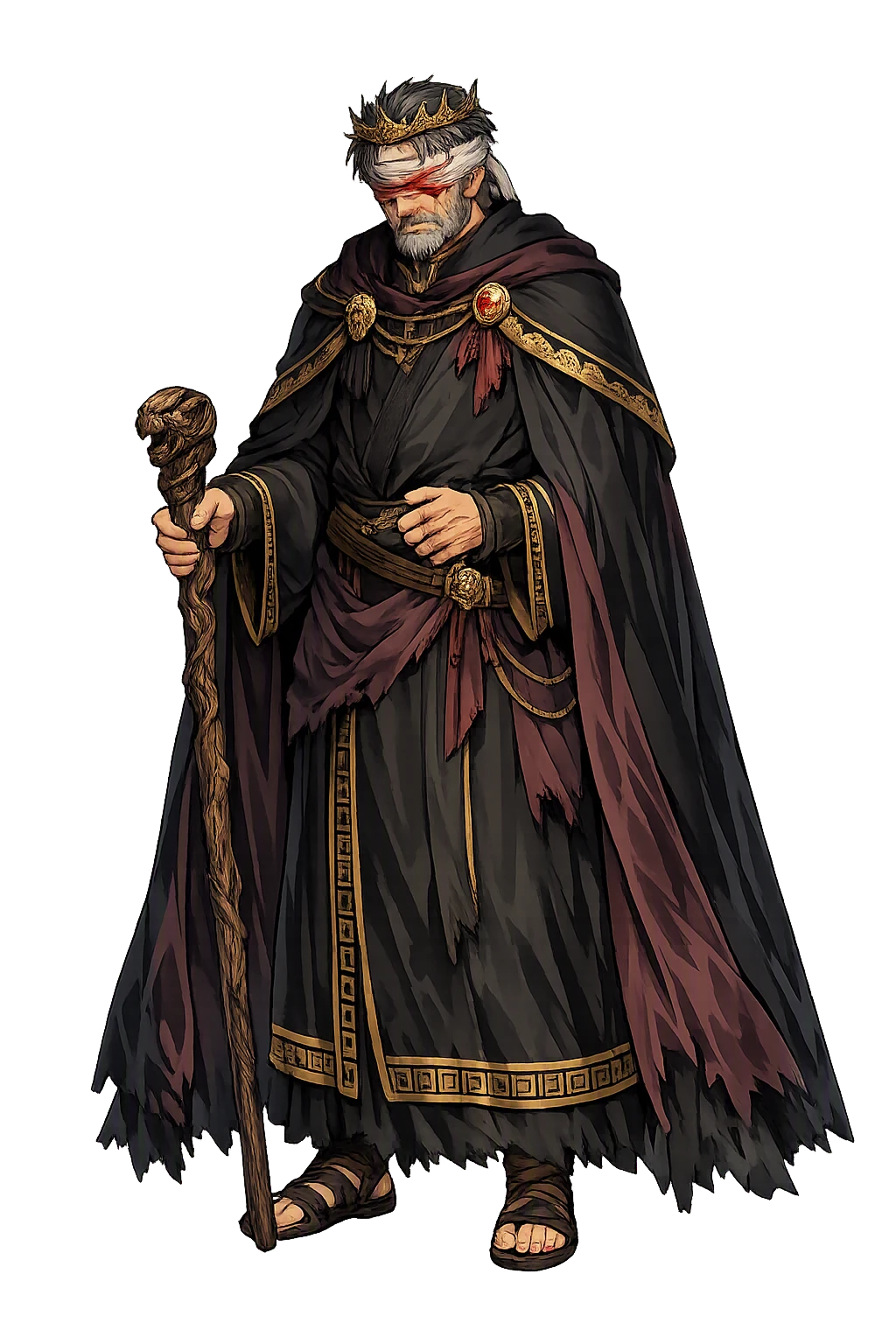
Oidípous is associated with The pierced ankles (The wound in the name: the pins that made the exposed child ‘Oidípous’), The Sphinx (The daughter of Typhon and Echidna who held Thebes hostage on her mountain (Hesiod, Theogony 326–329)), The golden brooches (Jocasta's dress-pins, with which Oidípous put out his own eyes at the hour of recognition (Sophocles, OT 1268–1279)), The crossroads (The place where three roads meet — the geometry of a prophecy fulfilling itself), The grove at Colonus (The Eumenides' ground outside Athens where the exile found his rest (Sophocles, Oidipous at Colonus 84–110)).

04Why restore Oidípous in Unicode?

Plain ASCII oidipous strips the stress, length, and script that make the name specific. Unicode restoration returns the name to its original written dignity.

05What is the most important myth about Oidípous?

“Pinned Ankles on Kithairon” — the The Exposure story that anchors the mythology of Oidípous, told in full on the lore page.

09

Scholarly Sources

The philological foundations of this restoration

Every claim on this page is grounded in established scholarship. The orthographic restorations follow disciplinary convention. The etymological chain follows the best available reference works. This is not invention — it is resurrection through scholarship.

◈

Lexicography & Philology

  • Liddell, H. G., Scott, R., & Jones, H. S. A Greek-English Lexicon. Oxford: Clarendon Press, 9th ed. 1996.
◎

Primary Texts

  • Sophocles
  • Sophocles, Oidipous Tyrannos (esp. 391–402, 716–813, 1034–1046, 1146–1297)
  • Sophocles, Oidipous at Colonus 84–110, 1518–1666
  • Homer, Odyssey 11.271–280
  • Hesiod, Theogony 326–329; Pindar, Olympian 2.35–42; Aeschylus, Seven Against Thebes
◉

Archaeology & Art History

  • Material evidence — iconography, inscriptions, and temple archaeology — for Oidípous and related cults.
✦

Religious Studies

  • Aristotle, Poetics 1450a, 1452a–b
  • Freud, Die Traumdeutung (1899)
Return

The Surface Awaits

You have traced the name from its earliest attestation to its Unicode restoration. Now return to the myth. The story is where the name lives.

Back to Lore
Oidípous mascot