PuniCodex

Extended Lore

𓇯 Nwt

Etymology · Orthography · Cult · Iconography · Reception · Sources

ASCII-equivalent form Nwt
Nwt — Sky, Stars, Cosmos
01

Quick Facts

Essential information about Nwt, Sky, Stars, Cosmos

Original Script𓇯
Unicode RestorationNwt
Reconstructed Pronunciation/nʊt/ (conventional)
PantheonEgyptian
DomainSky, Stars, Cosmos
MeaningWater-pot, sky (Egyptian nwt)
ClassificationASCII-equivalent form
Primary DomainNwt
Sacred SymbolsThe Starry Vault, Mother of the Gods, Swallower of the Sun, Lady of the Sycamore
02

Etymology & Word Family

From original script to Unicode restoration

Original Script 𓇯 Nwt — "Water-pot, sky (Egyptian nwt)"
Unicode Restoration Nwt Canonical scholarly spelling — ASCII-identical
Modern ASCII nut Plain-ASCII fallback

The name Nwt reaches the modern world through scholarly transliteration of the egyptian tradition. Because the conventional spelling uses only Latin letters, its Unicode and ASCII forms coincide — the tradition it carries is in the name itself, not in diacritics.

03

Unicode Character Breakdown

Character-by-character philological analysis

CharacterUnicodeNameBlockPhonetic Role
NU+004ELatin Capital Letter NBasic LatinSame
wU+0077Latin Small Letter WBasic LatinW: bilabial glide
tU+0074Latin Small Letter TBasic LatinSame

This restoration reflects fidelity to the attested tradition, not recovered diacritics: every character of Nwt already survives in ASCII. What the restoration preserves is the canonical spelling itself — the form scholarship standardised.

04

Cult & Worship

How the sacred was kept — rites, sanctuaries, remains

The Cult

No single city claimed her exclusively — she was everyone’s sky — but she received royal cult in the mortuary temples and a popular cult as the sycamore who feeds the dead at the edge of desert necropolises. Her five epagomenal days closed the year with festival commotion everywhere.

In the Earth

Her finest monuments are architectural: the ceilings of the Ramesside tombs in the Valley of the Kings and the zodiac ceiling of Dendera, where her body frames the circumpolar stars. The Nut spell (BD 148) was often written on stelae in the shape of the goddess herself, a tree-vault hybrid rising from the sycamore.

05

Iconography

How Nwt was imaged across the ages

The Image

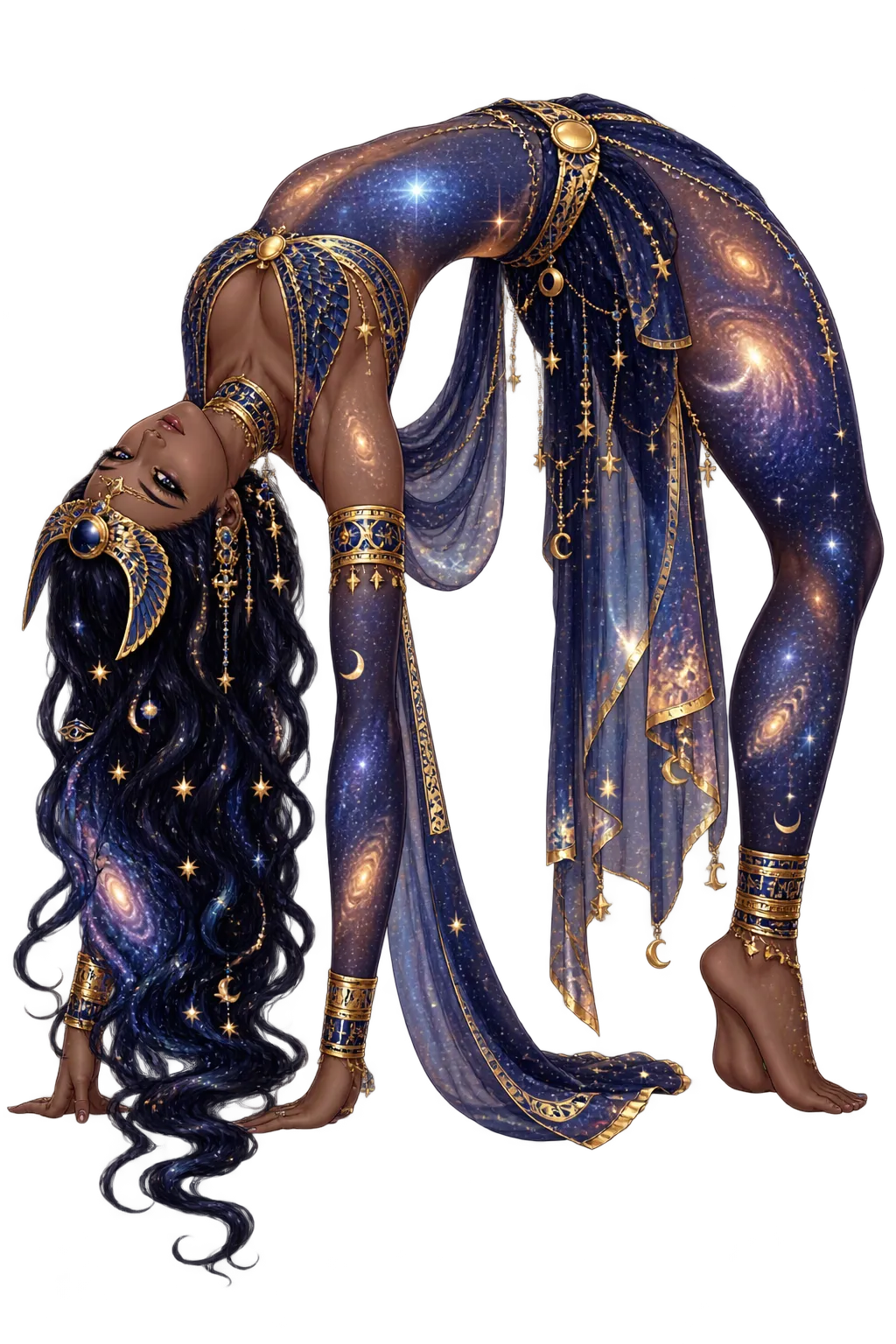
A naked or star-covered woman bent at the waist over the recumbent Geb, supported by Shu the air; or as a cow whose belly carries the sun-disc, four pillars of the sky beneath her legs. In the sycamore form she pours water from a jar over altars of the dead. Her headdress is the water-pot emblem that writes her name.

06

Reception & Transformation

The name after its own age — transmission, translation, survival

Afterlives

Through Plutarch she entered the classical imagination as one of the great mother-sky figures; Renaissance Hermeticism made her a standard emblem of the celestial vault. Modern Egyptology retains her as the canonical demonstration that Egyptian cosmology mapped theology directly onto visible nature.

Identifications Across Traditions

Nut merges readily with Hathor as sky-cow and with the sycamore-goddess of offering scenes; in the late period she absorbs the funerary role of Nut-as-tree. Greek authors rendered her as a Titaness-figure comparable to Rhea; her swallowing-and-birthing of the sun invited comparison with the devouring Time of Orphic cosmogonies.

Modern Legacy

Her image — the blue woman bent from horizon to horizon — is the most reproduced Egyptian cosmological image after the weighing of the heart. The five epagomenal days her myth explains still structure the Coptic calendar’s year-end; and ‘Nut, Nut, the sky is falling’ passed into Egyptian Arabic as a children’s rhyme.

07

The Meditation

What Nwt means — beyond the dictionary

A one-syllable name for the whole visible sky: nwt. To write it in ASCII is almost an act of honesty, for the word is a container — a water-pot determinative tipped onto its side — as if the Egyptians had already drawn the curve this temple builds its name upon. Her restoration needs no marks; the night sky over any city is her diacritic.

08

Frequently Asked Questions

Common questions about Nwt, Sky, Stars, Cosmos, and Unicode restoration

01How do you pronounce Nwt?

In reconstructed pronunciation, Nwt is /nʊt/ (conventional) — approximately “NOOT” — one syllable, the vowel long.

02What does Nwt mean?

Nwt means Water-pot, sky (Egyptian nwt) in the egyptian tradition.

03What are the symbols of Nwt?

Nwt is associated with The Starry Vault (Her body is painted blue across temple ceilings, scattered with the decans and planets she carries.), Mother of the Gods (By Geb she bore Osiris, Isis, Seth, Nephthys, and Horus the Elder — the third generation of the Ennead.), Swallower of the Sun (Each dusk the sun enters her mouth; each dawn she births it — time itself is her digestion.), Lady of the Sycamore (She appears in tree-form pouring water and bread on the dead from a celestial sycamore.).

04Why restore Nwt in Unicode?

Nwt is written entirely in ASCII letters, so its restoration is about canonical fidelity rather than recovered diacritics: the temple fixes the name in its scholarly standard spelling, attested in the source tradition, instead of leaving it to drift.

05What is the most important myth about Nwt?

“The Embrace of Geb and Nut” — the Heliopolitan Cosmogony story that anchors the mythology of Nwt, told in full on the lore page.

09

Scholarly Sources

The philological foundations of this restoration

Every claim on this page is grounded in established scholarship. The orthographic restorations follow disciplinary convention. The etymological chain follows the best available reference works. This is not invention — it is resurrection through scholarship.

◈

Lexicography & Philology

  • Faulkner, R. O. A Concise Dictionary of Middle Egyptian. Oxford: Griffith Institute, 1962.
  • Wb
◎

Primary Texts

  • Pyramid Texts (Nut as mother of the gods)
  • Book of the Dead, spells 17 and 148 (the Nut spell)
  • Plutarch, De Iside et Osiride (epagomenal myth)
◉

Archaeology & Art History

  • Temple ceiling programs: Dendera, Esna, Luxor
✦

Religious Studies

  • Heliopolitan cosmogony, Ennead tradition (Geb–Nut separation)
Return

The Surface Awaits

You have traced the name from its earliest attestation to its Unicode restoration. Now return to the myth. The story is where the name lives.

Back to Lore
Nwt mascot