PuniCodex

Extended Lore

Niamh

Etymology · Orthography · Cult · Iconography · Reception · Sources

Tier 2 Niamh
Niamh — Beauty, Otherworld
01

Quick Facts

Essential information about Niamh, Beauty, Otherworld

Scholarly TransliterationNiamh
Unicode RestorationNiamh
Reconstructed Pronunciation/ˈn̠ʲiːəvˠ/
PantheonCeltic
DomainBeauty, Otherworld
MeaningBright, radiant
ClassificationTier 2
Primary DomainNiamh
Sacred SymbolsThe golden hair, The white horse, The sea-crossing, The three hundred years, The broken girth
02

Etymology & Word Family

From original script to Unicode restoration

Scholarly Transliteration Niamh Niamh — "Bright, radiant"
Unicode Restoration Niamh Canonical scholarly spelling — ASCII-identical
Modern ASCII niamh Plain-ASCII fallback

The name Niamh reaches the modern world through scholarly transliteration of the celtic tradition. Because the conventional spelling uses only Latin letters, its Unicode and ASCII forms coincide — the tradition it carries is in the name itself, not in diacritics.

03

Unicode Character Breakdown

Character-by-character philological analysis

CharacterUnicodeNameBlockPhonetic Role
NU+004ELatin Capital Letter NBasic LatinSame, capitalized
iU+0069Latin Small Letter IBasic LatinSame
aU+0061Latin Small Letter ABasic LatinSame
mU+006DLatin Small Letter MBasic LatinSame
hU+0068Latin Small Letter HBasic LatinSame

The Tier 2 classification here reflects fidelity to the attested tradition, not recovered diacritics: every character of Niamh already survives in ASCII. What the restoration preserves is the canonical spelling itself — the form scholarship standardised.

04

Cult & Worship

How the sacred was kept — rites, sanctuaries, remains

The Cult

Niamh was never worshipped: no shrine, no feast, no votive custom attaches to her anywhere in the record, and Ireland's holy places preserve no site of hers. She belongs to the Fenian lay tradition — the great body of poetry sung about Fionn and the Fianna — where she functions as the Otherworld's summons, the bride from across the wave who breaks the heroes' hold on this world. In that corpus her 'cult' is purely narrative: storytellers sang the Lay of Oisín in the Land of Youth as the cycle's supreme emigration-and-return. The land she rules, Tír na nÓg, is a literary paradise — apple trees, undying youth, no grief — and no rite ever addressed it. What Ireland kept of Niamh was the story, and it kept it orally for centuries before any book took it down.

In the Earth

Niamh is an entirely textual figure: no ogham stone names her, no votive deposit invokes her, and Irish paganism generally left literature rather than dedications. Her tale has an exact documentary trail: the Laoi Oisín ar Thír na nÓg, ascribed to the eighteenth-century Clare poet Mícheál Coimín, survives in the Irish paper-manuscript tradition and reached print in the Transactions of the Ossianic Society (vol. 4, 1859), the learned society that did for the Fenian lays what Grimm did for the folktale. The medieval frame into which the lay fits its ending — Oisín and Caílte reciting Ireland to St. Patrick — is preserved in the Acallam na Senórach, whose great witness is the fifteenth-century Book of Lismore, with Laud Misc. 610 among its sister codices. Her Otherworld has no fixed address, and that is its nature: unlike the Dagda's Brú na Bóinne, where Newgrange gives myth a monument, Tír na nÓg was never mapped onto any real island — the material record of Niamh is the manuscript tradition itself, and the unbroken popularity of her name.

05

Iconography

How Niamh was imaged across the ages

The Image

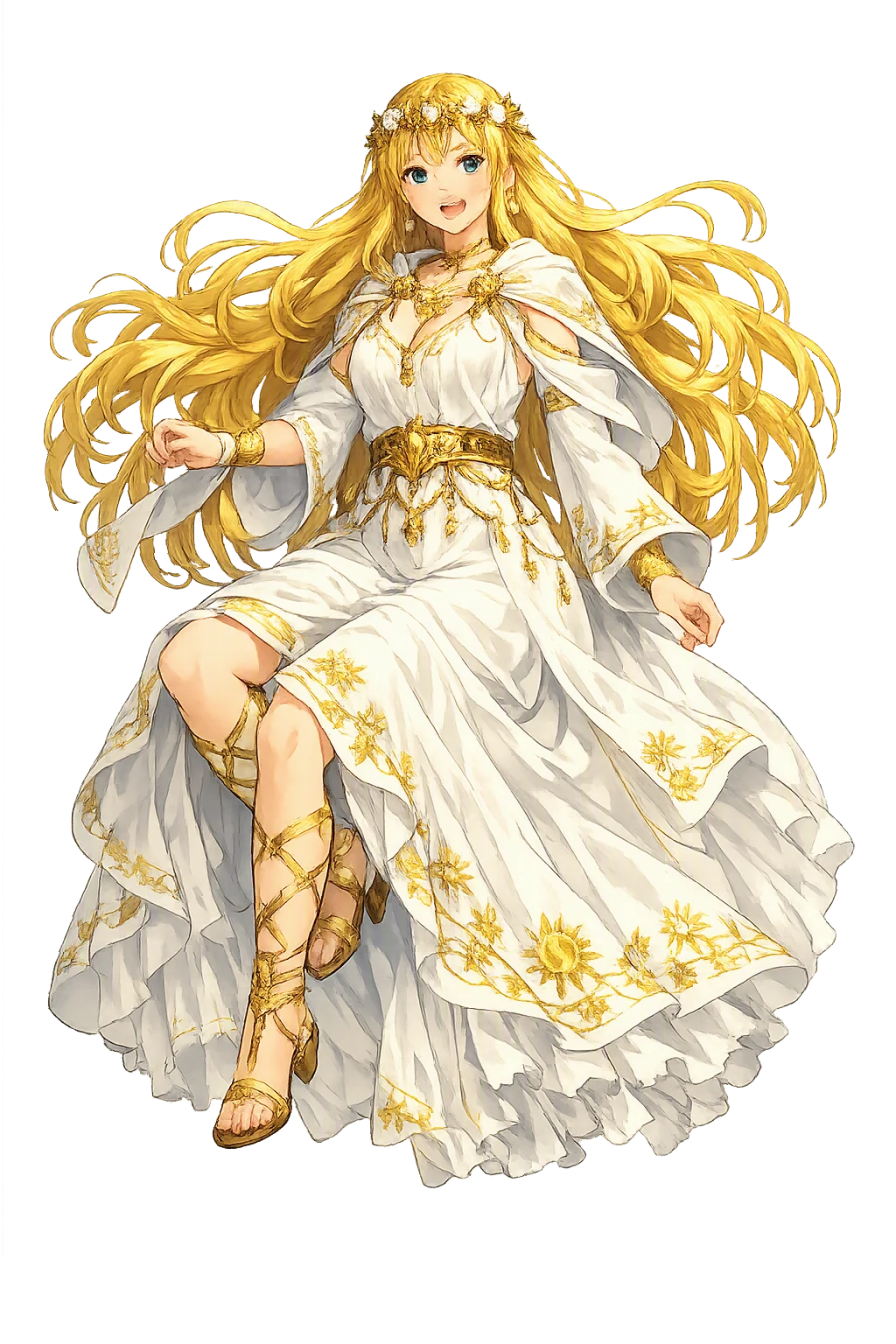
No pre-modern image of Niamh survives; her entire visual afterlife begins with the Celtic Revival. The texts give her a small, exact kit: golden hair — she is Niamh Chinn-Óir, Niamh of the Golden Hair — the white horse that travels on sea as on land, and the bright apparel of the síd. The lay fixes the picture every later illustrator followed: the rider coming up out of the wave-foam to the sleeping Oisín, the Fianna left standing on the strand. Edwardian and Revival illustrators gave the scene its canonical form — golden-haired rider, white stallion, green western sea — and twentieth-century Irish art, from bookplates to schoolbook covers, kept reproducing it. Earlier than the nineteenth century there is nothing: the medieval Fenian tradition sang her and never drew her.

06

Reception & Transformation

The name after its own age — transmission, translation, survival

Afterlives

Niamh's reception is the reception of her lay, and the lay is younger than its fame: ascribed to the Clare poet Mícheál Coimín (c. 1750), it travelled the Irish manuscript and oral traditions until the Ossianic Society printed it with a translation in 1859 — the single publication that made her an international figure. The scholarly age then placed her: Douglas Hyde's Literary History of Ireland (1899) set the Fenian lays, Oisín's voyage among them, at the centre of the national story, and the international folktale indexes catalogued the tale as the Irish master-text of the Land-of-Youth type. In the twentieth century the story passed from lecture-room to schoolroom: Oisín in the Land of Youth became a fixture of Irish school readers, quite likely the most-read Fenian text ever printed. Through it all the frame held — the summons, the three hundred years, the returning rider turned old — so that Niamh survives less as a character than as the door through which Ireland's heroes leave, and through which every emigrant's dream of return still passes.

Identifications Across Traditions

Niamh belongs to the oldest company in Irish narrative: the Otherworld woman who comes for a mortal man. Echtrae Chonnlai gives the type its starkest form — a woman of the síd, visible only to Connla, throws him an apple that never diminishes and calls him to Mag Mell, until he leaps into her crystal ship and is seen no more. Immram Brain sends a woman from Emain with a silver branch to summon Bran across the sea to the Land of Women, where a year is no time at all — the same time-arithmetic as Oisín's three centuries. In Tochmarc Étaíne the direction reverses: [[midir|Midir]] of Brí Léith wins back [[etain|Étaín]] and the two fly from Tara as swans. The frame that late tradition gave Niamh herself is genealogical: she is made a daughter of [[manannan|Manannán mac Lir]], lord of the sea-Otherworlds Emain Ablach and Mag Mell, whose Welsh cognate is [[manawydan|Manawydan fab Llŷr]] — the lay itself names her only as the daughter of Tír na nÓg's king, and the Manannán paternity is the tradition's own harmonization. Folklore comparison adds the international motif: the supernatural lapse of time in fairyland, the traveller who returns to find centuries gone, which Hartland made the type-case of his Science of Fairy Tales. The Welsh corpus preserves no Niamh; the nearest Brythonic resonances are [[rhiannon|Rhiannon]]'s unmatchable horse and the raid on [[annwn|Annwn]] in Preiddeu Annwn — kinship of motif, never of name.

Modern Legacy

Niamh has the largest modern afterlife of any Irish Otherworld woman, and it runs through one poem. W. B. Yeats's The Wanderings of Oisin (1889) — his first major work and the foundation-poem of the Irish Literary Revival — took the lay's summons as its frame: Niamh calls Oisin away on the white horse, and three enchanted islands later he returns to a Christian Ireland and dies with the Fianna on his lips. Yeats's three islands are his own invention, but the wooer is the lay's, and through him Niamh became the world literature's type of the Celtic Otherworld bride. Lady Gregory's Gods and Fighting Men (1904) carried the prose retelling to the same generation. In Ireland itself the name went the opposite way from mythology to the birth register: Niamh became one of the most popular Irish girls' names of the late twentieth century, so that the golden-haired rider is now, for most who bear the name, simply themselves. And Tír na nÓg has passed into the general vocabulary as the default name of the Celtic paradise — the land over the western sea where nobody grows old, reached only on a white horse, and only in her company.

07

The Meditation

What Niamh means — beyond the dictionary

Niamh is the name of a temptation, and the temptation is not what it first seems. She offers beauty, youth, and three hundred years without a wrinkle — and the story's verdict is that the offer is genuine. Tír na nÓg is no trap: the children are real, the delight is real, the warning she gives him is honest and exact. What the lay understands is that exemption from time is itself a kind of exile, and that a mortal carries his mortality inside him as homesickness. Oisín does not fall because the Otherworld failed him; he falls because Ireland is his, and a single touch of its soil outweighs three centuries of paradise.

Her name keeps the paradox in one syllable. Niamh — radiance, the shining thing — is the brightest name in the Fenian cycle, and she rides it out of the sea to the one man whose whole art was memory. Between them the lay poses the question it never answers: is the golden age the land across the water where nothing ages, or the lost Ireland of the Fianna that the old poet spends his last days reciting to a saint? Niamh holds one answer. Oisín holds the other. The white horse runs between them, and it does not wait.

08

Frequently Asked Questions

Common questions about Niamh, Beauty, Otherworld, and Unicode restoration

01How do you pronounce Niamh?

In reconstructed pronunciation, Niamh is /ˈn̠ʲiːəvˠ/ — approximately 'NEE-uv' (Munster) or 'NEEV' (standard) — the weight on the long 'ee', the final mh a soft v; never 'nee-AM' and never an English h.

02What does Niamh mean?

Niamh means Bright, radiant in the celtic tradition.

03What are the symbols of Niamh?

Niamh is associated with The golden hair (Brightness made visible — the name Niamh, 'radiance', worn as the epithet Chinn Óir), The white horse (The Otherworld's transport, and the vehicle of the warning: cross the sea-road, but never touch the ground of home), The sea-crossing (The threshold between the mortal world and Tír na nÓg, ridden as if it were a road), The three hundred years (Time suspended in the Land of Youth — the Otherworld's gift and its price, counted only when it is spent), The broken girth (The single touch of Irish soil that undoes the enchantment — mortality resumed in an instant).

04Why restore Niamh in Unicode?

Niamh is written entirely in ASCII letters, so its restoration is about canonical fidelity rather than recovered diacritics: the temple fixes the name in its scholarly standard spelling, attested in the source tradition, instead of leaving it to drift.

05What is the most important myth about Niamh?

“The Summons from over the Sea” — the Laoi Oisín ar Thír na nÓg story that anchors the mythology of Niamh, told in full on the lore page.

09

Scholarly Sources

The philological foundations of this restoration

Every claim on this page is grounded in established scholarship. The orthographic restorations follow disciplinary convention. The etymological chain follows the best available reference works. This is not invention — it is resurrection through scholarship.

◈

Lexicography & Philology

  • Irish folklore
  • MacKillop
◎

Primary Texts

  • The Immram Brain (Voyage of Bran); Tochmarc Étaíne; Cóir Anmann; medieval Irish saga literature.
◉

Archaeology & Art History

  • Material evidence — iconography, inscriptions, and temple archaeology — for Niamh and related cults.
✦

Religious Studies

  • Laoi Oisín ar Thír na nÓg, ascribed to Mícheál Coimín; first printed with an English translation in Transactions of the Ossianic Society 4 (Dublin, 1859), ed. John O'Daly
  • Acallam na Senórach (the Colloquy of the Ancients), ed. Whitley Stokes, Irische Texte 4.1 (1900) — the Oisín-and-Patrick frame
  • Duanaire Finn (The Book of the Lays of Fionn), ed. Eoin Mac Neill and Gerard Murphy, Irish Texts Society — the Fenian lay tradition
  • Dictionary of the Irish Language (Dublin: Royal Irish Academy, 1913–76; electronic ed. eDIL 2019), s.v. 1 niam 'lustre, brilliance'
  • MacKillop, A Dictionary of Celtic Mythology (Oxford, 1998), s.v. Niamh, Oisín, Tír na nÓg
  • Mac Cana, Celtic Mythology (1970) — the Irish Otherworld and the síd
  • Koch, ed., Celtic Culture: A Historical Encyclopedia (2006), s.v. Niamh, Oisín, Tír na nÓg
  • Immram Brain and Echtrae Chonnlai, ed. and trans. Meyer and Nutt, The Voyage of Bran (1895–97) — the Otherworld-summons parallels
  • Hartland, The Science of Fairy Tales (1891) — the supernatural lapse of time in fairyland
  • Yeats, The Wanderings of Oisin (1889); Gregory, Gods and Fighting Men (1904) — the Revival afterlife
Return

The Surface Awaits

You have traced the name from its earliest attestation to its Unicode restoration. Now return to the myth. The story is where the name lives.

Back to Lore
Niamh mascot