PuniCodex

Extended Lore

𒀭𒄊𒀕 Nergal

Etymology · Orthography · Cult · Iconography · Reception · Sources

Tier 2 Nergal
Nergal — Underworld, War, Plague
01

Quick Facts

Essential information about Nergal, Underworld, War, Plague

Original Script𒀭𒄊𒀕
Unicode RestorationNergal
Reconstructed Pronunciation/ˈnɛər.ɡæl/
PantheonMesopotamian
DomainUnderworld, War, Plague
MeaningLord of the great city
ClassificationTier 2
Primary DomainNergal
Sacred SymbolsLion, Sword, mace, and bow, Scorpion, Furnace and fire, Cuneiform wedge
02

Etymology & Word Family

From original script to Unicode restoration

Original Script 𒀭𒄊𒀕 Nergal — "Lord of the great city"
Unicode Restoration Nergal Canonical scholarly spelling — ASCII-identical
Modern ASCII nergal Plain-ASCII fallback

The name Nergal reaches the modern world through scholarly transliteration of the mesopotamian tradition. Because the conventional spelling uses only Latin letters, its Unicode and ASCII forms coincide — the tradition it carries is in the name itself, not in diacritics.

03

Unicode Character Breakdown

Character-by-character philological analysis

CharacterUnicodeNameBlockPhonetic Role
NU+004ELatin Capital Letter NBasic LatinSame, capitalized
eU+0065Latin Small Letter EBasic LatinSame
rU+0072Latin Small Letter RBasic LatinSame
gU+0067Latin Small Letter GBasic LatinSame
aU+0061Latin Small Letter ABasic LatinSame
lU+006CLatin Small Letter LBasic LatinSame

The Tier 2 classification here reflects fidelity to the attested tradition, not recovered diacritics: every character of Nergal already survives in ASCII. What the restoration preserves is the canonical spelling itself — the form scholarship standardised.

04

Cult & Worship

How the sacred was kept — rites, sanctuaries, remains

The Cult

Nergal's cult had a capital. At Kutha (Tell Ibrahim), north of Babylon, his temple Emeslam — 'House of the Warrior of the Netherworld' — stood from early times and was rebuilt in splendor by Nebuchadnezzar II, whose inscriptions describe the work; Neo-Assyrian kings made offerings to 'Nergal of Kutha' on campaign, invoking the god precisely as the power who sends plague and war — honored not despite the destructiveness but because it was royal, bounded, and therefore, within limits, just. No festival calendar of his survives, and none should be invented. His oldest name is a temple's name: Meslamtaea, 'he who comes forth from the Meslam,' the child conceived at the underworld's gate in the Sumerian theogony — theology written into his birth. The cult outlasted empires: Babylonian astronomical texts of the last centuries BCE still assign him Mars, and worship at Kutha is attested into the Hellenistic age, when Greek writers read the lion of the great city as their own Ares.

In the Earth

Nergal's principal cult centre was the city of Kutha (Tell Ibrahim), where the temple Emeslam was excavated and honored in royal inscriptions of the Neo-Babylonian kings. Votive objects, cylinder seals, and amulets depict him as a warrior armed with sword, mace, or bow, often accompanied by a lion. Bronze plaques and foundation deposits from Mesopotamian temples name him as divine protector of kings, while cuneiform copies of the Epic of Erra and Nergal and Ereshkigal from Nineveh, Assur, and Sippar preserve his literary mythology.

05

Iconography

How Nergal was imaged across the ages

The Image

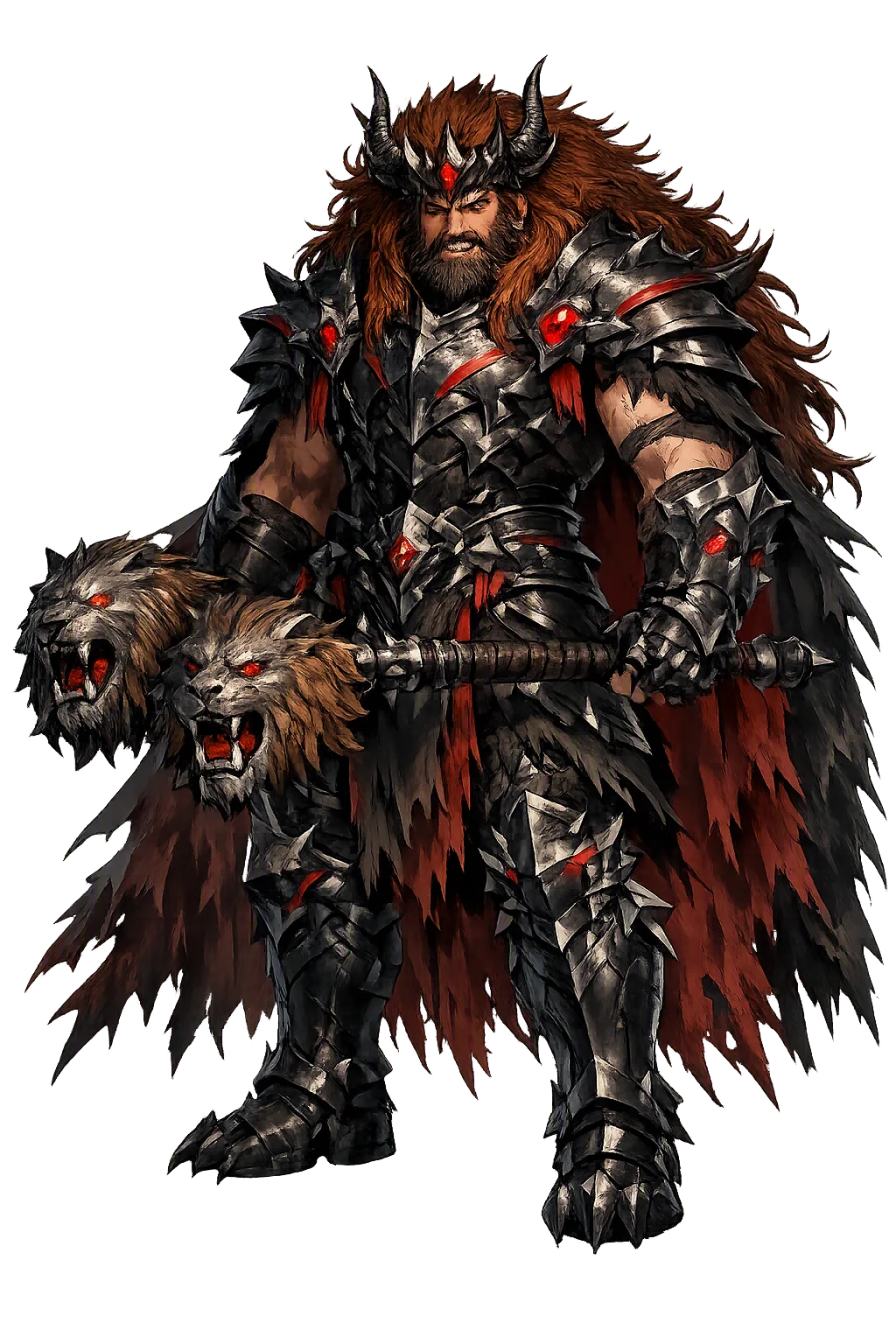
The lion is Nergal's face. From the Old Babylonian period onward, cylinder seals and bronze plaques show him as the armed warrior — sword, mace, or bow in hand — with the king of beasts beside him or beneath his feet, the predator that strikes without warning made the sign of a god who does the same. In the symbolic grammar of the boundary stones his emblem is abstracted further into the lion-headed mace, a staff topped with the beast's head that stands in the sculpted rows of kudurru divine symbols for Nergal alone. Around him cluster the hot creatures of the threshold: the scorpion of the desert's edge, the furnace-glow that Mesopotamian imagination lit in the underworld itself. No cult statue from Emeslam survives to tell us what his worshippers faced — the god's body was distributed across seals, plaques, and standards — but the type never wavered: the armed lion, burning.

06

Reception & Transformation

The name after its own age — transmission, translation, survival

Afterlives

Nergal's modern life began with the spade. The Assyrian palaces gave up his poems in the 1840s and 1850s: the library of Ashurbanipal at Nineveh yielded Nergal and Ereškigal and the Epic of Erra, pieced together from tablets of Nineveh, Assur, and Sultantepe. Assyriology then built his canon — René Labat's Traité (1951) published the diagnostic omens, and Luigi Cagni's edition of the Epic of Erra (1969) established the text on which a generation of readings rests, Thorkild Jacobsen's and Benjamin Foster's among them. The poem's afterlife in scholarship is the remarkable part: read as Mesopotamia's deepest meditation on war's appetite and the counselor who must restrain it, the Erra has become a text for political philosophy and peace studies as much as for mythology. His planet and his Greek passport travelled on without him; what the excavators recovered was the older, darker thing — a god whose own violence needed governing.

Identifications Across Traditions

Nergal was so closely identified with the Akkadian plague-god Erra that the two names are often treated as a single figure, especially in the first millennium BCE. His underworld role made him the consort of Ereshkigal; together they form the ruling couple of the Mesopotamian dead. Greek and Roman authors equated him with Ares and Mars, and Babylonian astral theology assigned him the planet Mars. In the Hebrew Bible, Nergal appears among the foreign gods of the Assyrian pantheon (2 Kings 17:30) — a rare case of a Mesopotamian deity entering the biblical record by name.

Modern Legacy

Nergal survives most visibly in Assyriology and in the continuing popular fascination with Mesopotamian underworld gods. His name has been adopted by bands, games, and fantasy settings as an emblem of infernal or martial power, though these modern uses rarely engage with the nuanced theology of the Epic of Erra or the Nergal and Ereshkigal myth. For PuniCodex, the name is a reminder that war, plague, and death were not separate departments in ancient Mesopotamia but a single jurisdiction personified by one god: the lion who rules both the battlefield and the grave.

07

The Meditation

What Nergal means — beyond the dictionary

To name Nergal is to name the moment when destruction becomes authority. He is not a chaotic demon but a god who descends through every gate, strips away his own divine equipment, and still emerges as sovereign. That descent is not a fall; it is a claim. The underworld, in his theology, is not an absence of order but a realm with its own king, its own queen, and its own laws.

The Epic of Erra adds a further tension: Nergal's violence is necessary enough to be feared and terrible enough to require restraint. Civilization, the poem suggests, survives not because the destroyer is eliminated but because he listens to counsel. That is a darker vision of peace than many modern mythologies prefer, but it is also a more honest one. Nergal still means: the power that kills must itself be governed, or it will burn the world it rules.

08

Frequently Asked Questions

Common questions about Nergal, Underworld, War, Plague, and Unicode restoration

01How do you pronounce Nergal?

In reconstructed pronunciation, Nergal is /ˈnɛər.ɡæl/ — approximately 'NAIR-gal' — stress the first syllable and let the second fall sharp, like a mace-stroke.

02What does Nergal mean?

Nergal means Lord of the great city in the mesopotamian tradition.

03What are the symbols of Nergal?

Nergal is associated with Lion (The kingly predator; Nergal's animal and the embodiment of merciless force), Sword, mace, and bow (The weapons of the warrior-god who strikes in battle and in plague alike), Scorpion (A creature of the hot desert and the threshold of death, associated with his underworld aspect), Furnace and fire (The burning heat of the Mesopotamian underworld and the fever of epidemic disease), Cuneiform wedge (The written sign 𒀭 (dingir) that marks his name as divine).

04Why restore Nergal in Unicode?

Nergal is written entirely in ASCII letters, so its restoration is about canonical fidelity rather than recovered diacritics: the temple fixes the name in its scholarly standard spelling, attested in the source tradition, instead of leaving it to drift.

05What is the most important myth about Nergal?

“Nergal and Ereshkigal” — the Descent story that anchors the mythology of Nergal, told in full on the lore page.

09

Scholarly Sources

The philological foundations of this restoration

Every claim on this page is grounded in established scholarship. The orthographic restorations follow disciplinary convention. The etymological chain follows the best available reference works. This is not invention — it is resurrection through scholarship.

◈

Lexicography & Philology

  • ETCSL
  • Black-Green
◎

Primary Texts

◉

Archaeology & Art History

  • Material evidence — iconography, inscriptions, and temple archaeology — for Nergal and related cults.
✦

Religious Studies

  • Nergal and Ereshkigal (Standard Babylonian and Amarna versions)
  • Epic of Erra (Erra and Ishum)
  • Enlil and Ninlil (Sumerian, ETCSL 1.2.1)
  • Black & Green, Gods, Demons and Symbols of Ancient Mesopotamia
  • Dalley, Myths from Mesopotamia
  • Foster, Before the Muses
Return

The Surface Awaits

You have traced the name from its earliest attestation to its Unicode restoration. Now return to the myth. The story is where the name lives.

Back to Lore
Nergal mascot