PuniCodex

Extended Lore

नरसिंह Narasiṃha

Etymology · Orthography · Cult · Iconography · Reception · Sources

Tier 1 Narasiṃha.com
Narasiṃha — Man-Lion Avatar
01

Quick Facts

Essential information about Narasiṃha, Man-Lion Avatar

Original Scriptनरसिंह
Unicode RestorationNarasiṃha
Reconstructed Pronunciation/narasimha/
PantheonSanskrit
DomainMan-Lion Avatar
MeaningThe Man-Lion — the fourth avatāra of Viṣṇu
ClassificationTier 1
Primary DomainNarasiṃha.com
Sacred SymbolsThe man-lion form, Claws (nakha), The pillar (stambha), Twilight (sandhyā), The serene child
02

Etymology & Word Family

From original script to Unicode restoration

Original Script नरसिंह Narasiṃha — "The Man-Lion — the fourth avatāra of Viṣṇu"
Unicode Restoration Narasiṃha Restored stress, length, and script
Modern ASCII narasimha Plain-ASCII fallback

Sanskrit Narasiṃha, from nara 'man' + siṃha 'lion'; the man-lion avatāra of Viṣṇu who slew Hiraṇyakaśipu.

03

Unicode Character Breakdown

Character-by-character philological analysis

CharacterUnicodeNameBlockPhonetic Role
NU+004ELatin Capital Letter NBasic LatinSame, capitalized
aU+0061Latin Small Letter ABasic LatinSame
rU+0072Latin Small Letter RBasic LatinSame
aU+0061Latin Small Letter ABasic LatinSame
sU+0073Latin Small Letter SBasic LatinSame
iU+0069Latin Small Letter IBasic LatinSame
ṃU+1E43Latin Small Letter M with Dot BelowUnknownM with dot: anusvara
hU+0068Latin Small Letter HBasic LatinSame
aU+0061Latin Small Letter ABasic LatinSame

The Tier 1 classification reflects how much of the original phonology this restoration preserves — stress and vowel length for Greek names, distinctive letters and diacritics for every other tradition.

04

Cult & Worship

How the sacred was kept — rites, sanctuaries, remains

The Cult

Narasiṃha's cult is ancient and continuous. The Udayagiri cave inscription of 401 CE already witnesses courtly devotion under Candragupta II, and by the medieval period his temples anchored regional landscapes: the nine shrines of Ahobilam scattered through the Nallamala hills, Simhachalam above Visakhapatnam where the deity is kept invisible under a coat of sandalwood paste renewed each year, and — newly risen — Yadadri in Telangana. Because his ferocity is the point, worship is a study in controlled approach: most temples daily propitiate the pacified lord, Lakṣmī often beside him, while the fierce form receives its great festival, Narasimha Jayanti in the spring month of Vaiśākha, when the emergence from the pillar is celebrated as the god's birthday. The priests are ordinary Vaiṣṇava arcakas, but the vow belongs to everyone: the man-lion's protective mantra is among the most widely worn in Hindu practice — at thresholds, in wartime, in childbirth.

In the Earth

The earliest monumental telling of the cycle stands at Udayagiri in Madhya Pradesh: Cave 6 (c. 400–401 CE, reign of Candragupta II) carves Narasiṃha disemboweling Hiraṇyakaśipu across his lap — one of the first dated images of the avatāra, and already iconographically complete. The sixth-century Dāśāvatāra temple at Deogarh adds a canonical panel within a full Viṣṇu program. In the far south, Ahobilam's nine shrines in the Nallamala hills embed the myth in living pilgrimage geography. The Vijayanagara capital at Hampi preserves the colossal monolithic Ugra-Narasimha, seated with the demon's body across his thighs, attributed to the early sixteenth century. Outside India, the Banteay Srei temple at Angkor (c. 967 CE) renders the same disemboweling in pink sandstone, with Prahlāda kneeling calmly beside the violence.

05

Iconography

How Narasiṃha was imaged across the ages

The Image

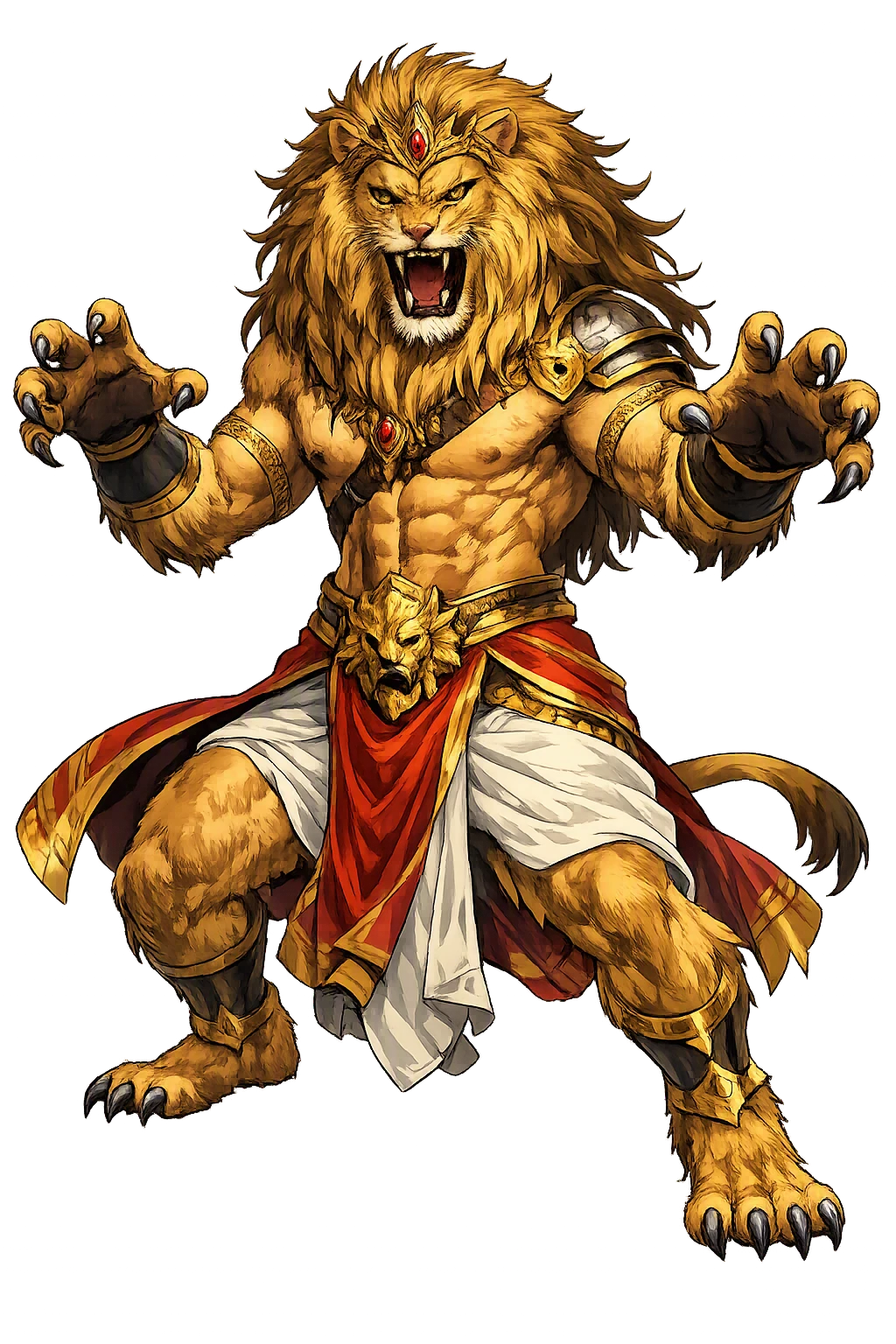
The iconography begins complete: the Udayagiri relief (c. 400 CE, Cave 6, Madhya Pradesh) already shows the man-lion with the tyrant across his thighs, among the first dated images of any avatāra. Two traditions then diverge — the ugra or fierce type, maned and many-armed, bulging-eyed, claws in the belly of Hiraṇyakaśipu, as in the colossal monolith at Hampi (early sixteenth century), and the soumya or serene type, seated in stillness, often with Lakṣmī. Sculptors codified the canon in the śilpa treatises — the fifteenth-century Rūpamaṇḍana prescribes the forms in detail — and the subject traveled with Sanskrit culture: Banteay Srei at Angkor (c. 967) renders the disemboweling in pink sandstone, Prahlāda kneeling unafraid beside it. South Indian bronzes carry the processional Narasimha through temple streets to this day, and the Deogarh Dashavatara panel (sixth century) shows the type absorbed into a full cosmic program.

06

Reception & Transformation

The name after its own age — transmission, translation, survival

Afterlives

The myth's transmission runs from the Purāṇas outward in every direction. Within India it fed sectarian argument for a millennium: the Śrīvaiṣṇava ācāryas hymned the Ahobilam lion — Vedānta Deśika's thirteenth-century verses make the hills themselves the god's body — while rival theological schools spun counter-tellings that kept Narasiṃha at the center of a long debate. Royalty took him up: the Vijayanagara kings identified their protection with the avatāra, and Hampi's colossus shows what that looked like at state scale; across the sea, Khmer builders carved the scene at Banteay Srei within decades of the temple's founding. The colonial age made him a document: Cunningham's Archaeological Survey fixed Udayagiri's importance in the nineteenth century, and the iconographic handbooks followed. In the bhakti centuries his name traveled as armor — the kavaca — and in modern scholarship the twilight loophole has become a standing case study in how Hindu theology thinks about the limits of language.

Identifications Across Traditions

Narasiṃha's afterlife is a study in devotional geography. In South India he became a royal deity: the Vijayanagara court identified itself with Viṣṇu's protective avatāras, and the colossal Ugra-Narasimha at Hampi still shows what the identification looked like in stone. Eastward, Khmer sculptors carved the disemboweling of Hiraṇyakaśipu at Banteay Srei (c. 967 CE), proof that the Purāṇic cycle traveled with Sanskrit culture beyond India. Śaiva tradition answered with the Śarabha episode, in which Śiva must subdue the man-lion's unquenchable rage — a counter-telling that kept Narasiṃha at the center of inter-sectarian argument. In Tantric practice his mantra became standard armor against danger; in vernacular bhakti, Prahlāda's story anchored the claim that devotion outlasts every worldly power.

Modern Legacy

Narasiṃha remains among the most actively worshipped forms of Viṣṇu. Ahobilam's nine shrines and Simhachalam near Visakhapatnam — where the deity is kept under a coat of sandalwood paste renewed annually — anchor major pilgrimage circuits, and Narasimha Jayanti, falling on the full moon of Vaiśākha, celebrates the twilight of the boon. The name itself never left circulation: Narasiṃha, Narasingh, and Narasimhudu serve as given names across India, and new temples — most visibly Yadadri in Telangana — continue to rise around the old story. Modern retellings, from children's comics to cinema, keep returning to the two figures the Purāṇas made unforgettable: the father with the airtight contract, and the son with only a name.

07

The Meditation

What Narasiṃha means — beyond the dictionary

Narasiṃha is the divine answer to a lawyer's question: what can kill the man who closed every door? The tradition's answer refuses the terms of the contract — not by breaking it, which would make the god a cheat, but by stepping into the one space the contract could not name: twilight, threshold, claw, man-lion. It is mythology doing what it does at its best, exposing the poverty of exhaustive conditions. The boon fails not because it was poorly drafted but because reality is wider than any list. And the myth's second movement is the greater one: the killing does not end the story — a child's unafraid gentleness does. Between the disemboweled tyrant and the blessed boy, the Purāṇas place the cycle's true thesis: the ferocity that guards the universe is finally governed by, and governs itself for, devotion.

08

Frequently Asked Questions

Common questions about Narasiṃha, Man-Lion Avatar, and Unicode restoration

01How do you pronounce Narasiṃha?

In reconstructed pronunciation, Narasiṃha is /narasimha/ — approximately 'NARASIMHA' — pronounce the restored form with attention to the preserved diacritics and length.

02What does Narasiṃha mean?

Narasiṃha means The Man-Lion — the fourth avatāra of Viṣṇu in the sanskrit tradition.

03What are the symbols of Narasiṃha?

Narasiṃha is associated with The man-lion form (The theriomorphic body that defeats the boon: leonine mane and claws joined to human torso and intelligence.), Claws (nakha) (Neither weapon nor hand — the talons that honor the letter of the boon while breaking its intent; the nails themselves are hymned (nakhastuti).), The pillar (stambha) (The palace column that conceals the god; in theology, the stambha is the imperishable inner support of all beings.), Twilight (sandhyā) (Neither day nor night — the loophole hour at which the law of the boon is honored and destroyed at once.), The serene child (Prahlāda standing unafraid beside the killer — devotion as the one power the man-lion will always answer.).

04Why restore Narasiṃha in Unicode?

Plain ASCII narasimha strips the stress, length, and script that make the name specific. Unicode restoration returns the name to its original written dignity.

05What is the most important myth about Narasiṃha?

“The Boon of Hiraṇyakaśipu” — the Bhāgavata Purāṇa 7.3 story that anchors the mythology of Narasiṃha, told in full on the lore page.

09

Scholarly Sources

The philological foundations of this restoration

Every claim on this page is grounded in established scholarship. The orthographic restorations follow disciplinary convention. The etymological chain follows the best available reference works. This is not invention — it is resurrection through scholarship.

◈

Lexicography & Philology

  • MW
  • Bhagavata
◎

Primary Texts

  • Bhāgavata Purāṇa 7.1–10
  • Viṣṇu Purāṇa 1.17–20
  • Śiva Purāṇa — the Śarabha episode (Śaiva counter-telling)
◉

Archaeology & Art History

  • Material evidence — iconography, inscriptions, and temple archaeology — for Narasiṃha and related cults.
✦

Religious Studies

  • Narasimha Purāṇa
  • Udayagiri Cave 6 relief and inscription, c. 400 CE
  • Monier-Williams, Sanskrit–English Dictionary, s.v. narasimha
Return

The Surface Awaits

You have traced the name from its earliest attestation to its Unicode restoration. Now return to the myth. The story is where the name lives.

Back to Lore
Narasiṃha mascot