PuniCodex

Extended Lore

Myrddin

Etymology · Phonology · Orthography · Cultural Legacy · Primary Sources

Tier 2 Myrddin
Myrddin — Seer, Wild Man
01

Quick Facts

Essential information about Myrddin, Seer, Wild Man

Scholarly TransliterationMyrddin
Unicode RestorationMyrddin
Reconstructed Pronunciation/ˈmər.ðɨn/
PantheonCeltic
DomainSeer, Wild Man
MeaningMerlin
ClassificationTier 2
Primary DomainMyrddin
Sacred SymbolsThe apple tree, The forest of Celyddon, The stag, Rock, tree, and water, Gwenddydd's questions
02

Etymology & Word Family

From original script to Unicode restoration

Scholarly Transliteration Myrddin Myrddin — "Merlin"
Unicode Restoration Myrddin Restored stress, length, and script
Modern ASCII myrddin Plain-ASCII fallback

Myrddin is Tier 2 by the mechanical rule: the normalized Middle Welsh form is already plain ASCII — there is no diacritic and no distinctive atomic letter for the ASCII alphabet to lose, and the digraph dd is an orthographic convention, not a lost character. The capital alone distinguishes the temple form from the input; the prophet's standing in the tradition is beside the point.

03

Unicode Character Breakdown

Character-by-character philological analysis

CharacterUnicodeNameBlockPhonetic Role
MU+004DLatin Capital Letter MBasic LatinSame, capitalized
yU+0079Latin Small Letter YBasic LatinSame
rU+0072Latin Small Letter RBasic LatinSame
dU+0064Latin Small Letter DBasic LatinSame
iU+0069Latin Small Letter IBasic LatinSame
nU+006ELatin Small Letter NBasic LatinSame

The Tier 2 classification reflects how much of the original phonology this restoration preserves — stress and vowel length for Greek names, distinctive letters and diacritics for every other tradition.

04

Cultural Significance

From ancient cult to modern Unicode

Ancient Domain

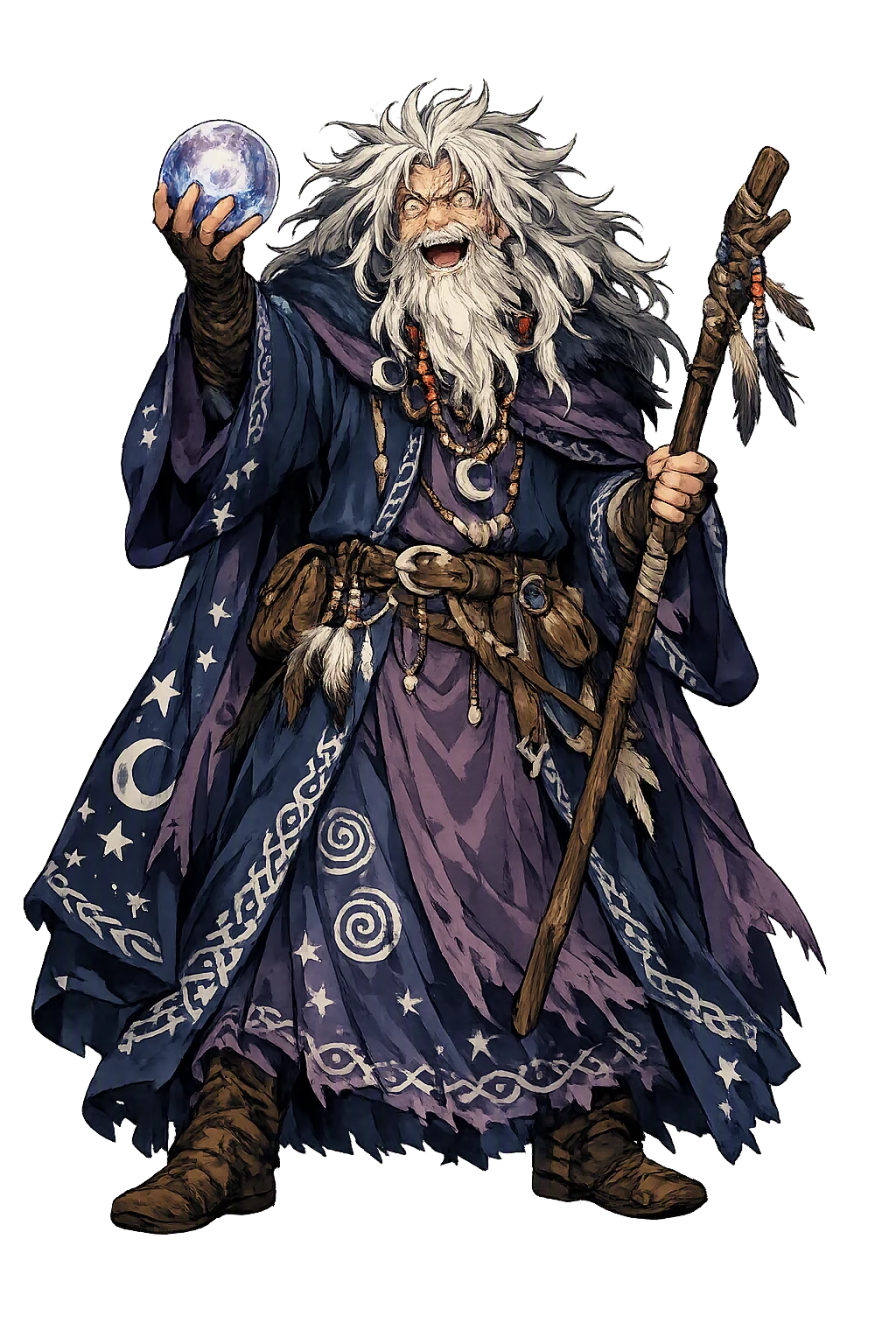
Myrddin is the original Welsh form of the name the world knows as Merlin: the prophet who went mad at the battle of Arfderydd in 573, fled into the Caledonian forest, and lived there as a wild man — lamenting his dead lord Gwenddolau, sheltering beneath an apple tree, and uttering the prophecies that made him the canonical voice of Welsh vaticination before Geoffrey of Monmouth made him the wizard of the Arthurian world.

Myrddin in Later Traditions

Myrddin's comparisons run north, not east. The twelfth-century Life of St Kentigern by Jocelyn of Furness knows a mad prophet at the court of Rhydderch Hael named Lailoken, who foretold his own threefold death; a fragmentary Latin life of 'Merlin the Wild' preserved in the Cotton collection tells the same penitence, conversion by Kentigern, and triple end — stoned, fallen on a stake, drowned in the Tweed. Nikolai Tolstoy's Quest for Merlin argued that Lailoken and Myrddin Wyllt are two records of one north-British wild-man figure, and the modern handbooks treat the kinship as real, its exact shape unproven. The Irish tradition offers no namesake — the wild men of the Irish tales, Suibhne Geilt above all, share the type rather than the name: the king driven mad by battle who lives in trees, speaks in verse, and is watched by the court he left. Within the Welsh corpus his truest kin is [[taliesin|Taliesin]], the other great prophetic poet, with whom the Vita Merlini pairs him in discourse; and his own tradition split him in two, as Gerald of Wales records — Merlinus Ambrosius of Dinas Emrys and Merlinus Celidonius of the Caledonian forest, the tower-boy and the wild man the romances later fused.

Modern Legacy

No Celtic figure has had a stranger second life. Geoffrey's Prophetiae Merlini — the seventh book of the Historia — circulated separately for centuries and became the most copied political prophecy of the Latin Middle Ages, mined for omens by kings and rebels alike; the romances then turned the prophet into the enchanter, and by the thirteenth-century Vulgate cycle Merlin is Arthur's maker: arranger of Uther's night at Tintagel, keeper of the Round Table's founding, and prisoner of the Lady of the Lake. Lady Charlotte Guest's Mabinogion (1838–49) and the nineteenth-century Arthurian revival carried the Welsh roots back into English view, and modern scholarship — Jarman above all — rebuilt the northern prophet behind the wizard. In Welsh memory the original never disappeared: Caerfyrddin, 'Myrddin's fortress', still bears the folk etymology Geoffrey loved, and the Myrddin of the Black Book remains the patron of Welsh prophecy — the figure every later brud quietly pretended to be. The name now means the wizard worldwide; the temple's task is to hand the name back to the wild man it began with.

Unicode Restoration as Cultural Act

Restoring Myrddin in a domain name is more than orthographic accuracy. It is a statement that the internet should recognize the full range of human writing — not only the ASCII keyboard.

05

Frequently Asked Questions

Common questions about Myrddin, Seer, Wild Man, and Unicode restoration

01How do you pronounce Myrddin?

In reconstructed pronunciation, Myrddin is /ˈmər.ðɨn/ — approximately 'MUR-thin' — stress the first syllable (the Welsh penult); the dd is the soft 'th' of 'this', and the whole name takes two short beats, never 'MER-lin'..

02What does Myrddin mean?

Myrddin means Merlin in the celtic tradition.

03What are the symbols of Myrddin?

Myrddin is associated with The apple tree (The wild man's shelter and confidant — prophecy spoken from hiding, sweet and bitter at once), The forest of Celyddon (The Caledonian wood — madness, exile, and second sight in one landscape), The stag (The wild mount he rides to court in the Vita Merlini, driving the forest's herds before him), Rock, tree, and water (The three elements of the foretold death — prophecy that cannot miss, however it is guarded against), Gwenddydd's questions (The sister's dialogue — prophecy as the speech left between the mad and those who loved them).

04Why restore Myrddin in Unicode?

Plain ASCII myrddin strips the stress, length, and script that make the name specific. Unicode restoration returns the name to its original written dignity.

05What is the most important myth about Myrddin?

The Annales Cambriae enter under the year 573 the battle of Arfderydd, fought in the north between the sons of Eliffer and Gwenddolau son of Ceidio — a historical-seeming conflict of the British Old North. The Welsh Triads count it among the futile battles of the Island of Britain, brought about, in the triad's famous understatement, for a lark's nest; and the triad records the consequence that matters here: Gwenddolau fell, and Myrddin became mad.From that seed the whole legend grows. Myrddin son of Morfryn, his lord dead and his side defeated, flees the world of the mead-hall into Coed Celyddon, the Caledonian forest, and becomes Myrddin Wyllt — the Wild — living from the forest's gifts and speaking only in verse and prophecy.

06

Scholarly Sources

The philological foundations of this restoration

Every claim on this page is grounded in established scholarship. The orthographic restorations follow disciplinary convention. The etymological chain follows the best available reference works. This is not invention — it is resurrection through scholarship.

Lexicography & Philology

  • Welsh Triads
  • MacKillop

Primary Texts

  • The Immram Brain (Voyage of Bran); Tochmarc Étaíne; Cóir Anmann; medieval Irish saga literature.

Archaeology & Art History

  • Material evidence — iconography, inscriptions, and temple archaeology — for Myrddin and related cults.
  • Myrddin is a textual figure, and his witnesses are among the most precisely identified in Welsh letters. The Afallennau and Oianau stand in the Black Book of Carmarthen (Aberystwyth, NLW Peniarth MS 1, c. 1250), the earliest surviving manuscript in Welsh; the Cyfoesi Myrddin a Gwenddydd stands in the Red Book of Hergest (Oxford, Jesus College MS 111, c. 1382–1410); Geoffrey's Vita Merlini survives complete in a single manuscript (British Library, Cotton Vespasian E.iv, thirteenth century). The landscape behind the texts is real and partly recoverable: Arfderydd is traditionally identified with Arthuret near Longtown in Cumbria, in the Old North the poems remember; Caerfyrddin (Carmarthen) overlays the Roman fort of Moridunum, 'sea-fort', attested in the Antonine Itinerary and confirmed by excavation — the place-name from which, on the scholarly account, the prophet's name derives; and Dinas Emrys, the hillfort in Gwynedd where Nennius sets the fatherless boy and the dragons, yielded post-Roman occupation material in Savory's excavations of 1954–56. No inscription names Myrddin, and none would be expected: the early stones of Wales record the dead, not prophets.

Religious Studies

  • Geoffrey of Monmouth, Vita Merlini, ed. and trans. Basil Clarke (Cardiff: University of Wales Press, 1973) — the madness, the Caledonian forest, the threefold death, Ganieda, and Taliesin's visit
  • Geoffrey of Monmouth, Historia Regum Britanniae (c. 1136), Books VI–VII — Merlinus Ambrosius, Vortigern's tower, the dragons, and the Prophetiae Merlini
  • Yr Afallennau and Yr Oianau, in the Black Book of Carmarthen (c. 1250); cf. A. O. H. Jarman, 'Llyfr Du Caerfyrddin: The Black Book of Carmarthen', Proceedings of the British Academy 71 (1985)
  • Cyfoesi Myrddin a Gwenddydd ei chwaer, in the Red Book of Hergest — the dialogue of Myrddin and his sister
  • Annales Cambriae, s.a. 573 — bellum Armterid; the battle of Arfderydd
  • Bromwich, Rachel, ed. and trans., Trioedd Ynys Prydein: The Welsh Triads (Cardiff: University of Wales Press, 1961; 3rd ed. 2006) — Arfderydd among the futile battles; Myrddin son of Morfryn
  • Historia Brittonum (Nennius), ed. and trans. John Morris (1980), §§40–42 — the fatherless boy Ambrosius and the two dragons
  • Gerald of Wales, Itinerarium Cambriae II.8 — the two Merlins, Ambrosius and Celidonius-Sylvester
  • Jocelyn of Furness, Vita Sancti Kentigerni — Lailoken, the mad prophet of Rhydderch's court
  • Jarman, A. O. H., The Legend of Merlin (Cardiff: University of Wales Press, 1970); and 'The Merlin Legend and the Welsh Tradition of Prophecy', in The Arthur of the Welsh (Cardiff, 1991)
  • Jackson, Kenneth H., Language and History in Early Britain (Edinburgh, 1953) — Moridunum and the name of Carmarthen
  • Tolstoy, Nikolai, The Quest for Merlin (London: Hamish Hamilton, 1985) — Lailoken and the northern wild man
  • Koch, John T., ed., Celtic Culture: A Historical Encyclopedia (ABC-CLIO, 2006), s.vv. Myrddin, Merlin, Arfderydd
  • MacKillop, James, Dictionary of Celtic Mythology (Oxford, 1998), s.vv. Merlin, Myrddin
Return

The Surface Awaits

You have traced the name from its earliest attestation to its Unicode restoration. Now return to the myth. The story is where the name lives.

Back to Lore
Myrddin mascot