PuniCodex

Extended Lore

Μοῖραι Moirai

Etymology · Orthography · Cultural Legacy · Reception · Primary Sources

Tier 1 Moirai
Moirai — Fate, Destiny, Thread
01

Quick Facts

Essential information about Moirai, Fate, Destiny, Thread

Original ScriptΜοῖραι
Unicode RestorationMoirai
Reconstructed Pronunciation/môi̯.rai/
PantheonGreek
DomainFate, Destiny, Thread
MeaningApportioners (from μείρομαι)
ClassificationTier 1
Primary DomainMoirai
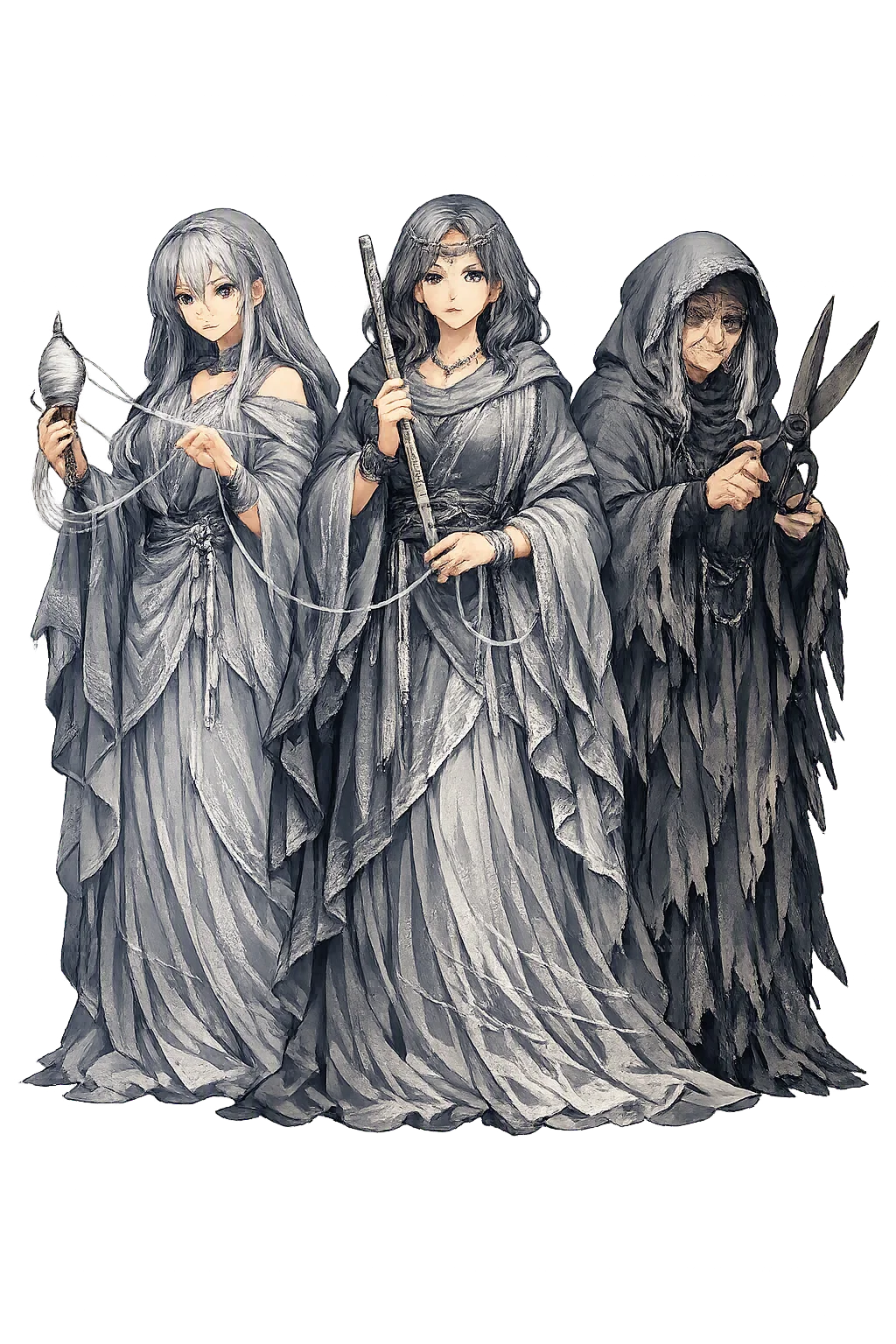
Sacred SymbolsThe thread, Spindle and distaff, The shears, The scales of Zeus, The number three
02

Etymology & Word Family

From original script to Unicode restoration

Original Script Μοῖραι Moirai — "Apportioners (from μείρομαι)"
Unicode Restoration Moirai Canonical scholarly spelling — ASCII-identical
Modern ASCII moirai Plain-ASCII fallback

Apportioners (from μείρομαι)

03

Unicode Character Breakdown

Character-by-character philological analysis

CharacterUnicodeNameBlockPhonetic Role
MU+004DLatin Capital Letter MBasic LatinMu
oU+006FLatin Small Letter OBasic LatinShort omicron
iU+0069Latin Small Letter IBasic LatinShort iota
rU+0072Latin Small Letter RBasic LatinRho
aU+0061Latin Small Letter ABasic LatinShort alpha
iU+0069Latin Small Letter IBasic LatinShort iota

The Tier 1 classification here reflects fidelity to the attested tradition, not recovered diacritics: every character of Moirai already survives in ASCII. What the restoration preserves is the canonical spelling itself — the form scholarship standardised.

04

Cultural Significance

From ancient cult to modern memory

Moirai in Later Traditions

Rome translated the Moirai as the Fata or Parcae — Nona, Decuma, and Morta, one for each month of gestation, which tells us where the Romans thought fate is decided: at the cradle. Their names passed into every European language as “fate” itself (Italian fato, French destin). Medieval Iceland and Ireland kept sisters of the same office — the Norns of the Prose Edda, who likewise shape and cut beneath the world-tree — and Shakespeare’s “weird sisters” in Macbeth descend from Old English wyrd, “fate,” through Holinshed’s chronicle: three women prophesying at the edge of a battlefield. In modern Greek, μοίρα simply means “fate.” The Moirai never needed a myth of conquest; every culture found them again.

Modern Legacy

The Moirai were worshipped, if modestly. Pausanias (2.11.3) describes their sanctuary at Sicyon, where they stood with Zeus Moiragetes, “Leader of the Fates,” and they received cult at Delphi and in Athens. Plato has Socrates acknowledge them in his last words — “we owe a cock to Asklepios” (Phaedo 118a). Their lasting monument is linguistic: “fate,” “moira,” the fatalism of tragedy and the novel. The image of three women spinning proved indestructible — it survives in Macbeth’s witches, in the cradle-fays of European folktale, and in the modern idiom of the “thread of life.” To spin, to measure, to cut: the oldest job description in the world, and the one nobody escapes.

In the Earth

The Moirai are creatures of text and vase more than of cult: no great temple is theirs, though Pausanias records their sanctuary at Sicyon beside Zeus Moiragetes (2.11.3) and they shared altars at Delphi. In art they appear from the late sixth century BCE as three working women — spinners with distaff and wool basket, deliberately ordinary, the fates dressed like the neighbors. Attic and South Italian vase painters show them at the births of gods and heroes; on Apulian funerary vases of the fourth century they attend Hades and Persephonē, shears in hand, turning a household craft into the machinery of death. Epigraphy extends their metaphor into administration: the Greek city distributed land and office by lot (klēros, the same language of “portion”), so that the polis lived institutionally inside the Moirai’s image of the allotted share.

05

The Meditation

What Moirai means — beyond the dictionary

The Moirai are Greek theology’s quietest, most radical idea: that the universe has a budget. Every life is allotted — spun out, measured, cut — and neither prayer nor virtue can extend the thread by a single cubit, though in the Odyssey Zeus protests (and concedes) that mortals blame the gods for what their own recklessness brings. Homer already contains the argument the philosophers will spend four centuries having: is fate compulsion, or only foreknowledge?

Plato’s answer — that we choose our lives and the Moirai only hold the spindle — turns fate into freedom with a terrible caveat: the choice is made half-blind, drunk on forgetfulness. The Moirai thus stand exactly where Greek thought passes from myth to ethics. They ask the question every mortal asks at three in the morning — how long, why me, who decided — and they answer with their implements: it is spun, it is measured, it is cut; and between the measuring and the cutting, everything you are is up to you.

06

Screen & Culture

Where Moirai echoes through film, television, and games — and how

07

Frequently Asked Questions

Common questions about Moirai, Fate, Destiny, Thread, and Unicode restoration

01How do you pronounce Moirai?

In reconstructed pronunciation, Moirai is /môi̯.rai/ — approximately 'MOY-rye' — one long falling note on the first syllable, then a bright quick ending; the plural of μοῖρα, 'portion.'.

02What does Moirai mean?

Moirai means Apportioners (from μείρομαι) in the greek tradition.

03What are the symbols of Moirai?

Moirai is associated with The thread (The life-thread each mortal receives at birth — spun, measured, and finally cut; the spindle is their oldest attribute in art.), Spindle and distaff (Klōthō’s working tools; on vase paintings the Moirai appear as household spinners, like the women of any Greek town.), The shears (Atropos’ implement — the cut no prayer delays; Greek and Roman funerary art borrows the image for death itself.), The scales of Zeus (In Iliad 22.209–213 Zeus weighs the fates (kēres) of Achilles and Hector in golden scales — the Moirai’s portion made visible.), The number three (Three sisters for three moments — beginning, middle, end; the triad that gives fate its complete, closed shape.).

04Why restore Moirai in Unicode?

Moirai is written entirely in ASCII letters, so its restoration is about canonical fidelity rather than recovered diacritics: the temple fixes the name in its scholarly standard spelling, attested in the source tradition, instead of leaving it to drift.

05What is the most important myth about Moirai?

“Daughters of Night — or of Zeus” — The Moirai’s mythology is scattered across the whole of Greek epic and philosophy — a genealogy told twice, two births they attend out of jealousy and pity, a loophole a god must pay for, and a final Platonic vision that hands fate back to the chooser. Their stories are always about the same question: who, in the end, is responsible for a life? The full telling lives on the lore page.

08

Scholarly Sources

The philological foundations of this restoration

Every claim on this page is grounded in established scholarship. The orthographic restorations follow disciplinary convention. The etymological chain follows the best available reference works. This is not invention — it is resurrection through scholarship.

Lexicography & Philology

  • Liddell, H. G., Scott, R., & Jones, H. S. A Greek-English Lexicon. Oxford: Clarendon Press, 9th ed. 1996.
  • Pape, W., & Benseler, G. E. Wörterbuch der griechischen Eigennamen. Braunschweig: Vieweg, 1884.
  • Beekes, R. S. P. Etymological Dictionary of Greek. Leiden: Brill, 2010.

Primary Texts

  • Hesiod, Theogony 217–222 and 901–906 (the two genealogies)
  • Homer, Iliad 19.91–133 (Herakles); 9.529–599 (Meleager); 20.127–128; 22.209–213 (the scales of Zeus)
  • Euripides, Alcestis 1–27; Apollodorus, Library 3.10.4; Hyginus, Fabulae 50–51 (Apollo and Admetos)
  • Plato, Republic 10.614b–621d (the myth of Er); Phaedo 118a
  • Pausanias 2.11.3 (sanctuary of the Moirai at Sicyon)

Archaeology & Art History

  • Material evidence — iconography, inscriptions, and temple archaeology — for Moirai and related cults.

Religious Studies

  • Beekes, Etymological Dictionary of Greek, s.v. μοῖρα
Return

The Surface Awaits

You have traced the name from its earliest attestation to its Unicode restoration. Now return to the myth. The story is where the name lives.

Back to Lore
Moirai mascot