PuniCodex

Extended Lore

ᛘᛁᚢᛚᚾᛁᚱ Mjólnir

Etymology · Phonology · Orthography · Cultural Legacy · Primary Sources

Tier 1 Mjólnir
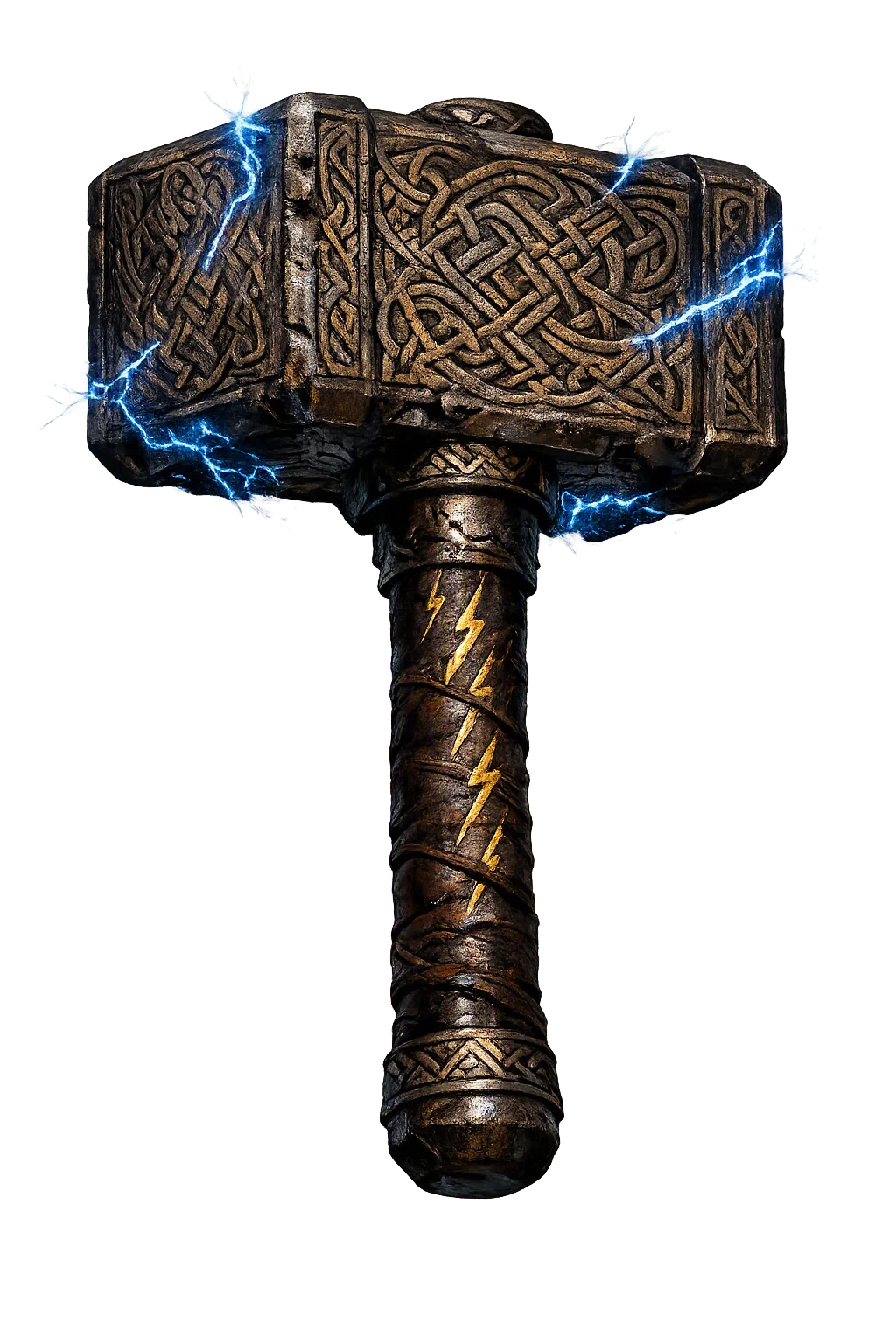
Mjólnir — Thunder Hammer
01

Quick Facts

Essential information about Mjólnir, Thunder Hammer

Original Scriptᛘᛁᚢᛚᚾᛁᚱ
Unicode RestorationMjólnir
Reconstructed Pronunciation/ˈmjɔlː.nir/
PantheonNorse
DomainThunder Hammer
MeaningThe grinder
ClassificationTier 1
Primary DomainMjólnir
Sacred SymbolsThe short haft, The unerring throw, The hidden hammer, Lightning made iron, The amulet
02

Etymology & Word Family

From original script to Unicode restoration

Original Script ᛘᛁᚢᛚᚾᛁᚱ Mjólnir — "The grinder"
Unicode Restoration Mjólnir Restored stress, length, and script
Modern ASCII mjolnir Plain-ASCII fallback

Mjólnir is Tier 1: the acute on ó marks stress on the first syllable — a feature the ASCII form loses — and the fuller scholarly form Mjǫllnir additionally carries the o-ogonek and the geminate ll of the dictionaries (Cleasby–Vigfusson, s.v. 'Mjöllnir'; Zoëga, s.v. 'Mjǫllnir'). The etymology is genuinely disputed: proposals connect the name to Old Norse mala, 'to grind' ('the grinder'), to mjǫll, 'new snow' ('the shining one'), and to the Slavic lightning word seen in Russian mólnija, and the scholarship has settled on none of them.

03

Unicode Character Breakdown

Character-by-character philological analysis

CharacterUnicodeNameBlockPhonetic Role
MU+004DLatin Capital Letter MBasic LatinSame, capitalized
jU+006ALatin Small Letter JBasic LatinSame
óU+00F3Latin Small Letter O with AcuteLatin-1 SupplementStress on o
lU+006CLatin Small Letter LBasic LatinSame
nU+006ELatin Small Letter NBasic LatinSame
iU+0069Latin Small Letter IBasic LatinSame
rU+0072Latin Small Letter RBasic LatinSame

The Tier 1 classification reflects how much of the original phonology this restoration preserves — stress and vowel length for Greek names, distinctive letters and diacritics for every other tradition.

04

Cultural Significance

From ancient cult to modern Unicode

Ancient Domain

In the norse tradition, Mjólnir is the hammer of Þórr — the one treasure the gods cannot do without. Dwarf-forged and short in the haft from Loki's sabotage, it never misses its mark, never flies so far that it fails to return to the thrower's hand, and shrinks small enough to be hidden inside a shirt. With it Þórr holds the wall between Ásgarðr and the giants.

Yet the hammer is not only a weapon. It is laid in the bride's lap to hallow the marriage, raised over the newborn, and lifted against the dead man's pyre — it blessed Baldr's burning ship. In the Viking Age men and women wore it in silver and iron around their necks, the heathen answer to the Christian cross, and it is worn again today.

Mjólnir in Later Traditions

The hammer did not stay inside Iceland's manuscripts. On the continent its god appears as Donar, and when Adam of Bremen describes the temple at Uppsala he says that Thor 'with his mace looks like Jupiter' — the interpretatio romana equating thunder with thunder. Saxo Grammaticus gives Thor an oak club and, tellingly, preserves the short handle: in the Gesta Danorum the hero Høther disables the weapon by lopping off its shaft, an euhemerized echo of the fly at the bellows. Archaeology reaches further back: scholars have long connected the hammer pendants to the older club-of-Hercules amulets of the Roman frontier provinces, and Bronze Age rock carvings already show axe- and hammer-bearing figures in consecrating poses.

Comparativists place Mjǫllnir in a wide Indo-European family of thunder-weapons — Indra's vajra, the club of the Dagda, the axe of Perun — and one proposed etymology would make the name itself a cousin of Slavic mólnija, 'lightning', though the derivation is contested. In later folklore the weapon survived transmuted: Neolithic axe-heads and belemnites were kept as 'thunder-stones' (torshammare), guards against lightning, and early-modern Icelandic grimoires went so far as to label the swastika 'Thor's hammer'. The twentieth century folded the hammer back into myth again through comics and film — a modern transmutation as thorough as any Saxo performed.

Modern Legacy

Nineteenth-century art made the hammer visible: Mårten Eskil Winge's Thor's Fight with the Giants (1872) swings it over the goat-chariot, and the book illustrations of Lorenz Frølich and Elmer Boyd Smith fixed the bridal veil and the forge in the popular imagination. In Wagner's Ring it is Donner — the continental Þórr — who raises the hammer in Das Rheingold to summon the storm that clears the air for the rainbow bridge to Valhalla. Games have made the weapon interactive, from Smite and Valheim to God of War Ragnarök, where Mjölnir is an antagonist's instrument. Marvel's Mjolnir, introduced in 1962, added the 'worthiness' enchantment — whosoever holds this hammer — a modern invention with no Eddic basis, and arguably the single most successful addition to the mythology since Snorri. In modern Heathenry and Ásatrú the hammer is worn and wielded again in earnest: the hamarsigna, the sign of the hammer, blesses rites much as the sources describe, and since 2013 the Mjölnir emblem has been approved for the government headstones of American service members. Restoring Mjólnir in Unicode preserves the name's Old Norse specificity — stress, rounding, and length — against the flattening force of plain ASCII.

Unicode Restoration as Cultural Act

Restoring Mjólnir in a domain name is more than orthographic accuracy. It is a statement that the internet should recognize the full range of human writing — not only the ASCII keyboard.

05

Frequently Asked Questions

Common questions about Mjólnir, Thunder Hammer, and Unicode restoration

01How do you pronounce Mjólnir?

In reconstructed pronunciation, Mjólnir is /ˈmjɔlː.nir/ — approximately 'MYAWL-lnir' — begin with the mj of 'music', sound the vowel like the short rounded 'o' of 'hot', and hold the ll double before the final '-nir'..

02What does Mjólnir mean?

Mjólnir means The grinder in the norse tradition.

03What are the symbols of Mjólnir?

Mjólnir is associated with The short haft (The flaw left by Loki's fly-form sabotage at the bellows — the defect that makes the hammer a one-handed weapon), The unerring throw (It never misses its target and never flies so far that it fails to return to the thrower's hand), The hidden hammer (It shrinks small enough to be kept inside the shirt — power carried unseen), Lightning made iron (The thunderbolt given haft and head, the storm wielded as a tool), The amulet (The pendant form worn across the Viking world, the heathen counterpart of the cross).

04Why restore Mjólnir in Unicode?

Plain ASCII mjolnir strips the stress, length, and script that make the name specific. Unicode restoration returns the name to its original written dignity.

05What is the most important myth about Mjólnir?

After Loki shears the goddess Sif's hair, he must replace it, and from the sons of Ívaldi he commissions three treasures: hair of living gold for Sif, the ship Skíðblaðnir, and the spear Gungnir. Swaggering, he wagers his own head with the dwarf Brokkr that Brokkr's brother Sindri — named Eitri in some tellings — cannot make three treasures as fine. At the forge, Loki turns himself into a fly and bites Brokkr at the bellows: once on the arm, once on the neck, and neither bite moves him. But the third bite lands on his eyelid as Sindri works the iron, and blood blinds him for one stroke of the bellows. Out comes a hammer — and its haft is too short.Óðinn, Þórr, and Freyr judge the treasures, and Brokkr names the hammer's virtues: however hard it is swung, it will not fail; thrown, it never misses; it will never fly so far that it does not return to the hand; and it can be made so small it is kept inside the shirt. Only the short haft stands against it. The gods judge it the best of all six gifts, for with it the Æsir can defend themselves against the frost giants — and Loki keeps his head. The flaw in the most trusted weapon in the world is the permanent signature of Loki's sabotage.

06

Scholarly Sources

The philological foundations of this restoration

Every claim on this page is grounded in established scholarship. The orthographic restorations follow disciplinary convention. The etymological chain follows the best available reference works. This is not invention — it is resurrection through scholarship.

Lexicography & Philology

  • Poetic Edda
  • Cleasby-Vigfusson

Primary Texts

  • Poetic Edda: Þrymskviða (Bellows translation) — the theft of the hammer and Þórr's bridal disguise
  • Poetic Edda: Lokasenna (Bellows translation) — Loki's flyting, with the hammer as refrain and final threat
  • Prose Edda: Skáldskaparmál (Brodeur translation) — Loki's wager and the forging of Mjǫllnir
  • Prose Edda: Gylfaginning (Brodeur translation) — the goat-hallowing, the duel with Hrungnir's tradition, and Baldr's pyre

Archaeology & Art History

  • Material evidence — iconography, inscriptions, and temple archaeology — for Mjólnir and related cults.
  • The hammer is one of the best-attested symbols of the Viking age. Around a thousand Mjǫllnir pendants in iron, silver, and amber have been unearthed across Scandinavia, England, northern Germany, the Baltic, and Russia — most simply made, about a hundred with ornament, and a tenth from graves, predominantly women's cremations; Jörn Staecker's typology (1999) and Katherine Beard's Eitri database (2019) order the material. Famous finds include the Rømersdal hammer from Bornholm, the gold-plated Bredsätra pendant from Öland, the Foss 'wolf-cross' from Iceland that reads as cross and hammer at once, and the Hiddensee gold treasure, where a hammer hangs among crosses. The Købelev hammer from Lolland (10th century) is the only one that names itself, inscribed in Younger Futhark 'hamar × is' — 'this is a hammer' — and the 11th-century Kvinneby copper amulet from Öland invokes Þórr's protection 'with his hammer' in runes. Iron hammer-rings cluster in the cremation graves of the Mälaren region, Åland, and Russia. Thor's hammer is carved on runestones (DR 26, DR 48, DR 120, VG 113, Sö 86, Sö 111) and appears in the fishing scenes on the Altuna stone and at Gosforth; the small bronze Eyrarland figure from Iceland (c. AD 1000) may show the god gripping it. Saxo Grammaticus records that as late as 1125 Magnus the Strong carried off great bronze 'hammers of Jupiter' from a Swedish temple. Textually, Þrymskviða and Lokasenna survive in the Codex Regius of the Poetic Edda (c. 1270), the forging and the hallowing of Baldr's pyre in the Prose Edda manuscripts, above all the Codex Regius GKS 2367 4to.

Religious Studies

  • Völsunga saga (Morris & Magnússon translation), Project Gutenberg #1152 — the heroic world in which the hammer's oath was sworn
  • Þrymskviða, Old Norse text (heimskringla.no)
  • Mjölnir — Wikipedia: attestations, archaeology, and the etymological debate
  • National Museum of Denmark — Christianity comes to Denmark: the mould that casts hammer and cross together
Return

The Surface Awaits

You have traced the name from its earliest attestation to its Unicode restoration. Now return to the myth. The story is where the name lives.

Back to Lore
Mjólnir mascot