PuniCodex

Extended Lore

Mixcōātl

Etymology · Orthography · Cult · Iconography · Reception · Sources

Tier 1 Mixcōātl.com
Mixcōātl — Clouds, Hunting, the Milky Way
01

Quick Facts

Essential information about Mixcōātl, Clouds, Hunting, the Milky Way

Scholarly TransliterationMixcōātl
Unicode RestorationMixcōātl
Reconstructed Pronunciation/miʃ.ˈkoː.aː.tɬ/
PantheonNahuatl
DomainClouds, Hunting, the Milky Way
Meaning"Cloud Serpent" — god of the hunt, of clouds, and of the starry road
ClassificationTier 1
Primary DomainMixcōātl.com
Sacred SymbolsThe bow and arrows, The star-serpent, The white stripes, The fire-drill, The hunting net
02

Etymology & Word Family

From original script to Unicode restoration

Scholarly Transliteration Mixcōātl Mixcōātl — ""Cloud Serpent" — god of the hunt, of clouds, and of the starry road"
Unicode Restoration Mixcōātl Restored stress, length, and script
Modern ASCII mixcoatl Plain-ASCII fallback

The name Mixcōātl carries the orthographic signature of the nahuatl tradition. Unicode restoration recovers what ASCII flattens.

03

Unicode Character Breakdown

Character-by-character philological analysis

CharacterUnicodeNameBlockPhonetic Role
MU+004DLatin Capital Letter MBasic LatinSame
iU+0069Latin Small Letter IBasic LatinSame
xU+0078Latin Small Letter XBasic LatinSame
cU+0063Latin Small Letter CBasic LatinSame
ōU+014DLatin Small Letter O with MacronLatin Extended-ALong ō of cōātl
āU+0101Latin Small Letter A with MacronLatin Extended-ALong ā of cōātl
tU+0074Latin Small Letter TBasic LatinSame
lU+006CLatin Small Letter LBasic LatinSame

The Tier 1 classification reflects how much of the original phonology this restoration preserves — stress and vowel length for Greek names, distinctive letters and diacritics for every other tradition.

04

Cult & Worship

How the sacred was kept — rites, sanctuaries, remains

The Cult

The Aztec hunters celebrated the god in the festival of Quecholli, when ritualized warfare, weapon-making, and the taking of game re-enacted the divine hunt. The Templo Mayor received his darts among its buried offerings, and the Toltec cult of Camaxtle at Tula supplied an older northern pedigree. Priests and warriors attached to the hunt performed his liturgy, recorded in detail by Sahagún’s informants. No continuous temple cult survives, but the Florentine Codex preserves the rite with a precision rare in Mesoamerican sources.

In the Earth

Teotihuacan's hunting-god precedes him; the Toltec-Aztec Camaxtle cult at Tula and the Templo Mayor's offerings (his arrows among the buried gifts) anchor his archaeology. The Florentine Codex's Quecholli chapter — weapons, dance, and the hunt's liturgy — is the fullest record, and the rock-art of the northern deserts (the bowmen of the Sierra Madre) keeps his people's original ground.

05

Iconography

How Mixcōātl was imaged across the ages

The Image

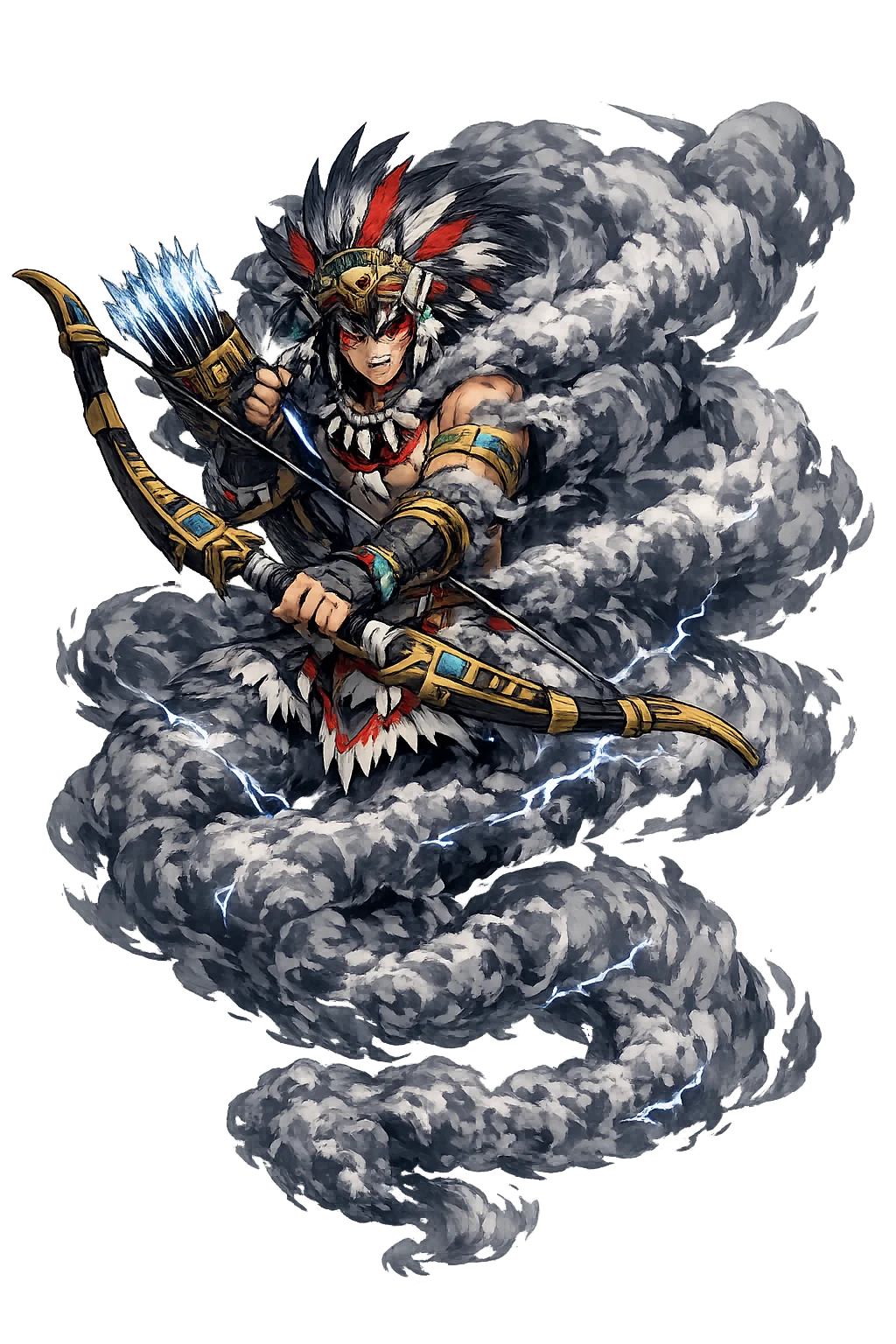
The Cloud Serpent is shown as a hunter armed with bow, arrows, and atlatl darts, his body sometimes marked with the red-and-white stripes of the sky and dressed in the pointed cap and animal-skin cloak of the chase. Codices such as the Florentine Codex give him quail, deer, and hunting dogs as attributes, while Teotihuacan antecedents and the rock-art bowmen of the Sierra Madre suggest a deep hunting-god lineage. The Milky Way itself became his celestial road, imaged as a bright stream of stars across the night sky rather than as a human body.

06

Reception & Transformation

The name after its own age — transmission, translation, survival

Afterlives

After the Spanish conquest, the public cult of Mixcōātl was suppressed along with the Templo Mayor, yet its memory survived in colonial chronicles compiled from Nahuatl-speaking elders and in the pages of Sahagún. Nineteenth-century Mexican nationalism reclaimed Aztec deities as emblems of a sovereign pre-Columbian past and in school textbooks and civic pageantry, while twentieth-century movements such as Mexicayotl revived the Quecholli hunt as living cultural heritage. Scholars of Mesoamerican religion still weigh his equation with Camaxtle and his relation to Teotihuacan’s hunting iconography. In popular astronomy and video games the Cloud Serpent continues to name the Milky Way and to signify an indigenous cosmos, so his reception moves between careful philological reconstruction, political symbolism, and broad new-age and popular-culture appropriation.

Identifications Across Traditions

The hunt-gods of North America stand in his lineage: the Huichol's Kauyumari (the blue deer-guide) and the Maya hunting-lords share his road-and-prey theology. Colonial chroniclers merged him with Santiago and with Nimrod (the hunter-king of the missionaries' Genesis); the people kept the star-serpent — and hunters in rural Mexico still note the sky's deer-road on the way to the field.

Modern Legacy

His name survives in the Milky Way's Nahuatl name itself; the Quecholli weapons-festival is documented in the Florentine Codex's fullest ritual detail; and the Chichimec hunting mythology is the standard account of the Aztecs' own self-image: the empire that began as wanderers following a serpent of stars. The Mexican National Museum of Anthropology's Mixcōātl figures — striped, netted, bowed — are his standing portraits.

07

The Meditation

What Mixcōātl means — beyond the dictionary

Mixcōātl is the god of the journey that made you. Every settled people remembers, somewhere, the road: the serpent in the night sky that was followed here. He asks the traveler's question, which is also the nation's and the individual's: what star did your ancestors follow — and does it still move, when you look up, the way it moved for them?

The weapons on his altar were the archaeology of gratitude: the city laid its old tools down each year, remembering what fed it first. Every settled people owes a debt to its wilderness; the Aztecs paid theirs honestly, in bows, once a year, to the serpent in the clouds.

The Florentine Codex keeps the festival's strangest detail: the king himself dressed as the hunt-god, net and all, at the year's darkest rite — the empire's ruler periodically reminded, in costume, that his house began as wanderers. Every nation needs that costume somewhere in its closet: the reminder of the road, worn by the people who have forgotten it most.

Look up on a dry winter night from the same deserts his people crossed: the serpent still pours itself across the sky, the oldest road sign in the hemisphere. The empires built on his route are dust in his direction, and the migrants still walking it are his living congregation — the hunt, the road, the star, unchanged.

08

Frequently Asked Questions

Common questions about Mixcōātl, Clouds, Hunting, the Milky Way, and Unicode restoration

01How do you pronounce Mixcōātl?

In reconstructed pronunciation, Mixcōātl is /miʃ.ˈkoː.aː.tɬ/ — approximately meesh-KOH-ahtl — long o, lateral finish.

02What does Mixcōātl mean?

Mixcōātl means "Cloud Serpent" — god of the hunt, of clouds, and of the starry road in the nahuatl tradition.

03What are the symbols of Mixcōātl?

Mixcōātl is associated with The bow and arrows (The hunt — his gift to the wandering tribes), The star-serpent (The Milky Way as a living road, his body across the night), The white stripes (His hunting-paint, cloud on dark sky, worn by his dancers at Quecholli), The fire-drill (Kindled beside the bow — the two technologies that made the wandering life possible), The hunting net (His snare and the badge of his hunters; a net full of stars is his sky).

04Why restore Mixcōātl in Unicode?

Plain ASCII mixcoatl strips the stress, length, and script that make the name specific. Unicode restoration returns the name to its original written dignity.

05What is the most important myth about Mixcōātl?

“The Serpent of Stars” — the The Road story that anchors the mythology of Mixcōātl, told in full on the lore page.

09

Scholarly Sources

The philological foundations of this restoration

Every claim on this page is grounded in established scholarship. The orthographic restorations follow disciplinary convention. The etymological chain follows the best available reference works. This is not invention — it is resurrection through scholarship.

◈

Lexicography & Philology

  • Florentine Codex
  • Sahagún
  • Karttunen
  • Nahuatl dictionary
  • Cambridge
◎

Primary Texts

  • The Florentine Codex (Sahagún); the Anales de Cuauhtitlan; colonial Nahuatl testimonies and pictorial manuscripts.
◉

Archaeology & Art History

  • Material evidence — iconography, inscriptions, and temple archaeology — for Mixcōātl and related cults.
✦

Religious Studies

  • Sahagún, Florentine Codex, Book 2 (Quecholli) and Book 7
  • Anales de Cuauhtitlān / Codex Chimalpopoca, trans. Bierhorst, History and Mythology of the Aztecs (1992)
  • Historia de los Mexicanos por sus pinturas
  • Diego Durán, Book of the Gods and Rites
  • Frances Karttunen, An Analytical Dictionary of Nahuatl
Return

The Surface Awaits

You have traced the name from its earliest attestation to its Unicode restoration. Now return to the myth. The story is where the name lives.

Back to Lore
Mixcōātl mascot