PuniCodex

Extended Lore

Μίδας Mídas

Etymology · Orthography · Cult · Iconography · Reception · Sources

Tier 2 Mídas.com
Mídas — King of Phrygia, the Golden Touch
01

Quick Facts

Essential information about Mídas, King of Phrygia, the Golden Touch

Original ScriptΜίδας
Unicode RestorationMídas
Reconstructed Pronunciation/mí.das/
PantheonGreek
DomainKing of Phrygia, the Golden Touch
MeaningPhrygian royal name
ClassificationTier 2
Primary DomainMídas.com
Sacred SymbolsGold, The ass's ears, The whispering reeds, The rose gardens, The Pactolus
02

Etymology & Word Family

From original script to Unicode restoration

Original Script Μίδας Mídas — "Phrygian royal name"
Unicode Restoration Mídas Restored stress, length, and script
Modern ASCII midas Plain-ASCII fallback

The name Mídas carries the orthographic signature of the greek tradition: Μίδας. Unicode restoration recovers what ASCII flattens.

03

Unicode Character Breakdown

Character-by-character philological analysis

CharacterUnicodeNameBlockPhonetic Role
MU+004DLatin Capital Letter MBasic LatinM uppercase
íU+00EDLatin Small Letter I with AcuteLatin-1 SupplementAcute on i
dU+0064Latin Small Letter DBasic Latind same
aU+0061Latin Small Letter ABasic Latina same
sU+0073Latin Small Letter SBasic Latins same

The Tier 2 classification reflects how much of the original phonology this restoration preserves — stress and vowel length for Greek names, distinctive letters and diacritics for every other tradition.

04

Cult & Worship

How the sacred was kept — rites, sanctuaries, remains

The Cult

Mídas received heroic or royal veneration in Phrygia, though the evidence is indirect. The great tumulus at Gordion and the palace citadel suggest dynastic mortuary cult, and Greek sources report a royal tomb visible to visitors. Herodotus preserves the memory of Midas's dedications at Delphi, linking the Phrygian king to panhellenic sanctuary practice. No temple exclusively his has been excavated; the cult seems to have centered on the dynastic dead and on the ancestor veneration that underpinned Phrygian kingship. Modern archaeology at Gordion continues to shape how his historical cult is imagined.

In the Earth

Gordion (Yassıhöyük), the Phrygian capital on the Sangarios, has been excavated by the University of Pennsylvania since 1950: the citadel's gate and megarons, and the Great Tumulus (Tumulus MM, ca. 740 BCE) with its preserved wooden chamber and hoard of bronzes — now dated a generation too early for Mídas himself and assigned to his dynasty, most plausibly Gordias his father. Old Phrygian inscriptions name Midas on the rock façade of the 'Midas Monument' at Yazılıkaya and at Midas City. The Assyrian annals of Sargon II supply the external chronicle, naming Mitâ of Muški between 718 and 709 BCE. His ivory throne at Delphi, which Herodotus saw, has not survived.

05

Iconography

How Mídas was imaged across the ages

The Image

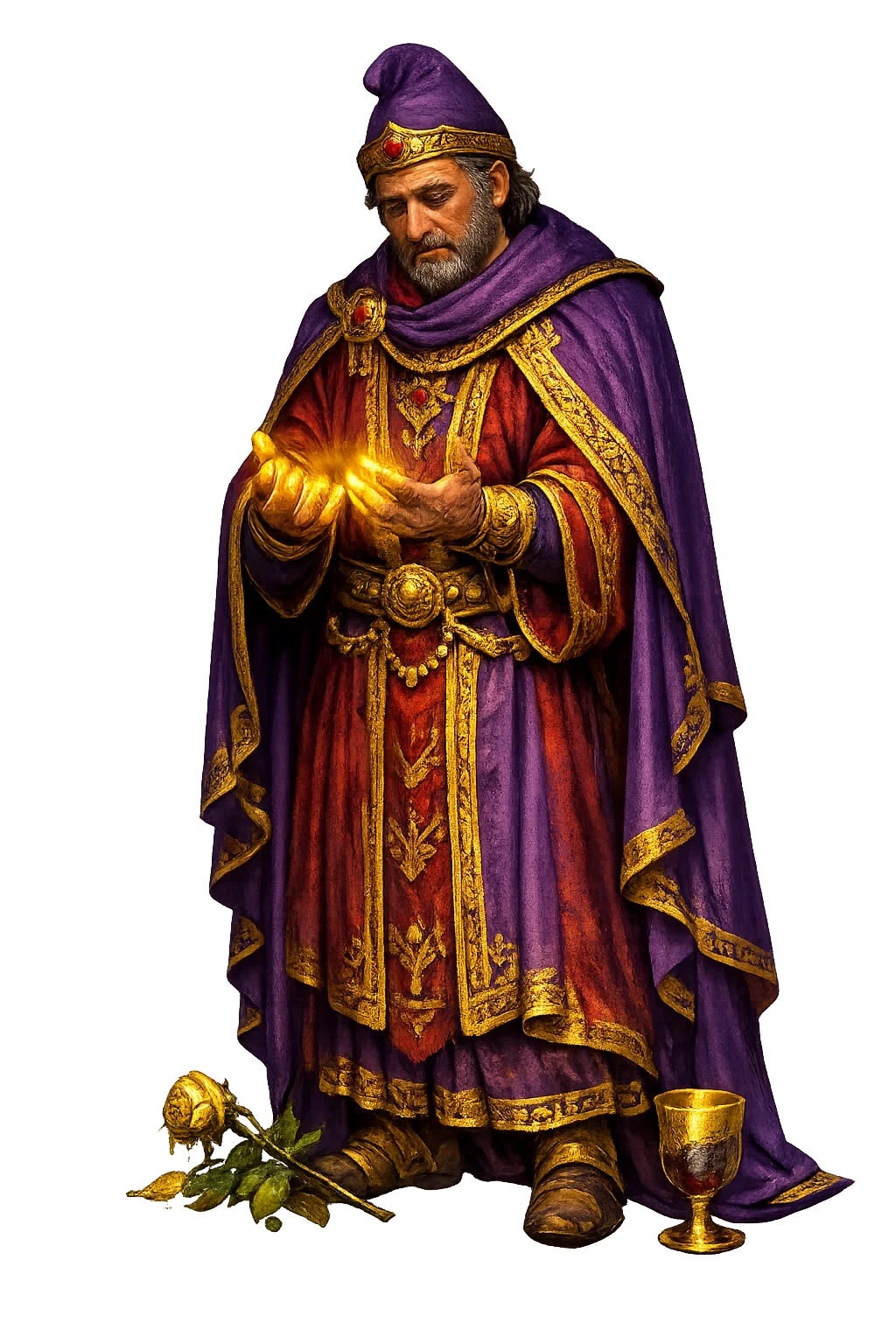
No certain ancient image of Mídas survives, but his attributes entered Greek visual culture through scenes of the musical contest with Apollo and the punishment of the ass's ears. Vase paintings show the king in barbarian dress, sometimes with pointed Phrygian cap, listening to the slave who barbers his secret. The golden-touch motif is more literary than visual in antiquity but became a favorite of later European painting and illustration. The Phrygian cap itself, associated with his dynasty, later became an emblem of liberty in Western iconography.

06

Reception & Transformation

The name after its own age — transmission, translation, survival

Afterlives

Mídas oscillates between history and folklore. Assyrian annals mention a Mitâ of Muški, giving a Near Eastern anchor to the Greek stories; Herodotus and later Greeks treated him as the archetype of barbarian wealth. Ovid's Metamorphoses fixed the golden-touch and ass's-ears episodes for the Latin West, where they became moral tales about greed and shame. The Renaissance and Baroque recycled Mídas as a cautionary figure, while the name entered modern English as a synonym for uncanny prosperity. Archaeology at Gordion since 1950 has tried to recover the historical king behind the legend, and the 'Midas touch' remains a durable metaphor in business and popular culture.

Identifications Across Traditions

Mídas absorbed no foreign gods; instead, the myth absorbed the man. Greek storytellers took a historical Phrygian dynasty and hung upon it their two great parables of appetite and judgment. Rome passed the fables on in Ovid's polished telling, and in time the moral inverted itself: the 'Midas touch', once a curse, became the financier's compliment. The ass's ears went the other way, remaining exactly what Apollo made them — the emblem of the critic who cannot hear.

Modern Legacy

Few names are so thoroughly proverbial. 'The Midas touch' names effortless profit; 'Midas ears' names the opposite gift in judgment. Hawthorne's A Wonder-Book (1852) added the golden daughter, the version children now learn first; opera, satire, and economics have all mined him. The historical king endures as firmly as the fool: Gordion's excavations made him a fixed point of Iron Age chronology. To restore Mídas with its acute is to restore the Greek shape of a Phrygian name — a small act of hearing rightly, which he himself never managed.

07

The Meditation

What Mídas means — beyond the dictionary

The touch and the ears are one story told twice. Both are parables of misjudged value: the king who thinks gold is the best thing in the world, and the listener who thinks pipes are better than the lyre. Each wish-come-true is a famine; each judgment is a deformity. The Greeks were exact about this — wealth and taste are the two places where a man chooses what he is, and Midas chose wrong both times, and knew it, and wept, and was not destroyed.

For the myth is gentler than its proverb. Dionysos releases him; Apollo only marks him. He washes the gold away in the river and, Ovid says, hated riches ever after — a man cured by his cure. Perhaps that is why a real king's name clung to the fable: the historical Midas was famous for sending his treasures away, a throne across the sea to Delphi. The legend only exaggerates the gesture. He is the king forever giving gold back, and the river still pays it out, grain by grain.

08

Frequently Asked Questions

Common questions about Mídas, King of Phrygia, the Golden Touch, and Unicode restoration

01How do you pronounce Mídas?

In reconstructed pronunciation, Mídas is /mí.das/ — approximately 'MEE-dass' — stress forward, the first syllable bright and the second clipped; the English 'MY-das' flattens both.

02What does Mídas mean?

Mídas means Phrygian royal name in the greek tradition.

03What are the symbols of Mídas?

Mídas is associated with Gold (The substance of his wish and his punishment), The ass's ears (The mark of the critic who hears wrongly), The whispering reeds (Grown from the hole where the barber buried the secret; they repeat it still), The rose gardens (His gardens below Mount Bermion, where Silenos was taken — roses of sixty petals, Herodotus says), The Pactolus (The river that took the gold from his hands into its sands).

04Why restore Mídas in Unicode?

Plain ASCII midas strips the stress, length, and script that make the name specific. Unicode restoration returns the name to its original written dignity.

05What is the most important myth about Mídas?

“Silenos Returned” — the Ovid, Met. 11.85–102 story that anchors the mythology of Mídas, told in full on the lore page.

09

Scholarly Sources

The philological foundations of this restoration

Every claim on this page is grounded in established scholarship. The orthographic restorations follow disciplinary convention. The etymological chain follows the best available reference works. This is not invention — it is resurrection through scholarship.

◈

Lexicography & Philology

  • Herodotus
◎

Primary Texts

  • Ovid
  • Ovid, Metamorphoses 11.85–193
◉

Archaeology & Art History

  • Material evidence — iconography, inscriptions, and temple archaeology — for Mídas and related cults.
✦

Religious Studies

  • Herodotus 1.14, 7.73, 8.138
  • Hyginus, Fabulae 191 (the music-contest)
  • Assyrian annals of Sargon II, years 5–13 (Mitâ of Muški)
  • Hawthorne, Nathaniel, A Wonder-Book (1852) — the gilded daughter in the modern tradition
Return

The Surface Awaits

You have traced the name from its earliest attestation to its Unicode restoration. Now return to the myth. The story is where the name lives.

Back to Lore
Mídas mascot