PuniCodex

Extended Lore

孟婆 Mèngpó

Etymology · Orthography · Cult · Iconography · Reception · Sources

Tier 1 Mèngpó.com
Mèngpó — Forgetting, Passage, Tea
01

Quick Facts

Essential information about Mèngpó, Forgetting, Passage, Tea

Original Script孟婆
Unicode RestorationMèngpó
Reconstructed Pronunciation/məŋ˥˩ pʰwo˧˥/
PantheonChinese
DomainForgetting, Passage, Tea
Meaning'Old Lady Meng' (孟婆), the goddess who brews the tea of forgetfulness
ClassificationTier 1
Primary DomainMèngpó.com
Sacred SymbolsThe teapot, The bowl, The bridge
02

Etymology & Word Family

From original script to Unicode restoration

Original Script 孟婆 Mèngpó — "'Old Lady Meng' (孟婆), the goddess who brews the tea of forgetfulness"
Unicode Restoration Mèngpó Restored stress, length, and script
Modern ASCII mengpo Plain-ASCII fallback

The name Mèngpó carries the orthographic signature of the chinese tradition: 孟婆. Unicode restoration recovers what ASCII flattens.

03

Unicode Character Breakdown

Character-by-character philological analysis

CharacterUnicodeNameBlockPhonetic Role
MU+004DLatin Capital Letter MBasic LatinSame letter
èU+00E8Latin Small Letter E with GraveLatin-1 SupplementGrave: falling (4th) tone
nU+006ELatin Small Letter NBasic LatinSame letter
gU+0067Latin Small Letter GBasic LatinSame letter
pU+0070Latin Small Letter PBasic LatinSame letter
óU+00F3Latin Small Letter O with AcuteLatin-1 SupplementStress mark (acute/tone)

The Tier 1 classification reflects how much of the original phonology this restoration preserves — stress and vowel length for Greek names, distinctive letters and diacritics for every other tradition.

04

Cult & Worship

How the sacred was kept — rites, sanctuaries, remains

The Cult

Mèngpó has no temple of her own — and a goddess whose office is erasure could hardly leave one. The evidence of her cult is indirect: the great underworld precinct at Fēngdū on the Yangtze, China's 'capital of the dead,' where Ming-Qing builders set the Nàihé Bridge in stone amid the Míngshān temple mountain, and where pilgrims still cross it for luck; and the print-circulation of the Yùlì, the Jade Record morality tract, whose woodblock illustrations place her, ladle-last, among the ten courts. There she receives worship by location rather than by altar — a station in the infernal circuit every visitor walks. Household ritual is almost entirely absent from the record; her 'devotees' are tellers, painters, and opera singers who keep her station vivid. What is genuinely attested is late, popular, and southwest-Chinese in flavor: a folk stratum the canon never canonized, caught by storytellers rather than priests. An honest verdict: she is less worshipped than encountered — the last officer of the underworld every soul meets, and the one whose service no one prays to need.

In the Earth

A folk goddess has no canonical temple archive, but her cosmology has monuments: the Fengdu ghost city on the Yangtze — China's "capital of the underworld" — preserves the Nàihé Bridge in stone, crossed by pilgrims and tourists for centuries, with its three arches for the virtuous, the ordinary, and the damned. Ming-Qing underworld scroll-paintings and the woodblock illustrations of the Jade Record (Yùlì) show her at her station, ladle in hand, among the ten courts' bureaucrats.

05

Iconography

How Mèngpó was imaged across the ages

The Image

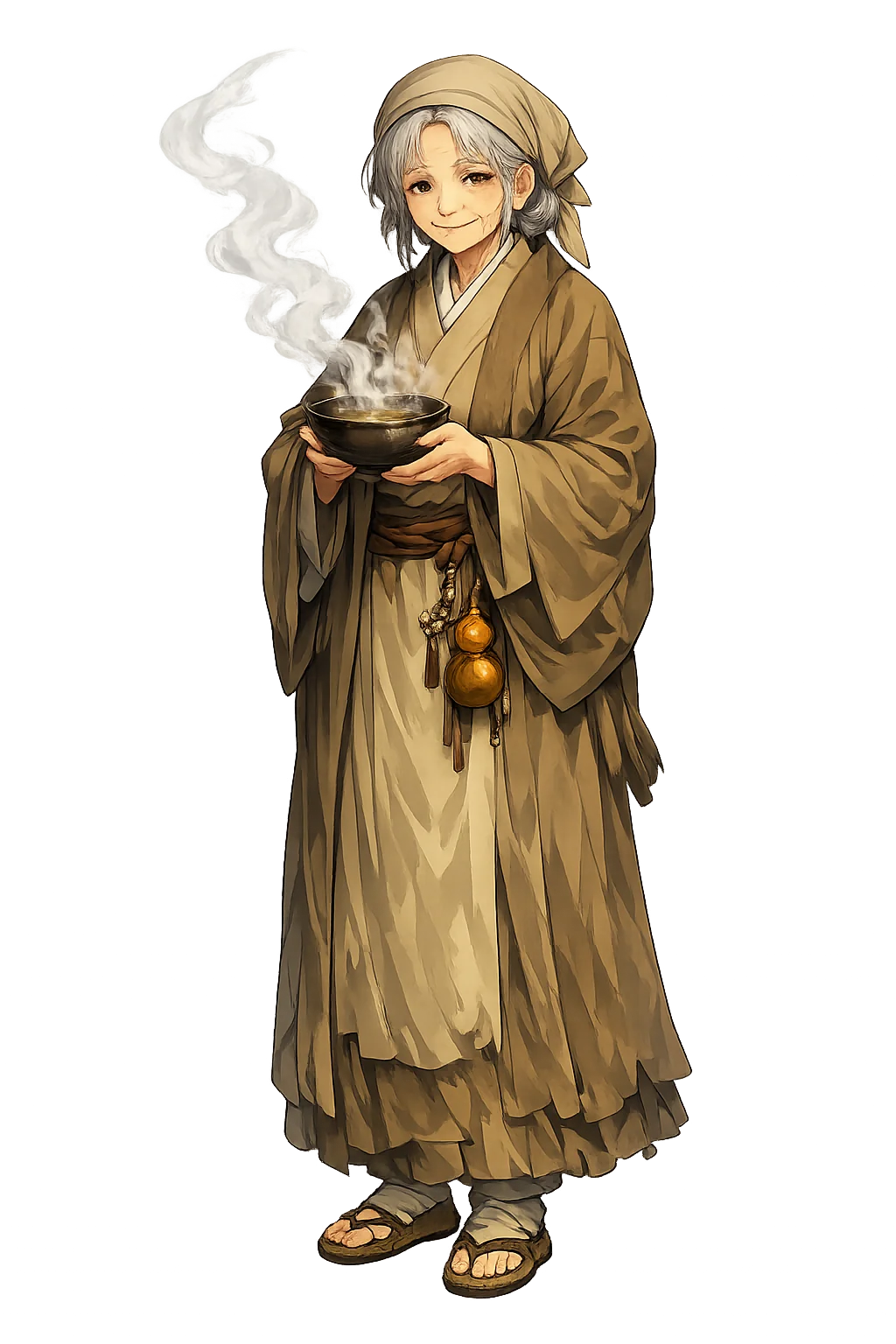
Mèngpó is painted, not sculpted — an image that lives in books and scrolls. Her canon formed in the infernal picture-cycles of the late imperial period: Ming-Qing underworld scroll-paintings and the woodblocks of the Jade Record, where she stands small and busy beside the bridge, gray-haired, bent over her kettle, ladle in hand — the bureaucracy's one grandmother among its magistrates. Attributes are few and exact: the teapot, the single bowl, the Nàihé Bridge arched behind her, and sometimes the five-flavored ingredients themselves, steeping a life's whole taste into one last cup. She is always kind-faced; the tradition never lets her be sinister, which is precisely its point. The great statues tourists photograph at Fēngdū are largely modern rebuilds of the temple mountain's statuary; her true originals are the prints — cheap, widely owned, damning and consoling in the same picture. Song-Yuan Ten Kings sets from the Ningbo workshops show the courts before her iconography settled; by the Qing she had her booth, her queue of souls, and her fixed, gentle pose.

06

Reception & Transformation

The name after its own age — transmission, translation, survival

Afterlives

Mèngpó's reception is a print story. Her charter text, the Jade Record, was a Ming morality tract that the Qing publishing industry multiplied into one of the most widely owned books in China — reprinted with fresh woodblocks through the nineteenth century, pasted up in temples, recited by storytellers, and carried by emigrants to Southeast Asia and the Americas, where her bridge followed the diaspora. The picture-cycles did parallel work: the Ten Kings painting tradition of Song-Yuan Ningbo had already crossed to Korea and Japan, and her station joined the infernal iconography East Asia shared, even where her name did not travel with it. Opera and the Qing storytellers' cycles humanized her further, giving her a biography the tracts never bothered with. Modern scholarship arrived late but thorough: the Dunhuang manuscript discoveries re-dated the whole underworld bureaucracy she serves, and Stephen Teiser's study of the Ten Kings scripture gave her station a documented history. Her afterlife in language outpaced her afterlife in religion — 'Mèngpō's soup' became the standing idiom for blessed oblivion, and it is as an idiom, more than a goddess, that most Chinese now meet her.

Identifications Across Traditions

She is the folk fusion at its most organic: Buddhist rebirth doctrine, Daoist underworld bureaucracy, and village storytelling meet in her bowl. Comparative scholars line her up beside Lethe — the Greek river of forgetfulness the dead must drink — noting that two civilizations independently decided memory cannot survive rebirth. In modern Chinese media she has become a star: films, songs, and web novels cast her as the melancholy romantic of the underworld, the goddess who remembers everything precisely so that others may forget.

Modern Legacy

"Mèngpó's soup" (孟婆湯) is a living idiom for oblivion — offered ruefully at partings and breakups across the Chinese internet. Her imagery saturates East Asian popular culture: the Nàihé Bridge scene is a fixture of afterlife drama from opera to anime-adjacent fantasy. The deeper legacy is conceptual: she embodies a mercy the modern world debates — whether healing requires forgetting — and gives the debate a face, a bridge, and a bowl.

07

The Meditation

What Mèngpó means — beyond the dictionary

Mèngpó is the goddess of letting go. Every tradition knows that some memories are poison; she alone made the antidote an act of hospitality — a cup of tea, served by a grandmother, at the bridge. She asks the question every grief eventually reaches: what would it cost you to forget — and what would it cost you to remember forever?

Her bowl is the folk answer to a question philosophy never settled: whether a person is their memories. The underworld's mercy is also its amnesty — the murderer and the mother drink alike, and both are reborn unburdened. We moderns keep our records differently: nothing is forgotten, everything is archived. She stands at the bridge asking the question the digital age most needs: what is forgiveness, if not a permission to forget — and who will serve the tea?

08

Frequently Asked Questions

Common questions about Mèngpó, Forgetting, Passage, Tea, and Unicode restoration

01How do you pronounce Mèngpó?

In reconstructed pronunciation, Mèngpó is /məŋ˥˩ pʰwo˧˥/ — approximately mung-pwoh, falling tone on Meng, rising on Po.

02What does Mèngpó mean?

Mèngpó means 'Old Lady Meng' (孟婆), the goddess who brews the tea of forgetfulness in the chinese tradition.

03What are the symbols of Mèngpó?

Mèngpó is associated with The teapot (Her instrument: oblivion brewed with care, not inflicted), The bowl (The single serving every soul receives — neither more nor less), The bridge (The crossing between judgment and rebirth, where memory ends).

04Why restore Mèngpó in Unicode?

Plain ASCII mengpo strips the stress, length, and script that make the name specific. Unicode restoration returns the name to its original written dignity.

05What is the most important myth about Mèngpó?

“The Last Station” — the The Office story that anchors the mythology of Mèngpó, told in full on the lore page.

09

Scholarly Sources

The philological foundations of this restoration

Every claim on this page is grounded in established scholarship. The orthographic restorations follow disciplinary convention. The etymological chain follows the best available reference works. This is not invention — it is resurrection through scholarship.

◈

Lexicography & Philology

  • Journey to the West
  • Chinese folk religion
  • Werner
◎

Primary Texts

  • Primary sources in the chinese tradition for Mèngpó.
◉

Archaeology & Art History

  • Material evidence — iconography, inscriptions, and temple archaeology — for Mèngpó and related cults.
✦

Religious Studies

  • Teiser, The Scripture on the Ten Kings
  • Birrell, Chinese Mythology
  • Yùlì bǎochāo (Jade Record), Ming–Qing morality tract and woodblocks
  • Fēngdū ghost-city pilgrimage tradition
  • Ming–Qing fiction and underworld scroll-paintings
Return

The Surface Awaits

You have traced the name from its earliest attestation to its Unicode restoration. Now return to the myth. The story is where the name lives.

Back to Lore
Mèngpó mascot