PuniCodex

Extended Lore

Matholwch — The Deeper Record

Etymology · Orthography · Cult · Iconography · Reception · Sources

ASCII-equivalent form Matholwch
Matholwch — King of Ireland
01

At a Glance

Matholwch — every fact links to its home

PantheonCeltic
DomainKing of Ireland
Scholarly TransliterationMatholwch →
Cited Works11 cited →
02

Etymology & Word Family

From attested form to canonical spelling — the full etymology page →

Scholarly Transliteration Matholwch Matholwch — "Good bear"
Canonical Restoration Matholwch Canonical scholarly spelling — ASCII-identical
Modern ASCII matholwch Plain-ASCII fallback

The name Matholwch reaches the modern world through scholarly transliteration of the celtic tradition. Because the conventional spelling uses only Latin letters, its canonical and ASCII forms coincide — the tradition it carries is in the name itself, not in diacritics.

03

Character breakdown

Character-by-character philological analysis

CharacterUnicodeNameBlockPhonetic Role
MU+004DLatin Capital Letter MBasic LatinSame, capitalized
aU+0061Latin Small Letter ABasic LatinSame
tU+0074Latin Small Letter TBasic LatinSame
hU+0068Latin Small Letter HBasic LatinSame
oU+006FLatin Small Letter OBasic LatinSame
lU+006CLatin Small Letter LBasic LatinSame
wU+0077Latin Small Letter WBasic LatinSame
cU+0063Latin Small Letter CBasic LatinSame
hU+0068Latin Small Letter HBasic LatinSame

This restoration reflects fidelity to the attested tradition, not recovered diacritics: every character of Matholwch already survives in ASCII. What the restoration preserves is the canonical spelling itself — the form scholarship standardised.

04

Cult & Worship

How the sacred was kept — rites, sanctuaries, remains

The Cult

Matholwch was never worshipped, and Ireland — whose crown the Welsh tale sets on him — never heard of him. The honest sentence is the whole one: no Irish text names him, no ogham stone or place-name records his kingship, and his existence is confined to a single Welsh tale, Branwen ferch Llŷr. Nothing attaches to him even inside the story: he comes to a wedding-feast and leaves at the head of a war, and the branch grants him no rite, no oath-cult, no grave-visit of his own. The nearest thing his branch owns to a holy place is Bedd Branwen, the Bronze Age cairn on Anglesey that belongs to his bride. What is known of him is purely narrative: a wronged king, a maimed stable, a cauldron, and the most catastrophic hospitality in Welsh literature.

In the Earth

Matholwch is a textual figure: no inscription, ogham stone, or place-name in Ireland names him, and his kingship exists entirely within the Welsh tale. His manuscript witnesses are exact — the Second Branch survives complete in the White Book of Rhydderch (Aberystwyth, National Library of Wales, Peniarth MS 4, c. 1350) and the Red Book of Hergest (Oxford, Jesus College MS 111, c. 1375–1425), the two great codices on which Williams's edition rests. The tale's one fixed point in the landscape is Welsh: Bedd Branwen, the cairn beside the river Alaw on Anglesey where the branch says Branwen was buried, is a genuine Bronze Age burial monument — cremation urns were recovered when the cairn was opened in the early nineteenth century, and later excavations confirmed its prehistoric date. The name attached to it is medieval folklore, not prehistory — but it proves the story was already rooted in Welsh ground centuries ago. The nearest epigraphic kin of his name-element are the Gaulish personal names in Matu- (Matugenos and kin): comparative evidence only, never identification.

05

Iconography

How Matholwch was imaged across the ages

The Image

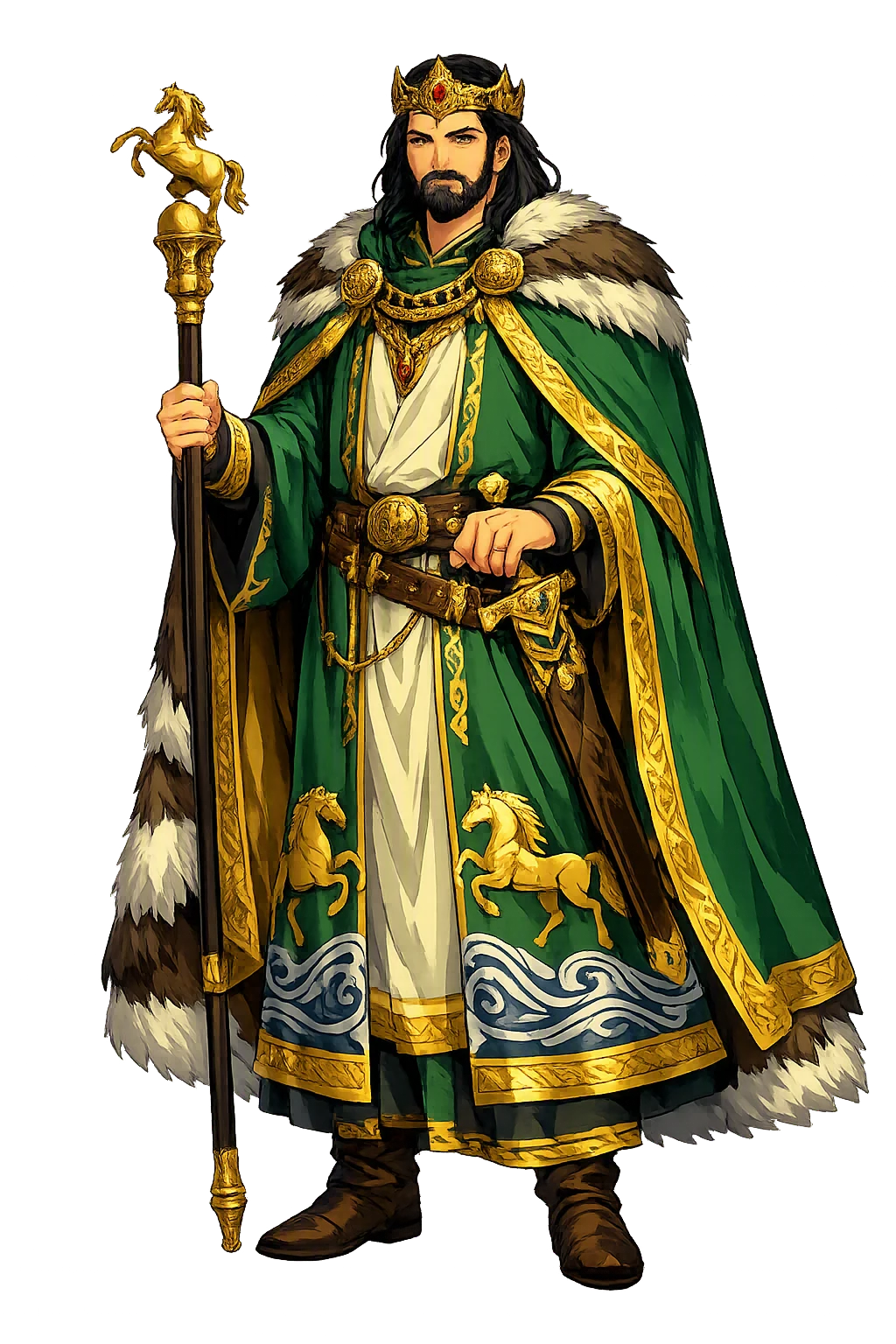
No image of Matholwch survives from any period, medieval or modern, and the tale itself gives him no personal attribute beyond the marks of his station — a king among kings at a wedding-feast — and the cropped ears and docked tails of his horses. The iconography of his branch belongs to things: the maimed steeds, the Cauldron of Rebirth that yields living warriors dumb as the dead, the starling that carries his queen's message across the sea. Later illustrators of the Second Branch reach for those objects and for Branwen; Matholwch remains a function in a crown, the guest whose grievance sets the machine turning and who is forgotten the moment the war begins. The reader who wants his likeness must build it from the tale's strongest note — the dignity of a man whose justice was handled like a debt, and priced in silver, gold, and a cauldron.

06

Reception & Transformation

The name after its own age — transmission, translation, survival

Afterlives

Matholwch's reception runs entirely through the fortunes of his branch. Branwen ferch Llŷr survived complete in the White Book of Rhydderch and the Red Book of Hergest, entered print in the Myvyrian Archaiology (1807), and became world literature in the nineteenth century, when the first complete English Mabinogion (Guest, 1838–49) carried his catastrophe abroad. Scholarship then gave him what Ireland never did: a study. Proinsias Mac Cana's Branwen Daughter of Llŷr (1958) remains the standard monograph on the branch, weighing its Irish affinities, and the tale's cauldron has been set beside real metal since 1891, when the Gundestrup cauldron was lifted from a Jutland bog — silver-gilt, its figured panels of death and rebirth an irresistible, if debated, analogue for the vessel that raised the dead to fight. His name, meanwhile, stays a Welsh curiosity, built on the same Math- 'bear' element as the Fourth Branch's king — a Welsh ear wearing an Irish crown, as Mac Cana first mapped him.

Identifications Across Traditions

Matholwch is a Welsh invention wearing an Irish crown, and the tradition knows it: no Irish-language tale names him, and his kingship of Ireland exists only inside Branwen ferch Llŷr. The honest comparisons are structural, and Proinsias Mac Cana's monograph Branwen Daughter of Llŷr mapped them: Brân's sea-crossing against the Voyage of Bran mac Febail (Immram Brain), the children of Llŷr against the Irish family of Lir, and above all the Cauldron of Rebirth against the cauldron-lore of Ireland — the Dagda's cauldron from Murias, from which no company went away unsatisfied, is the standard parallel for the Celtic vessel of inexhaustible power. The Welsh and Irish cauldrons divide the two ends of the motif between them: Ireland's feeds the living, Wales's revives the dead — and takes their speech as payment. Arthurian scholarship, from Loomis onward, has long set the cauldron and the carried head beside the Grail procession of Peredur; the comparison is illuminating and unprovable, and this temple registers it as such.

Modern Legacy

Matholwch entered the world's reading with Lady Charlotte Guest's translation of the Mabinogion (1838–49), which carried the Second Branch into English and made the maimed horses and the Cauldron of Rebirth part of the general inheritance of fantasy literature. Ifor Williams's Pedeir Keinc y Mabinogi (1930) fixed the text for scholarship, and Sioned Davies's translation (2007) is the modern English standard. The branch's sentences have never left Welsh letters — 'a fo ben, bid bont' is quoted wherever leadership is discussed — and Evangeline Walton's The Children of Llyr (1971) retells the whole catastrophe as a novel. The cauldron motif, transmitting through the Welsh tradition, stands behind every modern cauldron that raises armies of the dead; Lloyd Alexander's Prydain chronicles drew freely on the Mabinogion's world. On Anglesey, the Bronze Age cairn beside the river Alaw still answers to the name Bedd Branwen, Branwen's grave — the tale's one fixed point in the landscape of two islands.

07

The Scholarly Transliteration Note

What the written record preserves — and what it does not

Scholarly Transliteration

The normalized Middle Welsh form is Matholwch — already plain ASCII, with no diacritic or distinctive letter for the restoration to recover. Middle Welsh was written in the Latin alphabet, and its distinctive sounds are carried by digraphs (th, ch, ll) and the vowel-letter w, none of which the ASCII set lacks. The earlier monumental scripts of the two islands — the ogham stones of Ireland and Wales — predate the manuscript tradition, but no attestation of this name has ever been read on any of them. Because the name is pure ASCII, its domain was registered long ago in the ordinary way: matholwch.com is held by a third party outside the PuniCodex collection and is watched for release — no form of the name is currently owned, and this temple claims none.

08

The Meditation

What Matholwch means — beyond the dictionary

Matholwch is the king who accepted the compensation and could not accept it. Nothing in the tale is more carefully drawn than the failure of the settlement: the horses replaced, the silver staff, the golden platter, the cauldron itself — a full honor-price, formally paid, formally received. And still the insult kept working, not in him alone but in his nobles, until it expelled the queen to the kitchen and the butcher's daily blow. The Second Branch is the Mabinogion's treatise on the difference between settling a wrong and healing one.

His cauldron is the perfect emblem of the settlement's logic: it undoes the death and keeps the silence. The men who climb out of it fight as well as ever and cannot speak — cannot say what the war cost, cannot forgive, cannot testify. Matholwch ends as he began, a king whose kingdom is decided by what others do around him: Efnisien maims his horses, his nobles disgrace his wife, his guests massacre his peace, his bridegroom's gift arms his own destruction. The tale does not even grant him a death. It grants him something more instructive — a marriage made in good faith between two islands, and the proof that good faith is not enough when honor has been taught to count higher.

09

Frequently Asked Questions

Deep-dives into the cult, attestation, reception, and sources of Matholwch

01How do we know how Matholwch was worshipped?

Matholwch is a textual figure: no inscription, ogham stone, or place-name in Ireland names him, and his kingship exists entirely within the Welsh tale. The full cult record →

02Where do the earliest attestations of Matholwch come from?

The record rests on Branwen ferch Llŷr, the Second Branch of the Mabinogi — the whole of Matholwch's dossier: the suit, the insult, the compensation, the war, Ifor Williams, ed., Pedeir Keinc y Mabinogi (1930) — the standard critical edition of the Four Branches, Sioned Davies, trans., The Mabinogion, Oxford World's Classics (2007) — the modern English text followed here, among 9 cited works. The full source apparatus →

03How did later traditions reinterpret Matholwch?

Matholwch's reception runs entirely through the fortunes of his branch. Reception & transformation →

04What do the surviving images of Matholwch actually show?

No image of Matholwch survives from any period, medieval or modern, and the tale itself gives him no personal attribute beyond the marks of his station — a king among kings at a wedding-feast — and the cropped ears and docked tails of his horses. The iconography →

05What does the written record of Matholwch actually preserve?

The normalized Middle Welsh form is Matholwch — already plain ASCII, with no diacritic or distinctive letter for the restoration to recover. The Scholarly Transliteration note →

10

Scholarly Sources

The philological foundations of the record

Every claim on this page is grounded in established scholarship. The orthographic restorations follow disciplinary convention. The etymological chain follows the best available reference works. This is not invention — it is resurrection through scholarship.

◈

Lexicography & Philology

  • Mabinogion
  • MacKillop
◎

Primary Texts

  • The Immram Brain (Voyage of Bran); Tochmarc Étaíne; Cóir Anmann; medieval Irish saga literature.
◉

Archaeology & Art History

  • Megaw, R., & Megaw, V. Celtic Art: From Its Beginnings to the Book of Kells; Green, M. The Gods of the Celts.
✦

Religious Studies

  • Branwen ferch Llŷr, the Second Branch of the Mabinogi — the whole of Matholwch's dossier: the suit, the insult, the compensation, the war
  • Ifor Williams, ed., Pedeir Keinc y Mabinogi (1930) — the standard critical edition of the Four Branches
  • Sioned Davies, trans., The Mabinogion, Oxford World's Classics (2007) — the modern English text followed here
  • Proinsias Mac Cana, Branwen Daughter of Llŷr (1958) — the monograph on the branch's Irish affinities
  • Proinsias Mac Cana, Celtic Mythology (1970) — the cauldron motif and the Celtic frame
  • John T. Koch, ed., Celtic Culture: A Historical Encyclopedia (2006), s.v. Matholwch, Branwen ferch Llŷr — the name and the scholarship
  • James MacKillop, Dictionary of Celtic Mythology (1998), s.v. Matholwch — the traditional gloss 'good bear'
  • Rachel Bromwich, ed. and trans., Trioedd Ynys Prydein: The Triads of the Island of Britain (1978) — the concealment and disclosure of Brân's head
  • Lady Charlotte Guest, trans., The Mabinogion (1838–49) — the translation that brought the branch into English
Return

The Surface Awaits

You have traced the name from its earliest attestation to its canonical restoration. Now return to the myth. The story is where the name lives.

Back to Lore
Matholwch mascot