PuniCodex

Extended Lore

Math — The Deeper Record

Etymology · Orthography · Cult · Iconography · Reception · Sources

ASCII-equivalent form Math
Math — Magic, Kingship
01

At a Glance

Math — every fact links to its home

PantheonCeltic
DomainMagic, Kingship
Scholarly TransliterationMath →
Cited Works8 cited →
02

Etymology & Word Family

From attested form to canonical spelling — the full etymology page →

Scholarly Transliteration Math Math — "Bear"
Canonical Restoration Math Canonical scholarly spelling — ASCII-identical
Modern ASCII math Plain-ASCII fallback

The name Math reaches the modern world through scholarly transliteration of the celtic tradition. Because the conventional spelling uses only Latin letters, its canonical and ASCII forms coincide — the tradition it carries is in the name itself, not in diacritics.

03

Character breakdown

Character-by-character philological analysis

CharacterUnicodeNameBlockPhonetic Role
MU+004DLatin Capital Letter MBasic LatinSame, capitalized
aU+0061Latin Small Letter ABasic LatinSame
tU+0074Latin Small Letter TBasic LatinSame
hU+0068Latin Small Letter HBasic LatinSame

This restoration reflects fidelity to the attested tradition, not recovered diacritics: every character of Math already survives in ASCII. What the restoration preserves is the canonical spelling itself — the form scholarship standardised.

04

Cult & Worship

How the sacred was kept — rites, sanctuaries, remains

The Cult

No cult of Math is attested anywhere: no inscription, no votive, no Welsh feast-day, no holy place bears his name, and the medieval church calendar ignores him. What survives is not a cult but a fossil of kingship — the geas binding the king's life to a virgin's lap, which Celticists read as a literary memory of sacral kingship, the office made valid by taboo. In that reading Math is the institution's portrait rather than its object: a lord of the Children of Dôn — the Welsh counterparts of the Túatha Dé Danann, as Mac Cana showed — wearing the costume of a medieval Welsh prince. Even modern revival currents have not made him a figure of rite. His true afterlife runs through manuscripts and scholarly argument, not worship.

In the Earth

Math is a textual figure with no pre-Christian material attestation: no inscription, votive object, or image names him. His witnesses are manuscripts — the White Book of Rhydderch (Aberystwyth, NLW Peniarth 4–5, c. 1350) and the Red Book of Hergest (Oxford, Jesus College MS 111, c. 1400), the two codices in which the Fourth Branch survives. The epigraphic witness belongs to the root rather than the man: Gaulish personal names such as Matugenos, 'bear-born', attest the *matu- element in the onomastics of the continental Celts. The tale's own geography is real Gwynedd terrain — Dôl Pebin in Arfon, where Goewin's father held his land — and the branch's southern war-road runs to the maenor of Penardd, where Pryderi fell.

05

Iconography

How Math was imaged across the ages

The Image

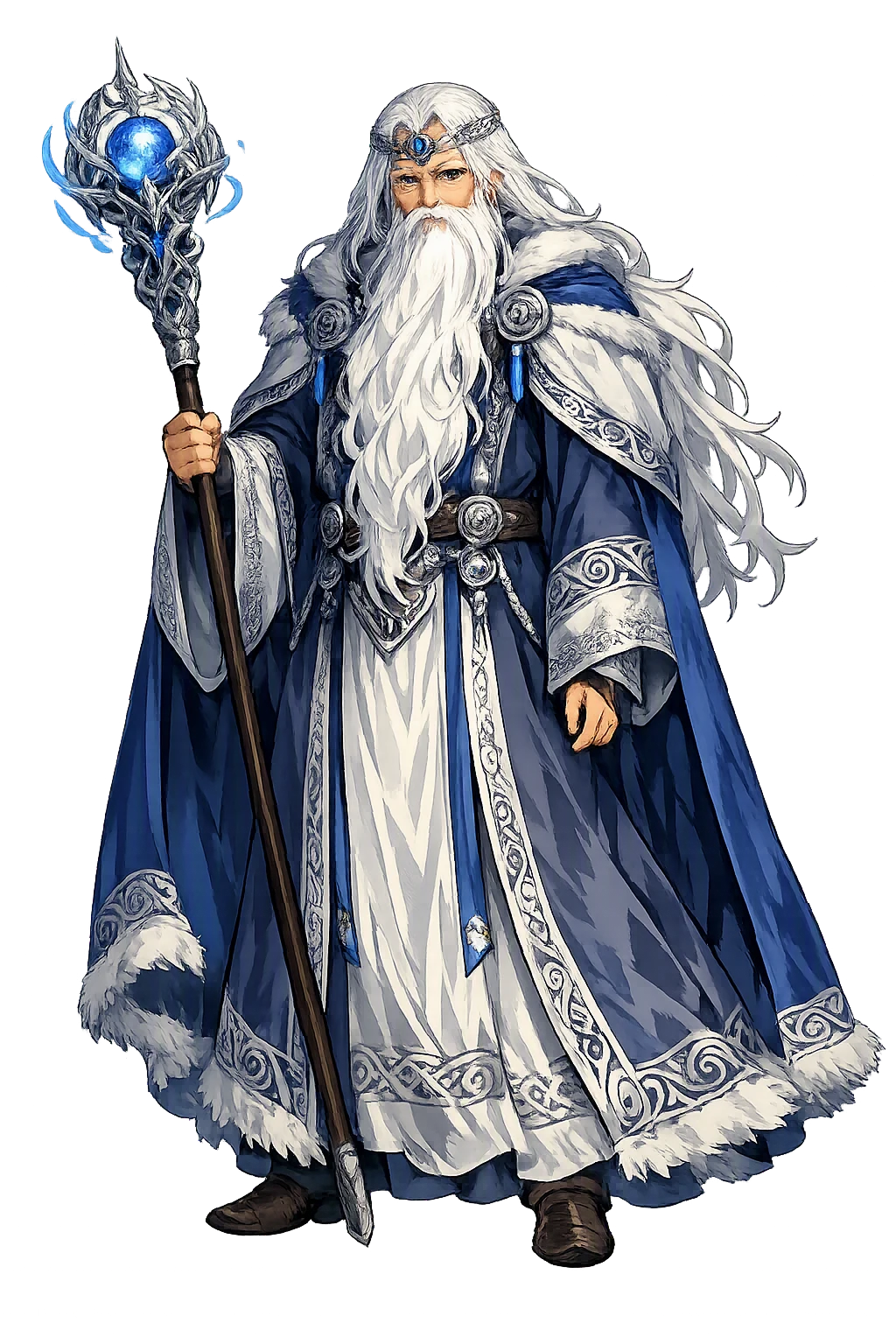
Math was never imaged. The two great codices that carry his branch — the White Book of Rhydderch and the Red Book of Hergest — are text without illustration, and no medieval artist, Welsh or continental, is known to have drawn the king whose wand made brides of flowers and brothers into beasts. His attributes are verbal: the hutlath, the wand of testing and transformation; the virgin's lap that serves as his throne; the stillness itself, which is his portrait. Modern artists have only occasionally taken him up — Alan Lee's illustrations for a 1982 edition of the Mabinogion give the Four Branches their most familiar painted face — but for most readers Math has no image at all. That may suit him: a king whose power is a condition, not a posture.

06

Reception & Transformation

The name after its own age — transmission, translation, survival

Afterlives

Math's afterlife is the afterlife of his branch, for the Fourth Branch of the Mabinogi carries his name — Math fab Mathonwy — and has done since the Middle Ages. The text rests on two pillars, the White Book of Rhydderch (c. 1350) and the Red Book of Hergest (c. 1400), and it first saw print in the antiquarian wave of the Myvyrian Archaiology of Wales (1807), then crossed into English with the first complete translation of the Mabinogion (Guest, 1838–49). Scholarship made him a problem worth solving: William John Gruffydd devoted a monograph to the branch (Math vab Mathonwy, 1928), and Proinsias Mac Cana's The Mabinogi (1975) set the geas and the flower-bride within the comparative study of Celtic kingship and myth. The standing debates — the branches' date, their unity, the meaning of the footholder taboo — have kept Math at the centre of Celtic studies for a century, and the name itself has quietly returned to Welsh use as a given name. A king with no temple and no statue owns the rarer afterlife: a text scholars cannot stop reading.

Identifications Across Traditions

Math is the Welsh reflex of a pan-Celtic institution: the sacral king whose rule is bound by taboo. Irish tradition gives the condition its clearest grammar — the gessi of kings, the network of prohibitions whose slow breaking dooms Conaire Mór in Togail Bruidne Da Derga — and Math's footholder geas is the same machinery in Welsh dress, a kingship valid only while its condition holds. Mac Cana reads the Children of Dôn as the Welsh counterpart of the Túatha Dé Danann, and the name itself crosses the water on its own root: Cath Maige Tuired names Mathgen as the seer of the Túatha Dé Danann, and Gaulish epigraphy attests Matugenos — both 'bear-born', from the *matu- that names the king and his father. Within the Mabinogi the root echoes across the branches: Matholwch, the Irish king of the Second Branch, carries the same Math- element. His closest kin are the members of his own house — his sister Dôn's children, above all Gwydion, whose plots the geas licences and whose punishments the king's wand performs — and the co-made bride Blodeuwedd, his one act of creation.

Modern Legacy

Math's afterlife is quieter than his nephews', but the Fourth Branch carried him far. In the twentieth century the branch was remade twice over: Evangeline Walton's The Virgin and the Swine (1936) retells his story as a tragedy of old religion and new, with the geas and the three animal years as its moral engine, and Lloyd Alexander's Chronicles of Prydain made Math son of Mathonwy the aged High King of Prydain for a generation of young readers — the geas laid aside, the grave authority kept. Alan Garner's The Owl Service (1967) drew its haunting from the Blodeuwedd strand that Math's wand set in motion, the branch repeating itself down the generations of a Welsh valley. In scholarship he stands at the centre of the Mabinogi industry: Ifor Williams's Pedeir Keinc y Mabinogi fixed the text, Sioned Davies's Oxford translation carries it to the world's readers, and Mac Cana's and Koch's handbooks treat the Fourth Branch as the masterpiece of medieval Welsh prose, with the footholder geas among the most-discussed cruxes in Celtic studies.

07

The Scholarly Transliteration Note

What the written record preserves — and what it does not

Scholarly Transliteration

Welsh is written in the Latin alphabet; the name is attested in Middle Welsh manuscripts as Math (Math uab Mathonwy), in the White Book of Rhydderch and the Red Book of Hergest, and the ASCII spelling loses nothing — hence a plain restoration. The plain-ASCII domain math.com is registered to a third party and held outside the collection; it is watched for release. Until then this temple stands without a domain of its own.

08

The Meditation

What Math means — beyond the dictionary

Math is the proof that a story's most powerful figure can be its stillest. He does not trick, march, or seduce; he sits, and the sitting is the kingship — feet in a maiden's lap, the realm held by nephews, the whole arrangement waiting for someone to notice that war is the one door out of the geas. What makes him great is what he does after the door is used against him: redress before revenge, a wronged girl made queen, a sentence fitted exactly to the crime and limited exactly to it, and then — the rarest thing in any mythology of punishment — restoration without residue. His wand does everything the tale needs: it tests, it transforms, it creates. But its deepest work is juridical. Math is the king whose magic is law and whose law has a measure — three years, three skins, and the account closed — and whose stillness is not weakness but the condition of rule itself.

09

Frequently Asked Questions

Deep-dives into the cult, attestation, reception, and sources of Math

01How do we know how Math was worshipped?

Math is a textual figure with no pre-Christian material attestation: no inscription, votive object, or image names him. The full cult record →

02Where do the earliest attestations of Math come from?

The record rests on Mabinogion (Fourth Branch: Math fab Mathonwy), Ifor Williams, Pedeir Keinc y Mabinogi, Sioned Davies, The Mabinogion (Oxford), among 6 cited works. The full source apparatus →

03How did later traditions reinterpret Math?

Math's afterlife is the afterlife of his branch, for the Fourth Branch of the Mabinogi carries his name — Math fab Mathonwy — and has done since the Middle Ages. Reception & transformation →

04What do the surviving images of Math actually show?

Math was never imaged. The iconography →

05What does the written record of Math actually preserve?

Welsh is written in the Latin alphabet; the name is attested in Middle Welsh manuscripts as Math (Math uab Mathonwy), in the White Book of Rhydderch and the Red Book of Hergest, and the ASCII spelling loses nothing — hence a plain restoration. The Scholarly Transliteration note →

10

Scholarly Sources

The philological foundations of the record

Every claim on this page is grounded in established scholarship. The orthographic restorations follow disciplinary convention. The etymological chain follows the best available reference works. This is not invention — it is resurrection through scholarship.

◈

Lexicography & Philology

  • Mabinogion
  • MacKillop
◎

Primary Texts

  • The Immram Brain (Voyage of Bran); Tochmarc Étaíne; Cóir Anmann; medieval Irish saga literature.
◉

Archaeology & Art History

  • Megaw, R., & Megaw, V. Celtic Art: From Its Beginnings to the Book of Kells; Green, M. The Gods of the Celts.
✦

Religious Studies

  • Mabinogion (Fourth Branch: Math fab Mathonwy)
  • Ifor Williams, Pedeir Keinc y Mabinogi
  • Sioned Davies, The Mabinogion (Oxford)
  • Proinsias Mac Cana, The Mabinogi
  • John T. Koch, Celtic Culture: A Historical Encyclopedia
  • Ranko Matasović, Etymological Dictionary of Proto-Celtic
Return

The Surface Awaits

You have traced the name from its earliest attestation to its canonical restoration. Now return to the myth. The story is where the name lives.

Back to Lore
Math mascot