The Living Myth
Sacred Formula · The Sacred Formula · a sacred formula addressed to any individual deity
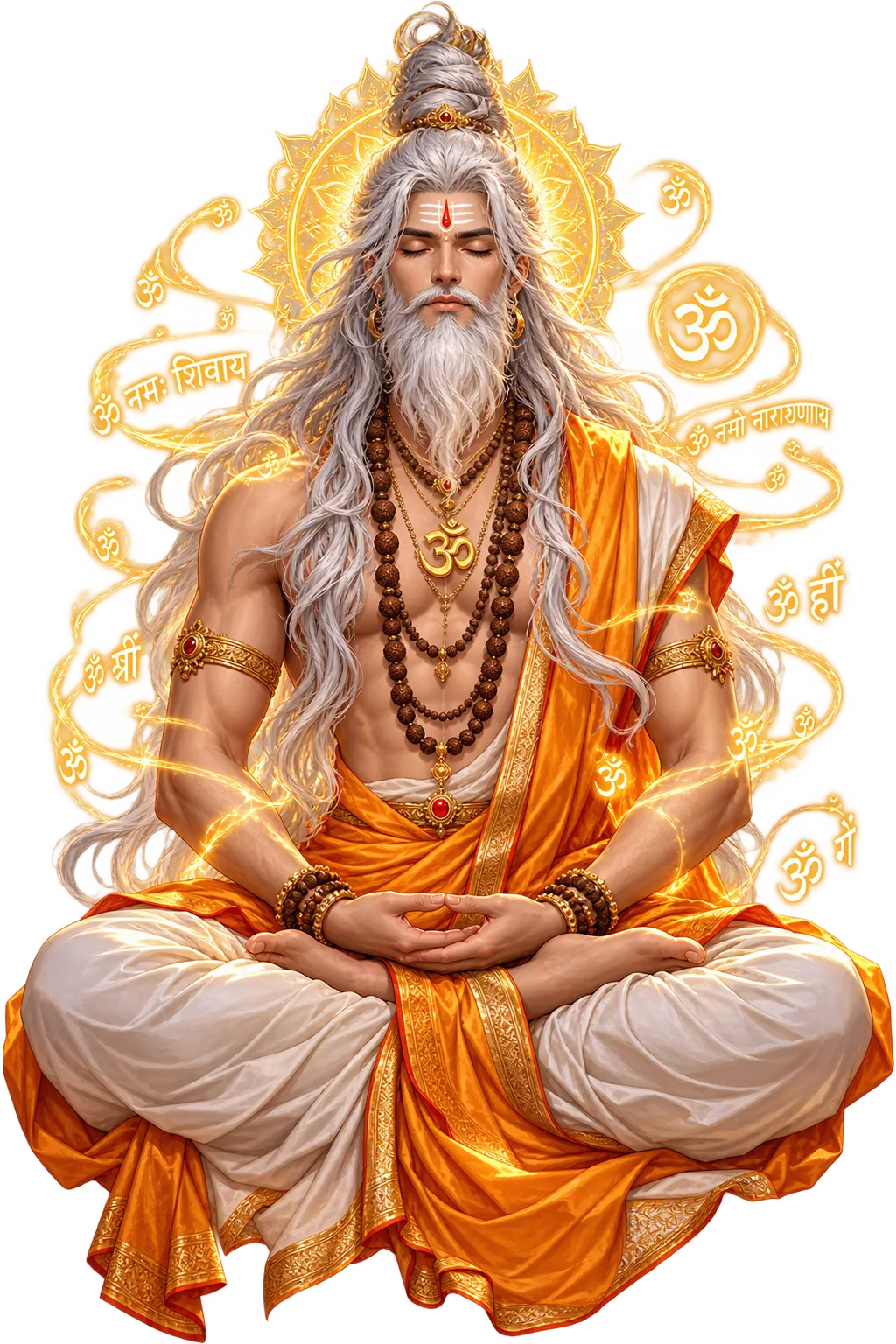
Stories of Mantra
The mantra’s mythology is the mythology of sound itself: the Vedic verse as the gods’ body, the Tantric syllable as the deity’s seed, and the modern AUM as the world’s most recognised sacred sound. Its stories are the mantra-sciences’ own — how verses were won from the gods, guarded by initiations, and tested in practice.
The twenty-four syllables to the solar light — ‘we meditate on the glorious light of the divine sun; may it inspire our minds’ — are the most recited verse in history. The tradition counts its recitation at dawn as the twice-born’s first and non-negotiable duty, kept without interruption for three millennia.
The Brāhmaṇas tell that certain verses — the vājas, the weapons — are feared by the gods themselves, pronounced only in the rite’s armoury. The mantra was power before it was prayer: the correctly uttered verse as a weapon the cosmos must obey.
The Tantras compressed the deities into single syllables — hrīṃ for the great goddess, krīṃ for Kālī, aiṃ for learning — each a ‘seed’ (bīja) that grows the god in the practitioner’s body. The syllables are analysed letter by letter: each phoneme a cosmic principle, the whole a deity in auditory form.
The transcendentalists carried AUM to New England; the yogis carried it to the world. Today the syllable opens and closes yoga classes on every continent, and the Hare Krishna mahāmantra — sixteen words — is the most widely sung Sanskrit text in history. The instrument of thought has become the planet’s shared sacred sound.
The Instrument of Thought
Mantra is sacred sound as technology: the formula — syllable, verse, or name — whose precise pronunciation installs divine power in the mind that holds it. From the Vedic verses the gods themselves are said to fear, to the single-syllable bījas that seed Tibetan mandalas, the mantra is India’s most exported spiritual instrument: AUM on every yoga studio’s lips.
The pranava, the syllable that contains the all — three letters, four states, one sound.
The seed-syllable — hrīṃ, oṃ, aiṃ — a condensed deity, planted in the heart by initiation.
The twenty-four-syllable verse to the solar light — recited at dawn by the twice-born for three millennia.
The recitation-count: the rosary (mālā) of 108 beads turning prayer into measured practice.
From the original script to the living URL
मन्त्र
The name in its original Sanskrit form. Mantra (मन्त्र) is attested in the source tradition — “a sacred formula addressed to any individual deity (e.g. om SivAya namaH), RTL. 61”. Its original diacritics and script distinctions carry the full phonetic and orthographic weight of the source tradition.
mantra
The plain mantra form is identical to the Unicode restoration. Because this name is already written in Latin letters, no diacritics, stress, or script information were lost — only capitalization differs.
Mantra
The Unicode restoration does not need to recover lost marks for Mantra. Its value is canonical spelling and consistent cataloguing, not the reconstruction of erased orthography. The domain is readable as-is to both DNS and humanity.
Mantra.com
This restoration is written entirely in ASCII letters — no Punycode encoding stands between Mantra and the DNS. The domain reads identically to machines and to human eyes.
The attested spelling family of Mantra
Mantra
Restores मन्त्र. The full Unicode restoration. mantra.com is not in the PuniCodex collection — it is watched for release; if it drops, this temple upgrades to an owned flagship. Attested by MW, RV.
How Mantra was spoken
How Mantra travels from ancient script to the modern URL
The lore you have read is the living myth. Extended Lore opens the scholarly vault beneath it: the cult and its material remains, a history of the image, the name after antiquity, a meditation on what the name still means, and the full scholarly apparatus — etymology, orthography, sources.
Enter Extended Lore