PuniCodex

Extended Lore

Mama Quilla

Etymology · Orthography · Cult · Iconography · Reception · Sources

Tier 2 Mama Quilla
Mama Quilla — Moon, Marriage
01

Quick Facts

Essential information about Mama Quilla, Moon, Marriage

Scholarly TransliterationMama Quilla
Unicode RestorationMama Quilla
Reconstructed Pronunciation/ˈma.ma ˈki.ʎa/
PantheonIncan
DomainMoon, Marriage
MeaningMother moon
ClassificationTier 2
Primary DomainMama Quilla
Sacred SymbolsSilver, The Crescent (Killa), The Lunar Calendar, The Mirror of the Coya, The Eclipse
02

Etymology & Word Family

From original script to Unicode restoration

Scholarly Transliteration Mama Quilla Mama Quilla — "Mother moon"
Unicode Restoration Mama Quilla Canonical scholarly spelling — ASCII-identical
Modern ASCII mamaquilla Plain-ASCII fallback

The name Mama Quilla reaches the modern world through scholarly transliteration of the incan tradition. Because the conventional spelling uses only Latin letters, its Unicode and ASCII forms coincide — the tradition it carries is in the name itself, not in diacritics.

03

Unicode Character Breakdown

Character-by-character philological analysis

CharacterUnicodeNameBlockPhonetic Role
MU+004DLatin Capital Letter MBasic LatinSame, capitalized
aU+0061Latin Small Letter ABasic LatinSame
mU+006DLatin Small Letter MBasic LatinSame
aU+0061Latin Small Letter ABasic LatinSame
QU+0051Latin Capital Letter QBasic LatinSame, capitalized
uU+0075Latin Small Letter UBasic LatinSame
iU+0069Latin Small Letter IBasic LatinSame
lU+006CLatin Small Letter LBasic LatinSame
aU+0061Latin Small Letter ABasic LatinSame

The Tier 2 classification here reflects fidelity to the attested tradition, not recovered diacritics: every character of Mama Quilla already survives in ASCII. What the restoration preserves is the canonical spelling itself — the form scholarship standardised.

04

Cult & Worship

How the sacred was kept — rites, sanctuaries, remains

The Cult

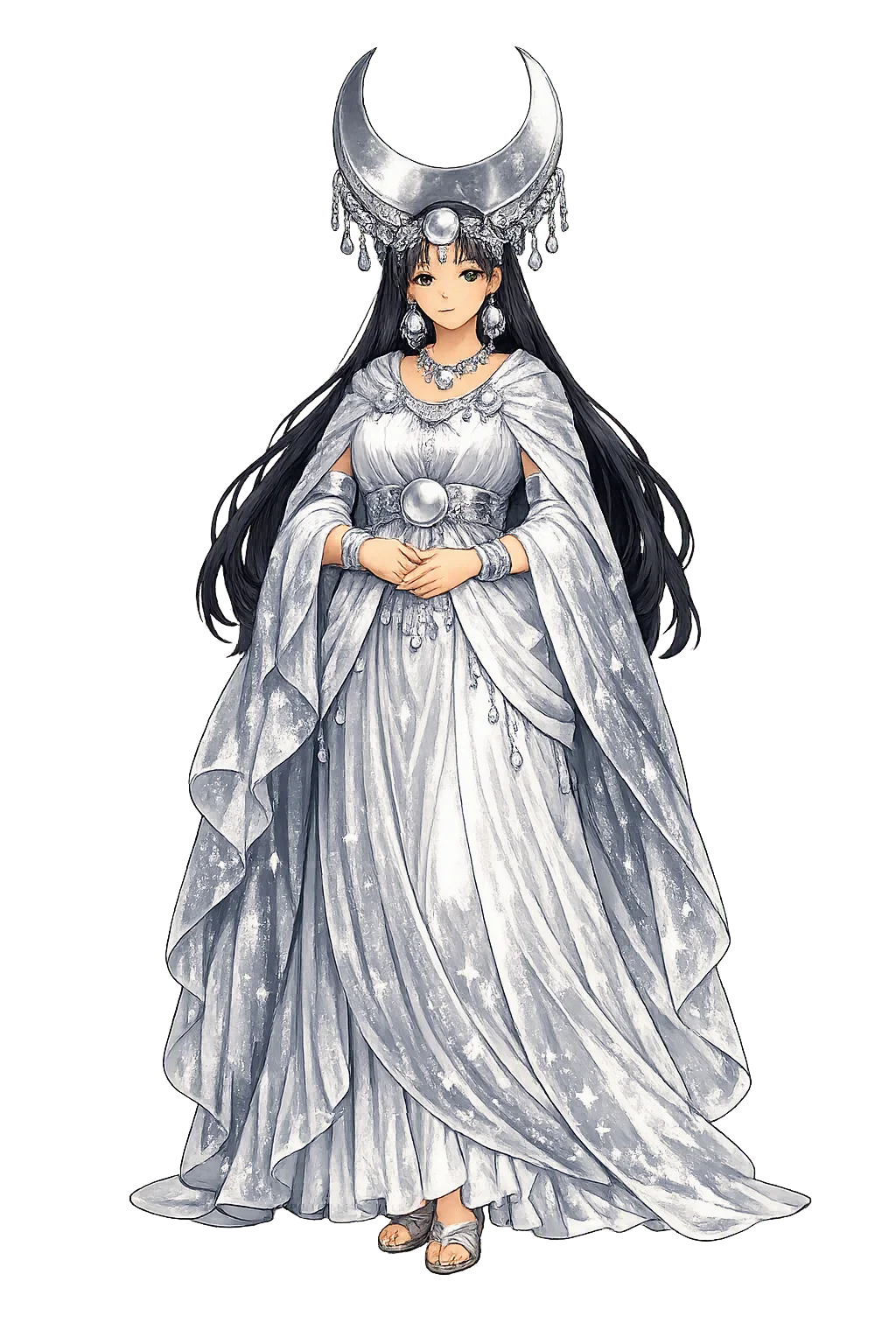
Mama Quilla kept the best-appointed cult in the Andean sky after the Sun's own. Her chamber in the Coricancha faced Inti's across the temple court — walls sheathed in silver, her image a silver woman with a great moon-disc at her breast — and the orders that served her were the most respected female institutions in the empire: the mamakuna, consecrated women, and the young ñustakuna (Cobo, Book 13; Polo). White maize and shellfish were laid before her, and her priests kept her phases, timing the festivals — the great moon-festival of her honor among them — that closed the planting season. When the jaguar seized the moon, the whole city became her votaries: shouting, drums, beaten dogs, pregnant women hidden against the eclipse's shadow. Her cult had an earthly mirror, too — the Coya, her living counterpart at the emperor's side — so her rites served both the silver image and the woman who wore her office.

In the Earth

The physical center of her cult was the Coricancha in Cuzco, whose curved western wall still stands beneath the Santo Domingo convent; excavations and the chroniclers' descriptions fix the moon chapel opposite the sun's — silver-clad, with her silver image facing the Punchao (the sun's golden boy-idol). The Spanish melted her silver into bullion, but the temple's plan survives in the foundations. Beyond Cuzco, moon imagery — crescents and full-moon discs — appears on colonial-era qirus (ritual cups) and in textiles that kept pre-conquest canons. Eclipse and moon observations are embedded in the architecture of state ritual sites such as the Coricancha itself, aligned to both solar and lunar standstills as modern archaeoastronomy (e.g., work associated with Dearborn and others at Cuzco) has argued.

05

Iconography

How Mama Quilla was imaged across the ages

The Image

Mama Quilla's one certain image stood in silver, and the conquerors melted it. Cobo describes the Coricancha statue: a woman of silver with a disc like the full moon at her breast — the moon worn as a heart — set against the Sun's golden boy in the facing chamber. No pre-conquest example survives; the metal of her shrine went into Spanish bullion, and her 'portraits' in the round are known only through that description. What survives is the attribute without the body: crescents and full-moon discs recur on colonial qirus, the ceremonial cups of the Andes, and in textile canons that kept older sky-patterns under Catholic names, while eclipse and moon observations are built into the Coricancha's alignments as archaeoastronomy has argued. The crescent pendants of Quechua and Aymara silversmiths descend, probably, from the disc at the goddess's breast.

06

Reception & Transformation

The name after its own age — transmission, translation, survival

Afterlives

Mama Quilla's afterlife begins with an act of destruction: the Spanish stripped her silver chamber and melted her image into bullion, so the mother of the dynasty survived only in description — Polo's and Cobo's — and in a word. The word proved durable. Santo Tomás recorded quilla in 1560, and it is still the Quechua word for both moon and month: her cycles remain how millions count time, the deepest semantic survival of any figure in this catalog. Nineteenth-century travelers rediscovered the ruined Coricancha beneath the Santo Domingo convent, and twentieth-century scholarship rebuilt her cult from the chronicles — Rowe's reconstruction of Inca state religion, Zuidema's decoding of the ceque ritual circuit, Bauer's mapping of the sacred landscape — while archaeoastronomy probed her temple's walls for lunar standstills. A goddess whose shrine was melted down within a generation of the conquest has been reassembled, piece by scholarly piece, ever since.

Identifications Across Traditions

Under Spanish rule, Mama Quilla's moon was quietly reassigned to the Virgin Mary — a mapping prepared by the Virgin's own lunar iconography (the woman clothed with the sun, the moon beneath her feet) and welcomed in Andean devotion, where Marian feasts absorbed the timing of the old lunar rites. The conversion was rarely clean: eclipse rituals survived under the surface, and the moon-festival season persists in the festival calendar of Cuzco's Corpus Christi. In the twentieth century the process reversed — the indigenous movement reclaimed the moon for Mama Quilla, and modern Killa Raymi celebrations in Ecuador and Peru explicitly restore the goddess to her festival, pairing her again with Inti in the revived Inti Raymi pageants. Andean religion here shows its characteristic resilience: the moon changed name for four centuries without changing office.

Modern Legacy

Mama Quilla's most durable legacy is lexical: killa/quilla, 'moon,' is also the Quechua word for 'month' — her cycles are still how millions count time, and the lunar-timed agricultural calendar remains the skeleton of Andean ritual life. Her festival, Killa Raymi or Coya Raymi (the 'moon festival,' associated with women and with September in the modern revival), is celebrated again in Ecuador and Peru as a festival of femininity and planting. The silver moon survives in the crafts: Quechua and Aymara artisans still make the crescent-disc pendants that descend from her shrine imagery. And in Cuzco's living calendar — Inti Raymi on the June solstice, with the Coya at the Sun's side — the sister-wife of the Sun remains the model of the queen: her title passed into the Spanish viceroyalty's own court etiquette.

07

The Meditation

What Mama Quilla means — beyond the dictionary

Mama Quilla embodies the Andean genius for pairing. The Inca universe is built of twinned powers — sun and moon, gold and silver, hanan and hurin, emperor and Coya — and she is the night half of the founding pair. Where the sun commands, the moon counts: her office is time, the patient arithmetic of waxing and waning by which planting, festival, and warfare were scheduled. That the dynasty's mother is the moon rather than the sun is a quiet but profound statement: empire's light may blaze, but its continuity — months, gestations, harvests — is feminine and lunar. Her eclipse myth sharpens the point: the moon's darkness is the moment the whole community must shout. A civilization, the goddess suggests, is measured not by its triumphs but by whether it makes noise for its mother when she is attacked.

08

Frequently Asked Questions

Common questions about Mama Quilla, Moon, Marriage, and Unicode restoration

01How do you pronounce Mama Quilla?

In reconstructed pronunciation, Mama Quilla is /ˈma.ma ˈki.ʎa/ — approximately 'MAH-mah KEE-lyah' — the chroniclers' 'Mama Quilla'; in modern Quechua orthography Mama Killa.

02What does Mama Quilla mean?

Mama Quilla means Mother moon in the incan tradition.

03What are the symbols of Mama Quilla?

Mama Quilla is associated with Silver (Her metal — her shrine in the Coricancha was sheathed in silver facing the Sun's gold), The Crescent (Killa) (The waxing moon, the favorable phase — the very word quilla means both 'moon' and 'month'), The Lunar Calendar (Her arithmetic: the twelve (or thirteen) lunar months that timed festivals, planting, and war), The Mirror of the Coya (The queen, her earthly counterpart, who bore the moon's title and diadem), The Eclipse (The jaguar's attack on the moon — the omen that emptied plazas and filled the night with noise).

04Why restore Mama Quilla in Unicode?

Mama Quilla is written entirely in ASCII letters, so its restoration is about canonical fidelity rather than recovered diacritics: the temple fixes the name in its scholarly standard spelling, attested in the source tradition, instead of leaving it to drift.

05What is the most important myth about Mama Quilla?

“Sister-Wife of the Sun” — the The Divine Pair story that anchors the mythology of Mama Quilla, told in full on the lore page.

09

Scholarly Sources

The philological foundations of this restoration

Every claim on this page is grounded in established scholarship. The orthographic restorations follow disciplinary convention. The etymological chain follows the best available reference works. This is not invention — it is resurrection through scholarship.

◈

Lexicography & Philology

  • D'Altroy
  • Bauer
◎

Primary Texts

  • Primary sources in the incan tradition for Mama Quilla.
◉

Archaeology & Art History

  • Material evidence — iconography, inscriptions, and temple archaeology — for Mama Quilla and related cults.
✦

Religious Studies

  • Cobo, Historia del Nuevo Mundo, Book 13 (1653)
  • Polo de Ondegardo, On the Errors and Superstitions of the Indians (1550s)
  • Murúa, Historia general del Piru (1616)
  • Urton, Inca Myths (1999)
  • Bauer, The Sacred Landscape of the Inca (1998)
  • D'Altroy, The Incas (2002)
Return

The Surface Awaits

You have traced the name from its earliest attestation to its Unicode restoration. Now return to the myth. The story is where the name lives.

Back to Lore
Mama Quilla mascot