PuniCodex

Extended Lore

Mamaqucha

Etymology · Orthography · Cult · Iconography · Reception · Sources

Tier 2 Mamaqucha
Mamaqucha — Sea, Fishermen
01

Quick Facts

Essential information about Mamaqucha, Sea, Fishermen

Scholarly TransliterationMamaqucha
Unicode RestorationMamaqucha
Reconstructed Pronunciation/mamaˈqutʃa/
PantheonIncan
DomainSea, Fishermen
MeaningMother sea
ClassificationTier 2
Primary DomainMamaqucha
Sacred SymbolsThe mother-name, Fish, The balsa raft, The western horizon
02

Etymology & Word Family

From original script to Unicode restoration

Scholarly Transliteration Mamaqucha Mamaqucha — "Mother sea"
Unicode Restoration Mamaqucha Canonical scholarly spelling — ASCII-identical
Modern ASCII mamaqucha Plain-ASCII fallback

The name Mamaqucha reaches the modern world through scholarly transliteration of the incan tradition. Because the conventional spelling uses only Latin letters, its Unicode and ASCII forms coincide — the tradition it carries is in the name itself, not in diacritics.

03

Unicode Character Breakdown

Character-by-character philological analysis

CharacterUnicodeNameBlockPhonetic Role
MU+004DLatin Capital Letter MBasic LatinSame, capitalized
aU+0061Latin Small Letter ABasic LatinSame
mU+006DLatin Small Letter MBasic LatinSame
aU+0061Latin Small Letter ABasic LatinSame
qU+0071Latin Small Letter QBasic LatinSame
uU+0075Latin Small Letter UBasic LatinSame
cU+0063Latin Small Letter CBasic LatinSame
hU+0068Latin Small Letter HBasic LatinSame
aU+0061Latin Small Letter ABasic LatinSame

The Tier 2 classification here reflects fidelity to the attested tradition, not recovered diacritics: every character of Mamaqucha already survives in ASCII. What the restoration preserves is the canonical spelling itself — the form scholarship standardised.

04

Cult & Worship

How the sacred was kept — rites, sanctuaries, remains

The Cult

The sea's cult was practiced at the waterline, and that is nearly all the record says. Cobo reports that the seashore itself was held sacred and that offerings were made where the surf breaks — an altar of water, perishable and immediate: food, coca, and textiles carried out with the tide. The cult belongs to the coastal peoples — Chimú, Chincha, and older valley traditions — rather than to the highland state, which met the ocean only at the end of its expansion; the great coastal oracle of Pachacamac, whose temple commanded the Lurín valley above the Pacific, mediated between maker and mother-water. No priesthood of the sea, no calendar of her festivals, and no temple of Mamaqucha as such is recorded anywhere in the chronicles. The silence is itself evidence: hers was a fisherman's and household's cult, addressed with the kinship term mama before the nets were cast.

In the Earth

No temple of Mamaqucha as such is known, and the sea-cult has left no secure iconography. What the coast has is Pachacamac: the vast adobe temple complex of the Lurín valley, occupied from the first millennium CE and expanded under the Inca, whose painted walls and plazas were still being described by Cieza in 1547. Seaside offerings documented ethnohistorically leave few durable traces — textiles, food, and shell disperse in the surf — but the maritime technology is material enough: balsa-raft traditions of the Ecuadorian and northern Peruvian coasts, confirmed archaeologically by navigation between the coast and offshore islands, gave the royal voyage legends their plausibility. The Chimú and earlier coastal societies left sea imagery in metal and mural; the Inca left the coast's greatest shrine enlarged. The mother sea herself was worshipped, fittingly, at the point where everything she gives washes back.

05

Iconography

How Mamaqucha was imaged across the ages

The Image

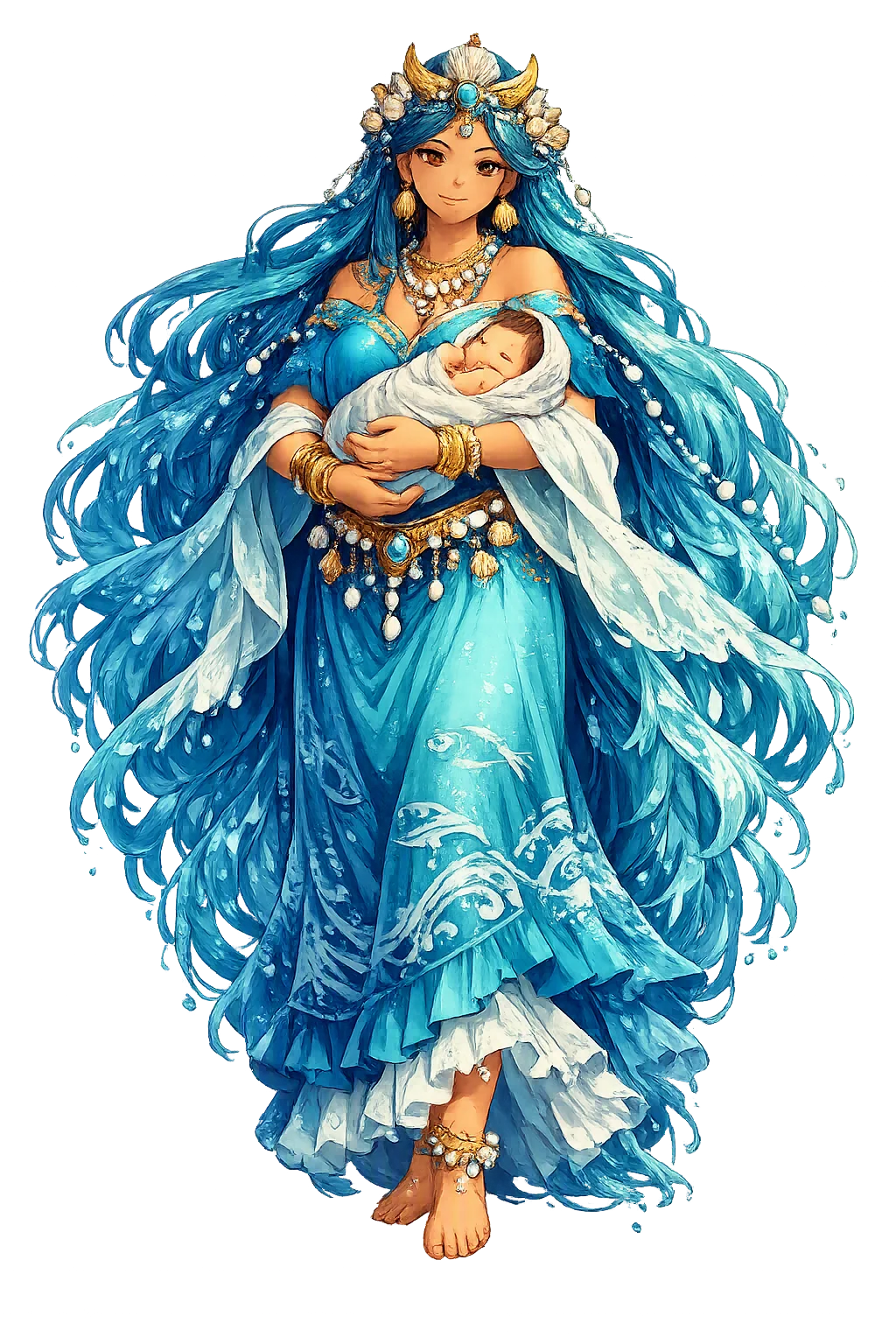
No image of Mamaqucha survives, and probably none was ever made. The coast's art is saturated with the sea — wave scrolls, fish, and sea-birds run across Moche and Chimú pottery and metalwork, and balsa sailing rafts were modeled even as funerary vessels — but none of it personifies the ocean as a goddess; the sea appears as the element that feeds, never as a face. The Inca state, which personified so much of the world, built her no temple and cast her no statue: she is the one power in this catalog whose canonical attribute is a shoreline. The attributes the texts give her are functional rather than figural — mother (mama), mother of fishes, the greatest of lakes, since qucha names every highland lake — a body of water addressed by kinship instead of likeness. Image evidence is lacking, and the lack appears to be the theology.

06

Reception & Transformation

The name after its own age — transmission, translation, survival

Afterlives

Mamaqucha's transmission is a chain of dictionaries, chronicles, and one stubborn word. Cieza de León heard the oracle of Pachacamac in 1547; Domingo de Santo Tomás recorded qucha — lake and sea — in his Vocabulario of 1560, fixing the double meaning her name depends on; the Huarochirí Manuscript (c. 1608) preserved the coast's own creation theology in Quechua; and Cobo and Sarmiento de Gamboa carried the sea-mother, and Topa Inca's westward voyage, into print. The voyage became her most traveled afterlife: repeated by every chronicler, it fed centuries of speculation about Inca seamanship and burst into modern debate when Thor Heyerdahl's Kon-Tiki expedition of 1947 set out to prove the raft legends plausible. Twentieth-century ethnohistory gave the sea-mother a scholarly address — Rostworowski's studies of Pachacamac, Bauer's of the sacred landscape — and modern Quechua lexicography keeps mama qucha an ordinary, spoken phrase. A goddess the empire never mapped has been carried, ever since, by language alone.

Identifications Across Traditions

Colonial Catholicism did not replace Mamaqucha so much as re-house her. The Virgin of Candelaria, Mamacha Candelaria, is the 'Mother' of Puno, the city on the shore of Lake Titicaca — the great lake addressed by the very word qucha; her February festival is among the largest in the Andes. Coastal devotion took similar paths: fishermen's religion folded the old mother-of-waters into saints' calendars, and north-coastal folklore kept sea-maiden figures who marry or drown mortal men, the mamá del mar motif recorded by twentieth-century ethnographers. Afro-Andean coastal cults along the Pacific later added Yemayá-style ocean motherhood, though that current comes from Brazil rather than deep antiquity. The syncretic pattern is stable: wherever Andean or Andean-descended communities face a large water, the water becomes a mother again.

Modern Legacy

Mamaqucha never stopped being spoken. Quechua-speaking communities across Peru still call the ocean mama qucha, and the word qucha rides in the names of uncounted lakes. The Mamacha Candelaria festival of Puno keeps the mother-by-the-water idiom at the center of Andean public religion, with dancers, barges, and a procession over the lake itself. Coastal communities from Chimbote to Ilo keep sea-side rituals in which offerings are still cast into the surf. And the name survives in scholarship as the standard example of Andean hydro-theology — the sea, like the mountains, addressed by kinship rather than distance. Restoring Mamaqucha as a name returns the Pacific to the grammar of family it had before the empire that failed to master it.

07

The Meditation

What Mamaqucha means — beyond the dictionary

The Andes are a vertical civilization: it reads the world up and down — terraces, peaks, apus above, dead below. Mamaqucha is the great exception, the horizontal. Where every apu is a named, ranked, assigned lord, the sea is simply Mother — an address, not an inventory entry. That asymmetry is the whole theology. The state could measure a mountain into its ritual circuit; it could not measure an ocean, and so it left the ocean in the one grammatical case it could not administer: the vocative. To call the sea 'mother' is to admit that some powers are fed by being spoken to, not by being organized. This temple keeps that admission. Mamaqucha is the entry in the lexicon that refused to become a monument, and is honored precisely for the refusal.

08

Frequently Asked Questions

Common questions about Mamaqucha, Sea, Fishermen, and Unicode restoration

01How do you pronounce Mamaqucha?

In reconstructed pronunciation, Mamaqucha is /mamaˈqutʃa/ — approximately 'ma-ma-KOO-cha' — the pitch peaks on the third syllable, the qu is a deep, throaty k, and the ch is as in 'church'.

02What does Mamaqucha mean?

Mamaqucha means Mother sea in the incan tradition.

03What are the symbols of Mamaqucha?

Mamaqucha is associated with The mother-name (mama + qucha — the sea addressed with a kinship term, as Pachamama is the earth addressed as mother.), Fish (Her children and the coast's staple food; the sea's bounty is a mother's milk.), The balsa raft (The ocean-going craft of Andean mariners; the royal voyage tradition makes it the bridge to the mother sea.), The western horizon (The sea as sunset, rain-cloud, and the unknown islands of empire-era story.).

04Why restore Mamaqucha in Unicode?

Mamaqucha is written entirely in ASCII letters, so its restoration is about canonical fidelity rather than recovered diacritics: the temple fixes the name in its scholarly standard spelling, attested in the source tradition, instead of leaving it to drift.

05What is the most important myth about Mamaqucha?

“The Sea That Feeds” — the The Mother of Fishes story that anchors the mythology of Mamaqucha, told in full on the lore page.

09

Scholarly Sources

The philological foundations of this restoration

Every claim on this page is grounded in established scholarship. The orthographic restorations follow disciplinary convention. The etymological chain follows the best available reference works. This is not invention — it is resurrection through scholarship.

◈

Lexicography & Philology

  • D'Altroy
  • Bauer
◎

Primary Texts

  • Primary sources in the incan tradition for Mamaqucha.
◉

Archaeology & Art History

  • Material evidence — iconography, inscriptions, and temple archaeology — for Mamaqucha and related cults.
✦

Religious Studies

  • Bernabé Cobo, Historia del Nuevo Mundo (1653), Book 13 (sea worship; Topa Inca's voyage)
  • Cieza de León, Crónica del Perú, First Part, ch. 5 (the oracle of Pachacamac)
  • Sarmiento de Gamboa, Historia Indica, ch. 60–62 (the Pacific voyage of Topa Inca Yupanqui)
  • Salomon & Urioste, The Huarochirí Manuscript (1991), ch. 1–2 (the maker and the flood)
  • Santo Tomás, Domingo de, Lexicon o vocabulario de la lengua general del Perú (1560), s.v. qucha
  • Bauer, Brian S., The Sacred Landscape of the Inca (1998)
Return

The Surface Awaits

You have traced the name from its earliest attestation to its Unicode restoration. Now return to the myth. The story is where the name lives.

Back to Lore
Mamaqucha mascot