PuniCodex

Extended Lore

龍王 Lóngwáng

Etymology · Orthography · Cult · Iconography · Reception · Sources

Tier 1 Lóngwáng.com
Lóngwáng — Dragons, Rain, Rivers
01

Quick Facts

Essential information about Lóngwáng, Dragons, Rain, Rivers

Original Script龍王
Unicode RestorationLóngwáng
Reconstructed Pronunciation/lʊŋ˧˥ waŋ˧˥/
PantheonChinese
DomainDragons, Rain, Rivers
Meaningwater deity in Chinese mythology
ClassificationTier 1
Primary DomainLóngwáng.com
Sacred SymbolsCrystal palace, Rúyì Jīngū Bàng, Dragon robe and royal crown, Rain clouds and tidal bore, Shrimp soldiers and crab generals
02

Etymology & Word Family

From original script to Unicode restoration

Original Script 龍王 Lóngwáng — "water deity in Chinese mythology"
Unicode Restoration Lóngwáng Restored stress, length, and script
Modern ASCII longwang Plain-ASCII fallback

The name Lóngwáng carries the orthographic signature of the chinese tradition: 龍王. Unicode restoration recovers what ASCII flattens.

03

Unicode Character Breakdown

Character-by-character philological analysis

CharacterUnicodeNameBlockPhonetic Role
LU+004CLatin Capital Letter LBasic LatinSame, capitalized
óU+00F3Latin Small Letter O with AcuteLatin-1 SupplementStress on o
nU+006ELatin Small Letter NBasic LatinSame
gU+0067Latin Small Letter GBasic LatinSame
wU+0077Latin Small Letter WBasic LatinSame
áU+00E1Latin Small Letter A with AcuteLatin-1 SupplementStress on a
nU+006ELatin Small Letter NBasic LatinSame
gU+0067Latin Small Letter GBasic LatinSame

The Tier 1 classification reflects how much of the original phonology this restoration preserves — stress and vowel length for Greek names, distinctive letters and diacritics for every other tradition.

04

Cult & Worship

How the sacred was kept — rites, sanctuaries, remains

The Cult

The Dragon King's cult is the village water-temple, and it is still standing. Lóngwáng miào — Dragon King shrines — line the rivers, lakes, and coasts of China, from the Black Dragon Pool northwest of Beijing, where Qing emperors sent officials to beg rain, down to one-room brick shrines beside a village well. The ritual year was agrarian and exact: spring temple fairs opened the planting season; a rainless summer turned the county magistrate, fasting and in undress robes, into the lead petitioner of his district, since the throne was answerable for weather as for any other duty. Vows were repaid with opera — after the rain came, troupes performed for days before the god's image. And the god traveled: his effigy rode in a sedan-chair to the riverbank when drought demanded his presence in person, for a king who governed water had to be shown the fields it was failing. Suppressed in the twentieth century, the shrines have quietly reopened. Rain still has an address.

In the Earth

The material cult behind the Dragon Kings is far older than the kings themselves. Shang oracle bones (c. 1250–1045 BCE) record rain sacrifices addressed to river and water powers, and Han texts describe rain-making rites performed with clay dragons — Dong Zhongshu's Chunqiu Fanlu gives the liturgy, and Wang Chong's Lunheng argues against it. Han mirrors and tomb reliefs show the older cosmic dragon of clouds and ascent, not yet a crowned bureaucrat. The named Dragon Kings of the Four Seas crystallize in medieval China under Buddhist influence: nāga kings with submarine palaces appear in translated sūtras from the early centuries CE, the Tang court formally enfeoffed the dragon kings of the Four Seas with royal titles, and by the Song their temples stood in the official register of sacrifices. The literary cycle reaches canonical form in the Ming novels Fengshen Yanyi and Xiyouji.

05

Iconography

How Lóngwáng was imaged across the ages

The Image

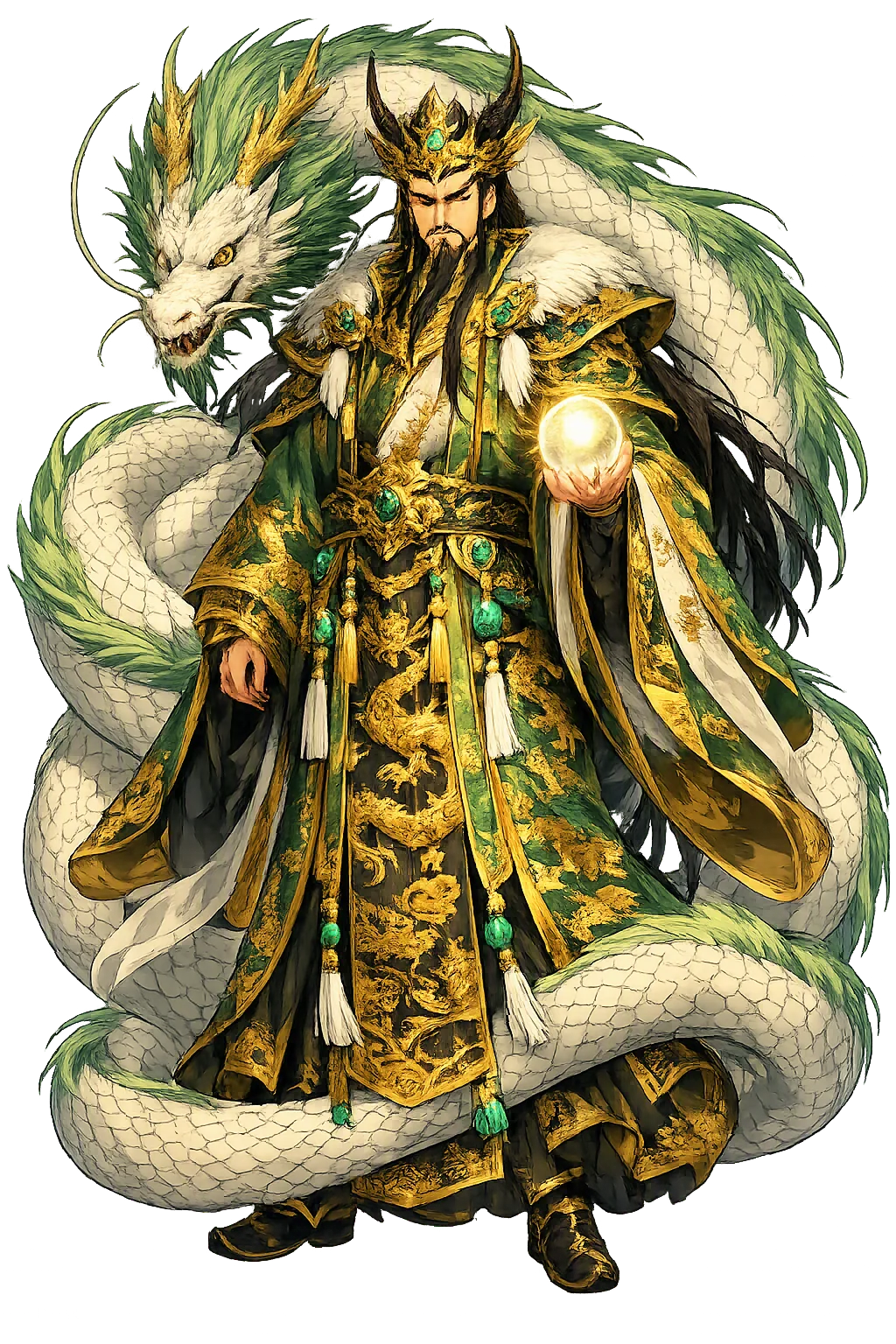
Look for the court, not the monster: the Dragon King is imaged as a magistrate who happens to rule water. In temple statuary and popular print he sits enthroned in beaded crown and five-colored dragon robe, a jade tablet in his hands like any official at audience, his feet on carved waves; beside the throne stand the shrimp soldiers, crab generals, and a tortoise counselor — the sea staffed as a yamen. No single masterpiece defines the type; the corpus is vernacular and serial. Lacquered wood effigies were built to be carried; Ming and Qing album leaves show the kings riding out through clouds to deliver a decree of rain; and the great print shops of Yangliuqing and Wuqiang sold New Year pictures of the crystal palace by the thousand to households that wanted the water governed on their own wall. On the opera stage the mask betrays him: horned, bewhiskered, gilded over scales — the one place the king is permitted, literally, to be a dragon.

06

Reception & Transformation

The name after its own age — transmission, translation, survival

Afterlives

The Dragon King's road to the world runs through print. The cult supplied the kings; the novels made them immortal: Fengshen yanyi and Xiyouji, fixed in the great Ming woodblock editions of the late sixteenth and early seventeenth centuries, canonized Āo Guǎng as literature's standing warden of drowned treasure. Qing popular culture multiplied him — temple murals, New Year prints, and above all the stage, where the Nézhā plays entered the permanent opera repertoire. Modern scholarship took the novels seriously only slowly: Lu Xun's Brief History of Chinese Fiction (1923–25) argued for their art as literature, and twentieth-century translation carried the crystal palace abroad — Arthur Waley's Monkey (1942) taught the English-speaking world the sea-pinning staff and the exasperated king who owned it, and W.J.F. Jenner's complete Xiyouji (1982) restored the bureaucratic comedy the abridgments had trimmed. The reception runs double to this day: in China the king remains a live address for rain, while in the wider world he endures as literature's oldest underwater creditor — the god you visit when you need what the sea keeps.

Identifications Across Traditions

The Dragon Kings are among the clearest cases of Buddhism and native Chinese religion merging into a single figure. Native Chinese water-dragon and river-god cults are ancient, but the named kings with submarine palaces, retinues, and treasuries owe much to the Indian nāgarājas — serpent kings of the waters — carried into China with the translated sūtras; Chinese translators rendered nāga as lóng (dragon), and the eight nāga kings of Buddhist scripture became native sea-kings. The relative weight of the Indian import against the older Chinese cult remains a matter of scholarly debate. Taoism then absorbed the kings wholesale into its celestial administration as rain officials answerable to the Jade Emperor. From China the figure travelled with the culture: in Japan the dragon kings appear as ryūō, kin to the sea-god Ryūjin of the undersea palace; in Korea as Yongwang, propitiated by fishing and farming villages alike; in Vietnam as Long Vương, guardian of waters and of the nation's own dragon genealogy.

Modern Legacy

The Dragon King never fully retired. His temples still stand along China's coasts and rivers, and rain-processions to the local king persisted in the countryside into the twentieth century. In literature and performance he is a permanent stock character: every adaptation of the Journey to the West — opera, film, television, animation — must eventually send someone down to the crystal palace, whether to borrow a weapon or to wreck the court. The feud with Nézhā alone has carried him through a century of Chinese animation, from the 1979 feature Nézhā Nào Hǎi (Nezha Conquers the Dragon King) to the 2019 blockbuster Ne Zha, where the dragon clan's grievance drives the plot. In the modern idiom the Dragon King's palace remains a byword for fabulous drowned wealth, and the figure himself endures wherever Chinese fantasy needs a throne beneath the sea.

07

The Meditation

What Lóngwáng means — beyond the dictionary

The Dragon King teaches that water is governed, not merely unleashed. In the Chinese imagination even rain is paperwork: every shower has an issuing authority, an amount, an hour, and a signature. This is not a failure of wonder but a different kind of wonder — the conviction that the wildest force in the farmer's world can be brought under seal and ledger, and that the price of that order is absolute accountability. The Jìng River king lost his head for a trifle of water and an hour's delay, because in a cosmos run as an administration there is no such thing as a small alteration.

To name a domain Lóngwáng is therefore to claim the throne under the waves: the palace where treasure and law are kept together, where the sea's own creatures wear the robes of ministers, and where a king may be sovereign of all he surveys and still answer for every drop. It is the oldest Chinese lesson about power — that it is real only when it is answerable.

08

Screen & Culture

Where Lóngwáng echoes through film, television, and games — and how

09

Frequently Asked Questions

Common questions about Lóngwáng, Dragons, Rain, Rivers, and Unicode restoration

01How do you pronounce Lóngwáng?

In reconstructed pronunciation, Lóngwáng is /lʊŋ˧˥ waŋ˧˥/ — approximately LUHNG-WAHNG — two even syllables, each rising from mid to high pitch; the 'o' of the first is like the 'oo' in 'book', the 'a' of the second like the 'a' in 'father'.

02What does Lóngwáng mean?

Lóngwáng means water deity in Chinese mythology in the chinese tradition.

03What are the symbols of Lóngwáng?

Lóngwáng is associated with Crystal palace (The underwater court (龍宮, Dragon Palace) — sovereignty, hidden wealth, and the ordered world beneath the chaos of the sea), Rúyì Jīngū Bàng (The compliant gold-banded staff, an iron pillar that once pinned the seas — the tameable measure of the waters, taken from the East Sea treasury by Sūn Wùkōng), Dragon robe and royal crown (Enfeoffed kingship within the celestial bureaucracy — the Dragon King rules as a peer of heaven's administration, not as a free lord), Rain clouds and tidal bore (The waters he commands — rain, rivers, lakes, and tides delivered by decree, withheld in drought, unleashed in flood), Shrimp soldiers and crab generals (The aquatic retinue of the Dragon Palace — the sea's own creatures enrolled as a court, a mirror of the imperial administration below the waves).

04Why restore Lóngwáng in Unicode?

Plain ASCII longwang strips the stress, length, and script that make the name specific. Unicode restoration returns the name to its original written dignity.

05What is the most important myth about Lóngwáng?

“The Jìng River Dragon King's Wager” — the Journey to the West story that anchors the mythology of Lóngwáng, told in full on the lore page.

10

Scholarly Sources

The philological foundations of this restoration

Every claim on this page is grounded in established scholarship. The orthographic restorations follow disciplinary convention. The etymological chain follows the best available reference works. This is not invention — it is resurrection through scholarship.

◈

Lexicography & Philology

  • Shan Hai Jing
  • Chinese folklore
◎

Primary Texts

  • Primary sources in the chinese tradition for Lóngwáng.
◉

Archaeology & Art History

  • Material evidence — iconography, inscriptions, and temple archaeology — for Lóngwáng and related cults.
✦

Religious Studies

  • Journey to the West (Xiyouji)
  • Investiture of the Gods (Fengshen Yanyi)
  • Dragon King (encyclopedia overview)
  • Ao Guang, Dragon King of the East Sea
  • Shanhaijing (Classic of Mountains and Seas)
  • Huainanzi
  • Encyclopaedia Britannica: Longwang
  • Unihan Database (Unicode Consortium)
Return

The Surface Awaits

You have traced the name from its earliest attestation to its Unicode restoration. Now return to the myth. The story is where the name lives.

Back to Lore
Lóngwáng mascot