PuniCodex

Extended Lore

ᛚᚢᚴᛁ Loki

Etymology · Phonology · Orthography · Cultural Legacy · Primary Sources

Tier 2 Loki
Loki — Trickery, Chaos, Shape-shifter
01

Quick Facts

Essential information about Loki, Trickery, Chaos, Shape-shifter

Original Scriptᛚᚢᚴᛁ
Unicode RestorationLoki
Reconstructed Pronunciation/ˈlo.ke/
PantheonNorse
DomainTrickery, Chaos, Shape-shifter
MeaningPossibly knot, loop, or flame
ClassificationTier 2
Primary DomainLoki
Sacred SymbolsThe sewn lips, The mistletoe dart, The net of Franangr, The serpent and the bowl, The mare's shape
02

Etymology & Word Family

From original script to Unicode restoration

Original Script ᛚᚢᚴᛁ Loki — "Possibly knot, loop, or flame"
Unicode Restoration Loki Restored stress, length, and script
Modern ASCII loki Plain-ASCII fallback

Loki is Tier 2 by the mechanical rule: the normalized Old Norse spelling is Loki, with a short o and no distinctive letter, so the plain ASCII form loses nothing — the restoration and the ASCII form are the same word. The etymology is genuinely uncertain: the most discussed derivation connects the name with the *luk- family — Old Norse lok 'cover, lid, lock', lúka 'to close, end' — whence 'knot', 'lock', or 'the one who closes', a reading that would suit his role at Ragnarök; the nineteenth-century equation with Logi, 'flame', is now abandoned. Attestation and lexicography follow Cleasby & Vigfusson, An Icelandic-English Dictionary (1874), s.v. Loki; Zoëga, A Concise Dictionary of Old Icelandic (1910), s.v. loki; and de Vries, Altnordisches etymologisches Wörterbuch (1962), s.v. Loki.

03

Unicode Character Breakdown

Character-by-character philological analysis

CharacterUnicodeNameBlockPhonetic Role
LU+004CLatin Capital Letter LBasic LatinSame
oU+006FLatin Small Letter OBasic LatinSame
kU+006BLatin Small Letter KBasic LatinSame
iU+0069Latin Small Letter IBasic LatinSame

The Tier 2 classification reflects how much of the original phonology this restoration preserves — stress and vowel length for Greek names, distinctive letters and diacritics for every other tradition.

04

Cultural Significance

From ancient cult to modern Unicode

Ancient Domain

In the norse tradition, Loki is the trickster of the Æsir — counted among the gods, bound to them by an oath of blood-brotherhood with Óðinn, yet the son of the giant Fárbauti and the goddess Laufey, and the moving cause of their deepest grief. Skáldskaparmál teaches poets to call him the 'slanderer of the gods' and the 'thief of the gods': the one who cuts Sif's hair, bargains his own head against the dwarfs' craft, and finds the loophole in every oath sworn in Ásgarðr.

His shape is never fixed: salmon in the falls of Franangr, mare to the stallion Svaðilfari, fly at the dwarfs' bellows, old woman prying secrets from Frigg. Fire runs through his reputation — the eating contest he loses to Logi, wildfire itself — and chaos through his offspring: by the giantess Angrboða he fathers Fenrir the wolf, Jǫrmungandr the world-serpent, and Hel the queen of the dead, the three creatures the gods must bind, drown, and banish to keep the world standing.

Loki in Later Traditions

The oldest comparative frame for Loki is the Greek Promētheús: a benefactor-trickster chained to a rock as punishment, torn daily and writhing — the parallel between the eagle and the dripping serpent was drawn as early as the Romantic mythographers, and Rooth's Loki in Scandinavian Mythology (1961) remains the standard monograph weighing such connections. The comparison illuminates the punishment but not the god: Promētheús suffers for helping mankind, Loki for destroying his own fellowship. The nineteenth century tried to dissolve Loki into a fire-god on the strength of his name's resemblance to Logi, 'flame' — the equation survived in Wagner's Loge — but modern philology rejects it: the o of Loki is short, the two figures are distinct in the texts themselves, and Logi appears in Gylfaginning as the personified wildfire who out-eats Loki at Útgarðr. That episode requires its own honest distinction: Útgarða-Loki, the cunning giant-king whose illusions humiliate Þórr on the eastern journey, is a different being from Loki Laufeyjarson — Snorri never confuses them, and scholarship since de Vries has treated the shared name as a genuine onomastic coincidence, however suggestive the parallel mastery of deception. Within the corpus Loki's clearest double is his byname Loptr, 'the airy one', under which the skalds name him when the poets need him in the sky.

Modern Legacy

Loki has the largest afterlife of any Norse figure after Þórr and Óðinn, and it forked early. The folk record kept a kinder god: the Faroese ballad Lokka táttur makes Lokki the clever helper who, with Óðinn and Þórr, saves a farmer's son from a giant — proof that a benevolent trickster-Loki survived in oral tradition long after the Eddic damnation. Learned Europe first remade him as fire: Wagner's Loge in the Ring cycle, the cynical flame who talks the gods into their bargains, is the nineteenth century's conflation of Loki with Logi rendered as opera. The twentieth century gave him back his malice and his charm at once — Neil Gaiman's 'Low Key Lyesmith' in American Gods hides the bound god in a prison cell — and the twenty-first made him a global franchise: Marvel's Loki, Thor's adopted brother and rival, has carried the name further than the Eddas ever traveled, at the price of thinning the mythology to a family quarrel. Modern heathenry remains honestly divided: many Ásatrú kindreds refuse to hail Loki at blót, reading him as the oath-breaker the Eddas describe, while others honor him as the necessary disturber without whom nothing in Ásgarðr ever changes. The deepest survival is idiomatic: in the Scandinavian languages his name still clings to the trembling air over hot ground and to the spider that ties knots — small, unsettled things that refuse to hold still.

Unicode Restoration as Cultural Act

Restoring Loki in a domain name is more than orthographic accuracy. It is a statement that the internet should recognize the full range of human writing — not only the ASCII keyboard.

05

Frequently Asked Questions

Common questions about Loki, Trickery, Chaos, Shape-shifter, and Unicode restoration

01How do you pronounce Loki?

In reconstructed pronunciation, Loki is /ˈlo.ke/ — approximately 'LOH-kee' — two even syllables with the weight on the first; keep the o short and round, and let the second syllable fall away lightly..

02What does Loki mean?

Loki means Possibly knot, loop, or flame in the norse tradition.

03What are the symbols of Loki?

Loki is associated with The sewn lips (Brokkr's needle, the price of the lost wager — the trickster's own weapon, speech, bound shut), The mistletoe dart (The small, overlooked thing that kills the best of the gods; the loophole made into a weapon), The net of Franangr (The first net, which Loki himself devised — and in which the gods catch him when he flees as a salmon), The serpent and the bowl (Skadi's venom-dripping snake fixed above his face, and Sigyn's bowl that stands between him and agony), The mare's shape (The form he took to lure Svaðilfari from the wall-builder; from that union he bore Sleipnir, Óðinn's eight-legged horse).

04What is the difference between Loki?

Each is a historically defensible restoration. Lóki.com is the alt-stress form: Acute on o: alternate stress.

05Why restore Loki in Unicode?

Plain ASCII loki strips the stress, length, and script that make the name specific. Unicode restoration returns the name to its original written dignity.

06What is the most important myth about Loki?

Deep in the flyting, when Óðinn moves to silence him, Loki invokes the oldest bond in the mythology: 'Do you remember, Óðinn, how in days of old we two blended our blood together? You said you would never taste ale unless it were brought to us both.' The blood-brotherhood oath — attested in the heroic lays as the rite that makes two men one — is the single fact that explains Loki's place among the Æsir: he is not one of them by birth, being the son of the giant Fárbauti, but he cannot be refused a seat while Óðinn's oath stands.The poem's whole tragedy hangs on that stanza. Every insult Loki hurls is spoken from inside the oath's protection, and every crime he is accused of is a crime against the brothers of his blood. When the Æsir finally bind him, they are not punishing an enemy at the gate but a kinsman at the table — which is why the punishment is not death but endlessness.

06

Scholarly Sources

The philological foundations of this restoration

Every claim on this page is grounded in established scholarship. The orthographic restorations follow disciplinary convention. The etymological chain follows the best available reference works. This is not invention — it is resurrection through scholarship.

Lexicography & Philology

  • Cleasby-Vigfusson
  • Zoëga

Primary Texts

  • Poetic Edda: Lokasenna (the flyting at Ægir's hall; the blood-brother oath, st. 9; Bellows translation)
  • Poetic Edda: Þrymskviða (Loki as Þórr's bridesmaid; Bellows translation)
  • Snorri Sturluson, Prose Edda: Gylfaginning (Útgarða-Loki's hall, the death of Baldr, the binding, Ragnarök; Brodeur translation)
  • Gylfaginning, Old Norse text (Guðni Jónsson edition), chs. 33–34, 44–51
  • Skáldskaparmál, Old Norse text (the kennings for Loki; Sif's hair and the wager of the head)

Archaeology & Art History

  • Material evidence — iconography, inscriptions, and temple archaeology — for Loki and related cults.
  • One carved stone is the entire candidate corpus for Loki's image: the Snaptun stone (Denmark, c. 1000), a hearth-stone or bellows-shield bearing a bearded face with scarred, sewn-shut lips, commonly identified as Loki from the Brokkr episode — an identification widely repeated but unprovable, since the stone carries no inscription. The Kirkby Stephen stone in Cumbria, showing a bound horned figure, has likewise been read as the bound Loki, though scholars also read it as a bound devil of Christian iconography. His attestation is otherwise textual: the Poetic Edda poems survive chiefly in the Codex Regius (GKS 2365 4to, c. 1270) and the Hauksbók; Snorri's account is transmitted by the principal Snorra Edda manuscripts (GKS 2367 4to, Codex Wormianus, Codex Upsaliensis). No runic inscription names the god, and no Scandinavian place-name is securely his — a silence that matches his ambiguous cultic standing: the one major god for whom no temple, toponym, or votive deposit is known.

Religious Studies

  • Cleasby & Vigfusson, An Icelandic-English Dictionary (1874), s.v. Loki
  • Zoëga, A Concise Dictionary of Old Icelandic (1910), s.v. loki
  • Anna Birgitta Rooth, Loki in Scandinavian Mythology (Lund: CWK Gleerup, 1961) — the standard monograph
  • Loki — overview of attestations, etymology, and scholarship
Return

The Surface Awaits

You have traced the name from its earliest attestation to its Unicode restoration. Now return to the myth. The story is where the name lives.

Back to Lore
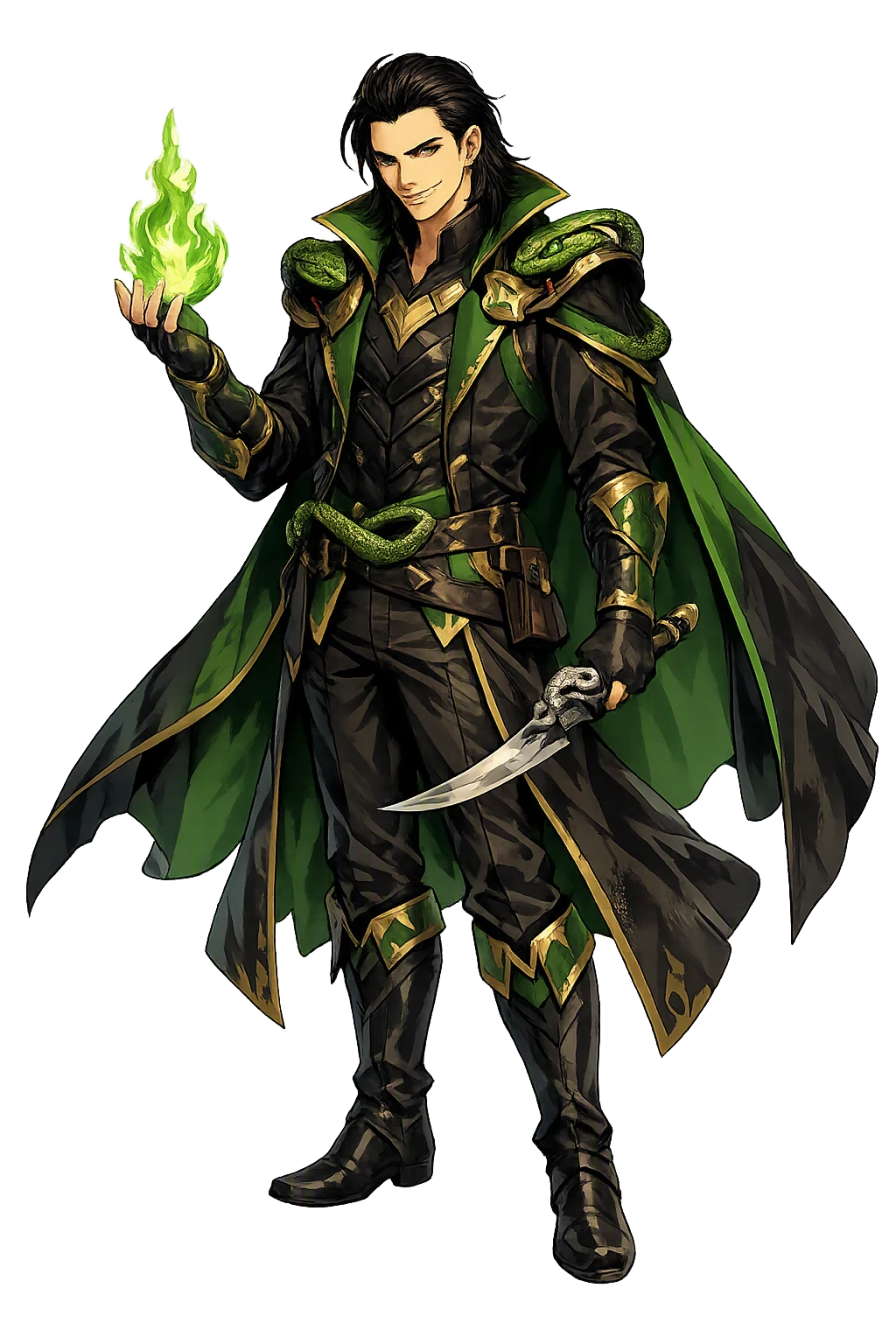
Loki mascot