PuniCodex

Extended Lore

Kǒngzǐ — The Deeper Record

Etymology · Orthography · Cult · Iconography · Reception · Sources

Preserves distinctive marks Kǒngzǐ.com
Kǒngzǐ — Wisdom, Ethics, Ritual, Learning
01

At a Glance

Kǒngzǐ — every fact links to its home

PantheonChinese
DomainWisdom, Ethics, Ritual, Learning
Attested478 BCE
Original Script孔子 →
Cited Works9 cited →
02

Etymology & Word Family

From original script to Unicode restoration — the full etymology page →

Original Script 孔子 Kǒngzǐ — "Master Kong"
Unicode Restoration Kǒngzǐ Restored stress, length, and script
Modern ASCII kongzi Plain-ASCII fallback

Kǒng (孔) the clan name; zǐ (子) 'master' — the honorific title of the philosopher Confucius (Kong Qiu).

03

Unicode Character Breakdown

Character-by-character philological analysis

CharacterUnicodeNameBlockPhonetic Role
KU+004BLatin Capital Letter KBasic LatinSame, capitalized
ǒU+01D2Latin Small Letter O with CaronLatin Extended-BCaron tone mark
nU+006ELatin Small Letter NBasic LatinSame
gU+0067Latin Small Letter GBasic LatinSame
zU+007ALatin Small Letter ZBasic LatinSame
ǐU+01D0Latin Small Letter I with CaronLatin Extended-BCaron tone mark

More than one historically valid Unicode spelling of Kǒngzǐ exists — each variant is a real, attested restoration, and the owned forms live as temples.

04

Cult & Worship

How the sacred was kept — rites, sanctuaries, remains

The Cult

Kǒngzǐ became a god by slow degrees, and the machinery of his worship is unusually well documented. The first temple stood at Qufu, raised on his residence in 478 BCE, the year after his death; the first imperial sacrifice came in 195 BCE, when Han Gaozu stopped at the tomb and offered the Great Sacrifice. In 59 CE Emperor Ming extended the rite to the empire's schools, and from the Tang onward every prefectural academy kept a temple (wénmiào) where the magistrate offered at the stipulated spring and autumn ceremonies — bells, grain-spirits, rows of dancers — the liturgy codified under the Tang and elaborated in the Kāiyuán ritual code of 732. The Song made the title hereditary in the Kong line as Duke Yansheng, which kept the ancestral sacrifices at Qufu until the Republic abolished it in 1935. Today's televised rites and Confucius Institutes are a modern movement laid over this old skeleton.

In the Earth

Qufu is the material anchor: the Temple of Confucius stands on the site of his residence, consecrated by Duke Āi of Lǔ in 478 BCE and rebuilt to its present Ming-era scale; beside it the Kong Mansion housed his descendants until 1949, and the Kong Lin cemetery holds over 100,000 lineage burials with thousands of stelae. Far older than any temple, the Guōdiàn bamboo slips — a Warring States library buried c. 300 BCE at Hubei and excavated in 1993 — preserve pre-imperial versions of texts in his tradition, proving the school was copying and teaching his books within three centuries of his death. And the Wǔ Liáng shrine stone reliefs (Shandong, 151 CE) already show the iconic scene of the young Kǒngzǐ asking Lǎozǐ about the rites: the myth cut in stone within three and a half centuries of the man.

05

Iconography

How Kǒngzǐ was imaged across the ages

The Image

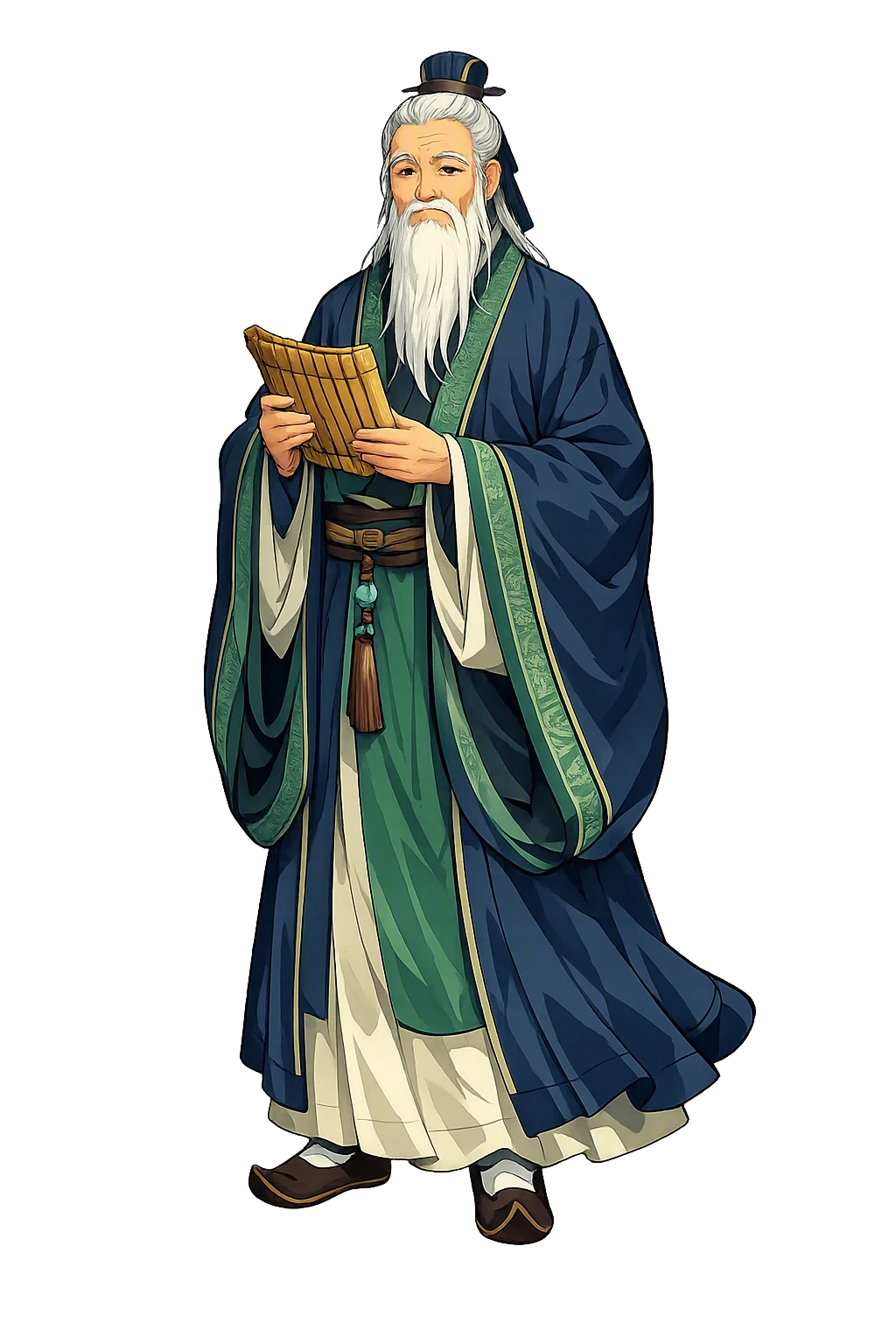
No likeness from life survives — the Master's face is a construction of the tradition, and the tradition knows it. The earliest images are Han narrative scenes in stone: at the Wǔ Liáng shrine (151 CE) he stands before Lǎozǐ, a young inquirer, not yet a sage. The decisive step was the portrait: tradition attributes the canonical image to the Tang painter Wú Dàozǐ, and a Qufu stele still claims to preserve his brushwork — full beard, layered robes, hands clasped at the chest, the face heavy and calm. Under the Song and Ming the type was codified for every school and temple; a Ming court version in the National Palace Museum, Taipei, shows the finished formula. Printers spread 'Traces of the Sage' narrative cycles, while the Jiajing reform of 1530 struck the statues themselves from official temples as uncanonical, leaving tablets — Qufu's own image survived the rule, and after its destruction in 1966 a new statue was carved for the Hall of Great Achievement. The face East Asia knows has barely changed in a thousand years.

06

Reception & Transformation

The name after its own age — transmission, translation, survival

Afterlives

The Master's afterlife began with a book compiled from memory: the Lúnyǔ took shape among the second and third generations of disciples — sayings and scenes stitched in no strict order — and by Han times it was read as scripture. The Han fought over the text itself, the New Text version in court orthography against an 'Old Text' recovered, its champions said, from the walls of his own house, while the apocryphal 'weft' books made him a prophet with a dragon brow and a moon-shaped chest, portents piled on the plainest of men. The Tang fixed the standard text — Yán Shīgǔ's imperial edition of 638 — and cut the canon in stone again at Chang'an (837–838); Zhū Xī's commentaries later carried the Four Books to examination immortality. Then came the great translation: in 1687 the Jesuits' Confucius Sinarum Philosophus put the canon into Latin and made the Master a European philosopher, read by Leibniz and fought over in the Rites Controversy. Modern philology brought him back down to earth — James Legge retranslated him for the Victorian age — and in 1973 the tomb of King Huai of Zhongshan yielded a bamboo Lúnyǔ, the oldest copy known, close to our text yet visibly different: proof that a transmission two and a half millennia long was never a straight line.

Identifications Across Traditions

The Master resisted deification in life — “while you do not yet know life, how can you know death?” (Analects 11.12) — but the Han state deified him anyway. Emperor Gāozǔ offered the first imperial sacrifice at his tomb in 195 BCE; by the Tang his posthumous titles swelled toward “King” and “Perfect Sage,” and Dǒng Zhòngshū gave his teaching cosmological armor. From Sòng times the neo-Confucians — above all Zhū Xī — rebuilt it into the metaphysics of East Asia, and for thirteen centuries the civil examinations made his classics the gateway to office in China, Korea, Japan, and Vietnam. The West received him through the Jesuits: Ricci’s circle Latinized Kǒng Fūzǐ as Confucius, and Voltaire kept his portrait like a household saint. Modernity first dethroned him — the New Culture Movement denounced him as the face of feudalism — and then reinstated him. Few mortals have been so many things to so many regimes.

Modern Legacy

His living monument is Qufu: the Temple of Confucius — consecrated in 478 BCE, the year after his death, when Duke Āi of Lǔ turned his former residence into a shrine — the adjacent Kong Mansion, and the Kong Lin cemetery, together the largest classical building complex in China after the Forbidden City. His bloodline is on record longer than any other on earth: the Kong genealogy counts more than eighty documented generations. From 605 to 1905 the empire’s examinations were built on his classics, making him — by crib-book, temple sacrifice, and schoolhouse portrait — the single most studied author in human history. Taiwan still keeps Teachers’ Day on his traditional birthday, 28 September; and the everyday word rú 儒, “scholar,” is his school’s oldest name.

10

The Original Script Note

What the written record preserves — and what it does not

Original Script

Written 孔子, identical in traditional and simplified characters: kǒng 孔 is the clan name — traditionally explained as a surname of the 子 lineage of the state of Sòng, carried into Lǔ by refugee ancestors — and zǐ 子 is the honorific 'Master', attached by disciples and canonized by the Shǐjì (ch. 47). The man himself was Kǒng Qiū 孔丘, courtesy name Zhòngní 仲尼; Kǒngzǐ is thus already a title, and the Jesuit latinization Confucius latinizes the title once more. The compound is firmly attested in Warring States texts — the Lúnyǔ, Mèngzǐ, and Zhuāngzǐ all know the Master by it. Pinyin Kǒngzǐ (Tone 3 + Tone 3, rising by sandhi to Tone 2 on the first syllable in speech) is the Modern Standard Mandarin reading per the Unihan Database.

11

The Meditation

What Kǒngzǐ means — beyond the dictionary

Kǒngzǐ is the rare founder who disclaimed founding anything. “I transmit, I do not create.” What he transmitted was a question rather than an answer: how should a human being live among other human beings? His answers were deliberately unheroic — learn, practice the rites, keep your word, honor your parents, govern by example — and the unheroism is their strength. He is the teacher as such, the man whose greatness is measured entirely in students.

The restoration of his name matters in a way he might have appreciated: drop a single tone-mark and the Master’s name dissolves into a string of letters. Orthography, he taught by every example of his life, is not decoration but the foundation of the Way. To write Kǒngzǐ is to keep the bell ringing.

12

Frequently Asked Questions

Deep-dives into the cult, attestation, reception, and sources of Kǒngzǐ

01How do we know how Kǒngzǐ was worshipped?

Qufu is the material anchor: the Temple of Confucius stands on the site of his residence, consecrated by Duke Āi of Lǔ in 478 BCE and rebuilt to its present Ming-era scale; beside it the Kong Mansion housed his descendants until 1949, and the Kong Lin cemetery holds over 100,000 lineage burials with thousands of stelae. The full cult record →

02Where do the earliest attestations of Kǒngzǐ come from?

The record rests on Sima Qian, Shiji 47, “Hereditary House of Confucius”, Sima Qian, Shiji 63, “Laozi and Han Fei” (the meeting with Laozi), Analects (Lunyu), esp. 2.4, 3.24, 7.1, 11.9, 11.12, 18.5–6, among 6 cited works. The full source apparatus →

03How did later traditions reinterpret Kǒngzǐ?

The Master's afterlife began with a book compiled from memory: the Lúnyǔ took shape among the second and third generations of disciples — sayings and scenes stitched in no strict order — and by Han times it was read as scripture. Reception & transformation →

04What do the surviving images of Kǒngzǐ actually show?

No likeness from life survives — the Master's face is a construction of the tradition, and the tradition knows it. The iconography →

05What does the written record of Kǒngzǐ actually preserve?

Written 孔子, identical in traditional and simplified characters: kǒng 孔 is the clan name — traditionally explained as a surname of the 子 lineage of the state of Sòng, carried into Lǔ by refugee ancestors — and zǐ 子 is the honorific 'Master', attached by disciples and canonized by the Shǐjì (ch. 47) The Original Script note →

13

Scholarly Sources

The philological foundations of this restoration

Every claim on this page is grounded in established scholarship. The orthographic restorations follow disciplinary convention. The etymological chain follows the best available reference works. This is not invention — it is resurrection through scholarship.

◈

Lexicography & Philology

  • Analects
  • Shiji
  • Chinese classics
◎

Primary Texts

  • The Shan Hai Jing (Classic of Mountains and Seas); the Huainanzi; the Chuci.
◉

Archaeology & Art History

  • Chang, K. C. Art, Myth, and Ritual: The Path to Political Authority in Ancient China.
✦

Religious Studies

  • Sima Qian, Shiji 47, “Hereditary House of Confucius”
  • Sima Qian, Shiji 63, “Laozi and Han Fei” (the meeting with Laozi)
  • Analects (Lunyu), esp. 2.4, 3.24, 7.1, 11.9, 11.12, 18.5–6
  • Chunqiu (Spring and Autumn Annals), with the Zuo commentary
  • Ames & Rosemont, The Analects of Confucius: A Philosophical Translation (1998)
  • Nylan & Wilson, Lives of Confucius: Civilization’s Greatest Sage Through the Ages (2010)
Return

The Surface Awaits

You have traced the name from its earliest attestation to its Unicode restoration. Now return to the myth. The story is where the name lives.

Back to Lore
Kǒngzǐ mascot