PuniCodex

Extended Lore

孔子 Kǒngzǐ

Etymology · Orthography · Cult · Iconography · Reception · Sources

Tier 1 Kǒngzǐ.com
Kǒngzǐ — Confucius, Moral Teaching, Ritual
01

Quick Facts

Essential information about Kǒngzǐ, Confucius, Moral Teaching, Ritual

Original Script孔子
Unicode RestorationKǒngzǐ
Reconstructed Pronunciation/kʰʊŋ˨˩˦ tsɨ˨˩˦/
PantheonChinese
DomainConfucius, Moral Teaching, Ritual
MeaningMaster Kong
ClassificationTier 1
Primary DomainKǒngzǐ.com
Sacred SymbolsQilin of the birth-omen, The Apricot Altar (Xíngtán 杏壇), The Analects (Lúnyǔ 論語), The Stone Classics, The cypress of Qufu
02

Etymology & Word Family

From original script to Unicode restoration

Original Script 孔子 Kǒngzǐ — "Master Kong"
Unicode Restoration Kǒngzǐ Restored stress, length, and script
Modern ASCII kongzi Plain-ASCII fallback

Kǒng (孔) the clan name; zǐ (子) 'master' — the honorific title of the philosopher Confucius (Kong Qiu).

03

Unicode Character Breakdown

Character-by-character philological analysis

CharacterUnicodeNameBlockPhonetic Role
KU+004BLatin Capital Letter KBasic LatinSame, capitalized
ǒU+01D2Latin Small Letter O with CaronLatin Extended-BCaron tone mark
nU+006ELatin Small Letter NBasic LatinSame
gU+0067Latin Small Letter GBasic LatinSame
zU+007ALatin Small Letter ZBasic LatinSame
ǐU+01D0Latin Small Letter I with CaronLatin Extended-BCaron tone mark

The Tier 1 classification reflects how much of the original phonology this restoration preserves — stress and vowel length for Greek names, distinctive letters and diacritics for every other tradition.

04

Cult & Worship

How the sacred was kept — rites, sanctuaries, remains

The Cult

Kǒngzǐ became a god by slow degrees, and the machinery of his worship is unusually well documented. The first temple stood at Qufu, raised on his residence in 478 BCE, the year after his death; the first imperial sacrifice came in 195 BCE, when Han Gaozu stopped at the tomb and offered the Great Sacrifice. In 59 CE Emperor Ming extended the rite to the empire's schools, and from the Tang onward every prefectural academy kept a temple (wénmiào) where the magistrate offered at the stipulated spring and autumn ceremonies — bells, grain-spirits, rows of dancers — the liturgy codified under the Tang and elaborated in the Kāiyuán ritual code of 732. The Song made the title hereditary in the Kong line as Duke Yansheng, which kept the ancestral sacrifices at Qufu until the Republic abolished it in 1935. Today's televised rites and Confucius Institutes are a modern movement laid over this old skeleton.

In the Earth

Qufu is the material anchor: the Temple of Confucius stands on the site of his residence, consecrated by Duke Āi of Lǔ in 478 BCE and rebuilt to its present Ming-era scale; beside it the Kong Mansion housed his descendants until 1949, and the Kong Lin cemetery holds over 100,000 lineage burials with thousands of stelae. Far older than any temple, the Guōdiàn bamboo slips — a Warring States library buried c. 300 BCE at Hubei and excavated in 1993 — preserve pre-imperial versions of texts in his tradition, proving the school was copying and teaching his books within three centuries of his death. And the Wǔ Liáng shrine stone reliefs (Shandong, 151 CE) already show the iconic scene of the young Kǒngzǐ asking Lǎozǐ about the rites: the myth cut in stone within three and a half centuries of the man.

05

Iconography

How Kǒngzǐ was imaged across the ages

The Image

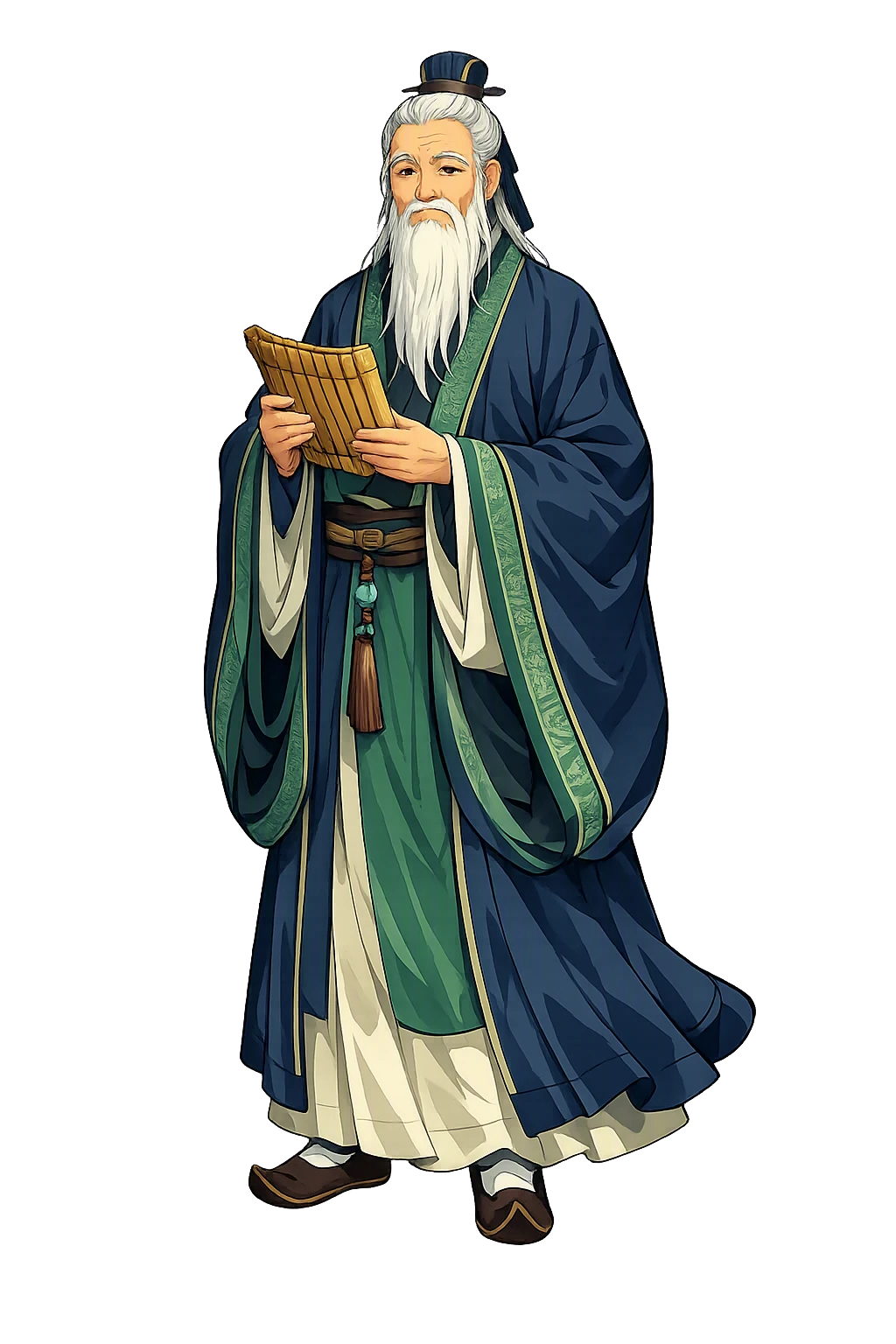
No likeness from life survives — the Master's face is a construction of the tradition, and the tradition knows it. The earliest images are Han narrative scenes in stone: at the Wǔ Liáng shrine (151 CE) he stands before Lǎozǐ, a young inquirer, not yet a sage. The decisive step was the portrait: tradition attributes the canonical image to the Tang painter Wú Dàozǐ, and a Qufu stele still claims to preserve his brushwork — full beard, layered robes, hands clasped at the chest, the face heavy and calm. Under the Song and Ming the type was codified for every school and temple; a Ming court version in the National Palace Museum, Taipei, shows the finished formula. Printers spread 'Traces of the Sage' narrative cycles, while the Jiajing reform of 1530 struck the statues themselves from official temples as uncanonical, leaving tablets — Qufu's own image survived the rule, and after its destruction in 1966 a new statue was carved for the Hall of Great Achievement. The face East Asia knows has barely changed in a thousand years.

06

Reception & Transformation

The name after its own age — transmission, translation, survival

Afterlives

The Master's afterlife began with a book compiled from memory: the Lúnyǔ took shape among the second and third generations of disciples — sayings and scenes stitched in no strict order — and by Han times it was read as scripture. The Han fought over the text itself, the New Text version in court orthography against an 'Old Text' recovered, its champions said, from the walls of his own house, while the apocryphal 'weft' books made him a prophet with a dragon brow and a moon-shaped chest, portents piled on the plainest of men. The Tang fixed the standard text — Yán Shīgǔ's imperial edition of 638 — and cut the canon in stone again at Chang'an (837–838); Zhū Xī's commentaries later carried the Four Books to examination immortality. Then came the great translation: in 1687 the Jesuits' Confucius Sinarum Philosophus put the canon into Latin and made the Master a European philosopher, read by Leibniz and fought over in the Rites Controversy. Modern philology brought him back down to earth — James Legge retranslated him for the Victorian age — and in 1973 the tomb of King Huai of Zhongshan yielded a bamboo Lúnyǔ, the oldest copy known, close to our text yet visibly different: proof that a transmission two and a half millennia long was never a straight line.

Identifications Across Traditions

The Master resisted deification in life — “while you do not yet know life, how can you know death?” (Analects 11.12) — but the Han state deified him anyway. Emperor Gāozǔ offered the first imperial sacrifice at his tomb in 195 BCE; by the Tang his posthumous titles swelled toward “King” and “Perfect Sage,” and Dǒng Zhòngshū gave his teaching cosmological armor. From Sòng times the neo-Confucians — above all Zhū Xī — rebuilt it into the metaphysics of East Asia, and for thirteen centuries the civil examinations made his classics the gateway to office in China, Korea, Japan, and Vietnam. The West received him through the Jesuits: Ricci’s circle Latinized Kǒng Fūzǐ as Confucius, and Voltaire kept his portrait like a household saint. Modernity first dethroned him — the New Culture Movement denounced him as the face of feudalism — and then reinstated him. Few mortals have been so many things to so many regimes.

Modern Legacy

His living monument is Qufu: the Temple of Confucius — consecrated in 478 BCE, the year after his death, when Duke Āi of Lǔ turned his former residence into a shrine — the adjacent Kong Mansion, and the Kong Lin cemetery, together the largest classical building complex in China after the Forbidden City. His bloodline is on record longer than any other on earth: the Kong genealogy counts more than eighty documented generations. From 605 to 1905 the empire’s examinations were built on his classics, making him — by crib-book, temple sacrifice, and schoolhouse portrait — the single most studied author in human history. Taiwan still keeps Teachers’ Day on his traditional birthday, 28 September; and the everyday word rú 儒, “scholar,” is his school’s oldest name.

07

The Meditation

What Kǒngzǐ means — beyond the dictionary

Kǒngzǐ is the rare founder who disclaimed founding anything. “I transmit, I do not create.” What he transmitted was a question rather than an answer: how should a human being live among other human beings? His answers were deliberately unheroic — learn, practice the rites, keep your word, honor your parents, govern by example — and the unheroism is their strength. He is the teacher as such, the man whose greatness is measured entirely in students.

The restoration of his name matters in a way he might have appreciated: drop a single tone-mark and the Master’s name dissolves into a string of letters. Orthography, he taught by every example of his life, is not decoration but the foundation of the Way. To write Kǒngzǐ is to keep the bell ringing.

08

Frequently Asked Questions

Common questions about Kǒngzǐ, Confucius, Moral Teaching, Ritual, and Unicode restoration

01How do you pronounce Kǒngzǐ?

In reconstructed pronunciation, Kǒngzǐ is /kʰʊŋ˨˩˦ tsɨ˨˩˦/ — approximately “KOHNG-dzuh,” each syllable on a dipping-then-rising melody; said in one breath, the first tone lifts and the second dips.

02What does Kǒngzǐ mean?

Kǒngzǐ means Master Kong in the chinese tradition.

03What are the symbols of Kǒngzǐ?

Kǒngzǐ is associated with Qilin of the birth-omen (The peace-beast said to have appeared before his birth, spitting a jade tablet announcing a child whose teaching would rule all under Heaven though he sat on no throne (later legend built on Shiji 47).), The Apricot Altar (Xíngtán 杏壇) (The teaching ground at Qufu where tradition seats the Master among his disciples; the phrase became a synonym for the school itself.), The Analects (Lúnyǔ 論語) (Twenty books of short exchanges — question, answer, sometimes only a sigh: the irreducible core of the tradition, memorized by every educated East Asian for two millennia.), The Stone Classics (The canon carved into stone at the imperial academy (the Xīpíng stones, 175–183 CE) so that no scribal error could corrupt the Master’s text.), The cypress of Qufu (The ancient cypresses at his tomb in the Kong Lin forest cemetery — living links in the longest documented family line on earth.).

04Why restore Kǒngzǐ in Unicode?

Plain ASCII kongzi strips the stress, length, and script that make the name specific. Unicode restoration returns the name to its original written dignity.

05What is the most important myth about Kǒngzǐ?

“The Qilin’s Jade Tablet (551 BCE)” — the The Birth story that anchors the mythology of Kǒngzǐ, told in full on the lore page.

09

Scholarly Sources

The philological foundations of this restoration

Every claim on this page is grounded in established scholarship. The orthographic restorations follow disciplinary convention. The etymological chain follows the best available reference works. This is not invention — it is resurrection through scholarship.

◈

Lexicography & Philology

  • Analects
  • Shiji
  • Chinese classics
◎

Primary Texts

  • Primary sources in the chinese tradition for Kǒngzǐ.
◉

Archaeology & Art History

  • Material evidence — iconography, inscriptions, and temple archaeology — for Kǒngzǐ and related cults.
✦

Religious Studies

  • Sima Qian, Shiji 47, “Hereditary House of Confucius”
  • Sima Qian, Shiji 63, “Laozi and Han Fei” (the meeting with Laozi)
  • Analects (Lunyu), esp. 2.4, 3.24, 7.1, 11.9, 11.12, 18.5–6
  • Chunqiu (Spring and Autumn Annals), with the Zuo commentary
  • Ames & Rosemont, The Analects of Confucius: A Philosophical Translation (1998)
  • Nylan & Wilson, Lives of Confucius: Civilization’s Greatest Sage Through the Ages (2010)
Return

The Surface Awaits

You have traced the name from its earliest attestation to its Unicode restoration. Now return to the myth. The story is where the name lives.

Back to Lore
Kǒngzǐ mascot