PuniCodex

Extended Lore

Kamapuaa

Etymology · Orthography · Cult · Iconography · Reception · Sources

Tier 2 Kamapuaa
Kamapuaa — Pig God, Agriculture
01

Quick Facts

Essential information about Kamapuaa, Pig God, Agriculture

Scholarly TransliterationKamapuaa
Unicode RestorationKamapuaa
Reconstructed Pronunciation/ka.maˈpu.a.a/
PantheonPolynesian
DomainPig God, Agriculture
Meaningmale fertility deity in Hawaiian mythology
ClassificationTier 2
Primary DomainKamapuaa
Sacred SymbolsThe boar's tusk, Kaliuwa'a — Sacred Falls, The rain, The spring, The cultivated field
02

Etymology & Word Family

From original script to Unicode restoration

Scholarly Transliteration Kamapuaa Kamapuaa — "male fertility deity in Hawaiian mythology"
Unicode Restoration Kamapuaa Canonical scholarly spelling — ASCII-identical
Modern ASCII kamapuaa Plain-ASCII fallback

The name Kamapuaa reaches the modern world through scholarly transliteration of the polynesian tradition. Because the conventional spelling uses only Latin letters, its Unicode and ASCII forms coincide — the tradition it carries is in the name itself, not in diacritics.

03

Unicode Character Breakdown

Character-by-character philological analysis

CharacterUnicodeNameBlockPhonetic Role
KU+004BLatin Capital Letter KBasic LatinSame, capitalized
aU+0061Latin Small Letter ABasic LatinSame
mU+006DLatin Small Letter MBasic LatinSame
aU+0061Latin Small Letter ABasic LatinSame
pU+0070Latin Small Letter PBasic LatinSame
uU+0075Latin Small Letter UBasic LatinSame
aU+0061Latin Small Letter ABasic LatinSame

The Tier 2 classification here reflects fidelity to the attested tradition, not recovered diacritics: every character of Kamapuaa already survives in ASCII. What the restoration preserves is the canonical spelling itself — the form scholarship standardised.

04

Cult & Worship

How the sacred was kept — rites, sanctuaries, remains

The Cult

The honest starting point is absence: no heiau dedicated to Kamapua'a has been excavated, and no priesthood of his is recorded. His sanctuary was a landscape — Kaliuwa'a, the sheer valley of Sacred Falls in the Koʻolau range, whose cliffs, pools, and mists were his house of worship in the Hawaiian open-air manner. The religion around him was the ordinary cult of the farm: Mālo and Kamakau show the pig as the chiefly offering of Hawaiian ritual, and the keeping and eating of pork sat inside the kapu system — the old rule barring women from pork among the most famous. Farmers prayed at family shrines to the powers of rain and cultivar, and the cycle remembers Kamapua'a as the force behind both. Modern practitioners of the Hawaiian renaissance honor him at the valley and in the rain; that revival is real, but it is new — the ancient cult left no temple, only the chants and the ground they describe.

In the Earth

Kamapua'a's material traces are modest but real. Pig bones dominate Hawaiian faunal assemblages from the earliest settlement layers — the pig was the islanders' principal meat and most prestigious sacrifice, which is why a pig-god could carry chiefly mana. Pig-tusk ornaments (niho pua'a), worn as anklets and necklaces by the ali'i, are well represented in contact-period museum collections. Kaliuwa'a, the sheer valley of his birth, shows no monumental works — Hawaiian gods kept open-air shrines — but its waterfalls, pools, and cliff walls were the sanctuary itself, and its modern closure to the public has made it again what the myth says it always was: his valley, closed.

05

Iconography

How Kamapuaa was imaged across the ages

The Image

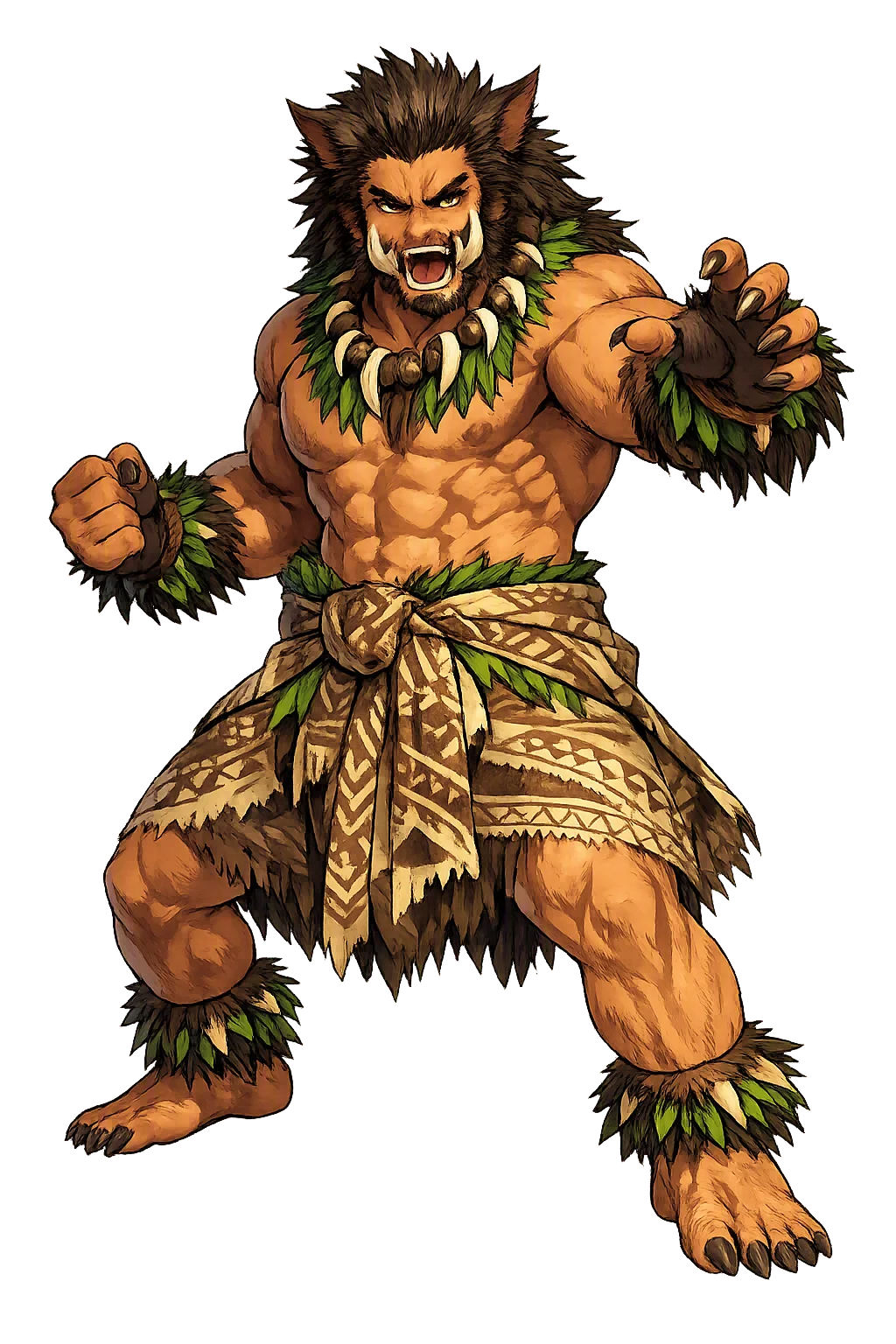
No pre-contact image of Kamapua'a is known to survive: Hawaiian carvers fashioned kiʻi for the great gods of the heiau, and none has ever been assigned to him. His iconography lives in chant, and it is a study in doubleness — the handsome young chief and the enormous boar whose rooting furrows became the valleys of the Koʻolau range — with a third form besides: the fog and warm rain that wrap his cliffs. Post-contact artists gave him a body at last. In the late twentieth century the block prints of Dietrich Varez and the murals of the Hawaiian renaissance fixed the popular image — the man-boar amid taro and rain — and the motif now lives on in tattoos and gallery walls. The honest portrait remains textual: every description in the cycle is a photograph of weather and pig, and no ancient carving contradicts it, because none exists.

06

Reception & Transformation

The name after its own age — transmission, translation, survival

Afterlives

The Kamapua'a cycle crossed the contact line in Hawaiian mouths and was caught on paper by the nineteenth-century Native press. Kamakau sketched him in the Hawaiian-language newspapers of the 1860s and 70s; Fornander printed the great Pele courtship in the Account of the Polynesian Race (1878–85); Moses Nakuina answered with the volcano side of the story. The timing mattered: the cycle was written down by men who had known it as living religion, in its own language, decades before translation thinned it. The English-language retellings that followed carried him to the world as a marvel-tale, and the first comparative shelf put him with the tricksters — Roland Dixon's Oceanic Mythology (1916) is the era's fossil. Later twentieth-century reference work, capped by Craig's Dictionary of Polynesian Mythology (1989), mapped the variants and their islands, and the renaissance returned the texts to performance. A cycle preserved in the nick of time by Native reporters has since traveled from fisherman's tale to university syllabus — the scholarly transmission, in the end, is the shortest leg of his long journey.

Identifications Across Traditions

Kamapua'a is Hawaiian to the bone — the pig has no pan-Polynesian divine twin of quite his kind, though the boar figures everywhere in island myth and tabu — and his nearest relations are local: his mother Hina, the great Polynesian goddess the Hawaiians multiplied into a dozen local Hinas, and his wife-rival Pele, whose cycle absorbs his. The nineteenth century treated him as a curiosity, and the early tale-collectors printed him as a marvel-story; Beckwith restored him to seriousness as the agricultural meaning of the pig. In the modern renaissance he is claimed as the god of the Hawaiian rainforest and of the feral pig problem alike — the axis between conservation and subsistence hunting — and his name rides canoes, taro brands, and hālau. If Pele is the volcano that owns the land, Kamapua'a is the garden that owns its pest.

Modern Legacy

Kamapua'a's legacy runs from the museum case to the dinner table. Pig remains dominate Hawaiian faunal assemblages from the earliest settlement layers — the pig was the islanders' principal meat and most prestigious offering, which is why a pig-god could carry chiefly mana. Pig-tusk ornaments, documented by Kamakau and preserved in the earliest contact-period collections in London and Honolulu, attest his prestige in chiefly dress. Sacred Falls — Kaliuwa'a — was closed to visitors after fatalities in the 1990s and remains kapu, a closure many Hawaiians frame as the valley reasserting his tapu. Taro farmers invoke him wryly: taro is his stolen treasure that became the staff of life. And the courtship cycle is performed still — the flood wooing the fire is one of the great set-pieces of Hawaiian storytelling, a comic epic that ends, unusually for a trickster, in a working marriage.

07

The Meditation

What Kamapuaa means — beyond the dictionary

Every agricultural people knows the animal in Kamapua'a: the creature that is wealth and destruction in one body — the pig that manures the field and roots it up, the rain that drowns the seedlings and fills the pond. What Hawaiian myth did with that knowledge is marry it. The boar does not get exterminated in this cycle; he gets married to the volcano and bound by treaty. It is among the most sophisticated land-use stories in this catalog: destruction domesticated not by force but by alliance, the pest made a spouse with terms.

There is a gentler reading too. Kamapua'a is the child no one wanted — half pig, born in the least approachable valley on the island — who grows up to be the one being Pele cannot defeat. The despised form conceals the effective nature. His cycle tells every misfit with a stubborn streak what the tradition believes: you are not the problem; you are the untried element, and the day will come when even the volcano needs rain.

08

Frequently Asked Questions

Common questions about Kamapuaa, Pig God, Agriculture, and Unicode restoration

01How do you pronounce Kamapuaa?

In reconstructed pronunciation, Kamapuaa is /ka.maˈpu.a.a/ — approximately 'kah-mah-POO-ah-ah' — five light syllables; stress on the pu, and let the final a-a sound as two separate vowels.

02What does Kamapuaa mean?

Kamapuaa means male fertility deity in Hawaiian mythology in the polynesian tradition.

03What are the symbols of Kamapuaa?

Kamapuaa is associated with The boar's tusk (His tusks furrowed the valleys; pig-tooth ornaments (niho pua'a) worn by chiefs carried his mana.), Kaliuwa'a — Sacred Falls (The sheer-walled valley of his birth, closed to entry under old custom — a sanctuary the myth still owns.), The rain (His element of courtship and war: he came to Pele as fog, rain, and thunderstorm, and water is how he wins.), The spring (Where his tusks struck the rock, fresh water broke forth — the wild hog as water-bringer.), The cultivated field (The garden he ravaged and then defended: his cycle ends as god of agriculture, not only of its destruction.).

04Why restore Kamapuaa in Unicode?

Kamapuaa is written entirely in ASCII letters, so its restoration is about canonical fidelity rather than recovered diacritics: the temple fixes the name in its scholarly standard spelling, attested in the source tradition, instead of leaving it to drift.

05What is the most important myth about Kamapuaa?

“The Child of the Cliffs” — the Birth story that anchors the mythology of Kamapuaa, told in full on the lore page.

09

Scholarly Sources

The philological foundations of this restoration

Every claim on this page is grounded in established scholarship. The orthographic restorations follow disciplinary convention. The etymological chain follows the best available reference works. This is not invention — it is resurrection through scholarship.

◈

Lexicography & Philology

  • Beckwith
  • Malo
◎

Primary Texts

  • Primary sources in the polynesian tradition for Kamapuaa.
◉

Archaeology & Art History

  • Material evidence — iconography, inscriptions, and temple archaeology — for Kamapuaa and related cults.
✦

Religious Studies

  • Beckwith, Hawaiian Mythology
  • Westervelt, Hawaiian Legends of Gods and Ghosts
  • Westervelt, Hawaiian Legends of Volcanoes
  • Fornander, An Account of the Polynesian Race
  • Kamakau, Ka Moolelo Hawaii
  • Craig, Dictionary of Polynesian Mythology
Return

The Surface Awaits

You have traced the name from its earliest attestation to its Unicode restoration. Now return to the myth. The story is where the name lives.

Back to Lore
Kamapuaa mascot