PuniCodex

Extended Lore

काली Kālī

Etymology · Orthography · Cult · Iconography · Reception · Sources

Tier 1 Kālī.com
Kālī — Time, Destruction, Empowerment
01

Quick Facts

Essential information about Kālī, Time, Destruction, Empowerment

Original Scriptकाली
Unicode RestorationKālī
Reconstructed Pronunciation/kaː.liː/
PantheonSanskrit
DomainTime, Destruction, Empowerment
MeaningThe Black One — the fierce goddess of time and destruction, consort of Śiva (fem. of kāla)
ClassificationTier 1
Primary DomainKālī.com
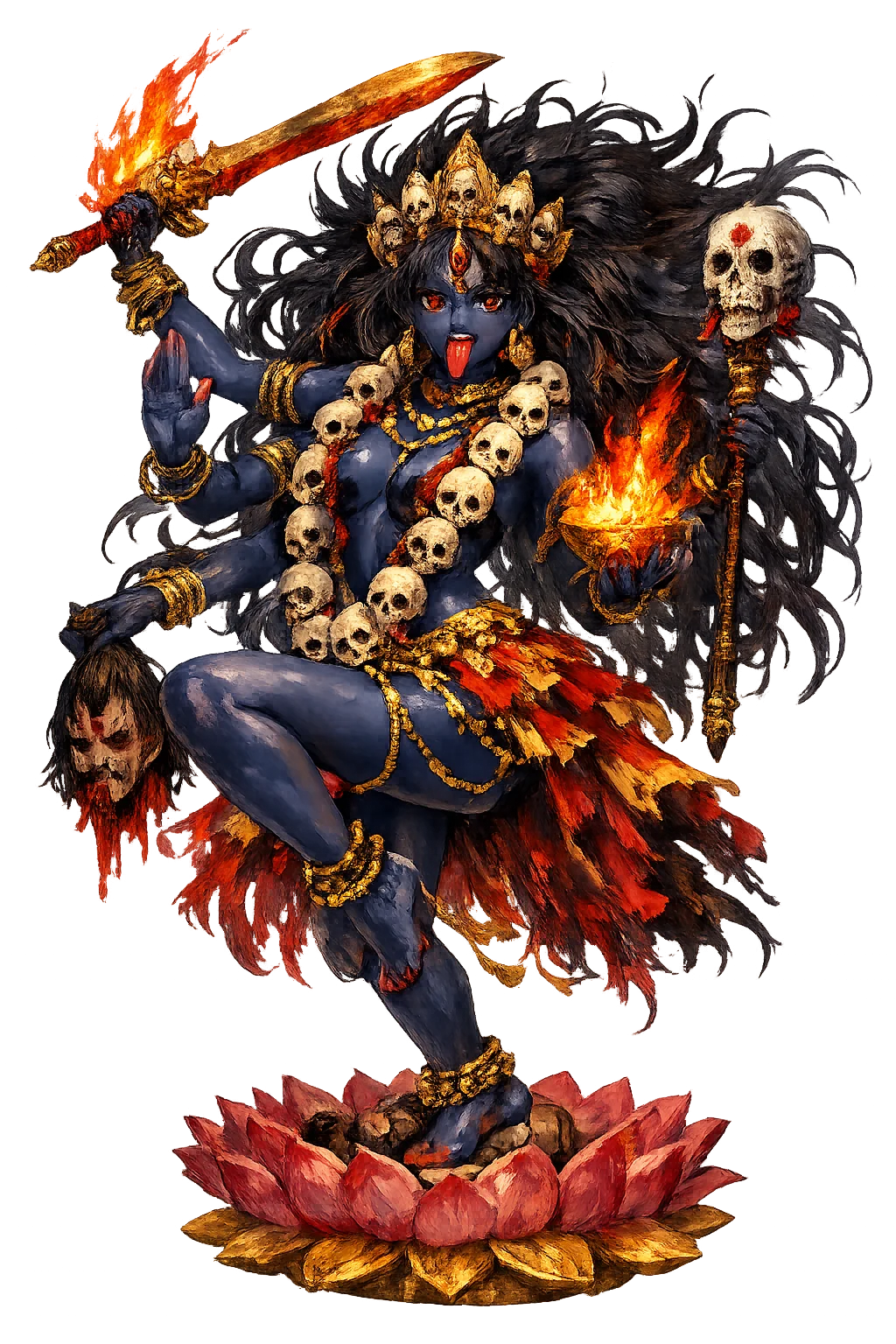
Sacred SymbolsBlack skin, Garland of fifty skulls, Severed head, Sword (khaḍga), Tongue extended
02

Etymology & Word Family

From original script to Unicode restoration

Original Script काली Kālī — "The Black One — the fierce goddess of time and destruction, consort of Śiva (fem. of kāla)"
Unicode Restoration Kālī Restored stress, length, and script
Modern ASCII kali Plain-ASCII fallback

From Sanskrit kālī-, feminine of kāla- 'black, dark; time', meaning 'the black one'; by folk etymology she is also 'Goddess of Time'.

03

Unicode Character Breakdown

Character-by-character philological analysis

CharacterUnicodeNameBlockPhonetic Role
KU+004BLatin Capital Letter KBasic LatinSame
āU+0101Latin Small Letter A with MacronLatin Extended-AMacron: long a
lU+006CLatin Small Letter LBasic LatinSame
īU+012BLatin Small Letter I with MacronLatin Extended-AMacron: long i

The Tier 1 classification reflects how much of the original phonology this restoration preserves — stress and vowel length for Greek names, distinctive letters and diacritics for every other tradition.

04

Cult & Worship

How the sacred was kept — rites, sanctuaries, remains

The Cult

Kālī's cult is documented best where it still lives: Bengal. The Kālīghāṭ ghaṭ on the Hooghly, counted among the fifty-one Śakti Pīṭhas where Satī's toes fell, drew worshippers for centuries before the present temple rose in 1809, and hereditary pujārī families still serve her there. Bengali tradition credits the sixteenth-century Tantric Krishnananda Agamavagīśa, author of the Tāntrasāra, with fixing her great public festival — Kālī Pūjā, on the new moon of Kārtik — after the goddess herself commanded it in a vision; it remains Bengal's second great festival night. The rites have always carried her ferocity: historically, goat sacrifice at her great temples, red hibiscus heaped before the image, and, in the Tantric current, cremation-ground sādhanā by initiates who approach her as the void itself. In Assam, where the Kālikā Purāṇa was composed, the great Śākta seat of Kāmākhyā kept her within its cycle of Tantric worship. None of this is antiquarian: the calendar, the offerings, and the possessive devotion of her votaries form a continuous living cult.

In the Earth

Kālī's archaeological footprint grows in medieval Bengal and the Deccan. Pala-Sena stone and terracotta images from Bengal and Bihar (10th–12th centuries CE) show her with protruding tongue, skull garland, and severed head. The Kālīghāṭ temple in Kolkata and the Dakṣiṇeśwar Kālī temple built by Rani Rashmoni (1855) anchor her modern cult. Kerala's Bhadrakālī temples preserve blood-offering rites, and Nepalese sculptures display her Tantric iconography.

05

Iconography

How Kālī was imaged across the ages

The Image

Learn the grammar and you cannot miss her: black skin, three eyes, four arms — sword and severed head in the right hands, blessing in the left — a garland of fifty skulls, a girdle of severed arms, the lolling tongue, and the white body of Śiva beneath her feet. The Devī-Māhātmya already wears her in skulls and severed hands; the Kālikā Purāṇa and the Tantric image-texts fixed the four-armed, blessing form and fused her with the older, emaciated battlefield goddess Camuṇḍā. The earliest surviving depictions are Pala-period black-stone steles from Bengal (10th–12th centuries, Indian Museum, Kolkata), already showing tongue and sword. Her devotees also image her as a yantra — the goddess distilled to geometry. In the nineteenth century the pat painters of Kalighat mass-produced her in watercolor for pilgrims — collections in the V&A and the Victoria Memorial hold the sheets — and the chromolithograph presses then froze the icon the whole world now recognizes. She has barely changed since.

06

Reception & Transformation

The name after its own age — transmission, translation, survival

Afterlives

Kālī reached Europe early, and the first meeting set the tone for a century. John Zephaniah Holwell's narrative of Bengal (1765–67) introduced her to English readers through her bloodiest festival; Edward Moor's Hindu Pantheon (1810) gave Europe its first colored image of her — the black goddess astride a corpse-white Śiva. Then the Thuggee literature — Sleeman's Ramaseeana (1836), Meadows Taylor's best-selling Confessions of a Thug (1839) — made 'the Kālī of the Thugs' a Victorian household word, a literary goddess largely invented from a real strangler cult's own claims to her protection. Meanwhile the true transmission ran in Bengali: the Devī-Māhātmya had been copied in manuscripts across India for a millennium, and the Śākta poets sang her into a new being — Govindadās in the sixteenth century, Rāmaprasād Sen in the eighteenth, whose songs to the mother-goddess remain her liturgy. Modern scholarship has spent two centuries peeling the caricature off the cult. It is still at work.

Identifications Across Traditions

Kālī is inseparable from Durgā, Pārvatī, Satī, and the ten Mahāvidyās of Tantra; she is the fierce face of the same goddess who appears as the gentle Gaurī. In Buddhist Tantra, especially in Tibet, she echoes in fierce ḍākinīs and in wrathful forms of Tārā. Southeast Asian goddess cults, from Cham Po Nagar to Javanese Durga, carry her shadow. The colonial and postcolonial West has appropriated her as a feminist and punk icon, often stripping away ritual context. Whether feared, loved, or misunderstood, Kālī remains the boundary where the sacred becomes unbearably real.

Modern Legacy

Kālī's image has traveled far beyond her temples. In Bengal she is the household mother, worshipped at Kālīghāṭ and Dakṣiṇeśwar — where the nineteenth-century saint Ramakrishna wept before her as a child before its mother, reclaiming her from the colonial caricature; in Kerala she appears as Bhadrakālī in blood-offering rituals; in the diaspora she is a symbol of South Asian identity and feminine power. Nineteenth-century missionaries had singled her out as the most degraded of India's deities, and Bengali nationalists answered by making her the wrathful motherland; revolutionary secret societies took her name before the courts did. Western occultists, from the Theosophists to modern Wiccans, have drawn on her iconography, sometimes with scholarly care and sometimes without. Film, comics, and protest art return to her again and again: the black-skinned woman with the sword, the tongue, the unblinking stare. Kālī endures because she refuses to be domesticated. She is the god who looks back.

07

The Meditation

What Kālī means — beyond the dictionary

Most of us spend our lives trying to keep Kālī out. We lock the door against death, shame, rage, and the parts of ourselves that do not fit the daylight world. Kālī is the one who kicks the door down. She is not cruel; she is honest. Time was always devouring us. The ego was always a borrowed costume. The blood she drinks is the blood of our pretending.

And yet she is also the mother. Ramakrishna wept before her image with the love of a child. To approach Kālī is to discover that destruction and tenderness are not opposites. The skulls she wears are the syllables of every prayer ever spoken. The sword she carries is the clarity we avoid because it hurts. When she stands on Śiva, she is not dominating him; she is waking him. Without her dance, the lord of yoga is only sleep. With it, he is alive.

08

Screen & Culture

Where Kālī echoes through film, television, and games — and how

09

Frequently Asked Questions

Common questions about Kālī, Time, Destruction, Empowerment, and Unicode restoration

01How do you pronounce Kālī?

In reconstructed pronunciation, Kālī is /kaː.liː/ — approximately 'KAH-lee' — both vowels are long and clear, the first like the 'a' in 'father' held out, the second like 'lee'.

02What does Kālī mean?

Kālī means The Black One — the fierce goddess of time and destruction, consort of Śiva (fem. of kāla) in the sanskrit tradition.

03What are the symbols of Kālī?

Kālī is associated with Black skin (The color of the void before creation and after destruction; the unmanifest beyond all forms.), Garland of fifty skulls (The fifty letters of the Sanskrit alphabet, showing that she wears language itself as ornament.), Severed head (The ego of the demon Raktavīja, or the ego of the practitioner; what must be sacrificed to see truly.), Sword (khaḍga) (Discrimination that cuts through illusion.), Tongue extended (The moment of shame and awakening; in Bengali tradition, she bites her tongue after stepping on Śiva.).

04Why restore Kālī in Unicode?

Plain ASCII kali strips the stress, length, and script that make the name specific. Unicode restoration returns the name to its original written dignity.

05What is the most important myth about Kālī?

“From the Brow of Durgā” — the Raktavīja story that anchors the mythology of Kālī, told in full on the lore page.

10

Scholarly Sources

The philological foundations of this restoration

Every claim on this page is grounded in established scholarship. The orthographic restorations follow disciplinary convention. The etymological chain follows the best available reference works. This is not invention — it is resurrection through scholarship.

◈

Lexicography & Philology

  • MW
  • KEWA
◎

Primary Texts

  • Kālikā Purāṇa (Dāruka episode and Assamese Śākta mythology)
  • Śiva Purāṇa; Vāmana Purāṇa; Matsya Purāṇa 12–13 (Dakṣa's sacrifice; the Śakti Pīṭhas)
  • Mahānirvāṇa Tantra 5.109ff. (Kālī as supreme deity)
◉

Archaeology & Art History

  • Material evidence — iconography, inscriptions, and temple archaeology — for Kālī and related cults.
✦

Religious Studies

  • Mārkaṇḍeya Purāṇa, Devī-Māhātmya 7 and 13 (Raktavīja; the goddess's proclamation)
  • Rachel Fell McDermott, Encountering Kālī
  • Monier-Williams, Sanskrit-English Dictionary (kāla, kālī)
Return

The Surface Awaits

You have traced the name from its earliest attestation to its Unicode restoration. Now return to the myth. The story is where the name lives.

Back to Lore
Kālī mascot