
Ītzpāpālōtl in 2026: why scholars still care
In 2026, names are treated as data points. Ītzpāpālōtl is a reminder that they are also cultural artifacts — and that the difference matters for search engines, AI training corpora, and anyone who types the name of a Nahuatl figure into a browser. Scholars never stopped caring about the difference between itzpapalotl and Ītzpāpālōtl; the web simply made that care actionable. What follows is the full scholarly picture — name, script, sound, myth, cult, and legacy — followed by the engineering compromise that lets a restored spelling live at a real address. The question is not whether the name is old. It is whether the digital world is old enough to hold it.
At a Glance
- Restored name: Ītzpāpālōtl
- ASCII form: itzpapalotl
- Meaning: "Obsidian butterfly"
- Domain of influence: Obsidian Butterfly, Stars
- Pantheon: Nahuatl
- Restoration: Preserves vowel length
- Live domain: ītzpāpālōtl.com
Overview
Itzpapālōtl (itzpapalotl) — Obsidian Butterfly, Stars · Obsidian butterfly — belongs to the Nahuatl tradition, where it is catalogued under the domain "Obsidian Butterfly, Stars". The name means "Obsidian butterfly".
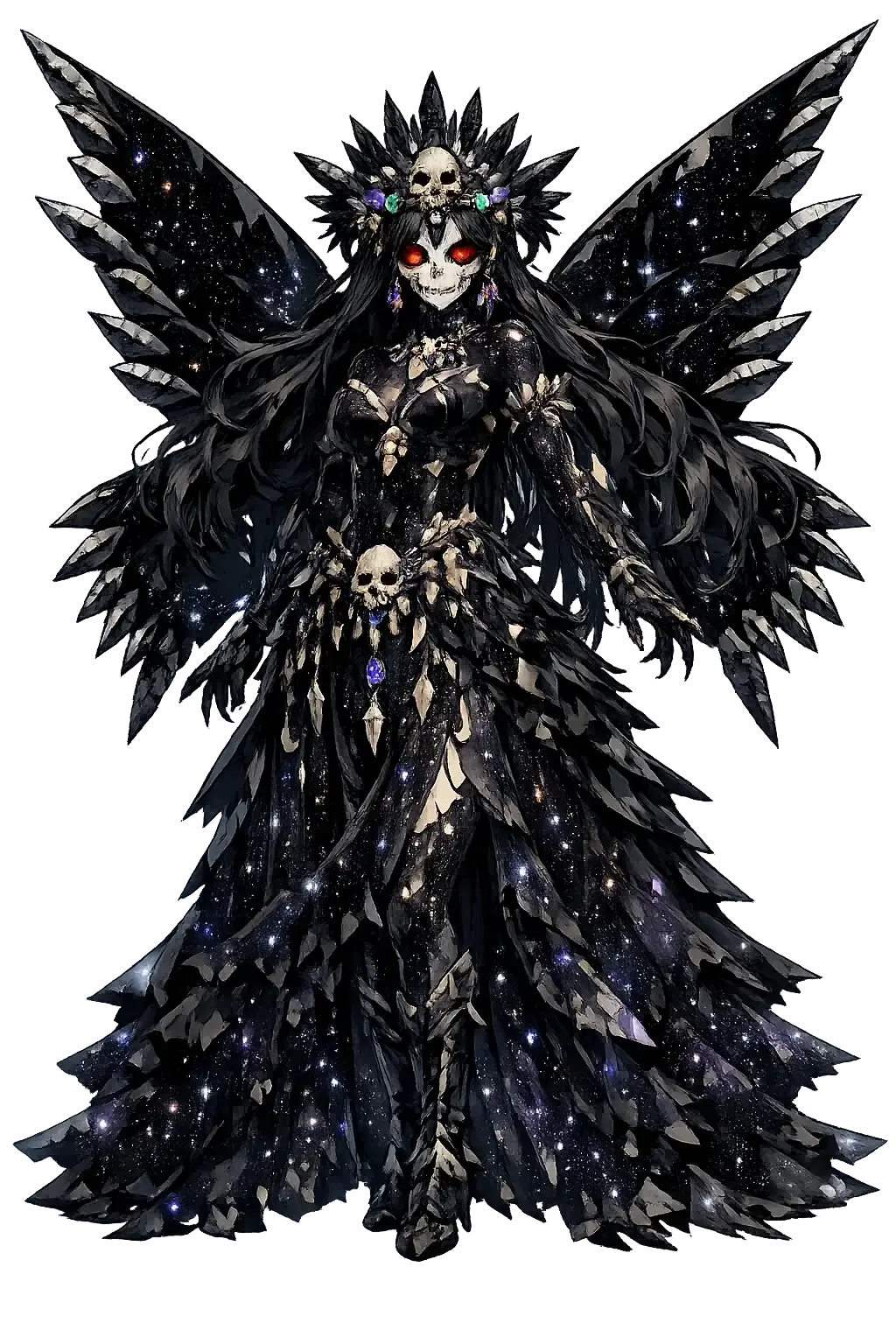
Itzpapālōtl is one of the most fearsome goddesses of the Nahua cosmos: a butterfly with wings of obsidian blades, mistress of Tamoanchan, and mother of the Cihuateteo. She is beauty that cuts, maternity that devours, and the star-demon who descends when the sun is darkened.
PuniCodex restores the name as Itzpapālōtl and serves its temple at itzpapālōtl.com. The original carries both stress and vowel length, and exactly one historically valid Unicode restoration exists. The plain ASCII form itzpapalotl survives as a modern convenience imposed by the early domain-name system; the restoration, not the fallback, is the form the project defends as philologically complete.
The Name
The theonym is attested in colonial-period alphabetic Nahuatl — Sahagún's informants name her Itzpapalotl — though no pre-conquest logophonetic spelling survives; her portrait is instead preserved pictorially in the Codex Borgia. The name is a compound of ītztli, 'obsidian, flint blade' — the black volcanic glass of sacrificial knives and divinatory mirrors — and papālōtl, 'butterfly,' a word whose reduplicated syllable imitates the flutter of wings. The whole means 'Obsidian Butterfly.'
The ASCII form itzpapalotl survives only because the early domain-name system could not carry diacritics; it is a technological compromise, not an ancient spelling. The Unicode restoration Itzpapālōtl marks the long ā of the butterfly's flight and the long ō of its stem — lengths reconstructed by linguists and invisible in colonial orthography. Because the original carries both stress and vowel length, and exactly one historically valid Unicode restoration exists, the name is a full restoration.
The letter-by-letter transformation runs:
- i → I — Same, capitalized
- t → t — Same
- z → z — Same
- p → p — Same
- a → a — Same
- p → p — Same
- a → ā — Macron: long vowel
- l → l — Same
- o → ō — Macron: long vowel
- t → t — Same
- l → l — Same
The project holds the domain itzpapālōtl.com (xn--itzpapltl-bcb15f.com) as the canonical home of this name.
The Original Script
Classical Nahuatl names survive in the alphabetic manuscripts of the colonial period, not in a fully deciphered pre-conquest phonetic script; the macron-bearing form shown here is a modern scholarly transliteration of the attested spoken name.
The form Itzpapālōtl therefore encodes reconstructed pronunciation rather than an attested ancient spelling, and no mark in it is decorative.
The name is composed of ītztli ('obsidian') and papālōtl ('butterfly'). Classical Nahuatl used macrons to mark vowel length, now reconstructed from colonial sources and comparative Uto-Aztecan evidence. The final -tl is a single lateral affricate. There is no surviving pre-contact alphabetic text of the name; it is known from alphabetic Nahuatl manuscripts produced under Spanish supervision, above all the Florentine Codex.
Pronunciation
The reconstructed pronunciation of the name is /its.pa.paː.ˈloːtɬ/ — Classical Nahuatl Reconstruction.
Phoneme by phoneme:
- itz- — [its], from ītztli, 'obsidian'; the blade that cuts and mirrors.
- -pap- — [pap], reduplicated syllable imitating the flutter of wings.
- -ā- — Long [aː], the stressed vowel of papālōtl, 'butterfly'.
- -lōtl — [ˈloːtɬ], 'butterfly'; final -tl is the Nahuatl lateral affricate.
For the modern speaker, the closest approximation is: 'eets-pah-PAHL-ohtl' — the name crackles like obsidian breaking; hold the second 'a' and the final 'o' long.
Kindred and historical forms of the name:
- Nahuatl — Itzpapālōtl, 'Obsidian Butterfly'.
- Related beings — Cihuateteo, the spirits of women who died in childbirth, of whom she is mother or queen.
- Astral role — Tzitzimime, star-demons of the northern sky associated with eclipses.
The macrons on ā and ō mark reconstructed long vowels, making the restoration a full restoration. The name is onomatopoeic and lethal: a butterfly made of razor-sharp obsidian.
Mythology
Itzpapālōtl belongs to the dangerous borderlands: between paradise and underworld, birth and death, daylight and eclipse. Her myths are preserved in fragments of the Florentine Codex and Borgia group codices.
The Lady of Tamoanchan (Origin)
Tamoanchan is the mythical paradise of origins, a lush mountain of flowers and fruit where the creator couple dwelt. Itzpapālōtl rules there as both guardian and destroyer, her obsidian wings protecting the tree from which the first humans were fashioned. To approach her is to risk being flayed by the very beauty one admires.
The Cihuateteo (Childbirth)
Women who died in childbirth were not ordinary dead. They became Cihuateteo, 'divine women', fierce spirits who accompanied the sun from zenith to sunset and prowled crossroads at night. Itzpapālōtl is their mother and queen. Because they had died bringing life, they had power over both: they could bless children or steal them away.
The Black Butterfly of Eclipse (Astronomy)
As a Tzitzimitl, Itzpapālōtl belongs to the star-demons of the northern sky. When an eclipse threatened, the Nahua believed these skeletal women descended head-first to devour the sun or moon. Ritual noise, arrows, and blood offerings were deployed to drive her back into the heavens and restore the light.
The Butterfly Who Led the Chichimecs (Migration)
Later alphabetic sources attach Itzpapālōtl to the Chichimec ancestors of the Mexica. The Historia de los Mexicanos por sus pinturas (c. 1540) names an obsidian butterfly among the wonder-beings of the migration age, and the Anales de Cuauhtitlan preserves the wider lore of the Chichimecs' star-guided wanderings out of Chicomoztoc, the Seven Caves. The evidence is late and fragmentary — friars wrote down what their informants said, and the Borgia-group codices show her sign without narrating her story — so the tradition should be cited with caution. But the association fits her astronomy: a people guided through the dark north by a star-demon. She is migration itself made divine — fragile as a butterfly, cutting as flint, leading the nameless toward an empire.
Mother of the Cihuateteo (Childbirth)
Women who died in childbirth did not become ordinary dead. They became Cihuateteo, 'divine women' — fierce spirits who accompanied the sun from its zenith to the western horizon and descended at crossroads to threaten the living (Florentine Codex; Karttunen, s.v. cihuateotl). Itzpapālōtl is their mother and queen. The midwife's orations preserved in the Florentine Codex address the dead woman as a warrior fallen in battle, honoured like a slain captive: she had died, the texts say, capturing a child for the people. The theology is exact — childbirth was a war, the lying-in room a battlefield, and its queen a butterfly whose wings were blades. The myth dignifies a death no weapon caused, and reads maternity as the risk that wins.
Symbols & Iconography
The iconography of Itzpapālōtl, fixed above all by the Codex Borgia, concentrates in a small set of recurring attributes, each a compressed statement about the name:
- Obsidian butterfly — The union of delicate beauty and sacrificial cutting power; in the Borgia her wings carry the motifs of the flint blade.
- Knife-edged wings — Instruments of war and childbirth, the two forms of tearing that the Nahua held to bring both life and death.
- Jaguar claws — Her hands and feet end in predator's talons, linking her to the night hunters of the Mesoamerican forest.
- Skeletal, death's-head face — The skull visage she shares with the other tzitzimime, the star-demons who descend when the sky darkens.
- Star imagery — Her identity as a Tzitzimitl, a stellar power of the northern sky feared at eclipses and at the year's end.
- Star headdress — Her identity as a Tzitzimitl, a stellar power that descends during eclipses.
Archaeology & Evidence
No temple, sculpture, or dedicatory inscription naming Itzpapālōtl has been securely identified, and that absence is intelligible: as a stellar demon and mistress of Tamoanchan she belonged to the feared classes of beings — the tzitzimime and the Cihuateteo — who were approached through ritual precaution more than through civic temple cult. Her material trace is indirect but genuine: the obsidian industry itself. Blades and mirrors of ītztli from the Pachuca and Otumba workshops filled temples, tombs, and offerings across Mesoamerica — the same black glass that forms her wings in the Codex Borgia. The primary evidence for her cult remains the textual and pictorial record gathered in the Scholarly Sources section.
Realm & Domain
Itzpapālōtl is one of the most fearsome goddesses of the Nahua cosmos: a butterfly with wings of obsidian blades, mistress of Tamoanchan, and mother of the Cihuateteo. She is beauty that cuts, maternity that devours, and the star-demon who descends when the sun is darkened.
Obsidian Wings
Her wings are edged with itztli, the black volcanic glass used for sacrifice and mirrors.
Tamoanchan
The paradise of origins, where the gods created the first humans from ground bones.
Mother of Cihuateteo
Women who died in childbirth became warrior spirits under her command, dangerous to the living.
Eclipse Star
As a Tzitzimitl she leads star-demons against the sun, threatening cosmic collapse.
Across Cultures
Colonial friars associated Itzpapālōtl with demons of the air and witches, flattening her complex identity into a Satanic figure. Modern scholars and artists have reclaimed her as an emblem of feminine ferocity, the dangerous side of motherhood, and the ecological violence of volcanic landscapes. Her image appears in Mexican feminist art and in celebrations of Día de los Muertos as a skeletal butterfly.
Within the Nahuatl tradition, closely related names in the corpus include Cihuacōātl, Cōātlīcue, Huitzilopōchtli, Mictlāntēcutli, Quetzalcōātl, and Tlāloc.
Cultural Legacy
Itzpapālōtl's afterlife runs through scholarship as much as through art. Eduard Seler's commentary on the Codex Borgia first fixed her obsidian-winged portrait for modern readers, and twentieth-century studies of the Cihuateteo made her a central case for understanding Nahua gender: women dead in first childbirth were reckoned warriors, their spirits honoured and feared like men dead in battle. Contemporary Mexican and Chicana artists have reclaimed the obsidian butterfly as an emblem of feminine ferocity — beauty that cuts — and she appears in tattoo art, graphic narrative, and Día de Muertos imagery as a skeletal butterfly. Obsidian itself, ītztli, remains one of the signature materials of Mexican archaeology: every blade from the great Pachuca and Otumba workshops is a fragment of her name.
The Scholarly Record
She receives no dedicated chapter in the Florentine Codex; her identity must be reconstructed from the books on the Cihuateteo and the tzitzimime, from the pictorial codices of the Borgia Group, and from one colonial transcript of a lost painted book. The evidentiary chain is therefore unusually dependent on the interplay of image and text. The witnesses and reference works on which this edition rests are listed below.
- Sahagún, Florentine Codex.
- Codex Borgia.
- Karttunen, An Analytical Dictionary of Nahuatl.
- López Austin, Tamoanchan, Tlalocan.
- Carrasco, Quetzalcoatl and the Irony of Empire.
A Meditation
Itzpapālōtl refuses the categories that make goddesses safe. She is not a nurturing mother in the pastel sense; she is the mother whose children are weapons. She is not a gentle butterfly; she is a razor-winged eclipse. To encounter her is to understand that creation and destruction were never separate in Mesoamerican thought.
In her, the feminine is not domesticated. It is astronomical, surgical, and maternal all at once. She asks us to look at the things we call beautiful and ask what they cut. She asks us to look at the things we call monstrous and ask what they protect. The obsidian butterfly is still flying, and her wings still catch the light like broken glass.
The Unicode Restoration
Ītzpāpālōtl preserves vowel length. The ASCII fallback itzpapalotl still resolves everywhere, but it is the restored form that carries the name's full information. Across the 11 characters of the name, the restoration adjusts 4: 4 marks of length (Ī, ā, ā, ō). That is the whole thesis of this temple: the marks are the message.
Name Variations
The lexicon records 1 additional form of the name:
- Itzpapalotl (ascii) — Plain ASCII form
The temple uses Ītzpāpālōtl as the primary form: it is the spelling that best balances philological accuracy with the practical limits of DNS.
Character by Character
The journey from itzpapalotl to Ītzpāpālōtl, one character at a time:
- i → Ī — Macron: long /iː/
- t → t — Same
- z → z — Same
- p → p — Same
- a → ā — Macron: long /aː/
- p → p — Same
- a → ā — Macron: long /aː/
- l → l — Same
- o → ō — Macron: long /oː/
- t → t — Same
- l → l — Same
The Domain Name
The restored name is live as a working domain: ītzpāpālōtl.com, which the DNS carries in punycode form as xn--tzppltl-u3ab82bvm.com — an ASCII-compatible encoding that lets a non-ASCII name travel the global network without breaking older infrastructure. The visitor sees Ītzpāpālōtl; the machines see the encoding. That duality is the engineering compromise on which the entire restoration rests, and it is why a name written the way its own tradition wrote it in Nahuatl transcription can now be typed into any browser on earth.
The Nahuatl Pantheon
Ītzpāpālōtl is one of 31 entries the PuniCodex lexicon catalogues under the Nahuatl pantheon. The Pantheon page gathers the tradition's major figures in one place, and the Lexicon lets you filter all 983 restorations by tradition or script — the fastest way to see where this name sits among its kin.
Frequently Asked Questions
What does Ītzpāpālōtl mean? The traditional gloss is "Obsidian butterfly."
Which tradition does Ītzpāpālōtl belong to? Ītzpāpālōtl is catalogued in the Nahuatl pantheon of the PuniCodex lexicon.
What does Ītzpāpālōtl preserve that ASCII cannot show? The form itself answers: Ītzpāpālōtl preserves vowel length — and the marks in the restored spelling are exactly that evidence.
Is Ītzpāpālōtl a working domain? Yes — ītzpāpālōtl.com resolves today and routes to this temple.
What is the punycode for ītzpāpālōtl.com? The DNS encoding is xn--tzppltl-u3ab82bvm.com; browsers perform the translation automatically, so visitors only ever see the restored name.
Can I use Ītzpāpālōtl in a normal browser? Yes. The DNS resolves the punycode form automatically, and the type tool on this site converts itzpapalotl to Ītzpāpālōtl for copying and pasting.
Where does the scholarly information come from? The entry is built from lexica, inscriptional evidence, and reviewed scholarly sources listed in the Scholarly Edition. Every claim is traceable to a canonical source.
Typing Ītzpāpālōtl
You do not need a special keyboard to use this restoration. The PuniCodex Type Tool converts the ASCII form itzpapalotl into Ītzpāpālōtl as you type, and the browser extension offers the same conversion inside any text field. Copy the restored form, paste it into the address bar, and the DNS does the rest.
Sister Temples
Other temples in the Nahuatl pantheon include Chicōmecōātl, Citlālicue, and Coyolxāuhqui — each with its own restoration story, its own scholarly record, and its own place in the lexicon.
Why This Restoration Matters
In 2026 the stakes are practical. Search indexes, language models, and localization pipelines all inherit whatever spelling the web normalizes — which means every Unicode domain is also a training signal. Ītzpāpālōtl teaches the machinery that the restored form exists, that it is used, and that it points to a real place. That is why a project built on philology ends up caring about DNS: the infrastructure decides which names the future sees. This restoration makes sure the future sees the whole name.
Explore Further
This post is one doorway into the temple. The home page carries the full character breakdown and the ambient canvas; the lore page tells the myths in long form; the Scholarly Edition preserves the sources, pronunciation data, and revision history; and the patron wall supports the restoration directly. For the wider map, browse the Lexicon, explore the Pantheon, or return to the PuniCodex blog.
Related Names
Sources
The full scholarly apparatus — every citation, revision, and review — lives in the Scholarly Edition. Key references for this post:
- Sahagún, Florentine Codex.
- Codex Borgia.
- Karttunen, An Analytical Dictionary of Nahuatl.
- Codex Borgia (with Seler's commentary).
- Lexicon authorities for this entry: Florentine Codex, Sahagún.