
Why Hermóðr belongs in your address bar
Every address bar is a choice. When you type Hermóðr, you are not typing a novelty; you are restoring a name that the early DNS, built for English typewriters, could not carry. The plain ASCII form hermod is a leftover of that constraint, not the name itself. This post is the long version of the restoration: where the name comes from, how the Younger Futhark tradition wrote it, how it is pronounced, what the myths and the material record preserve, and why its Unicode form now lives as a working domain. The claim throughout is simple — the original spelling is not decoration. It is the name.
At a Glance
- Restored name: Hermóðr
- ASCII form: hermod
- Meaning: "War-spirit"
- Domain of influence: Messenger, Courage
- Pantheon: Norse
- Classification: Tier 1
- Original script: ᚼᛁᚱᛘᚢᚦᚱ (Younger Futhark)
- Live domain: hermóðr.com
Overview
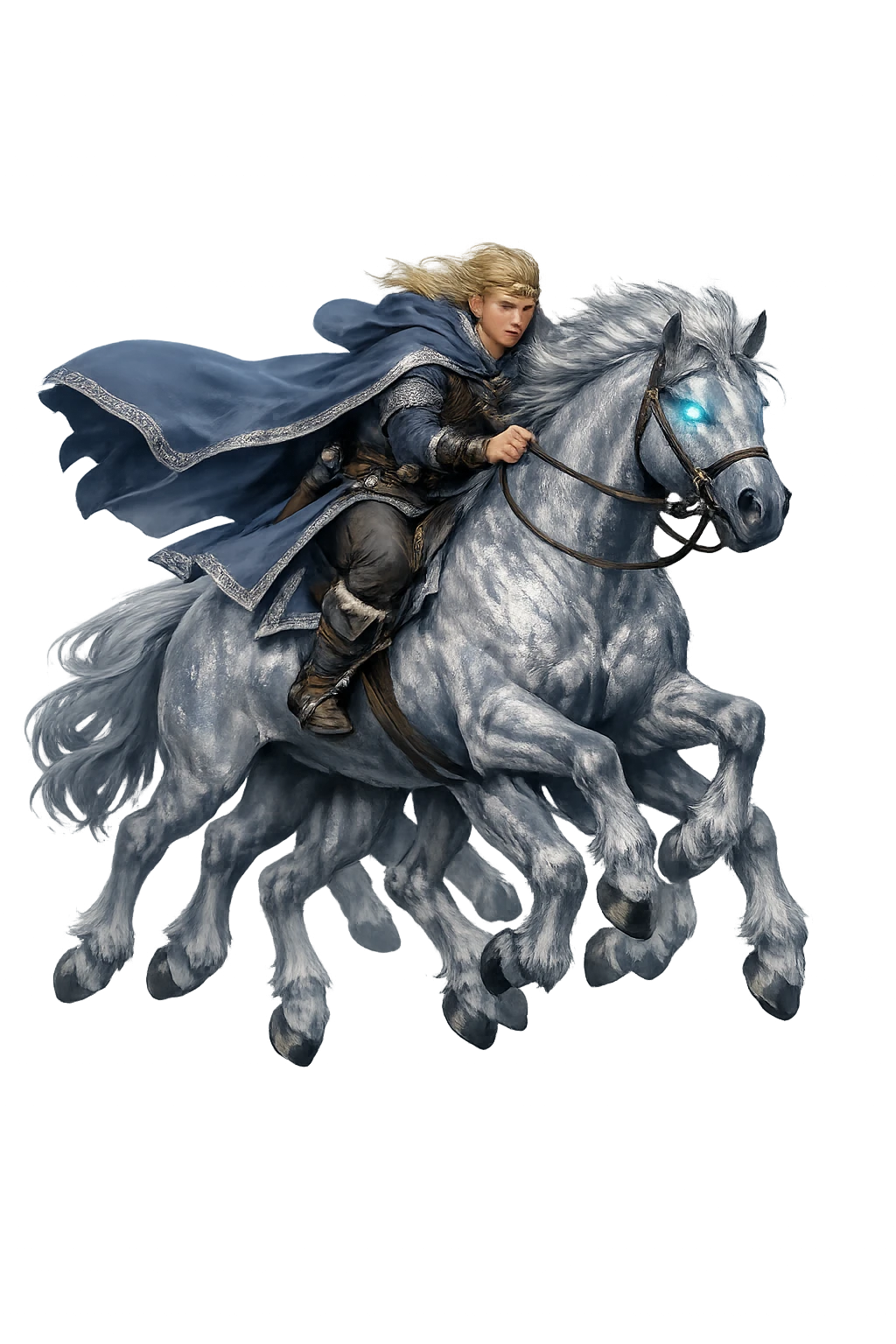
Hermóðr (hermod) — Messenger, Courage · Óðinn's Son, the Rider of the Nine Nights — is the god of the errand no one else could ride: the bold son of Óðinn who, when Baldr lay dead and Frigg asked who would dare the road to Hel, mounted his father's own horse and rode down to ransom the light.
Old Norse Hermóðr compounds her- ‘army, war’ with móðr ‘spirit, mind, courage’: ‘war-spirit’ — the name of a quality as much as of a person. Snorri calls him Hermóðr inn hvati, ‘the Bold’, and numbers him among Óðinn's sons; the Poetic Edda's Hyndluljóð names Heimdallr and Hermóðr together in Óðinn's kin. His one great narrative is also one of the finest things in the Prose Edda: nine nights through dark and deep valleys, over the resounding bridge Gjallarbrú, past the maiden Móðguðr, to the hall of Hel herself — and the return ride with the ring Draupnir, a ransom almost won.
PuniCodex restores the name as Hermóðr and serves its temple at hermóðr.com. The restoration keeps the long ó of Old Norse móðr and the distinctive letter ð, the voiced dental fricative the ASCII alphabet cannot write; it is the single historically valid Unicode form, which places the name in Tier 1. The plain ASCII hermod is a modern convenience of the early domain-name system, not an attested medieval spelling.
The Name
The name is attested in Old Norse as Hermóðr (nominative; genitive Hermóðs). It is a transparent Old Norse compound: her- ‘army, warfare’ (the same element as in her-jann, Hersir) and móðr ‘spirit, mind, mood, courage’ — the cognate of English mood and German Mut — hence ‘war-spirit, martial courage’. The final -r is the Old Norse nominative ending; the ASCII fallback hermod silently drops it along with the letter ð.
The ASCII form survives only because the early domain-name system could not carry non-ASCII letters or diacritics; it is a technological compromise, not a medieval spelling. The Unicode restoration Hermóðr recovers the long ó of the second element and the letter ð (eth), the voiced dental fricative written with a single runic and Insular letter. Because the restoration preserves distinctive letters and vowel length the ASCII form loses, the name is classified Tier 1.
The letter-by-letter transformation runs:
- h → H — Same, capitalized
- e → e — Same
- r → r — Same
- m → m — Same
- o → ó — Long ó (ON ó = /oː/)
- d → ðr — Eth (ð) + nominative -r
The project holds the domain hermóðr.com (xn--hermr-ltau.com) as the canonical home of this name.
The Original Script
The name is preserved in medieval Icelandic manuscripts in the Latin alphabet as Hermóðr — Old Norse (North Germanic), attested 13th c. CE in the Codex Regius of the Prose Edda and related codices, recording material centuries older. Before the Latin bookhand, Old Norse names were carved in the younger futhark; no runic attestation of this theonym survives, so the manuscript form is the primary witness.
The scholarly rendering proceeds step by step:
- The compound is her- ‘army’ + móðr ‘spirit, courage’, with the nominative singular ending -r.
- Old Norse orthography marks vowel length with the acute accent: ó = /oː/.
- The letter ð (eth), borrowed from the Insular script, writes the voiced dental fricative /ð/; ASCII substitutes plain d and loses the sound.
- The Unicode restoration Hermóðr keeps the length mark, the eth, and the nominative -r; the ASCII form hermod loses all three.
Pronunciation
The reconstructed pronunciation of the name is /ˈher.moːðr/ — Old Norse Reconstruction.
Phoneme by phoneme:
- Her- — Voiceless glottal [h], short front [e], trilled [r]; the ‘army’ element, stressed on the first syllable as in all Old Norse compounds
- -móðr — Voiced bilabial nasal [m], long close-mid back [oː] carried by the acute accent, voiced dental fricative [ð] as in English this, and the final syllabic nominative [r̩]
For the modern speaker, the closest approximation is: ‘HAIR-moth-r’ — the ‘th’ soft as in father, the vowel of móðr held long.
Kindred and historical forms of the name:
- Old Norse — Hermóðr, ‘war-spirit’, son of Óðinn
- Old English — Heremōd, the same compound borne by the flawed king of Beowulf and by ancestors in the West Saxon royal genealogy
- Owned form — Hermóðr
Hermóðr is Tier 1 because the restoration preserves what ASCII cannot: the long ó of móðr and the letter ð itself. English ‘Hermod’ loses the fricative, the length, and the nominative ending in one stroke.
Mythology
Hermóðr's mythology is a single, perfectly shaped narrative: the ride for Baldr. When Óðinn's beloved son dies of the mistletoe and the gods cannot speak for weeping, Frigg asks who will ride the Hel-road and offer the death-goddess ransom. Hermóðr the Bold, Óðinn's son, takes the errand; Óðinn lends him Sleipnir.
The Nine Nights (Gylfaginning 49)
He rides nine nights through dales so deep and dark he sees nothing, until he reaches the river Gjǫll and the gold-thatched Gjallarbrú. The maiden Móðguðr, who guards the bridge, asks his name and kin: five companies of dead men rode over the day before, ‘but the bridge resounds no less under you alone, and you do not have the colour of dead men’. Hermóðr names his errand; she tells him Baldr has crossed. He rides on to Helgrindr, dismounts, girths Sleipnir tighter, and leaps the gate.
In Hel's Hall
In the hall he finds Baldr sitting in the high seat, and spends the night there. In the morning he asks Hel for his brother's release; she answers with the famous condition — Baldr shall return if all things in the world, living and lifeless, weep for him. Hermóðr rides back with the ransom of tokens: the ring Draupnir, which Óðinn had laid on the pyre, and from Nanna a linen robe for Frigg and a finger-ring for Fulla. The Æsir then send messengers through the world to bid all things weep — and all do, until the giantess Þǫkk in a dark cave refuses: ‘let Hel hold what she has’. The gods, Snorri says, believe Þǫkk was Loki in another shape. The ransom fails by one refusal, and Hermóðr's great ride becomes the tragedy's hinge: everything was done rightly, and it was not enough.
Elsewhere in the Corpus
Beyond the ride, Hermóðr lives in lists and echoes: Hyndluljóð names him with Heimdallr among Óðinn's kin, and Snorri's þulur and Skáldskaparmál keep him in the catalogue of the Æsir and Óðinn's sons. The poem Baldrs draumar supplies the ride's mirror: Óðinn himself rides down to a grave-mound to wake a dead völva, the father's journey prefiguring the son's.
The Errand of the Nine Nights (Gylfaginning 49)
When Baldr fell to the mistletoe dart and the gods' grief had spent itself, Frigg asked who among the Æsir would ride the road to Hel and offer a ransom. Hermóðr the Bold, called Óðinn's sveinn — his lad, his attendant — stood up. They brought him Sleipnir, and he rode nine nights through valleys so dark and deep that he saw nothing until he reached the river Gjöll and the Gjallarbrú, the bridge roofed with glowing gold. There the maiden Móðguðr asked his name and lineage, and told him the bridge had thundered less under five companies of the dead the day before than under him alone.
The Gate and the Hall (Gylfaginning 49)
He rode on to Helgrindr, the barred gate of the dead, tightened the stirrups, and spurred Sleipnir — and the horse leapt the gate with room to spare. In the hall he found his brother Baldr seated in the high seat, and he stayed the night. In the morning he begged Hel to let Baldr ride home with him, telling how great the weeping was among the Æsir. Hel's answer became the condition on which the whole ending turns: if all things in the world, living and dead, weep for Baldr, he may return; if anything refuses, Hel keeps him.
The Ring and the Refusal (Gylfaginning 49)
Baldr sent back the ring Draupnir — the same ring Óðinn had laid on the pyre — and Nanna sent a linen headdress to Frigg and a gold ring to Fulla. Hermóðr carried the tokens and the tidings home, and the Æsir sent messengers through the world to ask all things to weep. All did — trees, stones, metals, beasts — save one giantess in a cave who called herself Þǫkk, Thanks, and wept dry tears: "let Hel hold what she has." The gods suspected it was Loki in disguise. Baldr stayed, and Hermóðr's nine nights stand in the Edda as the proof that even the boldest errand can be answered with a single refusal.
Symbols & Iconography
The iconography of Hermóðr is narrative rather than cultic — the corpus gives him no temple regalia, but the ride itself fixed a small set of attributes:
- Sleipnir — Óðinn's eight-legged horse, lent for the descent: the fastest mount in the world is his only equipment for the fastest errand ever ridden
- Draupnir — The golden ring that drips eight more rings every ninth night, laid on Baldr's pyre and brought back by Hermóðr as the token of the dead god's message
- Gjallarbrú — ‘The resounding bridge’, gold-thatched, over the river Gjǫll at the border of Hel; the sound of a single rider on it tells the dead a living man has come
- Helgrindr — The gate of Hel, which Sleipnir leaps rather than opens: the horse clears what the rider cannot pass
- The maiden Móðguðr — ‘Fierce courage’, the bridge's warden who names the riding god by the rumour of him: an echo of his own name, as if the road itself answered him
Archaeology & Evidence
No cult site, votive deposit, or named image of Hermóðr is known; his attestation is entirely literary. The material record offers candidates rather than proofs: the Gotlandic picture stones — above all Tjängvide and Ardre VIII — show an eight-legged horse bearing a rider between worlds, and scholars from Lindqvist onward have read them as Óðinn on Sleipnir approaching the dead. Hermóðr's own ride is one of the two great Sleipnir journeys in the corpus, and some interpreters have seen the Baldr cycle behind such scenes, but the stones carry no runes that name him.
The runic corpus is likewise silent on the god: Hermóðr survives in inscriptions only as a human personal name, and its second element -móðr is common in the anthroponymy (Þórmóðr and kin). The absence is itself instructive: the myth of the ride belongs to the world of poetry and prose, not to dedicatory practice.
Realm & Domain
Hermóðr is the messenger of the gods and, in the one myth that owns him, their boldest rider: the son of Óðinn who volunteers for the road to the dead when no other god will take it.
The Messenger
Frigg's question in Gylfaginning — who among the Æsir will ride to Hel and offer ransom for Baldr — is answered by Hermóðr alone; the errand defines him.
Courage
His name's second element, móðr, is courage itself; Snorri's byname for him is inn hvati, ‘the Bold’.
The Road Between Worlds
His nine-night ride — through dark valleys, over the resounding bridge, past its warden Móðguðr — is the fullest journey-to-Hel narrative the Norse corpus preserves.
Óðinn's House
He rides his father's horse Sleipnir and carries his father's ring; the myth keeps him inside Óðinn's household and errands.
Across Cultures
Scholars since Jacob Grimm have paired Hermóðr with the Greek Hermês: both are divine messengers, both escort souls between worlds, and the names look alike — but the resemblance is superficial, since Hermóðr is a transparent Old Norse compound and Hermês has no agreed Indo-European etymology. The deeper Germanic parallel runs the other way: the interpretatio romana made Óðinn the Germanic Mercury, and Hermóðr inherits the Mercury-function inside Óðinn's own household — the swift son doing the swift father's work.
The clearest cross-germanic reception is English. Beowulf preserves the same name as Heremōd, a Danish king whose promise curdled into cruelty — ‘a table-companion who should have been a comfort became a burden’ — and the West Saxon royal genealogy in the Anglo-Saxon Chronicle counts a Heremōd among Woden's descendants. Within the corpus, closely related figures include Helheimr (the realm he rides to) and Óðinn (the father whose errand and horse he borrows).
Cultural Legacy
Hermóðr's ride survived the Middle Ages as one of the best-loved episodes of the Norse revival: the Kearys' The Heroes of Asgard (1857), the first popular English retelling of the myths, made ‘Hermod's ride to Hel’ a set-piece for generations of children, and every modern handbook of Norse myth retells it.
In contemporary practice, modern Heathen and Ásatrú communities keep the story in their Baldr rites, reading Hermóðr as the model of the volunteer — the one who answers when the question ‘who will go?’ is asked of a silent hall. In comics and games he appears in minor guises (Marvel's Thor comics know a ‘Hermod the Swift’), but his true afterlife is the narrative one: he is the shape Norse tradition gave to devotion measured in miles ridden through the dark.
The Scholarly Record
The account of Hermóðr given in this edition rests on the witnesses and reference works listed below. The Eddas supply the narrative; the lexica secure the name's etymology; the English evidence carries the cognate reception.
- Snorri Sturluson, Edda, Gylfaginning 49 (Baldr's death; Hermóðr's ride), ed. and trans. Anthony Faulkes (London: Everyman, 1987).
- The Poetic Edda, trans. Carolyne Larrington, 2nd ed. (Oxford: Oxford University Press, 2014): Hyndluljóð (Óðinn's kin); Baldrs draumar (Óðinn's own descent).
- Cleasby, Richard, and Guðbrandur Vigfússon, An Icelandic-English Dictionary, 2nd ed. (Oxford: Clarendon Press, 1957), s.v. Hermóðr, her, móðr.
- de Vries, Jan, Altnordisches etymologisches Wörterbuch, 2nd ed. (Leiden: Brill, 1962), s.v. móðr.
- Gordon, E. V., An Introduction to Old Norse, 2nd ed. rev. A. R. Taylor (Oxford: Clarendon Press, 1957).
- Beowulf, ed. and trans. R. M. Liuzza, 2nd ed. (Peterborough, ON: Broadview, 2013), lines 901–915, 1709–1722 (King Heremōd).
- Grimm, Jacob, Teutonic Mythology, trans. James Steven Stallybrass, 4 vols. (London: George Bell, 1882–88).
- Lindow, John, Norse Mythology: A Guide to the Gods, Heroes, Rituals, and Beliefs (Oxford: Oxford University Press, 2001), s.v. Hermóðr.
- Lindqvist, Sune, Gotlands Bildsteine, 2 vols. (Stockholm: Wahlström & Widstrand, 1941–42).
A Meditation
Hermóðr is the god of the attempt that fails honourably. Everything in his ride is done rightly: he volunteers, he rides the nine nights without turning, he leaps the gate, he wins the condition, he carries the tokens home. And the ransom fails anyway, in a cave, at the last refusal — undone not by his weakness but by one withheld tear.
That is why the myth endures. Courage, in the Norse telling, is never measured by outcomes; the world itself is heading for Ragnarǫk and the gods know it. Hermóðr asks the uncomfortable question his name already contains — war-spirit, the mood for the fight — of every life that has watched something precious carried into the dark: when the errand cannot be won, will you still take it?
The Unicode Restoration
Hermóðr is classified as Tier 1: the restoration preserves at least one distinctive feature — a diacritic or a distinctive letter — that the ASCII form loses. The ASCII fallback hermod still resolves everywhere, but it is the restored form that carries the name's full information. Across the 6 characters of the name, the restoration adjusts 2: 1 mark of length (ó); 1 further adjustment (ðr). That is the whole thesis of this temple: the marks are the message.
The Domain Name
The restored name is live as a working domain: hermóðr.com, which the DNS carries in punycode form as xn--hermr-ltau.com — an ASCII-compatible encoding that lets a non-ASCII name travel the global network without breaking older infrastructure. The visitor sees Hermóðr; the machines see the encoding. That duality is the engineering compromise on which the entire restoration rests, and it is why a name written the way its own tradition wrote it in Younger Futhark can now be typed into any browser on earth.
Why This Restoration Matters
Restoring Hermóðr is part of a larger effort to make the web multilingual by default. The PuniCodex project does not ask users to learn a new alphabet; it asks the infrastructure to respect the alphabets that already exist. Every section of this post — the script, the sound, the myths, the evidence — converges on the same point: the marks in Hermóðr are information, and information deserves an address of its own. A single Unicode domain is a small proof, but it is a proof that scales: every name restored makes the next one easier, and every visit to hermóðr.com is a vote for the restored form.
Explore Further
This post is one doorway into the temple. The home page carries the full character breakdown and the ambient canvas; the lore page tells the myths in long form; the Scholarly Edition preserves the sources, pronunciation data, and revision history; and the patron wall supports the restoration directly. For the wider map, browse the Lexicon, explore the Pantheon, or return to the PuniCodex blog.
Related Names
Sources
The full scholarly apparatus — every citation, revision, and review — lives in the Scholarly Edition. Key references for this post:
- Snorri Sturluson, Edda, Gylfaginning 49 (Baldr's death and Hermóðr's ride), ed. and trans. Anthony Faulkes (London: Everyman, 1987).
- Hyndluljóð (Poetic Edda), on Óðinn's sons, trans. Carolyne Larrington, The Poetic Edda, 2nd ed. (Oxford: Oxford University Press, 2014).
- Cleasby, Richard, and Guðbrandur Vigfússon, An Icelandic-English Dictionary, 2nd ed. (Oxford: Clarendon Press, 1957), s.v. her-móðr, móðr.
- Cleasby, Richard, and Guðbrandur Vigfússon, An Icelandic-English Dictionary, 2nd ed. (Oxford: Clarendon Press, 1957), s.v. Hermóðr, her, móðr.
- Lexicon authorities for this entry: Poetic Edda, Cleasby-Vigfusson.