PuniCodex

Extended Lore

Hermês — The Deeper Record

Etymology · Orthography · Cult · Iconography · Reception · Sources

Preserves stress & vowel length Hermês.com · Hermēs.com
Hermês — Messengers, Commerce, Thieves
01

At a Glance

Hermês — every fact links to its home

PantheonGreek
DomainMessengers, Commerce, Thieves
Attested415 BCE
Original ScriptἙρμῆς →
Primary Sources4 cited →
02

Etymology & Word Family

From original script to Unicode restoration — the full etymology page →

Proto-indo-european *ser- to bind, to protect, boundary
Original Script Ἑρμῆς Hermês — "Heap of stones, boundary marker"
Unicode Restoration Hermês Restored stress, length, and script
Modern ASCII hermes Plain-ASCII fallback

From Ἑρμῆς, possibly from ἕρμα "boundary stone". Psychopomp and messenger.

03

Unicode Character Breakdown

Character-by-character philological analysis

CharacterUnicodeNameBlockPhonetic Role
HU+0048Latin Capital Letter HBasic LatinRough breathing
eU+0065Latin Small Letter EBasic LatinShort epsilon
rU+0072Latin Small Letter RBasic LatinRho
mU+006DLatin Small Letter MBasic LatinMu
êU+00EALatin Small Letter E with CircumflexLatin-1 SupplementCircumflex: long eta with stress
sU+0073Latin Small Letter SBasic LatinSigma

More than one historically valid Unicode spelling of Hermês exists — each variant is a real, attested restoration, and the owned forms live as temples.

04

Cult & Worship

How the sacred was kept — rites, sanctuaries, remains

The Cult

Hermês' cult was a street cult, decentralized, aniconic, everywhere. Its primary object was the herm, a squared pillar with head and phallus set up at doorways, crossroads, and gymnasia; pious practice fed and anointed them, and Theophrastus' "superstitious man" (Characters 16) pours oil on the roadside stones and kneels before them.

His named feasts were athletic, the Hermaia, gymnastic games honouring him with Heracles as patrons of the palaestra. In the agora he stood as Hermês Agoraios, guardian of fair dealing; beneath the earth he received the dead, for Attic curse tablets of the fourth century hand their victims over to "Hermes of the underworld, Charon, and the Furies." On his birth-mountain, Cyllene in Arcadia, Pausanias saw the sanctuary's ancient Hermes carved from fragrant thuon wood (8.17). No priestly college governed him; his priesthoods were small, local, and often hereditary, fitting for a god who lived at every threshold and therefore belonged to none.

In the Earth

Thousands of herms—four-sided pillars topped with Hermes' head and genitals—stood at doorways, crossroads, and gymnasia across Athens; the mutilation of the herms in 415 BCE is recorded by Thucydides and left numerous surviving examples. The Hermes of Praxiteles (Archaeological Museum of Olympia) is a fourth-century BCE marble of the god carrying the infant Dionysos. The herm of Andros and the Archanes herms illustrate his role as boundary guardian.

05

Iconography

How Hermês was imaged across the ages

The Image

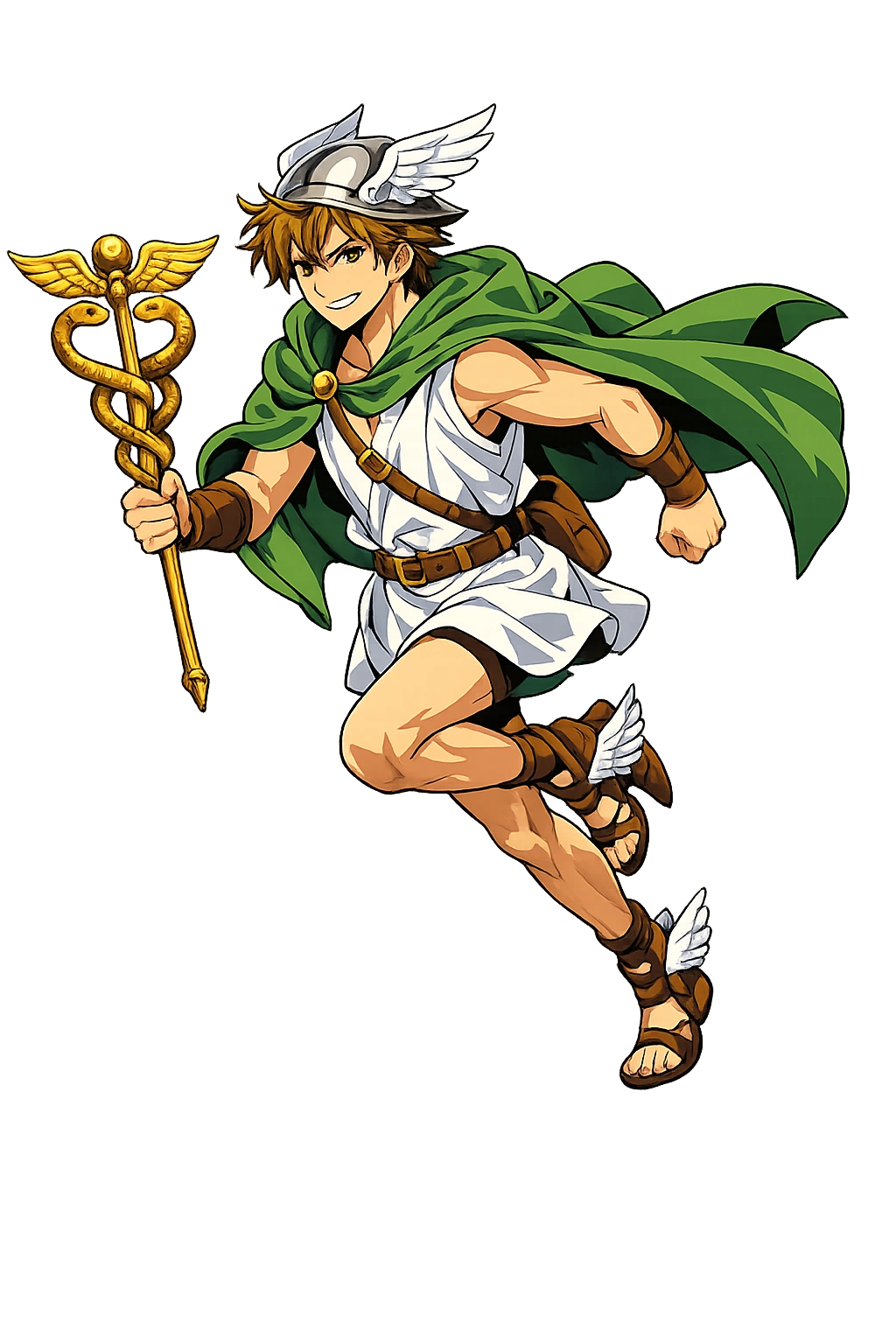
Hermês' oldest image is a head on a post; the aniconic herm remained his primary portrait throughout antiquity. When he took flesh in art, late-seventh-century craftsmen gave him the herald's equipment: the traveller's petasos, the short chlamys, the winged sandals, and the kerykeion, his snake-twined staff.

The archaic types are bearded: the shepherd, and the kriophoros carrying a sacrificial ram across his shoulders, a type Pausanias saw at Tanagra (9.22). The fourth century made him beautiful: Praxiteles' Hermes at Olympia (Archaeological Museum of Olympia), cradling the infant Dionysos while he pauses to fasten his sandal, is widely accepted as the only surviving original marble of the master. Hellenistic and Roman workshops multiplied the ephebic god, Hermes fastening his sandal, the orator Hermes Logios, and, in his mercantile guise, Hermes with the money-bag, while on gems and coins the caduceus alone suffices.

06

Reception & Transformation

The name after its own age — transmission, translation, survival

Afterlives

Rome renamed him Mercurius and lodged him in the week itself: dies Mercurii still echoes in French mercredi, Spanish miércoles, Italian mercoledì. His second career ran through the Hermetica, Greek treatises fathered on Hermes Trismegistus, which survived the Middle Ages above all in one fourteenth-century Venetian manuscript (Marcianus graecus 251).

Renaissance Europe believed the sage a contemporary of Moses: Cosimo de' Medici made Ficino interrupt his Plato to translate the Pimander in 1463 (printed 1471), and for two centuries Hermes Trismegistus ranked among antiquity's greatest minds, until Isaac Casaubon's Exercitationes (1614) redated the corpus to the Christian centuries and collapsed the primordial sage into a pious fiction, one of philology's decisive victories.

The alchemists kept his name in another register: their sealed vessels gave English hermetically sealed. Modern scholarship restored the Greek herald, Karl Kerényi's Hermes der Seelenführer (1942) reading him as guide of souls and god of the threshold, and hermeneutics, the art of interpretation, still carries his name, fittingly for the god who invented the trade of meanings.

Identifications Across Traditions

The Romans identified Hermês with Mercurius, the god of commerce and travel, whose name gives us 'merchant' and 'mercury.' The planet Mercury, swift in its orbit, bears his name. In Egypt he was fused with Thoth, the ibis-headed god of writing and wisdom, producing the figure of Hermes Trismegistus, central to Hellenistic and Renaissance occultism. The caduceus, though often confused with the rod of Asclepius, remains a global symbol of diplomacy and medicine.

Modern Legacy

Hermês is the god of everything that moves: messages, money, travelers, thieves, and souls. The herm was one of the most common religious objects in Athens; every doorway and road was under his protection. In philosophy, Hermes Trismegistus became a founder of alchemy and Hermeticism. Modern concepts of communication, commerce, and even the internet — a network of boundaries crossed at speed — would have seemed to the Greeks like the domain of Hermês. Restoring Hermês restores the name of the god who first made exchange possible.

09

The Original Script Note

What the written record preserves — and what it does not

Original Script

The Greek is Ἑρμῆς, rough breathing on the initial epsilon and a circumflex on the long closing η — a contracted name, genitive Ἑρμοῦ. Homer already trusts him with divine messages (Odyssey 5), and the Homeric Hymn to Hermes tells how he invented the lyre and stole Apollo's cattle on the day of his birth. The traditional etymology connects him with ἕρμα, the heap of stones that marks a boundary — herms still bear the name. PUNICODEX writes Hermês with the circumflex, since the Greek letters and breathings are not registrable.

10

The Meditation

What Hermês means — beyond the dictionary

Hermês is the god of the in-between moment: the handshake, the border crossing, the message sent but not yet received. He is neither Olympian splendor nor chthonic dread but the quick intelligence that moves between them. The Greeks trusted him on roads because they knew that roads are dangerous, and danger requires a clever companion.

Every time we send a message, make a trade, or cross a threshold, we repeat the gestures Hermês invented. The internet is his latest domain: a vast network of exchanges across boundaries, some honest, some thieving, all swift. The restoration of his name in Unicode is fitting: he would have approved of a script that lets any language travel instantly.

11

Screen & Culture

Where Hermês echoes through film, television, and games — and how

12

Frequently Asked Questions

Deep-dives into the cult, attestation, reception, and sources of Hermês

01How do we know how Hermês was worshipped?

Thousands of herms—four-sided pillars topped with Hermes' head and genitals—stood at doorways, crossroads, and gymnasia across Athens; the mutilation of the herms in 415 BCE is recorded by Thucydides and left numerous surviving examples. The full cult record →

02Where do the earliest attestations of Hermês come from?

The record rests on Homeric Hymn to Hermes, Homer, Odyssey 10.275–306; 24.1–14, Homer, Iliad 24 (Argeiphontes), among 6 cited works. The full source apparatus →

03How did later traditions reinterpret Hermês?

Rome renamed him Mercurius and lodged him in the week itself: dies Mercurii still echoes in French mercredi, Spanish miércoles, Italian mercoledì. Reception & transformation →

04What do the surviving images of Hermês actually show?

Hermês' oldest image is a head on a post; the aniconic herm remained his primary portrait throughout antiquity. The iconography →

05What does the written record of Hermês actually preserve?

The Greek is Ἑρμῆς, rough breathing on the initial epsilon and a circumflex on the long closing η — a contracted name, genitive Ἑρμοῦ. The Original Script note →

13

Scholarly Sources

The philological foundations of this restoration

Every claim on this page is grounded in established scholarship. The orthographic restorations follow disciplinary convention. The etymological chain follows the best available reference works. This is not invention — it is resurrection through scholarship.

◈

Lexicography & Philology

  • Liddell, H. G., Scott, R., & Jones, H. S. A Greek-English Lexicon. Oxford: Clarendon Press, 9th ed. 1996.
  • Pape, W., & Benseler, G. E. Wörterbuch der griechischen Eigennamen. Braunschweig: Vieweg, 1884.
  • Beekes, R. S. P. Etymological Dictionary of Greek. Leiden: Brill, 2010.
◎

Primary Texts

  • Homeric Hymn to Hermes
  • Homer, Odyssey 10.275–306; 24.1–14
  • Homer, Iliad 24 (Argeiphontes)
  • Ovid, Metamorphoses 1.668–723; 2.676–707
◉

Archaeology & Art History

  • Boardman, J. Greek Sculpture: The Classical Period; Carpenter, T. H. Art and Myth in Ancient Greece.
✦

Religious Studies

  • Antoninus Liberalis 23 (Nicander, Corinna)
  • Corpus Hermeticum
Return

The Surface Awaits

You have traced the name from its earliest attestation to its Unicode restoration. Now return to the myth. The story is where the name lives.

Back to Lore
Hermês mascot