PuniCodex

Extended Lore

Ἑρμῆς Hermês

Etymology · Orthography · Cultural Legacy · Reception · Primary Sources

Tier 1 Hermês.com · Hermēs.com
Hermês — Messengers, Commerce, Thieves
01

Quick Facts

Essential information about Hermês, Messengers, Commerce, Thieves

Original ScriptἙρμῆς
Unicode RestorationHermês
Reconstructed Pronunciation/her.ˈmɛːs/
PantheonGreek
DomainMessengers, Commerce, Thieves
MeaningHeap of stones, boundary marker
ClassificationTier 1
Primary DomainHermês.com
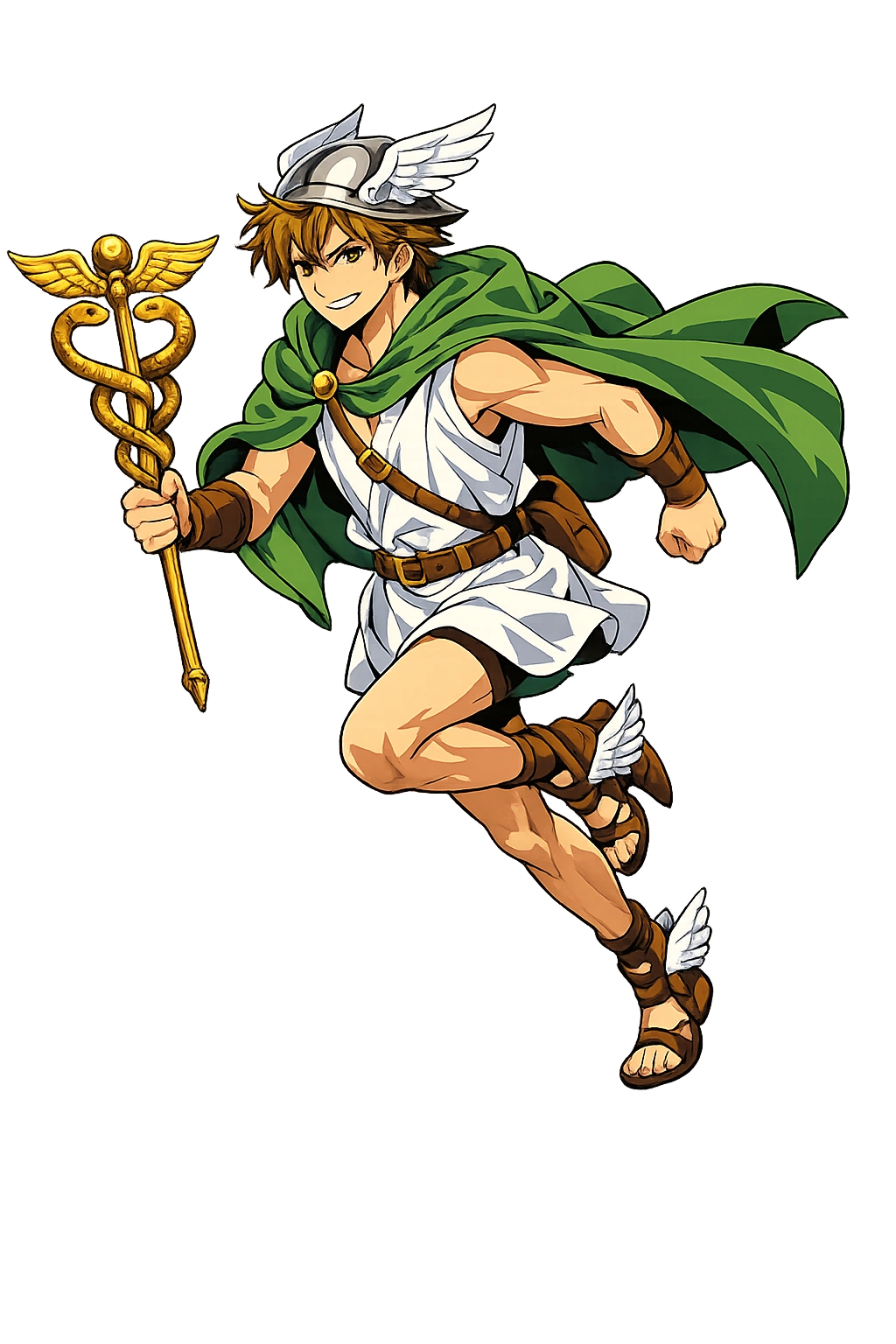
Sacred SymbolsCaduceus, Winged sandals, Traveler's hat, Lyre, Tortoise
02

Etymology & Word Family

From original script to Unicode restoration

Proto-indo-european *ser- to bind, to protect, boundary
Original Script Ἑρμῆς Hermês — "Heap of stones, boundary marker"
Unicode Restoration Hermês Restored stress, length, and script
Modern ASCII hermes Plain-ASCII fallback

From Ἑρμῆς, possibly from ἕρμα "boundary stone". Psychopomp and messenger.

03

Unicode Character Breakdown

Character-by-character philological analysis

CharacterUnicodeNameBlockPhonetic Role
HU+0048Latin Capital Letter HBasic LatinRough breathing
eU+0065Latin Small Letter EBasic LatinShort epsilon
rU+0072Latin Small Letter RBasic LatinRho
mU+006DLatin Small Letter MBasic LatinMu
êU+00EALatin Small Letter E with CircumflexLatin-1 SupplementCircumflex: long eta with stress
sU+0073Latin Small Letter SBasic LatinSigma

The Tier 1 classification reflects how much of the original phonology this restoration preserves — stress and vowel length for Greek names, distinctive letters and diacritics for every other tradition.

04

Cultural Significance

From ancient cult to modern memory

Hermês in Later Traditions

The Romans identified Hermês with Mercurius, the god of commerce and travel, whose name gives us 'merchant' and 'mercury.' The planet Mercury, swift in its orbit, bears his name. In Egypt he was fused with Thoth, the ibis-headed god of writing and wisdom, producing the figure of Hermes Trismegistus, central to Hellenistic and Renaissance occultism. The caduceus, though often confused with the rod of Asclepius, remains a global symbol of diplomacy and medicine.

Modern Legacy

Hermês is the god of everything that moves: messages, money, travelers, thieves, and souls. The herm was one of the most common religious objects in Athens; every doorway and road was under his protection. In philosophy, Hermes Trismegistus became a founder of alchemy and Hermeticism. Modern concepts of communication, commerce, and even the internet — a network of boundaries crossed at speed — would have seemed to the Greeks like the domain of Hermês. Restoring Hermês restores the name of the god who first made exchange possible.

In the Earth

Thousands of herms—four-sided pillars topped with Hermes' head and genitals—stood at doorways, crossroads, and gymnasia across Athens; the mutilation of the herms in 415 BCE is recorded by Thucydides and left numerous surviving examples. The Hermes of Praxiteles (Archaeological Museum of Olympia) is a fourth-century BCE marble of the god carrying the infant Dionysos. The herm of Andros and the Archanes herms illustrate his role as boundary guardian.

05

The Meditation

What Hermês means — beyond the dictionary

Hermês is the god of the in-between moment: the handshake, the border crossing, the message sent but not yet received. He is neither Olympian splendor nor chthonic dread but the quick intelligence that moves between them. The Greeks trusted him on roads because they knew that roads are dangerous, and danger requires a clever companion.

Every time we send a message, make a trade, or cross a threshold, we repeat the gestures Hermês invented. The internet is his latest domain: a vast network of exchanges across boundaries, some honest, some thieving, all swift. The restoration of his name in Unicode is fitting: he would have approved of a script that lets any language travel instantly.

06

Screen & Culture

Where Hermês echoes through film, television, and games — and how

07

Frequently Asked Questions

Common questions about Hermês, Messengers, Commerce, Thieves, and Unicode restoration

01How do you pronounce Hermês?

In reconstructed pronunciation, Hermês is /her.ˈmɛːs/ — approximately 'her-MACE' — the first syllable is quick and breathy; the second is long, level, and carries the accent.

02What does Hermês mean?

Hermês means Heap of stones, boundary marker in the greek tradition.

03What are the symbols of Hermês?

Hermês is associated with Caduceus (The herald's staff entwined with serpents, symbol of peace and negotiation), Winged sandals (Speed and the ability to cross all boundaries), Traveler's hat (Protection on the road), Lyre (The instrument he invented and traded to Apóllōn), Tortoise (From whose shell he made the first lyre).

04Why are there different spellings of Hermês?

Each form is a historically attested restoration rather than a mistake: Hermēs is the macron-only form (LSJ convention: length only, no circumflex). PUNICODEX registers the full set so the tradition is preserved under every defensible spelling.

05Why restore Hermês in Unicode?

Plain ASCII hermes strips the stress, length, and script that make the name specific. Unicode restoration returns the name to its original written dignity.

06What is the most important myth about Hermês?

“Born in a Cave on Mount Cyllene” — Hermês's myths celebrate intelligence in motion. Born at dawn, by nightfall he has invented music, stolen a herd, and talked his way out of both — and Zeús rewards him with every boundary-crossing office: herald, trader, guide of the dead. Every threshold in the Greek world — door, road, market, grave — stood under his sign. The full telling lives on the lore page.

08

Scholarly Sources

The philological foundations of this restoration

Every claim on this page is grounded in established scholarship. The orthographic restorations follow disciplinary convention. The etymological chain follows the best available reference works. This is not invention — it is resurrection through scholarship.

Lexicography & Philology

  • Liddell, H. G., Scott, R., & Jones, H. S. A Greek-English Lexicon. Oxford: Clarendon Press, 9th ed. 1996.
  • Pape, W., & Benseler, G. E. Wörterbuch der griechischen Eigennamen. Braunschweig: Vieweg, 1884.
  • Beekes, R. S. P. Etymological Dictionary of Greek. Leiden: Brill, 2010.

Primary Texts

  • Homeric Hymn to Hermes
  • Homer, Odyssey 10.275–306; 24.1–14
  • Homer, Iliad 24 (Argeiphontes)
  • Ovid, Metamorphoses 1.668–723; 2.676–707

Archaeology & Art History

  • Material evidence — iconography, inscriptions, and temple archaeology — for Hermês and related cults.

Religious Studies

  • Antoninus Liberalis 23 (Nicander, Corinna)
  • Corpus Hermeticum
Return

The Surface Awaits

You have traced the name from its earliest attestation to its Unicode restoration. Now return to the myth. The story is where the name lives.

Back to Lore
Hermês mascot