PuniCodex

Extended Lore

Ἥλιος Hēlios

Etymology · Orthography · Cultural Legacy · Reception · Primary Sources

Tier 1 Hēlios.com
Hēlios — Sun, Sight, Oaths
01

Quick Facts

Essential information about Hēlios, Sun, Sight, Oaths

Original ScriptἭλιος
Unicode RestorationHēlios
Reconstructed Pronunciation/hɛ́.li.os/
PantheonGreek
DomainSun, Sight, Oaths
MeaningSun (from PIE *seh₂wel-)
ClassificationTier 1
Primary DomainHēlios.com
Sacred SymbolsChariot, Winged sun disk, Crown of rays, The golden cup, Whip
02

Etymology & Word Family

From original script to Unicode restoration

Proto-indo-european *seh₂wol- sun
Original Script Ἥλιος Hēlios — "Sun (from PIE *seh₂wel-)"
Unicode Restoration Hēlios Restored stress, length, and script
Modern ASCII helios Plain-ASCII fallback

From Ἥλιος "sun", cognate with Latin sol, English sun. The solar charioteer.

03

Unicode Character Breakdown

Character-by-character philological analysis

CharacterUnicodeNameBlockPhonetic Role
HU+0048Latin Capital Letter HBasic LatinRough breathing
ēU+0113Latin Small Letter E with MacronLatin Extended-AEta: long epsilon
lU+006CLatin Small Letter LBasic LatinLambda
iU+0069Latin Small Letter IBasic LatinShort iota
oU+006FLatin Small Letter OBasic LatinShort omicron
sU+0073Latin Small Letter SBasic LatinSigma

The Tier 1 classification reflects how much of the original phonology this restoration preserves — stress and vowel length for Greek names, distinctive letters and diacritics for every other tradition.

04

Cultural Significance

From ancient cult to modern memory

Hēlios in Later Traditions

The Romans identified Hēlios with Sol, though Apollo increasingly absorbed solar attributes in both Greek and Roman religion — the identification never complete enough to erase Hēlios's older, purer identity as the sun itself. The emperor Aurelian made Sol Invictus ('the Unconquered Sun') the official patron of the Roman Empire in 274 CE; the cult's late-December festival later influenced the dating of Christmas. In Hellenistic Egypt, Hēlios was syncretized with Ra and Horus as a universal deity, and the Greek magical papyri invoke 'Helios' as the cosmic ruler. Neoplatonists — above all Julian the Apostate, whose hymn to the King Helios survives — saw Hēlios as the visible image of the intelligible sun, the One. The scientific era gave his name its most famous afterlife: Copernicus's heliocentric model made Hēlios, not Earth, the center of all things — the god's revenge on geocentrism.

Modern Legacy

Hēlios is the namesake of heliocentrism, the helium atom, and countless words for sunlight in the world's languages. The Colossus of Rhodes, one of the Seven Wonders of the Ancient World, was his bronze portrait at some seventy cubits — until an earthquake felled it in 226 BCE. His crown of rays passed into depictions of Christ as Sol Invictus and into the halo of Christian art; Sunday — the day of the Sun — carries his memory in half the languages of Europe. In modern culture the sun god remains the symbol of clarity, revelation, and dangerous power: the clarity that sees all, the power that burns. Restoring Hēlios restores the original Greek name of the star that makes every other story possible.

In the Earth

Rhodes gave Hēlios his greatest monument: the Colossus, a bronze statue by Chares of Lindos standing some seventy cubits over the harbor — one of the Seven Wonders until the earthquake of 226 BCE brought it down (Pliny, NH 34.41; Strabo 14.2.5). The Rhodians put his radiate head on their coinage for centuries, and the type became the standard portrait of the sun in numismatics. On the Athenian Acropolis, the east pediment of the Parthenon showed Hēlios's horses rising from the sea — the famous head in the British Museum. In Asia Minor, the relief at Ephesus and the Amarna-age solar precedents remind us that the radiate sun-god was an image older than Greece and younger than anyone.

05

The Meditation

What Hēlios means — beyond the dictionary

Hēlios is the god of total visibility. He cannot be bargained with or hidden from, and that is precisely what makes him both sanctuary and threat. In an age of surveillance cameras and data trails we have rebuilt Hēlios without his justice: we have made a sun that watches, but not one that testifies truthfully. For the Greeks, the sun's witness was sacred because it was incorruptible — the one account of events that could not be bought or frightened.

The restoration of Hēlios's name is a reminder that light is not neutral. It reveals, but it also exposes; it nourishes, but it also burns. Phaethōn's disaster is the modern myth we keep reenacting: power without the skill to steer it. The sun sees everything — and what it sees, it cannot unsee.

06

Frequently Asked Questions

Common questions about Hēlios, Sun, Sight, Oaths, and Unicode restoration

01How do you pronounce Hēlios?

In reconstructed pronunciation, Hēlios is /hɛ́.li.os/ — approximately 'HAY-lee-oss' — the first syllable rises like the sun; the rest is bright and clear.

02What does Hēlios mean?

Hēlios means Sun (from PIE *seh₂wel-) in the greek tradition.

03What are the symbols of Hēlios?

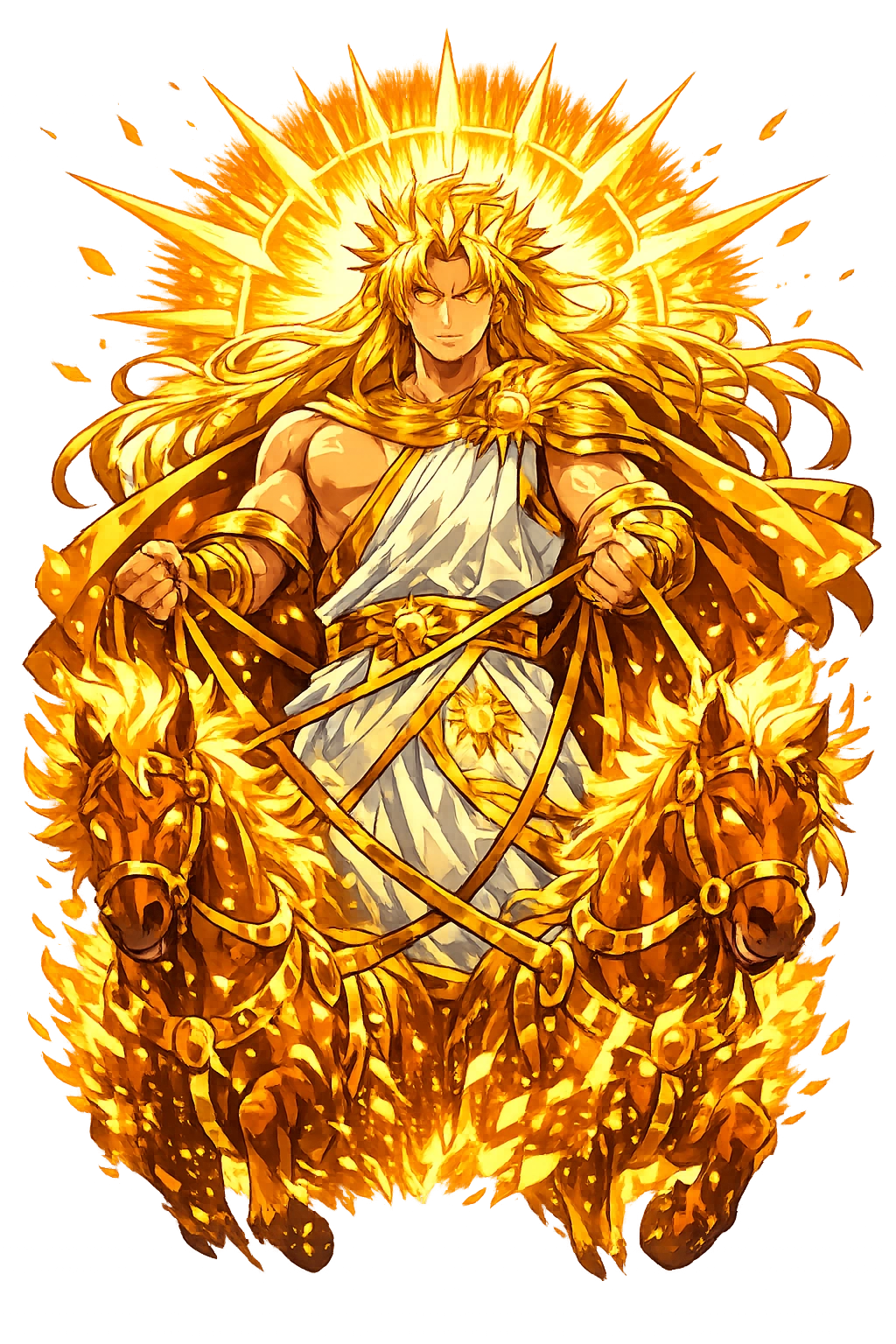
Hēlios is associated with Chariot (The wheeled car of fire; late tradition names its four horses Pyroís, Éous, Aíthōn, and Phlegéon — 'Fire, Dawn-blaze, Burning, Blazing'.), Winged sun disk (The sun as a flying radiant power — an image with a long afterlife in the art of Egypt, Persia, and Christianity.), Crown of rays (The projecting beams of light around his head — the attribute the Colossus of Rhodes wore at seventy cubits.), The golden cup (The bowl in which, from Stesichorus onward, the sun sails back east through the night by the stream of Ocean.), Whip (His control over the solar horses — the tool his son Phaethōn could not master.).

04Why are there different spellings of Hēlios?

Each form is a historically attested restoration rather than a mistake: Hḗlios is the ideal form (Stacked macron+acute on the stressed long vowel, matching Greek Ἥλιος; philologically ideal but often untypeable on phones.). PUNICODEX registers the full set so the tradition is preserved under every defensible spelling.

05Why restore Hēlios in Unicode?

Plain ASCII helios strips the stress, length, and script that make the name specific. Unicode restoration returns the name to its original written dignity.

06What is the most important myth about Hēlios?

“Across the Sky and Through Oceanus” — Hēlios's myths all depend on his unique vantage point: he sees everything. This makes him a witness, a revealer of secrets, and — in his children's stories — the passive victim of ambition he could foresee but not prevent. His is the mythology of total visibility: no one, not even Zeus, can keep a secret from the light. The full telling lives on the lore page.

07

Scholarly Sources

The philological foundations of this restoration

Every claim on this page is grounded in established scholarship. The orthographic restorations follow disciplinary convention. The etymological chain follows the best available reference works. This is not invention — it is resurrection through scholarship.

Lexicography & Philology

  • Liddell, H. G., Scott, R., & Jones, H. S. A Greek-English Lexicon. Oxford: Clarendon Press, 9th ed. 1996.
  • Pape, W., & Benseler, G. E. Wörterbuch der griechischen Eigennamen. Braunschweig: Vieweg, 1884.
  • Beekes, R. S. P. Etymological Dictionary of Greek. Leiden: Brill, 2010.

Primary Texts

Archaeology & Art History

  • Material evidence — iconography, inscriptions, and temple archaeology — for Hēlios and related cults.

Religious Studies

  • Comparative studies of greek religion and the place of Hēlios within it.
Return

The Surface Awaits

You have traced the name from its earliest attestation to its Unicode restoration. Now return to the myth. The story is where the name lives.

Back to Lore
Hēlios mascot