PuniCodex

Extended Lore

ᚼᛁᛘᛏᛅᛚᛚᚱ Heimdallr

Etymology · Orthography · Cult · Iconography · Reception · Sources

Tier 2 Heimdallr
Heimdallr — Foreknowledge, Watchman, Bifrost
01

Quick Facts

Essential information about Heimdallr, Foreknowledge, Watchman, Bifrost

Original Scriptᚼᛁᛘᛏᛅᛚᛚᚱ
Unicode RestorationHeimdallr
Reconstructed Pronunciation/ˈhɛim.dɑl.r̩/
PantheonNorse
DomainForeknowledge, Watchman, Bifrost
MeaningWorld-brightener (from heimr + dallr)
ClassificationTier 2
Primary DomainHeimdallr
Sacred SymbolsThe Gjallarhorn, The golden teeth, Himinbjǫrg, The hearing, The green ways of Rígr
02

Etymology & Word Family

From original script to Unicode restoration

Original Script ᚼᛁᛘᛏᛅᛚᛚᚱ Heimdallr — "World-brightener (from heimr + dallr)"
Unicode Restoration Heimdallr Canonical scholarly spelling — ASCII-identical
Modern ASCII heimdallr Plain-ASCII fallback

The name Heimdallr reaches the modern world through scholarly transliteration of the norse tradition. Because the conventional spelling uses only Latin letters, its Unicode and ASCII forms coincide — the tradition it carries is in the name itself, not in diacritics.

03

Unicode Character Breakdown

Character-by-character philological analysis

CharacterUnicodeNameBlockPhonetic Role
HU+0048Latin Capital Letter HBasic LatinSame
eU+0065Latin Small Letter EBasic LatinSame
iU+0069Latin Small Letter IBasic LatinSame
mU+006DLatin Small Letter MBasic LatinSame
dU+0064Latin Small Letter DBasic LatinSame
aU+0061Latin Small Letter ABasic LatinSame
lU+006CLatin Small Letter LBasic LatinSame
rU+0072Latin Small Letter RBasic LatinSame

The Tier 2 classification here reflects fidelity to the attested tradition, not recovered diacritics: every character of Heimdallr already survives in ASCII. What the restoration preserves is the canonical spelling itself — the form scholarship standardised.

04

Cult & Worship

How the sacred was kept — rites, sanctuaries, remains

The Cult

No temple, no certain place-name, no votive deposit — Heimdallr's cult is the most spectral in the Norse pantheon, and honesty requires saying so. What the corpus gives instead is one line and one find. Grímnismál, tallying the gods' dwellings, says that at Himinbjǫrg Heimdallr rules over the vé, the holy places — the only Eddic verse that grants him a cult domain, as if guarding sanctuaries were his worship. And a lead spindle-whorl from Saltfleetby in Lincolnshire, tenth or eleventh century, preserves a householder's charm calling on Óðinn, Heimdallr, and Þjálfi for help — the one surviving invocation of his name outside the poems, worn smooth by spinning hands. If that is a cult, it lived in household magic and at thresholds rather than in priesthood, festival, or sacrifice; no Norse source shows anyone pouring for him.

In the Earth

Heimdallr's material record is thin but real. The outstanding witness is the Saltfleetby spindle whorl (Lincolnshire, 10th–11th c.), a lead whorl whose runic inscription calls on Óðinn, Heimdallr, and Þjálfi for help — the only runic charm yet found that invokes the watchman by name, and proof his name travelled to England with the Norse settlers. In art, the Gosforth Cross in Cumbria carries a Ragnarǫk panel with a figure raising a horn, often read as Heimdallr sounding the last alarm, and the Jurby cross-slab on the Isle of Man shows a horn-blowing figure sometimes given the same reading; neither stone names him. Place-names formed on his hall Himinbjǫrg survive in Scandinavia (the Himberg type in Norway and Sweden), and Úlfr Uggason's Húsdrápa — composed about the carvings in Óláfr pái's hall at Hjarðarholt — proves his myth decorated a chieftain's hall by the 980s. Of the texts: the Codex Regius preserves Völuspá, Grímnismál, Þrymskviða, and Lokasenna; Rígsþula survives only in the Codex Wormianus; Hyndluljóðr in Flateyjarbók.

05

Iconography

How Heimdallr was imaged across the ages

The Image

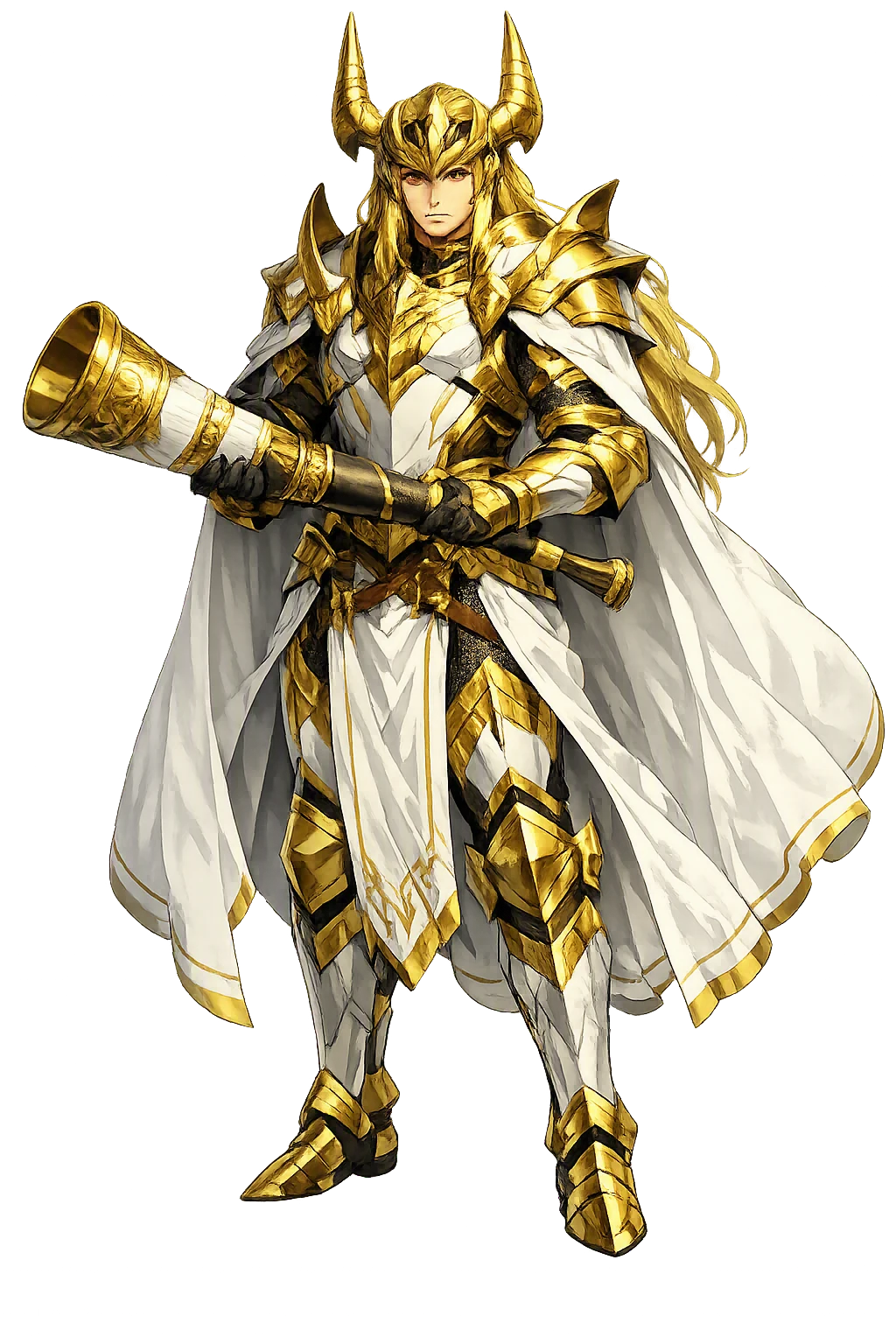
Heimdallr left no certain image of himself — almost fitting for the watcher whom no one saw. His attributes are textual and unmistakable: the Gjallarhorn, the gold-toothed grin behind the byname Gullintanni, the horse Gulltoppr, the bone-white skin Snorri insists on. Two carved candidates survive, both nameless. The tenth-century Gosforth Cross in Cumbria carries a Ragnarǫk panel with a figure raising a horn to his mouth, often read as the watchman sounding the last alarm; the Jurby cross-slab on the Isle of Man shows a similar horn-blower. Neither stone names him, and the handbooks say so. By the time of his great visual career — the nineteenth-century romantic rediscovery, when illustrators armed him with a horn — the image was reconstruction, not survival. What the poets drew was never a face but a function: sight, hearing, and the blast that ends them.

06

Reception & Transformation

The name after its own age — transmission, translation, survival

Afterlives

Heimdallr's reception is the reception of the Eddas themselves. His poems rode in the Codex Regius (c. 1270) and in the Wormianus codex that alone preserves Rígsþula, slept in Icelandic libraries, and re-entered Europe when Peder Resen printed the Edda at Copenhagen in 1665. The eighteenth century discovered him as Germanic antiquity: Ole Worm had once owned his manuscript, Paul-Henri Mallet's Monuments de la mythologie germanique (1756) — echoed in Thomas Percy's Northern Antiquities (1770) — carried the white watchman to Herder and the Romantics, who found in him a figure of sublime vigilance. Jacob Grimm gave him a philological habitation in the Deutsche Mythologie (1835), Karl Simrock put the Edda into German verse (1851), and the nineteenth-century scholarly tradition kept his dossier of bynames and kennings alive as the paradigm of a god whose myths perish: what survives are the names, the offices, and the lost poems behind the kennings — Heimdalargaldr, the lay Snorri found already hard to understand.

Identifications Across Traditions

Heimdallr resists the usual syncretic moves — no Roman writer ever matched him, and no continental charm securely names him — but the twentieth century built him a different kind of company. Georges Dumézil made Rígsþula a Scandinavian cornerstone of his trifunctional reading of Indo-European society: thrall, farmer, and noble begotten by one wandering god maps the pattern he traced from the Vedas to Rome. Within the Germanic record, the clearest pairing is the Saltfleetby spindle whorl from Lincolnshire, whose runic charm calls on Óðinn and Heimdallr and Þjálfi for help — the watchman invoked beside the Allfather in a working household. Scholars have also set his nine giantess-mothers beside Ægir's nine wave-daughters and his birth 'at the edge of the earth' beside other shore-born figures; none of the equations has won consensus, and the handbooks converge on the same honest word: enigmatic.

Modern Legacy

Heimdallr's afterlife runs on the horn and the watch. The name never left the North — Norwegian Heimdal survives in place-names and as a given name, and Icelandic keeps Heimdallur — and in modern reception he has become the fixed image of the gatekeeper: the cinema's Heimdall, sighting across the Bifröst, is now the spelling most of the world meets first, and security software borrows the name when it wants to promise that nothing gets past. Modern Heathenry honors him as the father of mankind's orders and the god of vigilance, while the scholarship keeps him as its favorite unsolved problem — the white god whose dossier is large and whose meaning is still debated.

07

The Meditation

What Heimdallr means — beyond the dictionary

Heimdallr is the god of the unglamorous miracle: attention. No adventure of his survives whole — the great deeds are lost poems and kenning-fragments — but the corpus is unanimous about the senses. He hears grass grow. He sees through night. He needs less sleep than a bird. And the Edda builds the whole meaning of vigilance out of that patience: the watch is not the battle; the watch is what makes the battle survivable, and the horn is what makes the watch worth keeping.

Rígsþula adds the stranger claim — that this same tireless attention once walked the green ways as Rígr and fathered every class of men, as if to say that society itself began as something watched over. His last act is not a victory: he blows the horn, and then he and Loki kill each other. The watch ends in the warning, not in the rescue. That is the whole of it, and it is enough: someone has to be awake when the rest of the world is not, and the Edda gave that someone a name.

08

Screen & Culture

Where Heimdallr echoes through film, television, and games — and how

09

Frequently Asked Questions

Common questions about Heimdallr, Foreknowledge, Watchman, Bifrost, and Unicode restoration

01How do you pronounce Heimdallr?

In reconstructed pronunciation, Heimdallr is /ˈhɛim.dɑl.r̩/ — approximately 'HAYM-dahl-r' — the ei is the diphthong of 'day', the a short and open, the double l held long, and the final r sounded as a light syllabic trill, as in Icelandic Heimdallur.

02What does Heimdallr mean?

Heimdallr means World-brightener (from heimr + dallr) in the norse tradition.

03What are the symbols of Heimdallr?

Heimdallr is associated with The Gjallarhorn (The resounding horn hidden beneath the sacred tree — the blast that will be heard in all worlds when the end begins), The golden teeth (Gullintanni, the byname Snorri explains plainly — the watchman's brightness struck in metal), Himinbjǫrg ('Heaven-mountain', his hall at the bridge's head — the one dwelling in the Edda defined entirely by the duty kept there), The hearing (He hears grass growing on the earth and wool on sheep — vigilance sharpened past the edge of the possible), The green ways of Rígr (The roads he walked as Rígr, sleeping three nights in each house — the wanderings that fathered the classes of men).

04Why restore Heimdallr in Unicode?

Heimdallr is written entirely in ASCII letters, so its restoration is about canonical fidelity rather than recovered diacritics: the temple fixes the name in its scholarly standard spelling, attested in the source tradition, instead of leaving it to drift.

05What is the most important myth about Heimdallr?

“The Watchman at Himinbjǫrg” — the Grímnismál 13 · Gylfaginning 27 story that anchors the mythology of Heimdallr, told in full on the lore page.

10

Scholarly Sources

The philological foundations of this restoration

Every claim on this page is grounded in established scholarship. The orthographic restorations follow disciplinary convention. The etymological chain follows the best available reference works. This is not invention — it is resurrection through scholarship.

◈

Lexicography & Philology

  • Cleasby-Vigfusson
  • Zoëga
◎

Primary Texts

  • Poetic Edda: Völuspá 1, 27, 46; Grímnismál 13; Þrymskviða 15; Lokasenna 48; Rígsþula; Hyndluljóðr 35–38
  • Snorri Sturluson, Prose Edda: Gylfaginning 15, 27, 49, 51; Skáldskaparmál (Húsdrápa on the seal-fight at Singasteinn)
◉

Archaeology & Art History

  • Material evidence — iconography, inscriptions, and temple archaeology — for Heimdallr and related cults.
✦

Religious Studies

  • Úlfr Uggason, Húsdrápa (c. 983) — the oldest attestation of the feud with Loki
  • Cleasby–Vigfusson, An Icelandic-English Dictionary, s.v. Heimdallr
  • Simek, Dictionary of Northern Mythology; Lindow, Norse Mythology: A Guide — s.v. Heimdallr
Return

The Surface Awaits

You have traced the name from its earliest attestation to its Unicode restoration. Now return to the myth. The story is where the name lives.

Back to Lore
Heimdallr mascot