PuniCodex

Extended Lore

GRAVITAS Gravitas

Etymology · Orthography · Cult · Iconography · Reception · Sources

Tier 2 Gravitas
Gravitas — Weight, Seriousness, Dignity
01

Quick Facts

Essential information about Gravitas, Weight, Seriousness, Dignity

Original ScriptGRAVITAS
Unicode RestorationGravitas
Reconstructed Pronunciation/ˈɡra.wi.tas/
PantheonGreek
DomainWeight, Seriousness, Dignity
MeaningWeight, importance
ClassificationTier 2
Primary DomainGravitas
Sacred SymbolsThe toga, The fasces, The plough, The set jaw, The surveyor's plumb-line
02

Etymology & Word Family

From original script to Unicode restoration

Original Script GRAVITAS Gravitas — "Weight, importance"
Unicode Restoration Gravitas Canonical scholarly spelling — ASCII-identical
Modern ASCII gravitas Plain-ASCII fallback

The name Gravitas reaches the modern world through scholarly transliteration of the greek tradition. Because the conventional spelling uses only Latin letters, its Unicode and ASCII forms coincide — the tradition it carries is in the name itself, not in diacritics.

03

Unicode Character Breakdown

Character-by-character philological analysis

CharacterUnicodeNameBlockPhonetic Role
GU+0047Latin Capital Letter GBasic LatinG uppercase
rU+0072Latin Small Letter RBasic Latinr same
aU+0061Latin Small Letter ABasic Latina same
vU+0076Latin Small Letter VBasic Latinv same
iU+0069Latin Small Letter IBasic Latini same
tU+0074Latin Small Letter TBasic Latint same
aU+0061Latin Small Letter ABasic Latina same
sU+0073Latin Small Letter SBasic Latins same

The Tier 2 classification here reflects fidelity to the attested tradition, not recovered diacritics: every character of Gravitas already survives in ASCII. What the restoration preserves is the canonical spelling itself — the form scholarship standardised.

04

Cult & Worship

How the sacred was kept — rites, sanctuaries, remains

The Cult

Gravitas never had a priest; its cult was civic theater, and every man in the toga was expected on stage. No temple, festival, or altar to the quality is attested anywhere in the Roman world — it was a virtue, not a numen — but Rome drilled it like a religion: the boy donning the toga virilis before the assembled Forum, the novice's tirocinium fori apprenticing his mornings to a senator, the censors' regimen morum grading the public bearing of the citizen body. Rhetoric schools taught the walk and the pause; Quintilian prescribed the gesture that made the orator's whole body testify. What survives of this 'worship' is behavioral rather than monumental: a choreography of seriousness repeated until it read as the Roman signature.

In the Earth

Gravitas survives most vividly in portraiture: the bronze statue known as the Arringatore (Aule Metele, c. 100–90 BCE, now in Florence) shows an Etruscan-Roman orator in full toga with his right arm raised in precisely the gesture Quintilian prescribes — the body arranged for public weight a century before the Institutio was written. Rows of togate statues marked the tombs along the Via Appia and the family dead in house atria; the wax ancestor masks (imagines) themselves decayed, but cupboards for them are built into surviving atrium houses, and their descendants in marble crowd the museums of the Roman world. Imperial mints later personified the abstract virtues on coinage — Pietas, Virtus, Clementia, Concordia — a type-set of Rome's character struck in silver and spent across three continents.

05

Iconography

How Gravitas was imaged across the ages

The Image

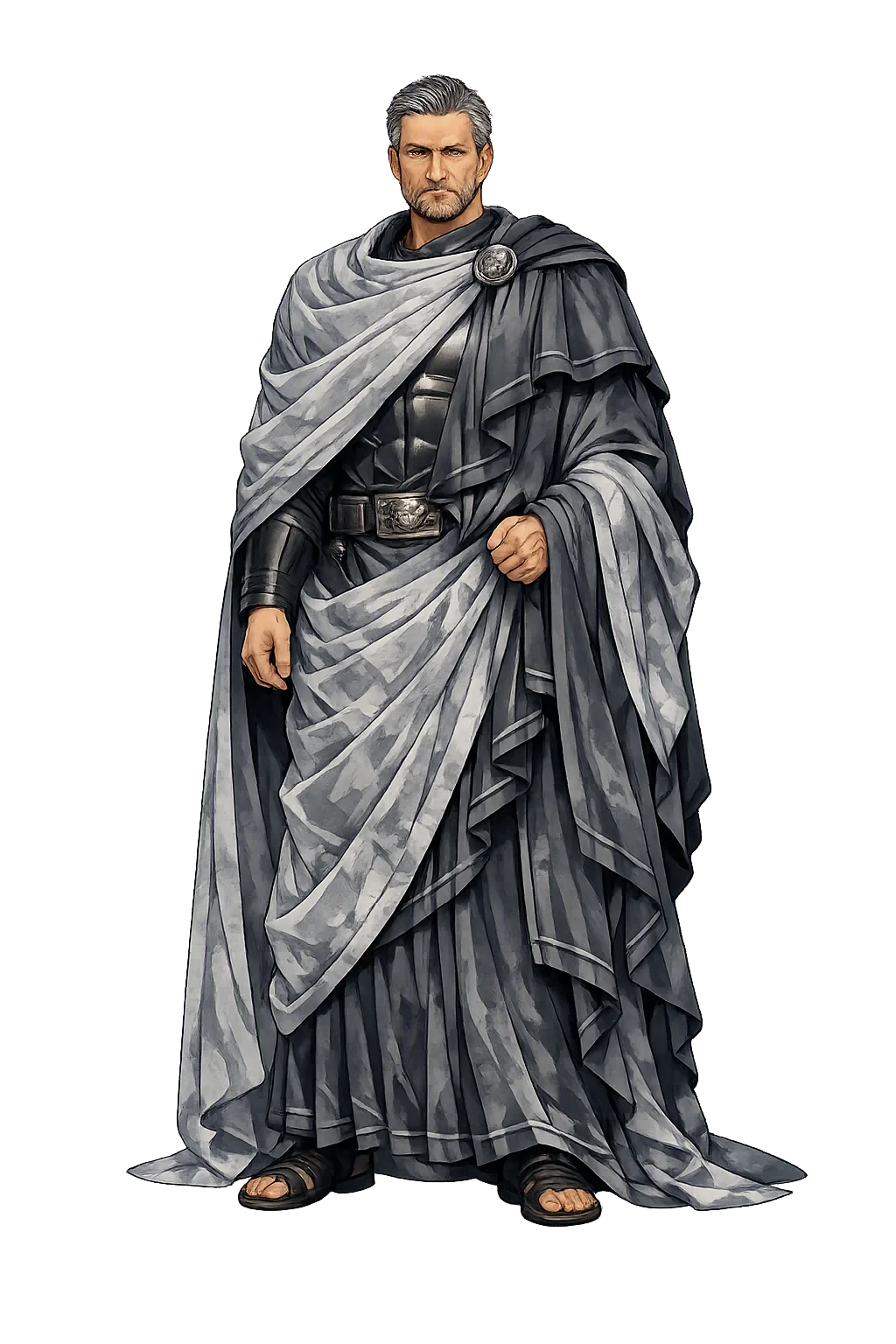
Gravitas was never given a face, and the silence is itself evidence. Rome struck personifications of her sister-virtues on imperial silver, but gravitas has no settled coin type and no known cult image — a quality that existed only when performed could not be frozen in allegory. Her iconography was instead a wardrobe: the heavy drape of the toga, the purple-bordered praetexta of magistrates, the tightly girded cinctus Gabinus donned for sacrifice and for battle. Sculpture expressed her without naming her — the aged veristic head that reads every wrinkle as a deposit of experience. When later centuries pictured Roman seriousness, they reached for these, not for an invented goddess.

06

Reception & Transformation

The name after its own age — transmission, translation, survival

Afterlives

The word's afterlife is a relay from forum to schoolroom to dictionary. Cicero and Quintilian fixed its rhetorical sense at the source; late antiquity handed it to Christian Latin as the dignity proper to bishops and councils, and the Middle Ages made it a property of princes — John of Salisbury's Policraticus weighs the ruler's gravitas against the courtier's flattery. Castiglione passed the baton to the Renaissance: the fourth book of the Cortegiano (1528) sets a sober gravità at the heart of the courtier-prince's art, and humanist schoolmasters drilled the vir gravis ideal into European elites for three centuries. English, which had long possessed the family through French (gravity, grave), re-imported the Latin form itself as a learned nineteenth-century borrowing — the last leg of a two-thousand-year journey that began on the floor of the Roman Forum.

Identifications Across Traditions

Greece supplied the template: the quality the Romans called gravitas had been honoured for centuries as semnótēs, the grave dignity of the mature citizen, and the Stoic teaching of Panaetius of Rhodes — transmitted through Cicero's De Officiis, which rests on Panaetius' Peri tôn kathēkontōn — welded the Greek analysis of character to the Roman word. Where Greece had made dignity a philosophical property, Rome made it a political one: the word walked out of the schoolroom into the Forum and the law court. Rome then exported it wholesale. Every European learned language absorbed the Latin word (gravità, gravité, gravedad), Christian Latin applied it to bishops and councils, and the humanists restored it as the crown of the orator's art. The twentieth century returned it to political speech as an unbuyable compliment — 'a statesman of real gravitas' — usually said of exactly what is missing.

Modern Legacy

Gravitas never needed archaeology to survive; it had dictionaries. From the root gravis English keeps grave, gravity, aggravate, gravid, and the borrowed word itself, now the standard of statesmanship: diplomats speak 'with the gravitas of the office,' judges weigh 'the gravity of the offence,' and the media award the word to the rare voice that slows a room. Newton's gravitas became physical law, the most literal legacy a word about weight could have. In an attention economy that pays for lightness and speed, gravitas has become almost countercultural — a compliment about what someone is not doing: not performing, not floating, not selling. The Latin Republic's measure of a citizen remains the standing rebuke of every market that rewards the opposite.

07

The Meditation

What Gravitas means — beyond the dictionary

Every culture answers, sooner or later, the question Rome put into one word: what makes a person's word weigh anything? The Roman answer was practice rather than theory — the plough returned to, the grief pressed down, the mask in the atrium, the voice held low — and its force comes from that. Gravitas is not a talent and not a pose. It is the visible sediment of repeated choices to carry more than one strictly has to, until carrying becomes shape.

The modern world runs on levitas, on the deliberately light: the hot take, the pivot, the brand, the message tested and discarded by noon. None of that is wicked — speed has its own genius — but a person or a polity made only of it cannot be leaned on. Gravitas is the ballast. Its lesson for the reader is quieter than a commandment: notice what gives your own words mass, and notice, as the Romans did with Cincinnatus, that the surest proof of weight is how quickly you set power down.

08

Frequently Asked Questions

Common questions about Gravitas, Weight, Seriousness, Dignity, and Unicode restoration

01How do you pronounce Gravitas?

In reconstructed pronunciation, Gravitas is /ˈɡra.wi.tas/ — approximately 'GRAH-wih-tahs' — three syllables, the first stressed and grounded, the ending short and definite; no diphthongs, no drift.

02What does Gravitas mean?

Gravitas means Weight, importance in the greek tradition.

03What are the symbols of Gravitas?

Gravitas is associated with The toga (The heavy woollen garment of the citizen engaged in public business — its very drape part of the office it announces), The fasces (The magistrate's bundle of rods carried by attendants: public power, physically borne, whose weight the bearer must carry with dignity), The plough (Cincinnatus' four-acre farm on the far bank of the Tiber — the ground to which true weight returns when office is done (Livy 3.26)), The set jaw (Aeneas' composure before his shattered crews — grief pressed down in the heart so that hope can be shown on the face (Aeneid 1.209)), The surveyor's plumb-line (Quintilian's demand that delivery carry authority and weight (Institutio Oratoria 11): the body's straight line, like the mason's, must hang true).

04Why restore Gravitas in Unicode?

Gravitas is written entirely in ASCII letters, so its restoration is about canonical fidelity rather than recovered diacritics: the temple fixes the name in its scholarly standard spelling, attested in the source tradition, instead of leaving it to drift.

05What is the most important myth about Gravitas?

“The Dictator Who Went Home” — the Livy 3.26–29 story that anchors the mythology of Gravitas, told in full on the lore page.

09

Scholarly Sources

The philological foundations of this restoration

Every claim on this page is grounded in established scholarship. The orthographic restorations follow disciplinary convention. The etymological chain follows the best available reference works. This is not invention — it is resurrection through scholarship.

◈

Lexicography & Philology

  • Lewis-Short
◎

Primary Texts

  • Cicero
  • Cicero, De Oratore, Brutus, and De Officiis 1 (the weighted speaker and the decorum of the serious life)
  • Virgil, Aeneid 1.208–209 (spem vultu simulat)
◉

Archaeology & Art History

  • Material evidence — iconography, inscriptions, and temple archaeology — for Gravitas and related cults.
✦

Religious Studies

  • Quintilian, Institutio Oratoria 11–12 (actio and the vir bonus dicendi peritus, 12.1.1)
  • Livy, Ab Urbe Condita 3.26–29 (Cincinnatus)
  • Polybius 6.53–54 (the imagines at the Roman funeral); Sallust, Bellum Catilinae 3–13 (levitas and decline)
  • Lewis & Short, A Latin Dictionary, and Ernout–Meillet, Dictionnaire étymologique, s.v. gravis
Return

The Surface Awaits

You have traced the name from its earliest attestation to its Unicode restoration. Now return to the myth. The story is where the name lives.

Back to Lore
Gravitas mascot