PuniCodex

Extended Lore

Gnowee

Etymology · Orthography · Cult · Iconography · Reception · Sources

Tier 2 Gnowee
Gnowee — Sun Goddess
01

Quick Facts

Essential information about Gnowee, Sun Goddess

Scholarly TransliterationGnowee
Unicode RestorationGnowee
Reconstructed Pronunciation/ˈɡnoʊi/
PantheonAboriginal
DomainSun Goddess
MeaningThe sun
ClassificationTier 2
Primary DomainGnowee
Sacred SymbolsBark torch, Yam stick / digging stick, The southern sky path, Darkness below
02

Etymology & Word Family

From original script to Unicode restoration

Scholarly Transliteration Gnowee Gnowee — "The sun"
Unicode Restoration Gnowee Canonical scholarly spelling — ASCII-identical
Modern ASCII gnowee Plain-ASCII fallback

The name Gnowee reaches the modern world through scholarly transliteration of the aboriginal tradition. Because the conventional spelling uses only Latin letters, its Unicode and ASCII forms coincide — the tradition it carries is in the name itself, not in diacritics.

03

Unicode Character Breakdown

Character-by-character philological analysis

CharacterUnicodeNameBlockPhonetic Role
GU+0047Latin Capital Letter GBasic LatinSame, capitalized
nU+006ELatin Small Letter NBasic LatinSame
oU+006FLatin Small Letter OBasic LatinSame
wU+0077Latin Small Letter WBasic LatinSame
eU+0065Latin Small Letter EBasic LatinSame

The Tier 2 classification here reflects fidelity to the attested tradition, not recovered diacritics: every character of Gnowee already survives in ASCII. What the restoration preserves is the canonical spelling itself — the form scholarship standardised.

04

Cult & Worship

How the sacred was kept — rites, sanctuaries, remains

The Cult

The evidence for a formal cult of Gnowee is genuinely thin, and it should be said plainly: no shrine, no festival, no priesthood is recorded. What the tradition preserves is practice without architecture — the tending of fire as the domestic remnant of her torch, and the reading of the sun's path as the journey of a mother still searching. Wurundjeri life kept those meanings in ordinary acts: fire carried, fire fed, the sky consulted. Modern Wurundjeri teaching restores the story on country walks and in welcome ceremonies — a revival of telling rather than of rite. Her cult, if the word applies at all, was the sunrise itself, attended daily by everyone.

In the Earth

The Gnowee narrative is preserved primarily in oral tradition and in nineteenth- and twentieth-century ethnographic records from the Melbourne region. No pre-contact written form exists; the material culture associated with the story includes bark torches, digging sticks, and the sky country itself as observed from Wurundjeri lands along the Yarra and its tributaries.

05

Iconography

How Gnowee was imaged across the ages

The Image

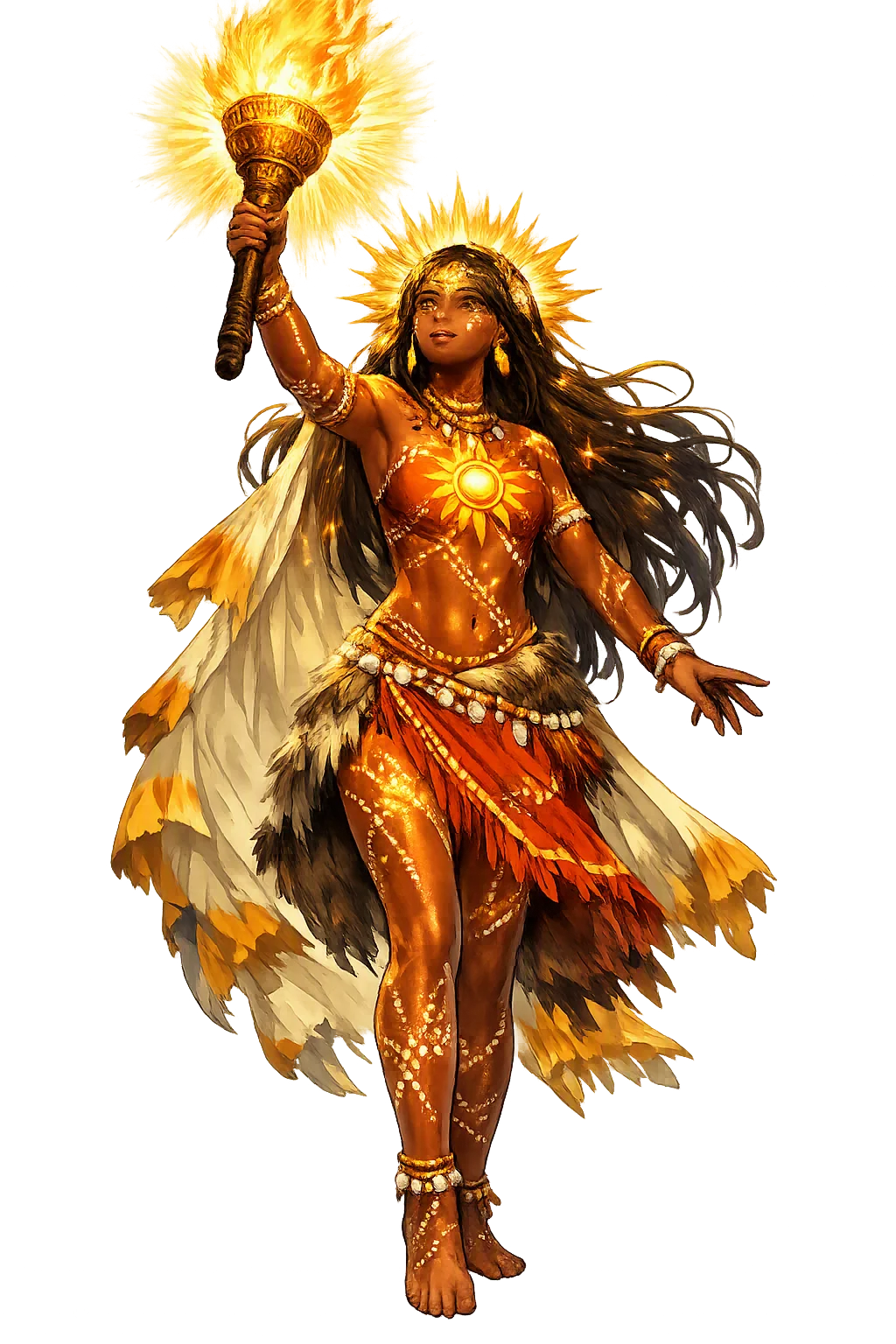
No image of Gnowee survives from before colonisation, and no text describes her face; her iconography is the sky. The tradition supplies a single attribute — the bark torch she carried into the dark while searching for her lost son, its flame becoming the sun when she rose — and everything else is inference. Modern Wurundjeri artists draw her accordingly: a woman with a burning bark brand, sometimes with the digging stick that drew her from camp, set against a bright disc. It is an honest modern image, and it knows it. Unlike the carved pantheons of the Old World, her figure was never fixed by workshops or manuscripts. The only canonical depiction is overhead, retraced every morning.

06

Reception & Transformation

The name after its own age — transmission, translation, survival

Afterlives

Gnowee's recorded journey is short but continuous. William Thomas, the Port Phillip Assistant Protector, wrote down Wurundjeri narratives in the 1840s and 1850s — the fragile paper route by which an oral story entered the colonial archive. Aldo Massola gathered the sun-woman cycle into Bunjil's Cave (1968), and A. W. Reed's mid-century compilations carried it to a national readership. From there the story reversed direction: catalogued by AIATSIS, taught back by the Wurundjeri Woi Wurrung Cultural Heritage Aboriginal Corporation, and folded into the Woiwurrung language revival, in which the old words for sun, fire, and mother are being re-learned by descendants of the people who told Thomas the tale. Her reception is, unusually, a loop — story taken out as ethnography, returned as language.

Identifications Across Traditions

Gnowee is a specifically Wurundjeri figure and is not equated with the sun deities of other Aboriginal nations, each of which owns its own solar narratives. She has sometimes been grouped with 'Mother Sun' figures in comparative anthologies, but such comparisons must respect the local ownership of the story. In contemporary Victoria she appears in educational and reconciliation materials as a Woiwurrung cultural teaching, not as a generic Aboriginal sun goddess.

Modern Legacy

The Gnowee story is one of the best-known narratives of the Wurundjeri people. It is told in Victorian schools, on Wurundjeri-led country walks, and in materials produced by the Wurundjeri Woi Wurrung Cultural Heritage Aboriginal Corporation. The figure has also inspired Australian children's literature, public art, and environmental education, where the sun-as-torch remains a potent image of renewable light and searching care.

07

The Meditation

What Gnowee means — beyond the dictionary

Gnowee invites meditation on the inseparability of love and loss. The sun rises not because it is a machine but because a mother is still looking. That reading transforms the sky from a clock into a story: every dawn is the relighting of a torch, every noon the height of a search, every dusk the guttering of a flame that will be renewed.

There is also a lesson about fire. In the myth, fire is not stolen or given; it is carried. It must be gathered, tended, and passed on. The sun is therefore the largest campfire, and the obligations that govern a small fire on country scale up to the cosmos itself. To remember Gnowee is to remember that light is labor and that care can outlast even the longest night.

08

Frequently Asked Questions

Common questions about Gnowee, Sun Goddess, and Unicode restoration

01How do you pronounce Gnowee?

In reconstructed pronunciation, Gnowee is /ˈɡnoʊi/ — approximately 'GNOH-wee' — stress the first syllable, keep the final vowel bright and short. Some Woiwurrung speakers render the initial cluster closer to 'NOH-wee' or 'NYOH-wee'.

02What does Gnowee mean?

Gnowee means The sun in the aboriginal tradition.

03What are the symbols of Gnowee?

Gnowee is associated with Bark torch (The sun itself; a domestic fire carried into the sky and kept alight across the day), Yam stick / digging stick (The tool that drew her away from her camp and set the search in motion), The southern sky path (Her track across the heavens, observed as the sun's daily arc), Darkness below (The earth that once swallowed her child and that she now lights from above).

04Why restore Gnowee in Unicode?

Gnowee is written entirely in ASCII letters, so its restoration is about canonical fidelity rather than recovered diacritics: the temple fixes the name in its scholarly standard spelling, attested in the source tradition, instead of leaving it to drift.

05What is the most important myth about Gnowee?

“The Woman Who Became the Sun” — the Wurundjeri tradition story that anchors the mythology of Gnowee, told in full on the lore page.

09

Scholarly Sources

The philological foundations of this restoration

Every claim on this page is grounded in established scholarship. The orthographic restorations follow disciplinary convention. The etymological chain follows the best available reference works. This is not invention — it is resurrection through scholarship.

◈

Lexicography & Philology

  • AIATSIS
  • Massola
◎

Primary Texts

  • Primary sources in the aboriginal tradition for Gnowee.
◉

Archaeology & Art History

  • Material evidence — iconography, inscriptions, and temple archaeology — for Gnowee and related cults.
✦

Religious Studies

  • Massola, Aldo, Bunjil's Cave: Myths, Legends and Superstitions of the Aborigines of South-East Australia, Lansdowne Press, 1968
  • Reed, A. W., Aboriginal Myths, Legends and Fables, Reed Books, 1982
  • AIATSIS — Australian Institute of Aboriginal and Torres Strait Islander Studies
  • Wurundjeri Woi Wurrung Cultural Heritage Aboriginal Corporation
  • William Thomas, Assistant Protector of Aborigines, Port Phillip District, nineteenth-century field notes
Return

The Surface Awaits

You have traced the name from its earliest attestation to its Unicode restoration. Now return to the myth. The story is where the name lives.

Back to Lore
Gnowee mascot